Japan PR Rejected? The 10 Real Reasons and Reapplication Strategy
Tokyo PR rejection rate is around 50% in 2025-2026. The rejection notice gives almost no detail — you must visit Immigration in person to ask why, and you only get one chance. The 10 most common rejection reasons cluster around payment timing, income, employer changes, and missed mandatory notifications.
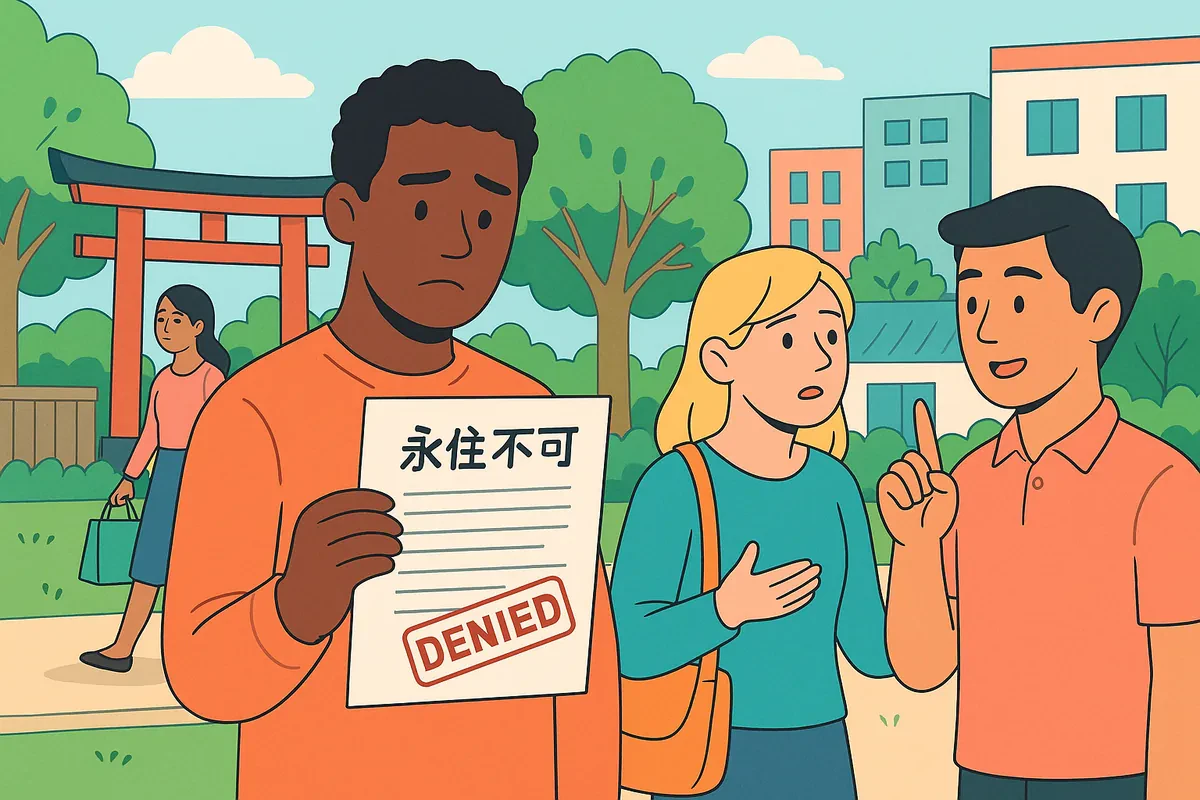
Bottom line: Around 56% of PR applications at Tokyo Immigration are rejected in 2025 (a roughly 44% approval rate, per VisaJapan's 2025 analysis of ISA published statistics). The rejection notice (不許可通知書) gives almost no detail — you must visit Immigration in person to ask why, and you only get one chance to do so. The 10 most common rejection reasons cluster around payment timing, income, employer changes, and missed delivery of mandatory notifications. Reapplying is allowed at any time, but most successful reapplications wait 3–6 months while fixing the underlying issue.
Information current as of April 2026 based on the ISA's revised PR Guideline (Feb 24, 2026), 2025 statistical analyses from VisaJapan and Solution Supporter, and rejection-pattern reports from administrative scriveners. For the underlying rules, see our PR complete guide.
What the rejection notice actually says
If you're rejected, Immigration sends a postcard with one line: "出入国管理及び難民認定法第22条第2項第2号に適合すると認められません" — "Does not meet Article 22, Paragraph 2, Clause 2 of the Immigration Control Act." That's it. No specific reason.
To find out why, you must:
- Go to the immigration office that processed your application in person — phone calls do not work
- Bring your rejection notice and residence card
- Ask to speak to the adjudicator (審査官)
- You get one chance only to hear the reason. Take notes — they will not give it to you in writing.
The adjudicator will tell you in fairly direct Japanese which factor was decisive. Bring a Japanese-speaking helper if your Japanese isn't strong enough to follow technical immigration vocabulary at speed.
The 10 most common rejection reasons
1. Late tax or pension payment (commonly cited by scriveners as the leading concern in 2026)
After the February 2026 guideline revision, even one late payment in the past 2 years may now be flagged. The ISA reviews 2 years for pension and health insurance, 3 years for income tax, and 5 years for resident tax. The 納税証明書 lists every payment date, so post-deadline payments are visible — though the ISA has not published a numeric tolerance, and individual outcomes remain at adjudicator discretion.
Practical step: settle all amounts, then maintain a clean 24-month record on 口座振替 (auto-debit) before reapplying. If your case is borderline, talk to an administrative scrivener before deciding when to file.
2. Insufficient income for your family size
The unwritten income floor is roughly ¥3 million annually for a single applicant, +¥700,000 per dependent. A married applicant with one child needs roughly ¥4.4 million. These are not legal minimums — they're the practical thresholds where Immigration starts rejecting. According to Touch Visa Center's analysis, applicants below these floors face elevated rejection risk regardless of other factors.
Fix: stable income above the floor for at least 3 consecutive years. For details, see our income requirements article.
3. Income volatility (especially freelancers)
Even if your average is high, sharp drops in any one year hurt. A freelancer who earned ¥6M, ¥3M, ¥5M over three years looks worse than a salaried employee earning ¥4M, ¥4M, ¥4M. Immigration prefers predictability over magnitude.
Fix: smooth your declared income. Build at least 3 consecutive years above the threshold.
4. Recent job change with documentation gaps
Changing employers is allowed, but if the change happened within the last 12 months and you can't show the new employer is stable (registered, sufficient capital, written contract), Immigration treats your income as unproven. See our PR during job change article for detail.
5. Failure to file the 14-day employer-change notification
When you change or leave employers on a work visa, you must file a 所属機関に関する届出 (notification of affiliation change) at Immigration within 14 days, per 入管法第19条の16. Missing this is reported by scriveners as one of the most common technical rejection causes — Immigration tends to treat it as a sign of weak compliance.
Fix: file the form immediately even if late. Then explain in your reason letter on reapplication.
6. Insufficient years of residence
The standard route is 10 consecutive years in Japan, of which 5 must be on work or residence visas. People often miscount: time on a "Cultural Activities" visa, time before age 16, or trips home longer than 90 days break the continuity. Spouse and HSP routes have shorter requirements (3 years and 1 year respectively) but with their own counting traps.
Fix: confirm the count from residence card history before filing. Don't apply early.
7. Recent criminal record or traffic violations
The "good conduct" requirement (素行善良) covers criminal charges, even minor ones. Traffic tickets accumulating to 3+ points within a few years can trigger this. A DUI arrest, even if the case was dropped, is generally reported by scriveners to block PR for several years (per published practitioner analyses; case-by-case discretion applies).
Fix: 5 clean years for major issues, 3 clean years for minor traffic accumulation, then reapply.
8. Guarantor issues
If your guarantor (身元保証人) cannot be reached when Immigration calls, or denies remembering they signed, your application is treated as unsupported. Recent reports suggest Immigration is calling guarantors more often than before.
Fix: tell your guarantor in advance that Immigration may call. Pick someone who actually knows you.
9. Japanese language ability concerns
The 2026 guideline revision strengthened language-proficiency review. Some scriveners report applicants are now occasionally asked to demonstrate elementary-school-level reading and writing if interview Japanese is weak — a check that was rare before 2026. Implementation varies by adjudicator and is not consistently applied yet.
Practical step: build basic Japanese skills (around JLPT N4 reading equivalent) before filing if your daily Japanese is limited.
10. Inadequate reason letter
The 理由書 (reason letter) is your one chance to explain who you are, why you intend to stay permanently, and what you contribute. A short, generic letter ("I love Japan") is treated as evidence of weak ties. A 1500–2000-word letter with concrete details (community involvement, family, professional contributions, future plans) is what scriveners recommend.
Fix: rewrite the reason letter substantively before reapplying.
If the rejection letter you got feels impossible to decode, post your situation on LO-PAL for free — a local helper can accompany you to Immigration to hear the reason in Japanese, take notes, and translate them so you understand exactly what to fix before reapplying.
Reapplication strategy
Legally you can reapply the day after rejection, but in practice that almost always fails again per scrivener reports because the underlying issue isn't fixed.
| Original reason | Recommended wait before reapplying | What to fix |
|---|---|---|
| Late payments | 24+ months | Build 24 months of clean record on auto-debit |
| Income too low | 12+ months | Build at least one full year above the threshold |
| Job change too recent | 12 months | Wait until new employer's record is established |
| Missed 14-day notification | 3–6 months | File the notification, then explain in reason letter |
| Traffic accumulation | 3+ years | Drive cleanly |
| Insufficient residence years | However many years are missing | Continue accumulating |
| Reason letter weak | 3 months | Rewrite substantially |
| Criminal issue | 5+ years | Clean record |
What you can NOT recover from quickly
Two situations require very long waits:
- Disclosed criminal proceedings. Even a settlement or dropped case stays on the record. Plan 5–10 years.
- Past visa overstay or deportation. If you ever overstayed and were deported or received an exit order, PR is generally blocked for 5 years (exit-order route) or 10 years (deportation route) per Article 5 of the Immigration Control Act. See our overstay recovery guide.
Counter phrases for hearing the rejection reason
- 不許可の理由を教えてください (Fukyoka no riyuu o oshiete kudasai) — Please tell me the reason for rejection.
- 具体的にどの点が問題でしたか (Gutaiteki ni dono ten ga mondai deshita ka) — Specifically, what was the issue?
- 再申請する場合、何を改善すべきですか (Saishinsei suru baai, nani o kaizen subeki desu ka) — If I reapply, what should I improve?
Related Articles
- Japan PR Complete Guide
- 2026 PR Guideline Changes
- Job Changes During PR Application
- Fixing Pension Gaps
Take a Local With You to Hear the Rejection Reason
The one-shot in-person reason hearing is the most important conversation in your PR journey — and it's in fast adjudicator-grade Japanese. Post a task on LO-PAL for free: a local helper can accompany you to Immigration, take detailed notes, and explain everything in your language so you walk out knowing exactly what to fix. You only pay when the task is done.
Disclaimer: This article is general information, not legal advice. Japanese immigration rules change frequently and individual outcomes depend on adjudicator discretion. Before filing any application, consult a licensed administrative scrivener (行政書士) or immigration attorney (弁護士). The Immigration Services Agency website (moj.go.jp/isa) is the authoritative source for current rules and forms.
Written by

Founder, LO-PAL
Former Medical Coordinator for Foreign Patients (Ministry of Health programme) and legal affairs professional. Built LO-PAL from firsthand experience navigating life abroad.
Written with partial AI assistance
Read full bio →