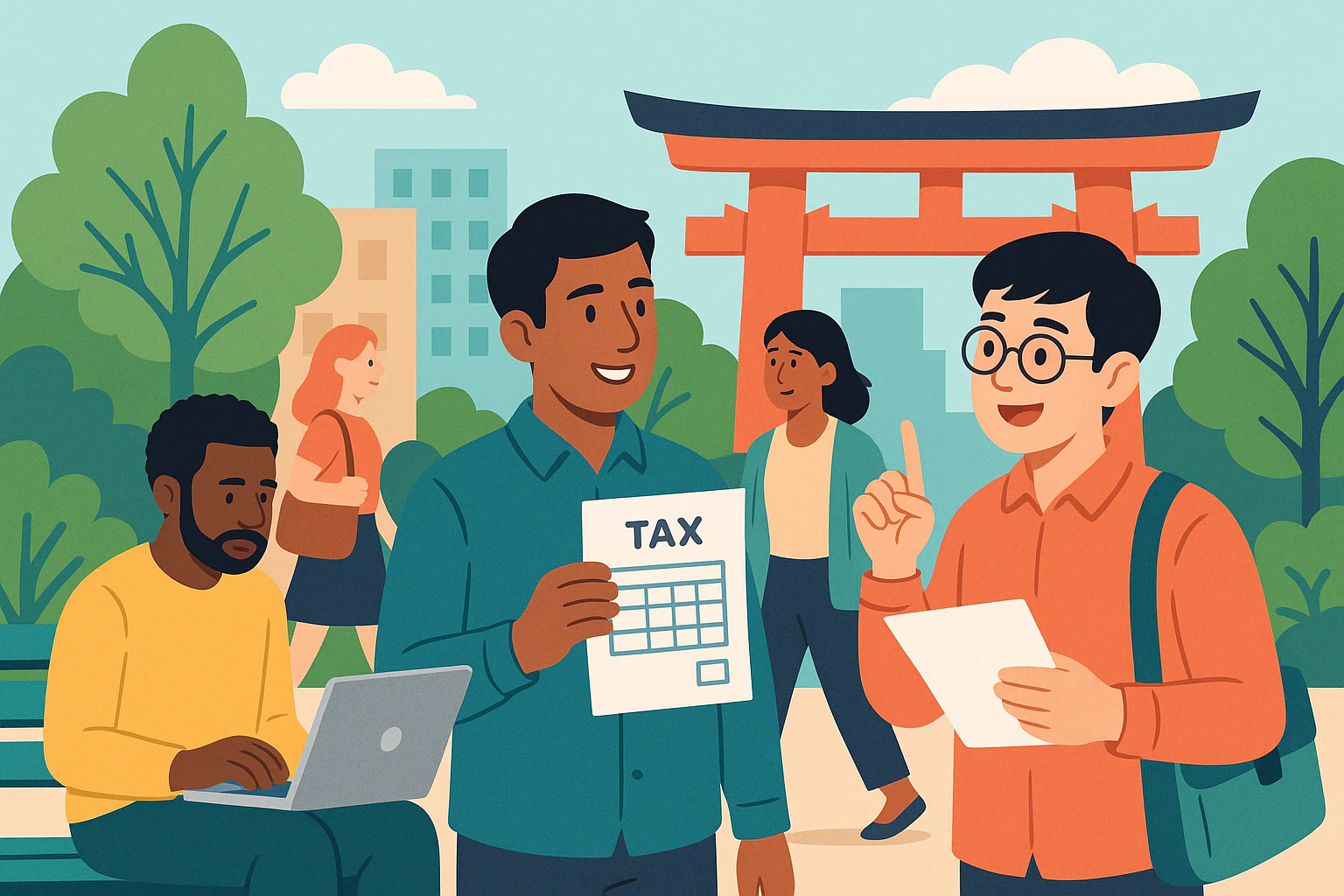
Freelance Credit Card Approval in Japan: 確定申告, Documents, and Timing
Self-employed and freelance foreign residents face structural disadvantages in card screening. Automated systems prefer salaried employment, and 個人事業主 income is verified through 確定申告書 — which doesn't exist until your first March filing. This guide explains which issuers underwrite freelancers reasonably and exactly when to apply.

Self-employed and freelance foreign residents in Japan face a structural disadvantage in card screening: automated systems prefer salaried employment with a known company, and "individual proprietor" income is verified through 確定申告書 — which only exists after at least one March filing cycle. The fix is not waiting forever; it's understanding which issuers underwrite freelancers reasonably and what documents to have ready.
- Best timing to apply: after at least one full year of 確定申告 (file in March, apply from April–May)
- Best card types: 流通系 (Epos, Aeon, Saison) and Rakuten — same as employees
- Documents: 確定申告書 copy, 開業届 if you have one, 住民税通知 from your municipality
- Avoid initially: high-tier bank-issued cards (JCB GOLD, Amex Gold) until you have 2–3 years of 確定申告 history
Information current as of May 2026 based on each issuer's eligibility text, the National Tax Agency documentation on individual proprietors, and consistent practitioner reporting on freelance card screening.
Japan's credit-card industry was built around the salaryman model: a single long-term employer, an annual 源泉徴収票, and predictable monthly income deposits to one account. Self-employed people — the rapidly growing freelance and individual-proprietor segment — fit that model poorly, and the screening algorithms reflect it. But "harder" is not "impossible," and the path is well-documented if you know where to push.
Why freelancers get rejected more often
Three reasons, in order of impact:
- Income volatility: Underwriting models discount inconsistent monthly income heavily. A freelancer with ¥6M annual but variable monthly receipts may underwrite worse than a salaryman with ¥4M and a stable paycheck.
- Verification difficulty: 源泉徴収票 doesn't exist for self-employed. The substitute is 確定申告書 (tax return), but you don't have one until your first March filing. New freelancers in their first 6 months have effectively unverifiable income.
- Employer database mismatches: Automated screening cross-references "employer name" against a database of known Japanese companies. Sole proprietors typing their own 屋号 (trade name) often fail this check.
Foreign-resident freelancers compound these with the structural issues that affect all foreigners — residence-period considerations, thin CIC files, name mismatches.
Who underwrites freelancers reasonably
| Card | Freelance posture | Notes |
|---|---|---|
| Rakuten Card | Reasonable | Lists "個人事業主" as a 職業 option directly. 1 year of 確定申告 helps. |
| Epos Card | Forgiving | In-person at Marui counter is best; associate can ask clarifying questions |
| Aeon Card | Most forgiving | Designed for non-employee profiles; no income floor |
| Saison Card International | Reasonable | Same-day at counter if approved |
| Bank-issued (MUFG, Mizuho, SMBC) | Harder | Generally requires 3+ years of 確定申告 history; PR strongly preferred |
| Amex Green | Reasonable for higher-income freelancers | Annual fee but income verification more flexible than Japanese banks |
| Saison Platinum Business AMEX | Targeted at sole proprietors | Annual fee ~¥22,000; underwriting designed for 個人事業主 |
Documents to have ready
Before you apply, gather these. Some issuers will ask for them after submission; others won't, but having them ready speeds the process and improves your odds:
- 確定申告書 (filed tax return) — at least one full year. The "B様式" version with 所得 and 納税額 visible.
- 開業届 (notification of business commencement) — filed with your local 税務署. Not required for tax purposes if income is small, but useful for proving you are a registered 個人事業主.
- 住民税納税証明書 (resident tax payment certificate) — from your municipal office. Confirms tax compliance.
- 事業用銀行口座 (business bank account) — separate from personal. Demonstrates organized finances.
- 2–3 month bank statements showing receipts from your business — primary verification when 確定申告 isn't yet ready.
- 青色申告 certification if you've upgraded to 青色 — signals more serious bookkeeping.
For more on 確定申告 itself, see our freelance taxes guide.
Application timing: when to apply
| Status | Recommended action |
|---|---|
| First 6 months as freelancer, no 確定申告 yet | Wait. Use a debit card. Build CIC record via mobile installment. |
| 6–12 months, planning to file 確定申告 in March | Apply at Aeon (most forgiving) using bank statements as income proof. Approval less certain but worth trying. |
| 1 year + 確定申告 filed | Apply at Rakuten, Epos, or Saison. Best application odds. |
| 2+ years 確定申告 + ¥4M+ annual | Eligible for higher-tier products: Amex Green, JCB GOLD, Saison Platinum Business AMEX. |
| 3+ years 確定申告 + 青色 + business account | Bank-issued cards become realistic. |
The "wait until you have 確定申告" rule is the single most-skipped advice. If you apply in your first 6 months as a freelancer and get rejected, you've burned a 6-month application window across all major issuers. The patient approach — debit card now, credit card after first 確定申告 — is worth the wait.
Filling the application form
Several form fields trip up freelance applicants. Here's how to handle each:
- 職業 (occupation): Select 個人事業主 (sole proprietor) or 自営業 (self-employed). Don't select 会社員 (employee) just because it sounds higher-status — the income mismatch will reject you faster than 個人事業主 ever would.
- 勤務先名 (employer name): Enter your 屋号 if you have one, otherwise your own name. If asked for 法人名, leave blank or write "個人" (individual).
- 勤続年数 (years of employment): Enter years since 開業届 filing, or since you started self-employment if no 届 filed.
- 年収 (annual income): Enter 所得 (after-expenses income) from 確定申告書, not gross 売上. Underwriters cross-check this against your filed return.
- 事業内容 (business description): Be specific. "IT consulting for foreign companies" is better than "consulting." "English teacher (private tutor)" is better than "teacher."
If you're nervous about getting these right, the in-person counter at Marui (Epos) or Saison Counter is more forgiving — an associate can ask clarifying questions and the rejection rate is lower than for online applications. Posting on LO-PAL gets you a Japanese-speaking helper who can sit on a video call while you fill the online form. Free to post; you only pay if you accept hands-on help.
Business cards (法人カード) for sole proprietors
Some sole proprietors qualify for "法人カード" or "ビジネスカード" products that are technically corporate but accept 個人事業主. The benefit: separate business expense tracking, sometimes higher limits, and more flexible income verification.
- Saison Cobalt Business AMEX: No annual fee, no 法人登記 required. Designed for 個人事業主.
- Saison Platinum Business AMEX: ¥22,000 annual. Higher limits, concierge service.
- Amex Business Green: ¥13,200 annual. Good for international travel and overseas-paying clients.
- JCB ビジネスプラス: JCB-branded business card. Lower acceptance overseas.
For most freelancers in their first 1–2 years, a personal card is sufficient — adding a business card without first establishing personal credit can confuse the file. After 2–3 years and stable income, a business card is a useful addition.
If your application is rejected
- Don't reapply immediately. The 申込情報 stays on file for 6 months.
- Pull your CIC report (¥500) and check for any 異動 marks or unexpected entries.
- Verify your 在留カード has 2+ years remaining.
- If your 確定申告 is recent, wait until your 住民税 has been recalculated (typically July) and reapply with the new 住民税通知.
- Consider Aeon (mailed, but most forgiving) or in-person at Marui Epos as the next attempt.
Red flags that hurt freelance applications
- Cash-only business with no bank deposits — invisible to underwriters. Even if you earn well, you can't prove it.
- Multiple bank accounts with low average balances — looks like financial juggling, not stability.
- Recent address change within 6 months — destabilizes your file. Apply after 6+ months at current address.
- Active カードローン balance — even legal ones (Acom, Promise) read as financial stress to card issuers.
- 0–1 year visa renewal pending — wait until renewed.
Phrases for in-person applications
- 「個人事業主としてクレジットカードを申し込みたいです」 (Kojin jigyou nushi to shite kurejitto kaado wo moushikomitai desu) — I'd like to apply for a credit card as a sole proprietor.
- 「確定申告書のコピーを持ってきました」 (Kakuteishinkokusho no kopii wo motte kimashita) — I brought a copy of my tax return.
- 「フリーランスでも審査は通りますか?」 (Furiiransu demo shinsa wa toorimasu ka?) — Can freelancers pass screening?
Related articles
- Credit, Loans, and Mortgages in Japan for Foreigners (2026)
- Freelance Taxes in Japan for Foreigners (2026)
- Building Credit History in Japan from Zero
- Credit Bureau Disclosure Guide
Disclaimer: This article is general information, not financial advice. Card-issuer underwriting criteria for self-employed applicants change without public notice. Verify current rules on each issuer's official page before applying. Approval is always at the issuer's discretion based on your individual 確定申告 history, CIC file, and other factors specific to your case.
Get Your Application Documents Reviewed by a Local
If you're filing your first 確定申告 or unsure how to translate your business into a 職業 dropdown, post your question on LO-PAL for free. A local Japanese person can review your form, explain unfamiliar fields, and check that your documents match what the issuer wants to see. Free to ask; you only pay if you accept hands-on task help.
Written by

Founder, LO-PAL
Former Medical Coordinator for Foreign Patients (Ministry of Health programme) and legal affairs professional. Built LO-PAL from firsthand experience navigating life abroad.
Written with partial AI assistance
Read full bio →