Consumer Loans in Japan: Statutory Caps, 闇金 Warning Signs, and How to Verify
Japan's consumer-loan industry is heavily regulated — but illegal lenders (闇金) operate aggressively at the edges. The single most important rule: every legitimate lender must display a registration number, verifiable at the FSA database. This guide covers the statutory rate caps (利息制限法 / 出資法), 総量規制, the 4 major legal lenders, predatory clause patterns, and where to report harassment.
Japan's consumer-loan industry is heavily regulated — but illegal lenders (闇金) operate aggressively at the edges, and several legal products are easy to misuse. The single most important rule: every legitimate lender must display a registration number ("関東財務局長(◯)第◯号" or "◯◯県知事(◯)第◯号"). Verify it at the FSA's lender database. If the lender doesn't show up, it is illegal — full stop.
- Statutory rate caps: 20%/15%/18% by principal size (利息制限法). Above 20% APR = criminal offense (出資法).
- 総量規制: Registered lenders cannot extend credit beyond 1/3 of annual income. Bank card loans are statutorily exempt.
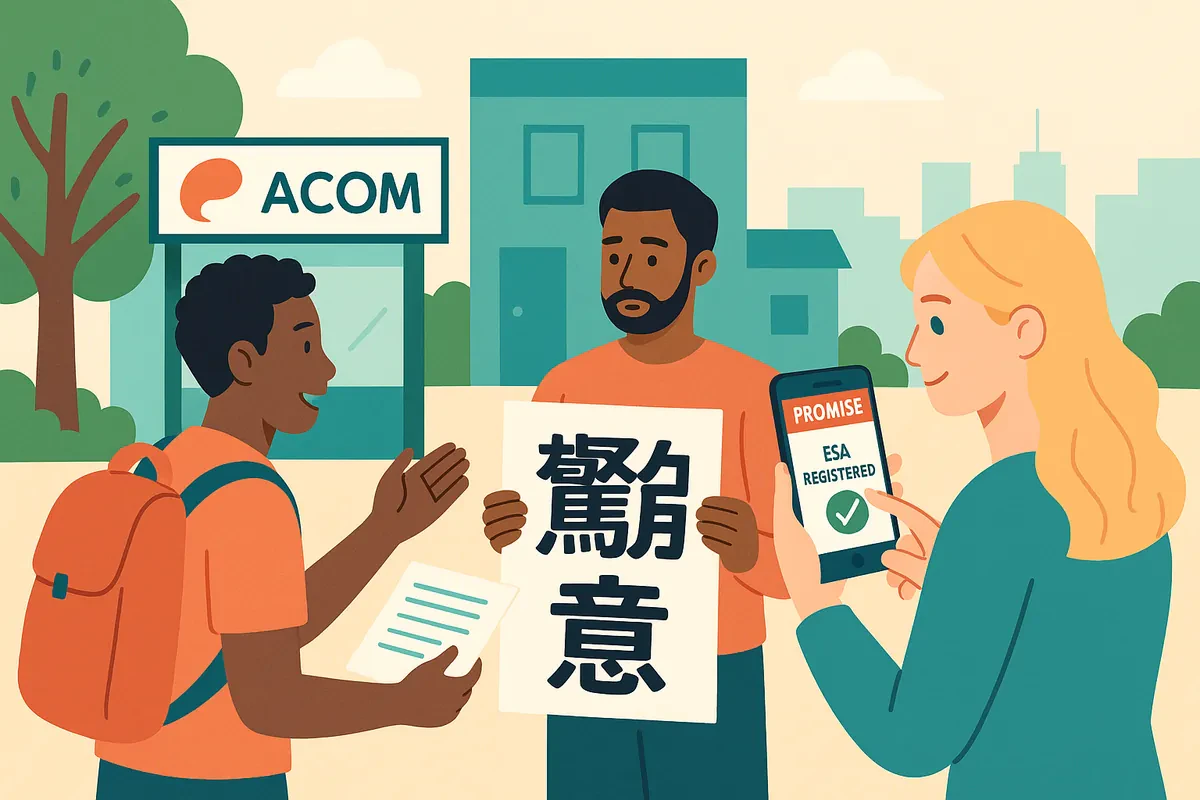
- Major legal lenders: Acom, Promise, Aiful (no PR required), Lake (PR required) — all FSA-registered, all subject to 総量規制
- If you've borrowed from 闇金: 法テラス (multilingual line 0570-078377) provides free legal triage. Police 警察相談 #9110 for harassment.
Information current as of May 2026 based on the Financial Services Agency Money Lending Business Act overview, the Interest Rate Restriction Act (利息制限法) e-gov text, the Japan Financial Services Association explainer, and the National Consumer Affairs Center.
Foreign residents in Japan face a specific risk profile in consumer lending: many predatory lenders specifically target non-Japanese-speakers, knowing the language barrier makes verification harder and complaint-filing more intimidating. Understanding the statutory framework is the single best protection.
The statutory rate caps
Three Japanese laws set the boundaries on consumer interest rates:
| Statute | What it does | Rate ceiling |
|---|---|---|
| 利息制限法 Article 1 | Civil ceiling — interest above this is unenforceable | 20% under ¥100,000 / 18% ¥100,000–¥1M / 15% ¥1M+ |
| 出資法 | Criminal ceiling — charging more is a criminal offense | 20% (since 2010 reform; was 29.2% before) |
| 貸金業法 — 総量規制 | Aggregate consumer borrowing capped against income | 1/3 of annual income for registered moneylenders |
The "grey zone" between 利息制限法 and 出資法 was abolished in 2010. Today, any loan charging above 20% APR is a criminal violation by the lender.
Important: 総量規制 exclusions
Per the Japan Financial Services Association, the 1/3-of-income cap distinguishes 除外貸付け (excluded — never counted) and 例外貸付け (exception — permitted with capacity check):
Excluded (never counted toward 1/3):
- Mortgage / 不動産購入のための貸付け
- Auto loans secured on the vehicle being purchased
- High-cost medical loans (高額療養費)
- Securities-collateralized lending
Exceptions (permitted with capacity check):
- Refinancing strictly to borrower's advantage (lower rate, longer term, no new draw)
- Emergency medical costs other than 高額療養費
- Sole-proprietor business loans (with business plan submission)
- Joint borrowing with spouse (combined income, with consent)
Important practical note: standalone unsecured カードローン used to buy a car is not excluded — only the secured auto loan is. Some practitioners and lenders blur this; the rule's wording in 貸金業法施行規則 第10条の21・第10条の23 is the authoritative text.
Major legal consumer-finance lenders
All four are FSA-registered (verifiable at clearing.fsa.go.jp/kashikin/) and subject to 総量規制:
| Lender | Group | PR required? | Foreign-resident eligibility |
|---|---|---|---|
| アコム (Acom) | MUFG | No | 在留カード or 特別永住者証明書 required, stable income, Japanese phone |
| プロミス (Promise) | SMBC Consumer Finance | No | Same as Acom |
| アイフル (Aiful) | Independent | No | Same as Acom |
| レイク (Lake) | SBI 新生 Financial | Yes — PR required per published FAQ | Lake's eligibility text excludes non-PR foreigners |
None of the four publishes a numeric minimum 在留期間 — only that the residence card must be valid. Practitioner consensus: ~1 year remaining is the realistic informal threshold.
Bank カードローン (Mizuho, MUFG, SMBC, Rakuten Bank) are not subject to 総量規制 statutorily because banks are regulated under the Banking Act. However, banks have voluntarily tightened internal screening since 2017 under FSA self-restraint guidance, and most major bank カードローン products informally apply similar 1/3 considerations. Foreign residents face stricter bank screening regardless.
How to verify a lender is legitimate
- Find the registration number on the lender's site, business card, or contract — it looks like "関東財務局長(◯)第○○号" (for multi-prefecture lenders) or "東京都知事(◯)第○○号" (for single-prefecture lenders).
- Visit FSA registered lender database and search by the registration number, company name, or address.
- If the lender appears with matching registration: legitimate.
- If the lender does not appear: illegal. Do not borrow. Report to FSA hotline 0570-016811 (Mon–Fri, 10:00–17:00).
This verification step takes 30 seconds. It is the single most important consumer-protection check in Japanese lending.
闇金 warning signs
The National Consumer Affairs Center (国民生活センター) publishes recurring alerts about predatory schemes targeting foreign residents and others. Patterns to recognize:
Common 闇金 patterns
- "ソフト闇金" / "090金融": Operator gives only a mobile number, no fixed office, no registration number. Often texts/calls applicants directly.
- SMS / SNS / LINE solicitation: "ブラックOK / 審査なし / 即日融資" promises with rates not disclosed. Sometimes posing as legitimate companies.
- Personal-to-personal lending (個人間融資): "Online matching" between borrowers and "individual lenders." Many of these are 闇金 operations using individual fronts, per consumer center alerts.
- "Pay-later cash purchase" (後払い現金化): Schemes that buy cheap items via your card on installment, then resell back to you for cash at high effective interest. Consumer center alert.
- "Salary factoring" (給与ファクタリング): Scheme structured as "buying your future salary" to evade 貸金業法. National Consumer Affairs Center has flagged these as illegal moneylending in disguise.
- Daily-rate pricing ("1日◯%" / "10日で◯%"): "1日1%" sounds small but is 365% APR — far above the 20% criminal cap.
Predatory clauses to watch for
- Upfront fees / 保証料 deducted from principal: Counted as みなし利息 under 利息制限法 Article 3 — pushing the effective rate above the cap is illegal.
- Demands for 保証人 / 担保 — especially 在留カード or 健康保険証 retention: Holding identity documents as collateral is illegal and a serious red flag for trafficking-adjacent abuse. Refuse and walk away.
- Refusal to provide 契約書面 (Article 17 documents) or 受取証書 (Article 18 receipt): Both are mandatory under 貸金業法 — failure indicates illegal operation.
- Guarantor requirements that won't release after loan completion: Legitimate lenders release guarantor obligations on full repayment. Predatory lenders don't.
- Aggressive contact rules: Calls or visits after 21:00, contact at workplace despite refusal, contact with family or neighbors — all violate 貸金業法 §21.
If you've borrowed from 闇金
The good news: 闇金 contracts are void and unenforceable under Japanese law. You do not legally owe the principal beyond what the law would allow under 利息制限法, and many courts have ruled that 闇金 borrowers owe nothing.
The actions:
- Do not panic-pay. 闇金 escalates harassment specifically because they have no legal recourse and rely on intimidation.
- Call 法テラス multilingual line: 0570-078377 (or 050-3754-5430 from IP phones). Mon–Fri 9:00–17:00. Languages include English, Chinese, Korean, Spanish, Portuguese, Vietnamese, Tagalog, Nepali, Thai, Indonesian. JLSC multilingual page
- If harassment is severe (threats to safety, contact with family/employer): call 警察相談 #9110 for police advice line.
- If 闇金 has your residence card or other ID: file a police report immediately. This is a serious crime and police will act.
- Consider 自己破産 only as a last resort with a 弁護士 (cheaper alternatives like 任意整理 may be sufficient given that 闇金 debt is largely unenforceable). See our debt recovery guide.
Legitimate alternatives if you need money urgently
- Health insurance高額療養費: If the urgent need is medical, 高額療養費 covers above-threshold expenses. See our health insurance article.
- 生活福祉資金貸付制度: Welfare loan administered by 社会福祉協議会. Low or no interest for 緊急小口資金 up to ¥100,000 with relatively forgiving terms. Foreign residents eligible. Search "生活福祉資金 貸付" + your municipality.
- 住宅確保給付金: Housing security benefit if you've lost work. See our housing benefit guide.
- Employer salary advance (会社の前借り): Many Japanese employers will grant a salary advance for emergencies — ask HR before considering external lending.
- Bank カードローン or registered consumer-finance: If urgent and you qualify, Acom/Promise/Aiful at 18% (legal cap) is far better than any 闇金 product.
Reporting illegal lending
| Issue | Where to report | Number |
|---|---|---|
| Illegal lender suspected | FSA Financial Services User Counseling | 0570-016811 (Mon–Fri 10–17) |
| Lender complaint / dispute | Japan Financial Services Association | 0570-051-051 |
| Consumer hotline (general) | 消費者ホットライン | 188 |
| Police consultation | 警察相談専用 | #9110 |
| Legal aid (multilingual) | 法テラス multilingual | 0570-078377 |
Phrases for emergency support calls
- 「闇金からお金を借りてしまいました」 (Yamikin kara o-kane wo karite shimaimashita) — I borrowed money from an illegal lender.
- 「在留カードを取られました」 (Zairyuu kaado wo toraremashita) — They took my residence card.
- 「家族や会社に連絡されています」 (Kazoku ya kaisha ni renraku sarete imasu) — They are contacting my family and workplace.
- 「英語で相談できますか?」 (Eigo de soudan dekimasu ka?) — Can I consult in English?
Related articles
- Credit, Loans, and Mortgages in Japan for Foreigners (2026)
- Debt Recovery and Credit Rebuilding
- Credit Bureau Disclosure Guide
- Housing Security Benefit
Disclaimer: This article is general information, not legal or financial advice. Consumer-protection rules and lender registration status change. If you suspect illegal lending or are facing harassment, contact 法テラス, the FSA, or police immediately rather than relying solely on this article. Statutory rate caps and 総量規制 rules cited are accurate as of 2026 but verify on the FSA's live page before any major decision. The lender registration database (clearing.fsa.go.jp/kashikin/) is the authoritative source.
Talk to a Local About Your Situation
If you've borrowed from a lender you're now unsure about, or if you're being pressured by collection calls, post your question on LO-PAL for free. A local Japanese person can help you verify the lender, draft a Japanese-language complaint, or accompany you to a 法テラス consultation. Free to ask; you only pay if you accept hands-on task help.
Written by

Founder, LO-PAL
Former Medical Coordinator for Foreign Patients (Ministry of Health programme) and legal affairs professional. Built LO-PAL from firsthand experience navigating life abroad.
Written with partial AI assistance
Read full bio →