Building Credit History in Japan from Zero: An 18-Month Plan for Foreigners
How foreign residents in Japan can build a Japanese credit file from zero in 6–18 months, using only legal, low-cost methods. The order matters: bank account and 在留カード first, mobile installment second, retail-issued card third, limit increase fourth. This is the no-shortcut path to a normal-thickness CIC file.
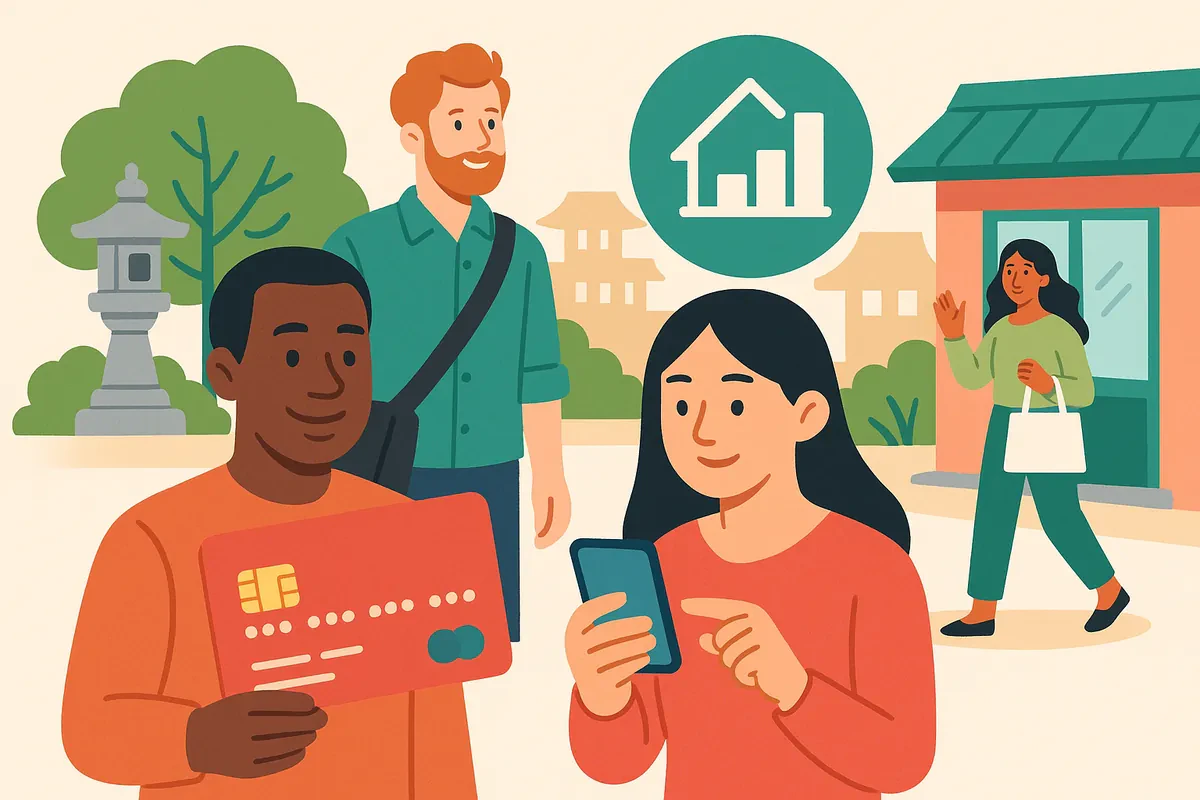
How to build a Japanese credit file from zero in 6–18 months, using only legal, low-cost methods that any foreign resident can do without a Japanese co-signer or unusual income. The order matters: bank account and 在留カード first, mobile installment second, retail-issued card third, limit increase fourth. Skipping steps doesn't speed it up — it just resets the clock.
- Day 1–30: Bank account, MyNumber card, mobile contract on installment (24-month phone plan) — this opens a CIC record
- Month 1–6: Pay every monthly installment on time. No late payments, no missed phone bills.
- Month 6–9: Apply for a 流通系 card (Epos at Marui, Aeon, Saison, Rakuten)
- Month 9–18: Use the card monthly, pay in full, request a limit increase after 6 months of clean usage
- Month 18+: Add a second card, consider an auto loan, qualify for higher-tier products
Information current as of May 2026 based on the CIC public information page, the JICC registration period documentation, and consistent practitioner reporting on Japanese credit-card screening behavior.
Building credit in Japan as a foreigner is not hard. It's just specific. The system does not reward a high salary or a strong overseas record — it rewards a Japanese paper trail of consistent, on-time payments to Japanese reporting members. Once you understand that the only data point that matters is "monthly status report to CIC/JICC," the path becomes obvious.
Why your home-country score doesn't help
None of Japan's three credit bureaus exchange data with foreign bureaus. A 780 FICO from the US, a "very good" Equifax from the UK, a clean Schufa from Germany — none of these appear when a Japanese issuer pulls your file. You start at zero. This is structural, not personal — the same is true for a Japanese national returning home after 10 years abroad.
This is also why presenting overseas bank statements or U.S. tax returns to a Japanese card issuer rarely helps. The underwriting model is built on Japanese-side reporting. Read more in our why overseas credit doesn't transfer article.
Step 1: Open the bureau record (Months 1–3)
The fastest way to get an entry into CIC is a 携帯電話の分割払い (mobile-phone installment plan). When you buy a smartphone on a 24-month or 36-month installment plan from DOCOMO, au, Softbank, or Rakuten Mobile, the carrier reports monthly to CIC under "携帯電話端末割賦販売契約."
| Carrier | Foreign-resident enrollment | What to bring |
|---|---|---|
| DOCOMO | Accepted with 在留カード | 在留カード, 1+ year remaining preferred, Japanese bank account |
| au (KDDI) | Accepted with 在留カード | 在留カード, secondary ID, Japanese bank account or card |
| Softbank | Accepted with 在留カード | 在留カード, 健康保険証 or driver's license, Japanese bank account |
| Rakuten Mobile | Accepted with 在留カード | 在留カード, online enrollment OK, Rakuten Bank link possible |
| MVNOs (IIJmio, Mineo, etc.) | Often accepted but no installment | Cheaper monthly but does NOT report to CIC |
The MVNO trade-off is real: monthly fees are cheaper, but if your goal is building credit, a 24-month installment with a major carrier is the better investment in the first year.
Beyond mobile, two other paths open a CIC record:
- Shopping credit (ショッピングクレジット): 0% installment plans for furniture, electronics, etc. Reports to CIC if the lender is a CIC member (most are).
- Auto loan (auto loan): If you buy a car within the first year, a dealer captive finance loan reports to CIC and JICC. Heavy first step but builds a thick file fast.
Step 2: Six months of clean payments (Months 1–6)
The single most important rule: never let an automated payment fail. Set up 自動引き落とし (auto-debit) on every account. Keep at least ¥30,000 buffer in your designated bill-payment account. A single 1-day-late mark on your CIC record sets back card applications by months — or in some cases, blocks them entirely if combined with other risk factors.
Concrete defenses:
- Keep a separate account just for auto-debits, fund it monthly above the expected total
- Set a calendar reminder 5 days before each due date for the first 6 months
- If you change banks, update the carrier and any lenders before the next due date — never expect them to chase you
- Travel reminder: if you'll be abroad on a due date, the auto-debit still runs from your Japanese account. Top up before you leave.
If something does go wrong — sudden bank-account closure, an unexpected hold — call the carrier or lender's customer center immediately. Some allow a 1–2 day grace period before the late-payment is reported, but only if you proactively call.
Step 3: First credit card (Months 6–9)
By month 6, you have a thin but clean CIC file: one or two trade lines, all "$" symbols, no late payments. This dramatically improves card-application odds at retail-issued cards (Epos, Aeon, Saison, Rakuten). For the full comparison, see our easy-approval cards guide.
Apply for one card. Not two, not three. Multiple applications in 6 months are visible to all issuers as 申込情報 and read as financial stress, even if all applications were approved. After the first card arrives, wait at least 3 months before considering a second.
Step 4: Use the card every month (Months 6–18)
The behavior that builds credit is not "carrying a balance." It is consistent monthly usage with full repayment. In Japan, the standard payment method is 一回払い (single-payment in the next billing cycle), which is interest-free. Use the card for routine spending — utilities, groceries, train fare — and let the auto-debit settle the full amount monthly.
What to avoid:
- リボ払い (revolving balance) — high interest (15%–18%), reads as financial stress on your file. Card issuers heavily promote it because it's profitable for them, not for you.
- キャッシング (cash advance) on credit card — flagged by automated systems as desperation borrowing. Use only in genuine emergencies.
- Multiple monthly statements at the limit — using 100% of available credit reads negatively. Aim for 30–50% utilization.
One month after activating the card, the issuer reports to CIC. After 3 monthly cycles of clean usage, your file thickens noticeably. After 6 months, you can request a limit increase via the issuer's app.
Step 5: Limit increases and second cards (Month 18+)
Limit increases at 6, 12, and 18 months are routine if your file is clean. The request is in-app at most issuers — Rakuten e-NAVI, Saison Net Answer, Epos Net. Do not request raises in months 1–3; the algorithm reads early requests as stress.
By month 18, you can comfortably:
- Add a second card from a different issuer (Visa + Mastercard combo for international acceptance)
- Apply for a higher-tier product (JCB GOLD if under 40, Amex Green, View Gold)
- Take an auto loan from a bank (1–4% rates) instead of dealer captive finance
- Begin preparing for mortgage applications if PR is on the horizon
Common credit-building mistakes
| Mistake | Why it sets you back | What to do instead |
|---|---|---|
| Buying phone outright instead of installment | No CIC record opens — slows credit building 6+ months | Take 24-month installment even if you can pay cash |
| Cancelling cards as soon as you stop using them | Removes a trade line; thinner file = lower score | Keep first card open as your primary, even after upgrading |
| Multiple card applications in 6 months | 申込ブラックリスト pattern; auto-rejection at most issuers | Apply for one card, wait 6 months, then consider a second |
| Using only リボ払い for the points | 15%–18% interest; reads as financial stress on file | Use 一回払い only; pay in full each month |
| Letting 在留カード expire on file | Card can be suspended under AML rules even with clean payments | Update card issuer within 14 days of 在留カード renewal |
| Skipping mobile bills during travel | 1-day late = ¥, multi-month late = 異動 mark | Auto-debit with funded account; check before long trips |
Edge cases for foreign residents
Spouse-of-Japanese: leverage the Japanese spouse
If your spouse is a Japanese national or PR holder with a clean credit file, becoming a 家族カード (family card) supplementary user on their card builds your file faster than starting from zero on your own. Some issuers report family card usage to the supplementary user's CIC file (verify with each issuer). After 6+ months, apply for a primary card on your own.
Working holiday visa: limited options
Working-holiday visa holders generally cannot get credit cards because residence period is too short. Use a debit card (Sony Bank Wallet, Rakuten Debit, JNB Visa Debit) for daily spending. These do not build credit, but they are accepted at most online and offline merchants.
Student visa: yes, you can
Student-visa holders can apply for retail-issued cards. Rakuten and Epos are the most common approvals. List your part-time income or your parent/spouse as backup contact. Your CIC file will be thin at first, but a 24-month phone installment + 1 year of card usage gets you to a normal-thickness file by graduation.
Self-employed / freelance: harder, but possible
Self-employed applicants face stricter scrutiny because income verification depends on 確定申告書 (tax return), which only exists after your first March filing. Wait until you have at least one full year of 確定申告 history. See our freelance credit card guide.
The 18-month milestone
After 18 months of: (1) clean mobile installment, (2) one or two cards used and paid in full, (3) limit increase confirmed, your file looks like a young Japanese-citizen file. At this point, most automated underwriting systems no longer treat you as a thin-file applicant. You can apply for higher-tier products, bank cards, and even small bank loans without facing the "no record" penalty.
If you're not sure where you currently stand, pulling your CIC, JICC, and KSC reports tells you exactly. The full disclosure procedure is in our credit bureau guide.
Related articles
- Credit, Loans, and Mortgages in Japan for Foreigners (2026)
- Credit Bureau Disclosure Guide
- Easy-Approval Cards for Foreign Residents
- Rakuten Card Foreigner Approval Guide
- Freelance Credit Card Approval
- Why Overseas Credit Doesn't Transfer
Disclaimer: This article is general information, not financial advice. Card-issuer and lender criteria change without public notice. Approval is at each issuer's discretion based on your individual file at CIC, JICC, and KSC. Verify current eligibility on each issuer's official application page.
Get Your Plan Reviewed by a Local
If you'd like a Japanese-speaking helper to review your specific situation — your visa type, current bank account, mobile contract, any past rejections — and suggest the safest next step, post your question on LO-PAL for free. A local can compare your profile against current issuer rules and help you avoid the wait-6-months-and-try-again loop. Free to ask; you only pay if you accept hands-on task help.
Written by

Founder, LO-PAL
Former Medical Coordinator for Foreign Patients (Ministry of Health programme) and legal affairs professional. Built LO-PAL from firsthand experience navigating life abroad.
Written with partial AI assistance
Read full bio →