
Japan Spouse Visa Application (2026): Documents, Timeline & Questionnaire
Japan spouse visa application 2026 guide: required documents, realistic timelines, and how to write the Questionnaire to reduce sham-marriage suspicion.
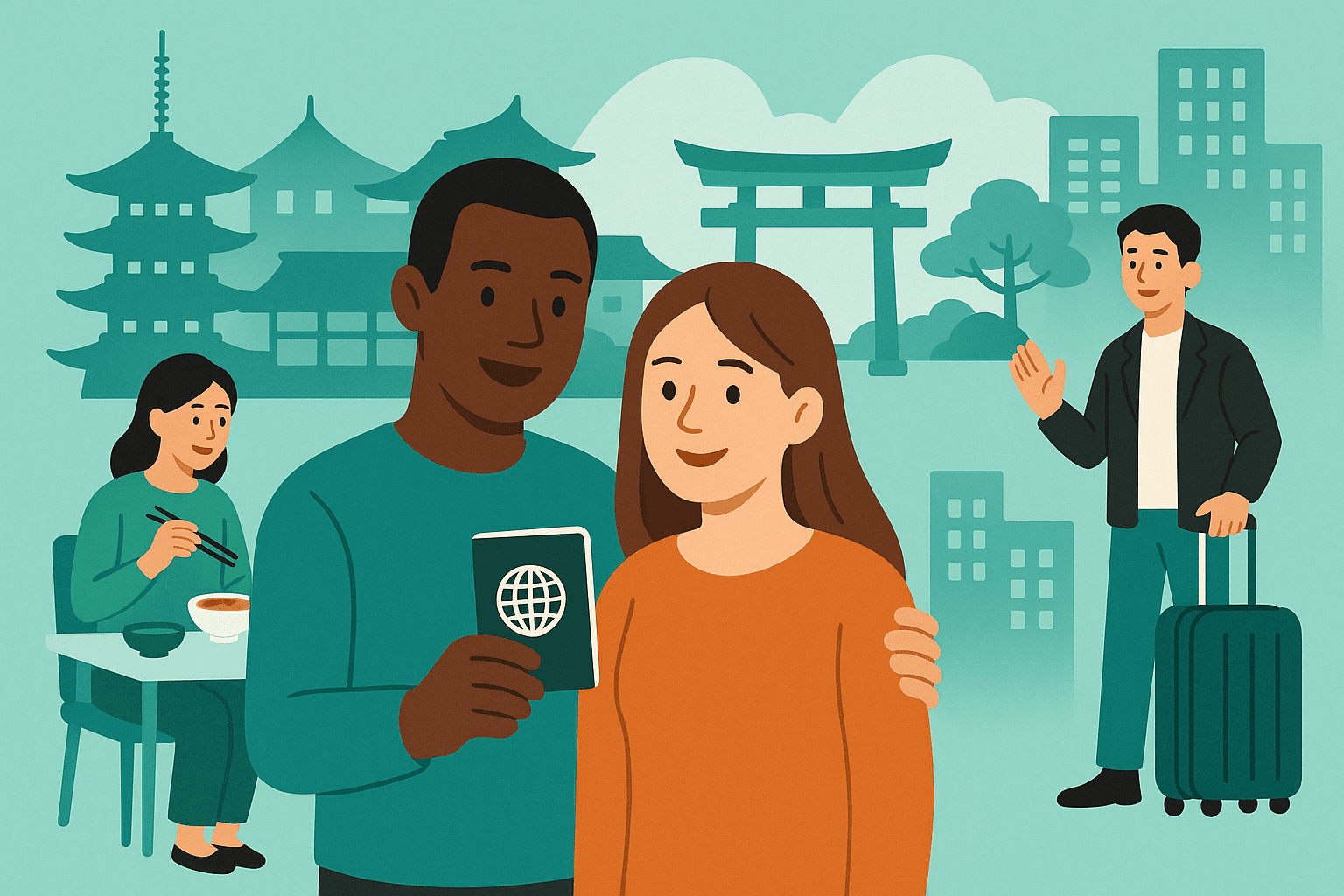
Planning a Japan spouse visa application in 2026? The frustrating part usually isn’t the “generic checklist”—it’s proving your relationship is real in the Immigration Questionnaire (relationship history) and organizing evidence so your case doesn’t look like a “sham marriage.”
This guide focuses on (1) how to write the Questionnaire clearly, (2) what evidence actually reduces suspicion, (3) realistic timelines (COE vs visa issuance), and (4) what changed with Japan’s Online Residence Application System in January 2026.
Quick orientation: Most spouse cases go through a COE (issued in Japan by the Immigration Services Agency) and then a visa (issued by a Japanese embassy/consulate). Japan’s Ministry of Foreign Affairs notes standard visa issuance is 5 working days after acceptance (when there are no issues), but it can take over a month if referred for further examination; without a COE, visa issuance is typically 1–3 months.
Japan Spouse Visa Application Basics: COE vs Change of Status (Which Route Fits You?)
Before you gather documents, decide which route you’re actually doing. “Spouse visa” is often used casually, but the process depends on where you are applying from and whether you’re already in Japan.
Also, remember the split in roles: ISA (Immigration Services Agency) handles residence-status examinations inside Japan (COE, change of status, extensions). MOFA (embassies/consulates) issues the visa sticker/visa permission for entry.
Route A (Most common): COE → Visa → Entry
This route fits you if the foreign spouse is outside Japan and plans to move to Japan for mid/long-term residence. Your Japanese spouse (or a qualified proxy in Japan) typically submits the COE application to ISA.
ISA lists the standard processing period for COE as 1–3 months (a planning baseline, not a guarantee). After your COE is issued, you apply for the spouse visa at the Japanese embassy/consulate in your country of residence; MOFA states standard visa issuance processing is 5 working days if there are no issues.
ISA: Certificate of Eligibility (COE) application overview and MOFA: Visa processing time are the two official pages you should anchor your timeline to.
Route B: Change of Status of Residence (Inside Japan)
This route fits you if you are already living in Japan on another valid status of residence and you get married, then apply to change to Spouse of a Japanese National (or similar spouse status) at ISA.
In this case, you are not applying for a “visa” at an embassy—your goal is permission for a new status of residence inside Japan. Processing times vary by office and season, and ISA publishes monthly nationwide averages so you can plan more realistically (more on that below).
Realistic timeline planning (what people confuse)
Many people mix up these steps and think “spouse visa = 2–3 months total.” In reality, you’re stacking multiple clocks: (1) document collection, (2) COE review or change-of-status review, (3) visa issuance (if applying overseas), plus (4) travel and city-hall registration after arrival.
MOFA warns that if your visa application needs further examination, it can take more than a month. MOFA also explicitly recommends getting a COE for long-term stays because if you apply for a long-term visa without a COE, issuance will take a long time (typically 1–3 months).
How to check progress (and why Tokyo can feel slower)
ISA warns they cannot answer individual application progress inquiries and asks applicants not to call just to check progress. If you applied online, you can check your status in the online system; ISA also publishes average processing periods and (since October 2024) switched from quarterly to monthly publication so applicants can see more up-to-date averages.
Tokyo and major regional offices can feel slower simply because more applications converge there, and additional-document requests (tsuikan shorui / “additional materials”) can extend the timeline anywhere.
What changed in the online system in January 2026 (important for 2026 applicants)
ISA launched a new Online Residence Application System starting January 5, 2026 (Monday) at 9:00. ISA also posted a key warning: applications made before December 2025 may no longer appear in the “application information list” screen (with limited exceptions), so users who want to keep their past records should print or save their list.
Start here for official updates and helpdesk contacts: ISA: Online residence procedures portal and ISA notice about the new online system (effective Jan 5, 2026).
January 2026 issues ISA publicly announced (read this if you’re using online)
1) Additional-document upload issue: ISA announced a bug where some applicants cannot submit additional documents through the online system. Until recovery, ISA requests you submit additional documents by mail or at the counter.
2) Email-notification issue (Jan 5–9, 2026): ISA announced some notification emails were sent with the residence card number blank; they stated this was fixed and that from January 10, 2026 the same emails would not be sent, and those affected from Jan 5–9 would be resent corrected emails by January 12, 2026.
3) My Number Card “special period” limitation: ISA warned that from January 2026, if a foreign national user submits an extension/change application and then enters a period where they have not extended the My Number Card validity (“special period”), they may become unable to submit materials through the online system.
Online system practical setup tips (so you don’t miss emails)
ISA’s “usage environment” notes the system is designed with Microsoft Edge (Chromium) in mind and recommends using a PC rather than a smartphone/tablet. They also warn about email deliverability: allow emails from @rasens-immi.moj.go.jp, and note that overseas IP restrictions and some free email addresses can cause notification emails not to arrive.
If you’re stuck on system operation, ISA lists an Online Residence Application System helpdesk: 050-3786-3053 and mjf.support.cw@hitachi-systems.com.
Japan Spouse Visa Application Step 0: International Marriage Paperwork in Japan (City Hall Steps + Translations)
Immigration won’t examine your spouse status until the marriage itself is properly registered/recognized. International marriage paperwork is where couples often lose weeks—because requirements vary by nationality and municipality, and because translations are easy to mess up.
If you can, call your ward/city office (koseki section) before you go, and ask exactly what they want for your nationality combination.
City hall/ward office: what typically happens
- Get the marriage notification form (婚姻届 / kon’in todoke). Many city offices provide it; some couples pick it up in advance.
- Complete signatures: the couple signs, and you usually need two witnesses (証人).
- Bring identity documents (passports, residence cards if you have them, etc.) and nationality/capacity documents for the foreign spouse.
- Submit at the koseki counter (or the designated municipal counter). Some municipalities accept after-hours submissions, but if your case is complex, going during normal hours helps because staff can check documents in real time.
Example (Moriya City): common international-marriage requirements
Moriya City’s FAQ is a good “typical list” example of what many municipalities ask for when a Japanese national marries a foreign national: the marriage notification form, the foreign national’s nationality proof (passport, etc.), a certificate of legal capacity to marry (婚姻要件具備証明書), and Japanese translations of foreign-language documents that include the translation date and translator signature, plus identification documents.
They also note that the certificate of legal capacity to marry is generally issued by the embassy, but may not be issued depending on the country—so you must confirm with your embassy in advance.
Moriya City FAQ (international marriage requirements example)
Example change (Shibuya Ward): koseki tohon is “generally no longer required” (from March 1, 2024)
Procedures do change. Shibuya Ward states that from March 1, 2024, attaching a koseki tohon for a marriage notification is generally no longer required. However, Shibuya also warns that if the marriage involves a foreign national or a marriage formed overseas, required documents differ and you should contact the koseki section.
Shibuya Ward: marriage notification page (procedure note)
Translation “reality check” (what staff usually need to accept it)
Many municipalities accept self-translations, but they typically want a format that looks official and traceable: the Japanese translation, the translator’s name/signature, and the translation date (as shown in municipal guidance like Moriya City’s example). If your translation looks sloppy, you risk a “please come back again” situation.
Tip: keep the translation simple, mirror the original layout when possible, and be consistent about names (romanization vs kanji/kana) across every document you submit.
Japan Spouse Visa Required Documents Checklist (With a “Reality Check” on What Immigration Actually Cares About)
There is no single universal list because required documents vary by application type (COE vs change of status), nationality, and what your regional office asks for. But successful spouse cases almost always cover the same three pillars: legal marriage, real relationship, and stable livelihood.
Use this section as a working checklist, then confirm your final list with your local office, your embassy/consulate, or a qualified professional if your case has risk factors.
Pillar 1: Legal marriage (documents that prove you’re married)
- Marriage certificate / acceptance of marriage notification (format varies by where the marriage was registered)
- Japanese spouse’s family registry (戸籍 / koseki) or equivalent proof (common request)
- Passports (copies) and IDs
- Japanese translations of any foreign-language civil documents
Pillar 2: Real relationship (Questionnaire + evidence)
- Questionnaire (質問書) / relationship-history statement (details below)
- Photos together over time (not just one wedding photo set)
- Travel and meeting records (boarding passes, itineraries, hotel bookings)
- Communication logs (selected excerpts + a summary table)
- Proof of cohabitation when applicable (lease, mail, utility bills, same address on documents)
Pillar 3: Livelihood / stability (how you’ll live in Japan)
- Proof of income (employment certificate, tax certificates, etc. as applicable)
- Proof of residence (juminhyo, housing plan, or lease depending on the stage)
- Letter of guarantee (身元保証書) when requested
Reality check: Immigration doesn’t approve spouse cases because you submitted “many documents.” They approve because the file is internally consistent: dates align, addresses make sense, names match, and the relationship story is believable and backed by evidence.
If you apply for the visa without a COE (overseas “direct visa” route)
MOFA recommends using a COE for long-term stays because visa issuance can take much longer without it. Some embassies accept spouse/dependent applications without a COE only when you have a reason you cannot obtain one, and they warn it may take months.
For example, the Embassy of Japan in the U.S. posts required documents for a dependent/spouse application without a COE and notes it may take a few months to issue a visa without one.
Embassy of Japan in the U.S.: Dependent visa (without a COE) document list
Spouse visa Japan processing time: a practical way to plan backwards
Use “planning buffers” instead of best-case hopes. As a baseline, build around: (1) COE review time (ISA’s standard processing period is 1–3 months), (2) visa issuance time (MOFA’s standard is 5 working days after acceptance if there are no issues), and (3) extra time for additional-document requests.
Then check ISA’s monthly average processing-times publication and compare it with your target move date. ISA explicitly says they publish average processing periods and (since October 2024) publish them monthly, and they also say they can’t answer individual progress inquiries—so planning with published averages is the realistic approach.
ISA: notice about not inquiring for individual progress + monthly averages
How to respond when Immigration requests “additional documents”
Additional-document requests are common in spouse cases—especially when your relationship is short, long-distance, or your documents don’t naturally show cohabitation. Don’t panic, and don’t over-submit random files.
- Read the request carefully and match each requested item with a clear label (A, B, C…).
- Write a short cover letter listing exactly what you’re submitting, with dates and names.
- Submit clean evidence (summaries + selected samples), not 300 pages of unorganized screenshots.
- Keep copies of what you submit, and keep your story consistent with your Questionnaire.
Japan Spouse Visa Questionnaire + “Sham Marriage” Screening: Red Flags, Evidence Ideas, and How to Get Help
This is the section most “checklist” articles skip. In spouse cases, Immigration is actively trying to detect marriages that exist only to obtain status of residence—so your Questionnaire and evidence package are not just formalities; they are the center of the review.
Think of the Questionnaire as a credibility test: can a third party read your relationship story and conclude, “Yes, this looks like a normal marriage,” based on facts, dates, and evidence?
What “Japan spouse visa sham marriage screening” looks like in real files
Immigration rarely says “we suspect sham marriage” in plain language. Instead, suspicion shows up as: more questions, more requests for additional documents, or longer reviews because officers need to verify details.
You reduce suspicion by making your story specific and verifiable, and by proactively explaining anything that could look unusual from the outside.
Common red flags (not automatic rejection, but you must explain)
- Very short relationship before marriage (e.g., weeks) with limited in-person meetings
- Long-distance with few visits and vague communication proof
- Large age gap (especially when combined with other red flags)
- No shared language (or unclear how you communicate day-to-day)
- Inconsistent addresses, dates, or name spellings across documents
- Prior immigration problems (overstay, prior removals, repeated short stays that look like “visa runs”)
- Low evidence of merged lives (no visits to family, no shared plans, no cohabitation explanation)
How to write a strong Questionnaire (a practical template)
Your goal is clarity, not romance. Write in a way that an officer can cross-check with dates in passports, flights, photos, and chat records.
Step 1: Make a one-page relationship timeline first
Before writing paragraphs, create a table you can reuse everywhere (Questionnaire, cover letters, explanations). Include exact dates and locations.
- First contact (date, platform, language used)
- First in-person meeting (date range, city, proof you have)
- Major visits (date ranges + boarding passes/itineraries)
- Engagement decision (date, where, who knew)
- Marriage registration (date, municipality/country)
- Living plan in Japan (address plan, when you will cohabit)
Step 2: Answer the “relationship narrative” questions like a case file
When a Questionnaire asks “How did you meet?” don’t answer “Online.” Answer: platform + month/year + why you were there + how you moved from chat to calls + when you met + what you did together. Keep it factual and consistent.
When the form asks about family, include whether you met each other’s parents, how (in person/video), and when. If you haven’t met, say why (distance, health, timing) and show a plan (future visit date if known).
Step 3: Preempt the “Why did you marry so fast?” question (if it applies)
If your relationship is short, write a short explanation paragraph that sounds like real life. Examples that tend to be credible (when true): frequent visits, long daily calls, prior friendship history, pregnancy/children, or strong family involvement.
Avoid vague statements like “We knew right away.” Replace them with measurable facts: number of visits, how long each visit was, and what concrete steps you took (meeting family, wedding planning, housing planning).
Evidence ideas that actually reduce suspicion (organized, not random)
Immigration officers are busy. Your evidence should make the relationship easy to verify at a glance.
1) Photo set with captions (best format)
- 10–20 photos across time (not all from one day)
- Include different contexts: daily life, family, trips, events
- Add captions: date, place, who is in the photo, and why it matters
2) Communication proof: do a summary table + a few samples
- Create a one-page summary (e.g., “Jan–Jun 2025: daily LINE calls; Jul–Dec 2025: weekend video calls + travel planning”)
- Attach a limited number of chat screenshots that show: names, dates, and normal couple topics (planning, family, life logistics)
- If you have another language, add brief Japanese/English explanations for key excerpts
3) Travel proof that matches your timeline
- Boarding passes, e-tickets, itineraries
- Entry/exit stamps that align with claimed visits
- Hotel bookings or invitations (where appropriate)
4) Cohabitation proof (if you already lived together)
- Lease with both names, or landlord letter
- Mail to both parties at the same address
- Utility bills (even if only one name is on the bill, show supporting context)
If you applied online: how to spot “additional docs needed” in status
ISA notes that online applicants can check progress in the Online Residence Application System, and that when additional materials are required the system can display a “waiting for completion/additional submission” indicator (for example, “追完待ち”) in the attachments/materials area.
Use that as your cue to act fast and submit exactly what was requested (and remember the January 2026 notice that some additional-document submissions may need to be mailed or submitted in person due to a system issue).
Where to get help (official + local options)
If you’re struggling with Japanese forms/portals or you want a second set of eyes on your plan, there are real public support options.
FRESC (Foreign Residents Support Center): consultations + online application support
FRESC is a government one-stop support center. ISA’s FRESC page notes you can consult immigration at FRESC and can receive support for online residence applications. MOFA also directs visa-application general inquiries to the “MOFA Visa Information” service at FRESC, with location details and phone guidance.
- ISA: What FRESC is + support options
- MOFA: Visa-application consultation reception (FRESC Visa Information)
- FRESC (reservation line for immigration consultation): 03-5363-3025 (published on official/local government guidance pages)
Tokyo option: Foreign Residents’ Advisory Center (FRAC)
If you’re in Tokyo, the Tokyo Metropolitan Government’s Foreign Residents’ Advisory Center (FRAC) offers free consultations (phone-based with face-to-face available). Their published hours and phone numbers include: English (Mon–Fri 9:30–12:00 / 13:00–17:00) at 03-5320-7744.
Tokyo Metropolitan Government: FRAC consultation info
Don’t forget this legal obligation (after you get spouse status)
If you hold a spouse-related status and you divorce or your spouse passes away, ISA states you must file a “spouse-related notification” within 14 days. Many people miss this because nobody explains it at the beginning—so put it on your calendar as a compliance item.
ISA: Notification concerning a spouse (14-day rule)
Need More Help? Ask on LO-PAL
Spouse visa success often comes down to small “local” details: what your specific city hall wants for your nationality, whether your translations look acceptable, and whether your Questionnaire reads like a clear, consistent story.
That’s exactly where we can help. On LO-PAL, foreign residents and tourists in Japan can connect with local Japanese helpers: post a question or request a task, and locals in your area respond (with multilingual support).
A quick local-help checklist (what a Japanese local can realistically do for you)
- Call your ward/city office to confirm the exact marriage-registration requirements for your nationality
- Explain what city hall staff mean (and what you should bring next time)
- Sanity-check your document translations for “looks acceptable at the counter” quality
- Help you draft a clean relationship timeline for your Questionnaire
- Review your evidence captions so they read naturally and clearly
- Accompany you to a municipal counter (when appropriate) to reduce misunderstandings
If you want to know more about this topic or need specific local information, ask a local Japanese person on LO-PAL.
この記事のライター

LO-PAL 創業者
厚生労働省支援の外国人患者受入れ医療コーディネーター、法務の専門家。自らの海外生活経験と医療現場での知見をもとにLO-PALを設立。
※ 一部AIを使用して執筆しています
詳しいプロフィール →