
How to Keep Childcare Leave Pay After Daycare Rejection

The all-in-one Japanese learning app
From travel phrases to real fluency — all in one app.
All 2,136 standard kanji included. Every feature is free to use.
Fast guide for foreign parents in Japan: the 3 documents, key deadlines, and city-specific traps to keep childcare leave benefits.
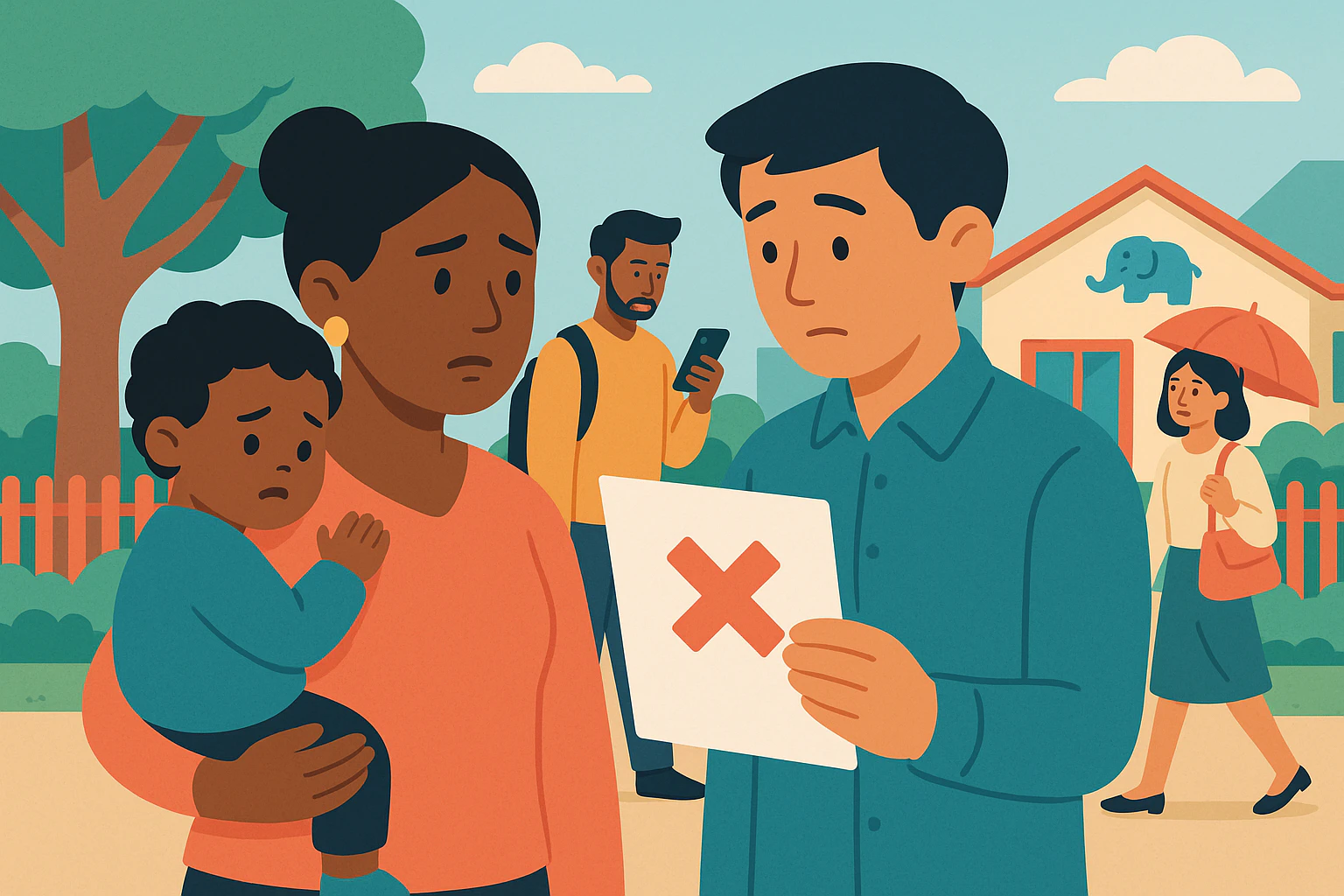
Bottom line: after April 2025, a daycare rejection letter by itself is no longer enough to keep childcare leave benefits.
Collect 3 items: the MHLW extension-reason declaration, a full copy of your hoikuen application, and the city/ward non-admission or waiting-list notice.
Main counters: city hall or the ward office handles daycare documents, your employer or HR handles the employment-insurance filing, and Hello Work decides the extension.
Act early: keep every page or screenshot, avoid boxes that clearly say you do not want admission, and confirm the correct Hello Work before your child hits the key age milestone.
Information current as of March 2026 based on MHLW, Minato City, Kyoto City, Yokohama City, and Osaka City.
If you are trying to keep childcare leave pay after a hoikuen rejection, the practical phrase to understand is childcare leave extension Japan. In everyday English, parents say “leave pay,” but the official program is the childcare leave benefit under employment insurance. Since April 2025, MHLW’s extension procedure has required more proof than before, and Hello Work now checks whether your daycare application looked like a real attempt to return to work quickly.
I also work in legal affairs in Japan, and this is exactly the kind of problem where people lose money because three offices each explain only one-third of the process. The system itself exists. The risk is the handoff.
What changed for childcare leave extensions after April 2025
The April 2025 change was not “just bring a rejection letter later.” Under the MHLW extension page and its Q&A on childcare leave benefits, Hello Work now looks at whether your hoikuen application was made for a genuine, prompt return to work. That means a municipal non-admission notice is still necessary, but it is no longer sufficient on its own.
The biggest trap is wording. MHLW says statements that clearly show no real wish for admission can sink the extension, such as “I do not want admission,” “I want to extend childcare leave,” or “please keep me on hold.” On the other hand, softer wording that means “I can tolerate leave extension if no place is available” is not automatically fatal nationwide, although local forms can still lower your daycare ranking.
This matters because city hall and Hello Work are checking different things. The municipality decides daycare placement. Hello Work decides whether your benefit extension meets the national rules. That is why a parent can have a perfectly real rejection notice from the ward office and still have a problem if the application form itself signals no intent to return.
| Item | Amount/count | Source/as-of date |
|---|---|---|
| Documents now checked for the extension review | 3 | MHLW extension procedure page, March 2026 |
| First extension endpoint | Until before the child reaches 1 year 6 months | MHLW childcare benefits page, March 2026 |
| Re-extension endpoint | Until before the child reaches 2 years | MHLW childcare benefits page, March 2026 |
| How recent the municipal notice generally must be | Within 2 months before the key date, or 3 months for April intake | MHLW Q&A, August 2025 edition |
| Kyoto deadline after you actually return to work | Within 2 weeks | Kyoto City Form 6 guidance, March 2026 |
The “key date” above is the milestone tied to your extension stage. The safe rule is simple: do not wait until after the milestone to start dealing with daycare paperwork, and watch April intake calendars especially closely because many cities close April applications months earlier.
The 3 documents you now need from city hall and your employer
Here is the fastest all-Japan workflow. It matches the format that already works in search: a short checklist you can follow in order.
- Work backward from your child’s milestone. For the first extension, plan before your child turns 1. For the second extension, plan before the 18-month milestone. If you are aiming for an April start, check your city’s annual guide early because April deadlines often arrive in the previous autumn or winter.
- Submit a real hoikuen application. Apply to places you could honestly use. MHLW’s Q&A says you do not need to apply to many facilities just to satisfy the rule, but you should not make the form look like a fake application either.
- Keep the full application copy. MHLW says the copy should be all pages. If you filed online, save the confirmation screen or print the submitted data. If you later changed your preferences, keep the revised version too.
- Get the municipal non-admission document. This may be called an 入所保留通知書 or 入所不承諾通知書. If your city keeps you on the waiting list automatically, ask whether a separate proof document exists for a specific month.
- Complete the extension-reason declaration. Download the declaration from the MHLW extension procedures page. This is the form Hello Work uses to judge whether the daycare application really matched a quick return-to-work plan.
- Give the packet to HR early. In practice, your employer usually submits the childcare leave benefit paperwork to the Hello Work office that covers the workplace. Tell HR that your packet now includes the declaration, the hoikuen application copy, and the municipal notice.
- Confirm the correct Hello Work before filing. The benefit claim goes by workplace jurisdiction, not whatever office is most convenient for you personally. If HR is unsure, have them verify it from the official Hello Work list.
Counter phrases you can actually use:
- 保育所利用申込書の写しをください。育児休業給付金の延長手続きに必要です。 (Hoikusho riyou moushikomi-sho no utsushi o kudasai. Ikuji kyuugyou kyuufukin no enchou tetsuzuki ni hitsuyou desu.) — I need a copy of my daycare application. It is necessary for the childcare leave benefit extension procedure.
- 入所保留通知書または入所不承諾通知書を発行できますか。 (Nyuusho horyuu tsuuchisho matawa nyuusho fushoudaku tsuuchisho o hakkou dekimasu ka?) — Can you issue a waiting-list notice or a non-admission notice?
- 会社を管轄するハローワークに出す書類を確認したいです。 (Kaisha o kankatsu suru Hellowaaku ni dasu shorui o kakunin shitai desu.) — I want to confirm the documents that will be submitted to the Hello Work office covering my employer.
Not sure about your city’s form or checkbox wording? Ask on LO-PAL.
Tokyo, Kyoto, and Yokohama examples that trip parents up
The national rule is the same, but the municipal workflow is not. These three examples show why parents get tripped up even when they have read the MHLW page correctly.
Tokyo example: Minato Ward
In Minato City’s English nursery school guide, returning to work after childcare leave means returning to the same employer that approved the leave. If you return during the waiting period after applying, Minato says you must submit a Return to Work Certificate to the regional city office.
Minato also gives one of the clearest warnings in Japan: if you decline your first-choice placement or miss the deadline for the placement-decline form, a waiting-list notice may not be issued for that month. If that happens, your childcare leave benefit extension can become much harder or impossible for that month. In other words, a casual “I’ll just refuse and keep waiting” plan can backfire.
Kyoto example
Kyoto makes the return-to-work promise very explicit. Its Written Oath for Reinstatement from Childcare Leave says that once your child is admitted, you must return to work by the end of the month in which childcare starts. Then you must submit a Certificate of Reinstatement within two weeks.
Kyoto’s form is also important for April 2025 screening because it says the city may provide Hello Work with application details needed to investigate the benefit extension, including the application date, the desired start month, and whether you declined an offer. So in Kyoto, assume your daycare-side paperwork and your Hello Work-side paperwork must match perfectly.
Yokohama example
Yokohama’s general rule is that if your desired facility is not available, you receive a “facility/business use adjustment result (hold) notice” and stay in the adjustment process for later months within the fiscal year. But if you need a separate proof document for a particular month, Yokohama also has a hold certificate application form.
Yokohama is also very clear about the checkbox problem. In one ward’s FY2026 caution sheet, ticking the box that says you can tolerate childcare leave extension even if it lowers your ranking sends you to the lowest priority. The sheet also warns that if you are still offered a place and then decline it, you will not get a hold notice or a hold certificate for that case. On the return side, Yokohama’s childcare-leave user notice says admitted parents generally need to end childcare leave during the start month and return by the first day of the following month.
What foreign parents run into in real life:
One foreign resident wrote on Reddit, “Just flat refuses to sign the form … I don’t know what would be accepted.”
Another parent said delaying the daycare process was “not really feasible because we needed childcare for me to return to work.”
Individual experiences vary. These stories are not official guidance, but they show the real friction points: employer signatures, language barriers, and timing pressure.
What to do if HR, Hello Work, and city hall tell you different things
This is the part that confuses almost everyone. Even Osaka City’s own public response page records a parent complaining that they were bounced between the ward office and Hello Work over the childcare-leave extension checkbox.
- City hall or ward office: daycare application, ranking, hold or non-admission notice, and any city-specific certificates.
- HR or employer: your employment-insurance paperwork and the filing route to Hello Work.
- Hello Work: the national judgment on whether the benefit extension qualifies.
What if HR says, “City hall decides it”?
That is only half true. City hall decides daycare placement, but MHLW’s revised procedure makes clear that Hello Work checks whether the extension conditions are met. Ask HR, in writing, which Hello Work office covers the workplace and when they plan to submit your packet.
What if city hall says, “Ask Hello Work”?
That is also normal. The municipality usually cannot promise benefit continuation. What you should ask city hall for is narrower and more useful: the exact document name, whether a separate certificate exists, whether your application stays active automatically, and whether any checkbox changes ranking.
What if the employer is the bottleneck?
Start with the childcare leave benefits page, which lists the dedicated call center at 0570-200-406 for questions about the program. If you need labor-side help because your employer is not cooperating, use the MHLW foreign worker consultation page and your prefectural Labour Bureau consultation route. If you are a foreign parent, get everything by email if possible so you have a record.
Your safest playbook is this: ask city hall for documents, ask HR for filing timing, and ask Hello Work for the benefit rule. Do not ask one office to answer the other office’s question.
Related Articles
- Easy Japanese city hall paperwork in Japan
- Best translation apps for foreign residents in Japan
- Having a baby in Osaka City as a foreigner
Need More Help? Ask on LO-PAL
Don’t risk taking time off work only to be sent home because one notice is missing or one checkbox was wrong. On LO-PAL, you can book a local Japanese helper to accompany you to city hall or Hello Work, translate at the counter, and help you get the paperwork right the first time.
Written by

Founder, LO-PAL
Former Medical Coordinator for Foreign Patients (Ministry of Health programme) and legal affairs professional. Built LO-PAL from firsthand experience navigating life abroad.
Written with partial AI assistance
Read full bio →