Best Japanese Learning Apps in 2026: An Honest Comparison (and How to Stop Juggling Five)
Almost no famous app teaches all of Japanese, so serious learners quietly end up paying for three or four at once. Here's a straight, up-to-date comparison of the main Japanese learning apps in 2026 — what each is genuinely good at, what it really costs, and the one all-in-one option that replaces the pile.

Search "best app to learn Japanese" and you get the same five names in a different order every time. What almost none of those lists admit is the awkward truth underneath: no single famous app actually teaches all of Japanese. One is brilliant at kanji, another at grammar, another at building a daily habit — so serious learners quietly end up running three or four apps at once, paying for several, and juggling five streaks.
This is an honest, up-to-date comparison of the main Japanese learning apps in 2026: what each one is genuinely good at, where it stops, what it really costs, and how to stop paying for a small pile of half-solutions.
Full disclosure: we make one of the apps below — LO-PAL Lingo. We've kept the comparison factual: every competitor's price and features here come from their own public information as of July 2026, and we'll tell you plainly what the other apps do better. You're smart enough to judge for yourself.
The real problem: one language, five apps
Japanese isn't one skill. To actually use it you need roughly five things working together:
- Kanji — reading and recognising the ~2,000 characters daily life and the JLPT expect.
- Vocabulary — thousands of words, remembered long-term rather than crammed.
- Grammar — the particles and patterns that turn words into sentences.
- Reading & listening — understanding real material, not just tapping tiles.
- Actually using it — writing, output, and surviving real conversations.
Most popular apps do one or two of these well and ignore the rest. So the typical committed learner's phone ends up looking like this: Duolingo for the habit, WaniKani for kanji, Bunpro for grammar, Anki for vocabulary, and a JLPT app for test practice. That's easily $25–40 a month and five separate streaks to feel guilty about. The apps don't talk to each other, so nothing you learn in one reinforces the others.
How we compared them
We judged every app on five things that actually matter after the first week of enthusiasm wears off:
- Coverage — how many of those five skills it really handles.
- Does it make it stick — proper spaced repetition (SRS), or just streaks and tiles.
- Does it fit life in Japan — or is it built for a generic tourist phrasebook.
- Price — the real monthly cost, and how much is genuinely usable for free.
- Honesty of the free tier — a free plan you can actually learn from, versus a locked demo.
The quick comparison
| App | Best for | Free tier | Price (2026) | Covers |
|---|---|---|---|---|
| LO-PAL Lingo | An all-in-one built for life in Japan | Almost everything free | $2.99/mo (optional) | Kanji, vocab, grammar, reading, listening, keigo, scenes, JLPT mocks, AI writing |
| Duolingo | Building a daily habit | ~2–3 lessons/day | Super ~$13/mo | Basic vocab & sentences |
| WaniKani | Kanji & reading | First 3 levels free | $9/mo · $299 lifetime | Kanji + vocabulary only |
| Bunpro | Grammar | 30-day trial | $5/mo · $150 lifetime | Grammar (+ vocab) |
| Renshuu | The best free option | Generous & ad-free | Pro $6.99/mo | Vocab, kanji, grammar, sentences |
| Anki | Total control (DIY) | Free (except iOS) | Free · iOS $24.99 once | Whatever you build yourself |
| Migii JLPT | Test drilling | Ad-supported, limited | Premium (tiered) | JLPT practice questions |
The apps, one by one
Duolingo — best for building the habit
Duolingo is the friendliest on-ramp in the business. The gamification, streaks and reminders are genuinely good at getting you to open the app every day, and the free Japanese course will carry a beginner through hiragana, katakana and simple sentences. Where it stops is depth: kanji instruction is shallow, grammar is barely explained, there's almost no real reading or listening practice, and it won't get you through the JLPT. On mobile the free tier now runs on limited daily energy — enough for two or three lessons — and unlimited practice means Super Duolingo at around $13/month (less if you pay yearly). Great as a warm-up. Not a full course.
What learners say: reviewers love it as a starting point — the hiragana/katakana teaching and bite-sized daily lessons that build the habit. The recurring complaint is that it stalls after the beginner stage: "speaking" is really just reading sentences aloud rather than holding a conversation, and after a year of Duolingo-only study many people can recognise only 100–200 kanji — nowhere near enough to read comfortably.
WaniKani — the kanji gold standard
For kanji specifically, WaniKani is superb. Its mnemonic-plus-SRS system takes you through roughly 2,000 kanji and 6,000 vocabulary words across 60 levels, and thousands of learners swear it's the reason they can finally read. But that's all it does — no grammar, no listening, no conversation. The first three levels are free; after that it's $9/month, $89/year, or $299 for lifetime. An excellent specialist tool you'll still need to pair with something else.
What learners say: users regularly credit it as the thing that finally made kanji click, thanks to the mnemonics and relentless review schedule. The common gripes: you can't skip ahead or control the pace, and if you take a few days off the reviews pile up fast — a well-known burnout trap.
Bunpro — the best grammar SRS
Bunpro is what WaniKani is for kanji, but for grammar: 900+ grammar points organised N5 to N1, drilled with fill-in-the-blank spaced repetition so the patterns actually stick. If grammar is your weak spot, it's the sharpest tool available. It's also grammar-first by design, so you'll want another app for kanji and listening. There's a 30-day free trial, then $5/month, $50/year, or $150 lifetime.
What learners say: it's a community favourite for JLPT grammar and pairs neatly with WaniKani. The main criticism is that the grammar explanations can be thin for subtle, easily-confused points, and it's fairly dry and text-heavy for a complete beginner.
Renshuu — the most generous free app
Renshuu deserves more attention than it gets. Its free plan is genuinely comprehensive and ad-free: vocabulary, kanji, grammar and example sentences with native audio, plus learning paths for most textbooks and the JLPT. If your budget is zero, this is one of the two apps we'd point you to. The trade-offs are a busier, older-feeling interface and some quality-of-life features held back for Pro ($6.99/month, or $109.99 lifetime). Substance over polish.
What learners say: fans rave about how much you get for free and how clearly its grammar explanations "click" — several say points made sense on Renshuu that never did elsewhere. The usual knock is the interface: busy and a little overwhelming at first, and less slick than the newer apps.
Anki — the power user's engine
Anki isn't really a Japanese app — it's the most powerful flashcard SRS ever made, and it's free on desktop, Android and web (the iOS app is a one-time $24.99). Advanced learners build or download decks and remember astonishing amounts. The catch is everything is do-it-yourself: no course, no structure, no hand-holding, and a setup curve that stops most beginners cold. Unbeatable if you enjoy building your own system; overwhelming if you just want to learn.
What learners say: devoted users call it a game-changer for long-term retention and love that it's free and endlessly customisable. The complaints are just as consistent: the options are famously "Byzantine," it looks plain, and beginners routinely misconfigure it (or bounce off the setup before they ever get going).
Migii JLPT — focused test drilling
If your only goal is a JLPT score, Migii has a huge bank of practice questions with explanations across N5–N1 and solid progress tracking. It's built for drilling, not for learning the language from scratch, and the free version is heavily ad-supported with the full-length mock tests locked behind premium. A useful crammer for the weeks before the exam rather than a daily home.
What learners say: it holds a high store rating (around 4.6/5) and users value the sheer size of the question bank. But complaints recur: even paying users report a full-screen ad on opening, some explanations are broken or missing, and a few fluent speakers have flagged outright errors in the harder tests.
Our pick: LO-PAL Lingo — the all-in-one
Here's where our bias is on the table — and here's why we built it anyway. Every app above is good at its one job and then hands you off to the next app and the next subscription. Lingo puts the whole of Japanese into one place, on one streak.
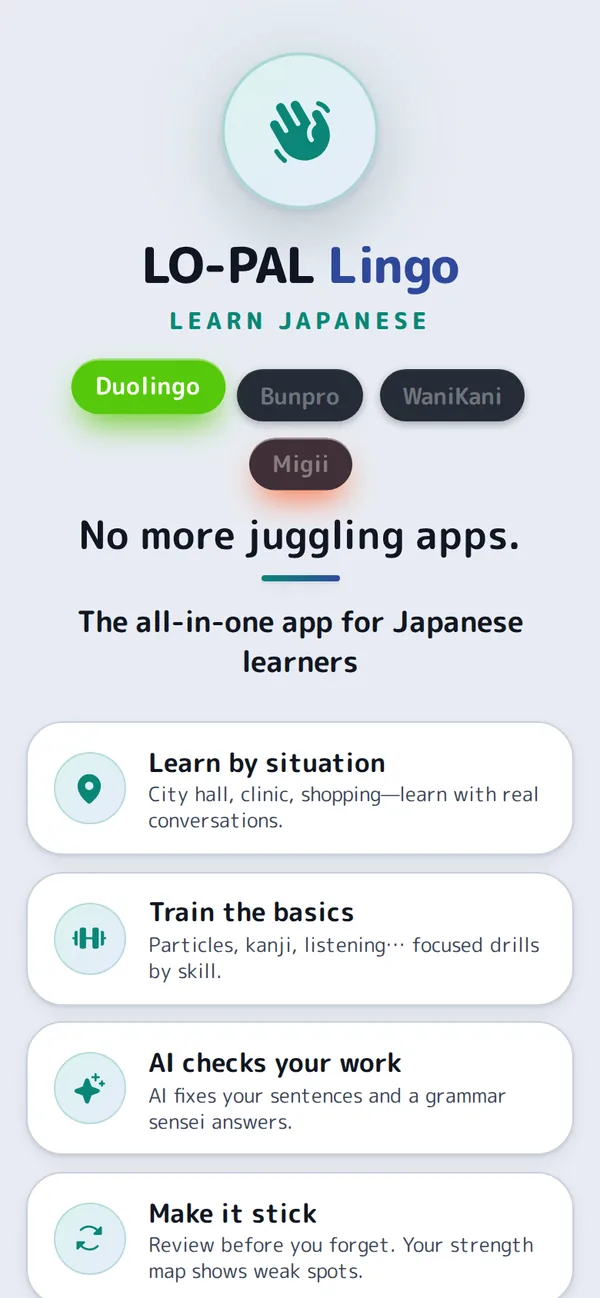
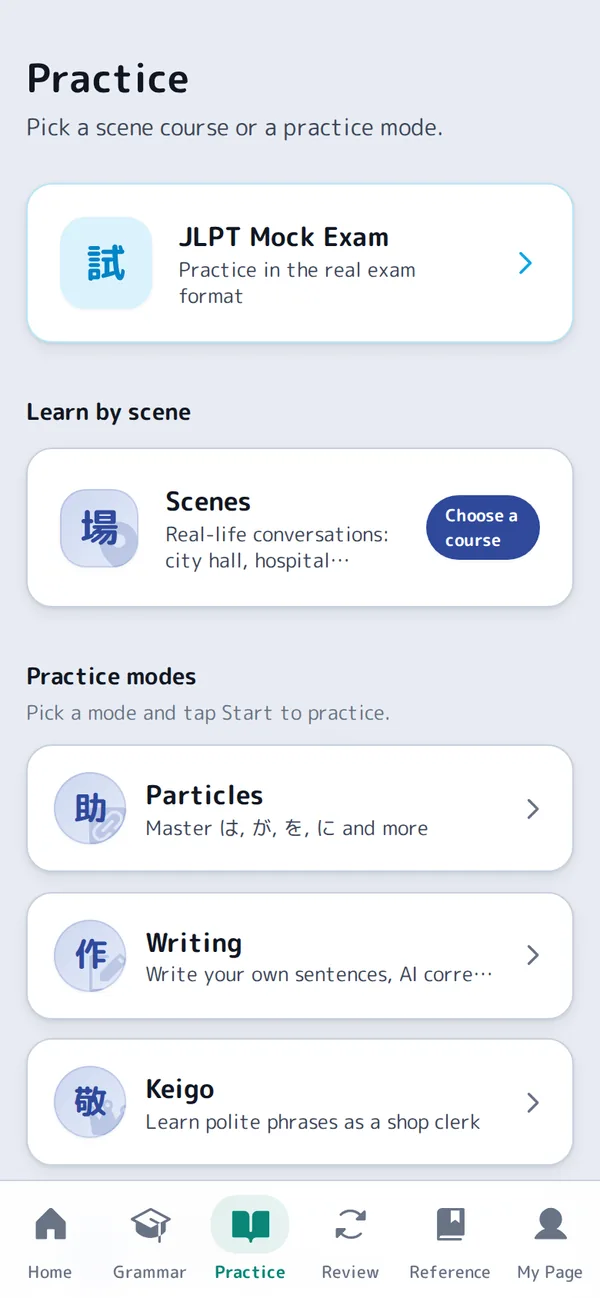
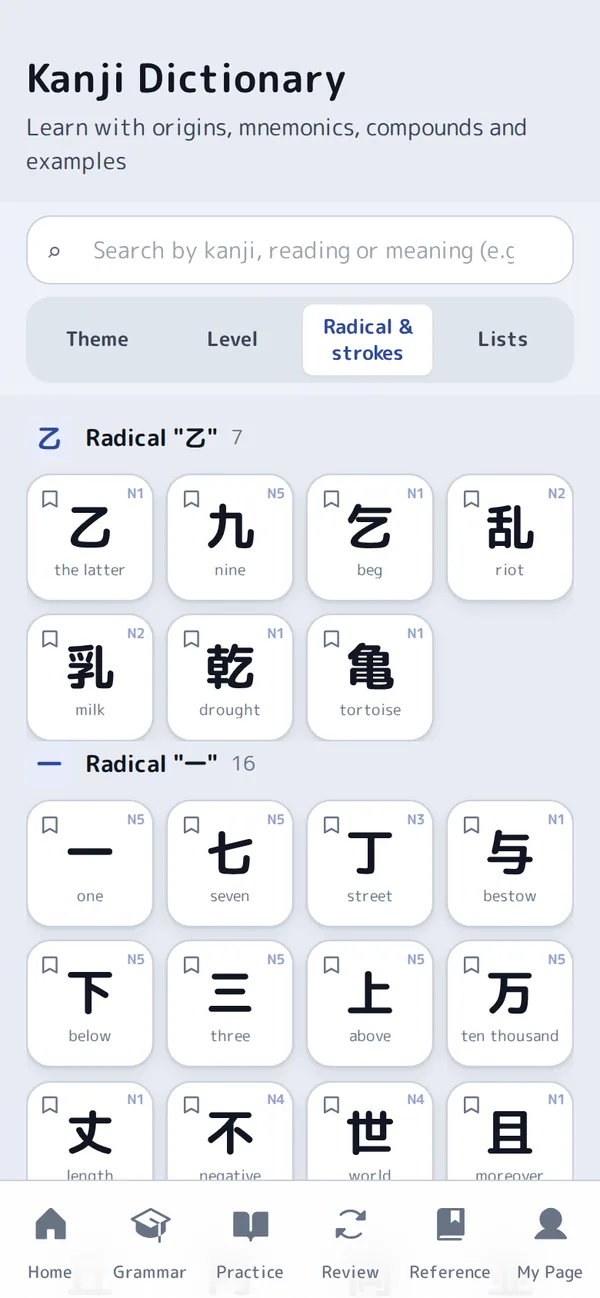
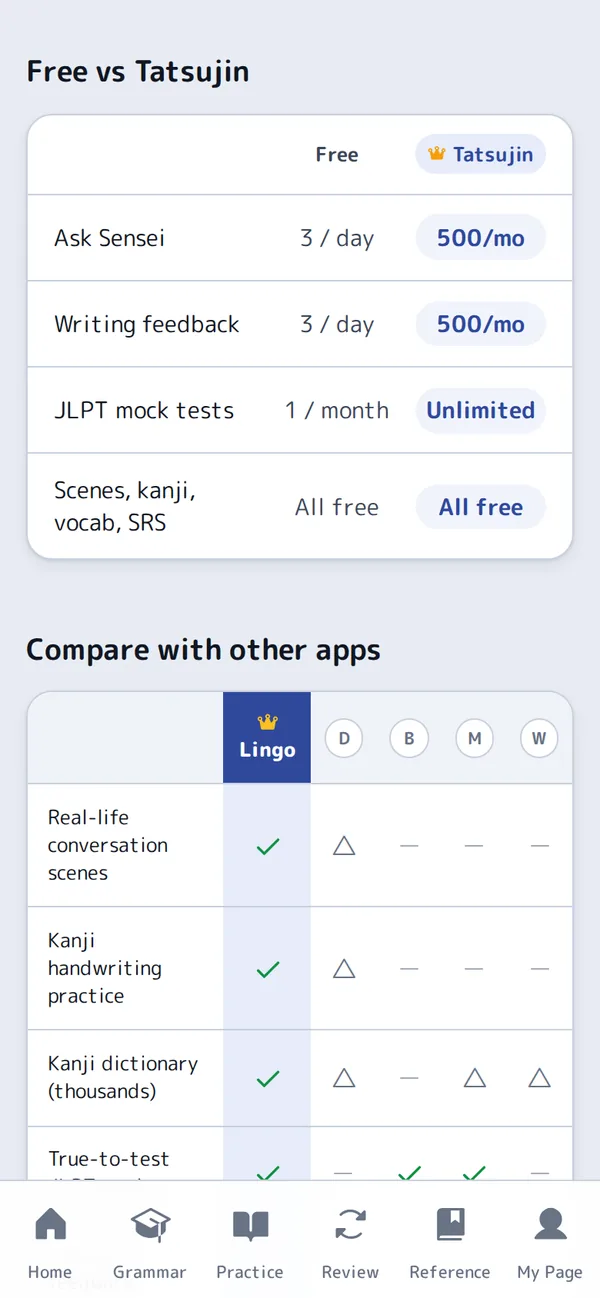
In a single app you get kanji (a full dictionary of thousands, with mnemonics and handwriting practice), vocabulary flashcards with custom decks, grammar drilled with spaced repetition, particles, keigo, reading, listening, real-life conversation scenes, AI writing feedback, an AI grammar "Sensei" you can ask questions on the spot, and true-to-format JLPT mock exams. All of it uses the same SRS underneath, so kanji you learn shows up in the reading, and grammar you drill comes back in the mocks.
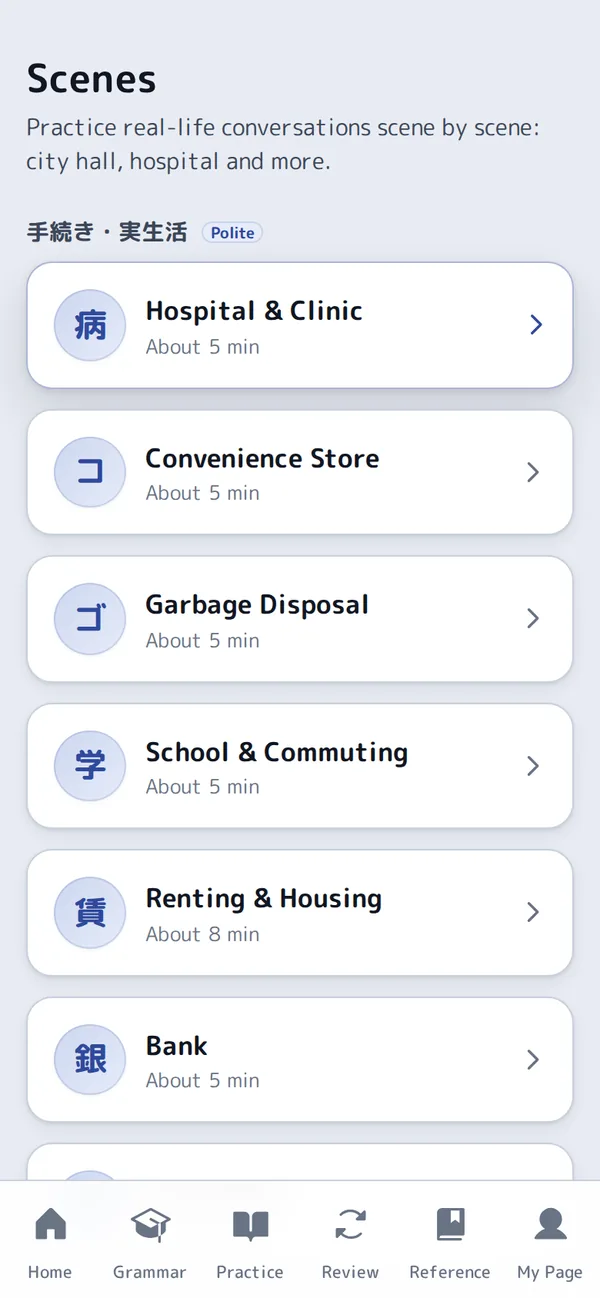
Built for life in Japan, not a generic phrasebook
This is the part global apps can't copy. Lingo's conversation scenes are the situations foreign residents actually face: the city hall counter, the clinic, sorting your garbage, renting an apartment, the bank, your kid's school. You're not learning to order sushi for tourists — you're learning the Japanese that gets you through the week.
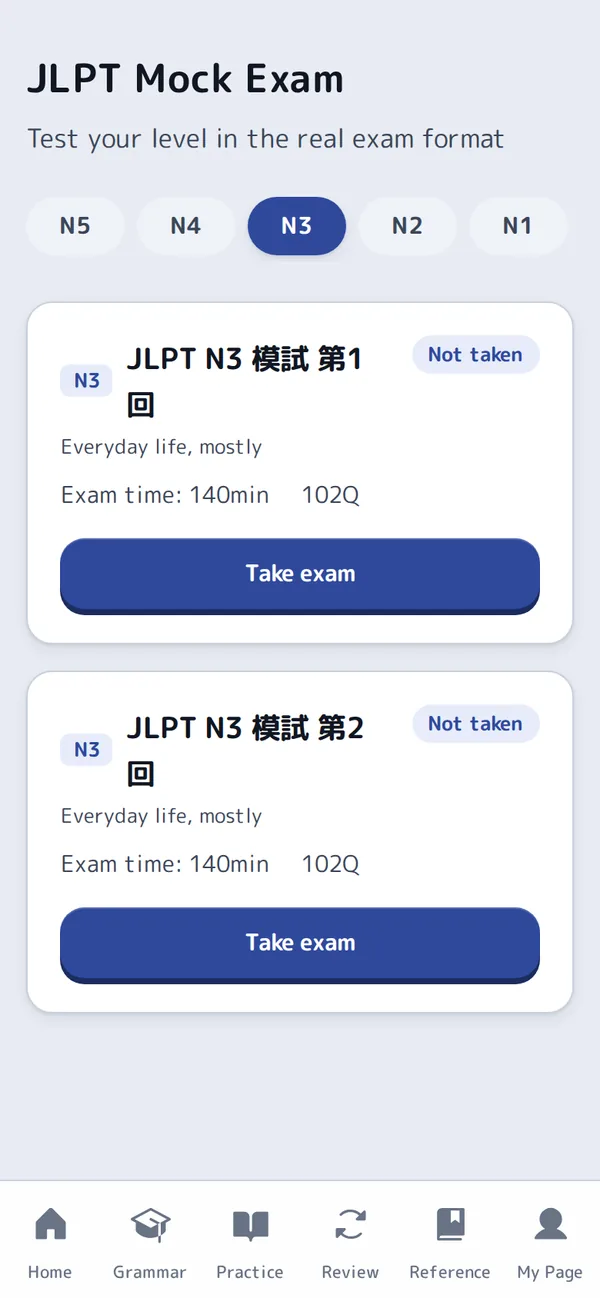
For the JLPT, Lingo runs full mock exams in the real test format and timing — 140 minutes, the actual question count — not just loose practice questions, so exam day feels familiar. And because the questions and explanations are supervised by native Japanese speakers, you're not learning from machine-generated guesses.
The honest part: almost everything is free
Here's the pricing, plainly. The great majority of Lingo is free, forever — scenes, kanji, vocabulary, grammar, particles, keigo, reading, listening and all the SRS review. The only things limited on the free plan are the two features that genuinely cost us money to run: the AI Sensei and AI writing feedback (three each per day for free), and JLPT mock exams (one a month free). Lifting those limits is the optional Tatsujin plan at $2.99/month — cheaper than any single-skill app on this page, and it replaces all of them.
One more thing if you live in Japan: Lingo uses the same account as LO-PAL, so the guides you're reading right now and your Japanese study sit under one login.
The honest caveat: Lingo is the newcomer here. It doesn't have a decade of App Store reviews behind it like Duolingo or WaniKani, so don't take our word for it — try it free and judge for yourself. What it offers in return is coverage and price, and because the questions and explanations are checked by native Japanese speakers, breadth doesn't come at the cost of accuracy.
So which should you actually pick?
We'd rather give you the honest map than pretend one app wins every category:
- You only care about kanji → WaniKani.
- You only need to fix grammar → Bunpro.
- You want a fun daily habit and you're a beginner → Duolingo.
- You want the best free option and don't mind an older interface → Renshuu.
- You love building your own system → Anki.
- You're cramming for the JLPT next month → Migii, or Lingo's mocks.
But if you want one app that covers all of Japanese, keeps it stuck with real spaced repetition, is built for actually living in Japan, and would rather charge you $2.99 than $30 across five subscriptions — start with Lingo. You can use it free, and you don't even need to sign up to try it.
Frequently asked questions
What's the best free app to learn Japanese?
Renshuu and LO-PAL Lingo are the two most generous. Renshuu's free plan is comprehensive and ad-free; with Lingo, almost everything (kanji, grammar, vocab, listening, scenes, SRS) is free, and only the AI features and unlimited JLPT mocks are paid.
Is Duolingo enough to learn Japanese on its own?
For building a daily habit and getting started, yes. For real kanji depth, grammar explanations, listening, output, or passing the JLPT — no. Most learners either outgrow it or pair it with a kanji and grammar app.
What's the best app for JLPT preparation?
For pure question drilling, Migii and Bunpro are strong. If you also want full-format timed mock exams plus the grammar, kanji and vocabulary behind them in one place, Lingo covers the whole exam and the study around it.
Do I have to pay to learn seriously?
No. You can get a long way for free with Renshuu, Anki or Lingo. Paid plans mainly buy convenience, AI feedback, and removing daily limits — not the core learning itself.
Sources & further reading
Prices and features are taken from each app's own site — the primary source for anything that changes: Duolingo, WaniKani, Bunpro, Renshuu, Anki and Migii JLPT.
The learner feedback above is summarised from public reviews and study communities rather than any single person, including Tofugu, Migaku, the WaniKani community forums, JLPT Samurai, and App Store and Google Play ratings, all as of July 2026.
Try LO-PAL Lingo free at lingo.lo-pal.app — most of it costs nothing, and there's a free one-minute check that estimates your JLPT level before you start.
Prices and features were verified from each provider's public information as of July 2026 and can change; check the app's own site for the latest. LO-PAL Lingo is made by LO-PAL, the publisher of this guide.
Written by

Founder, LO-PAL
Former Medical Coordinator for Foreign Patients (Ministry of Health programme) and legal affairs professional. Built LO-PAL from firsthand experience navigating life abroad.
Written with partial AI assistance
Read full bio →