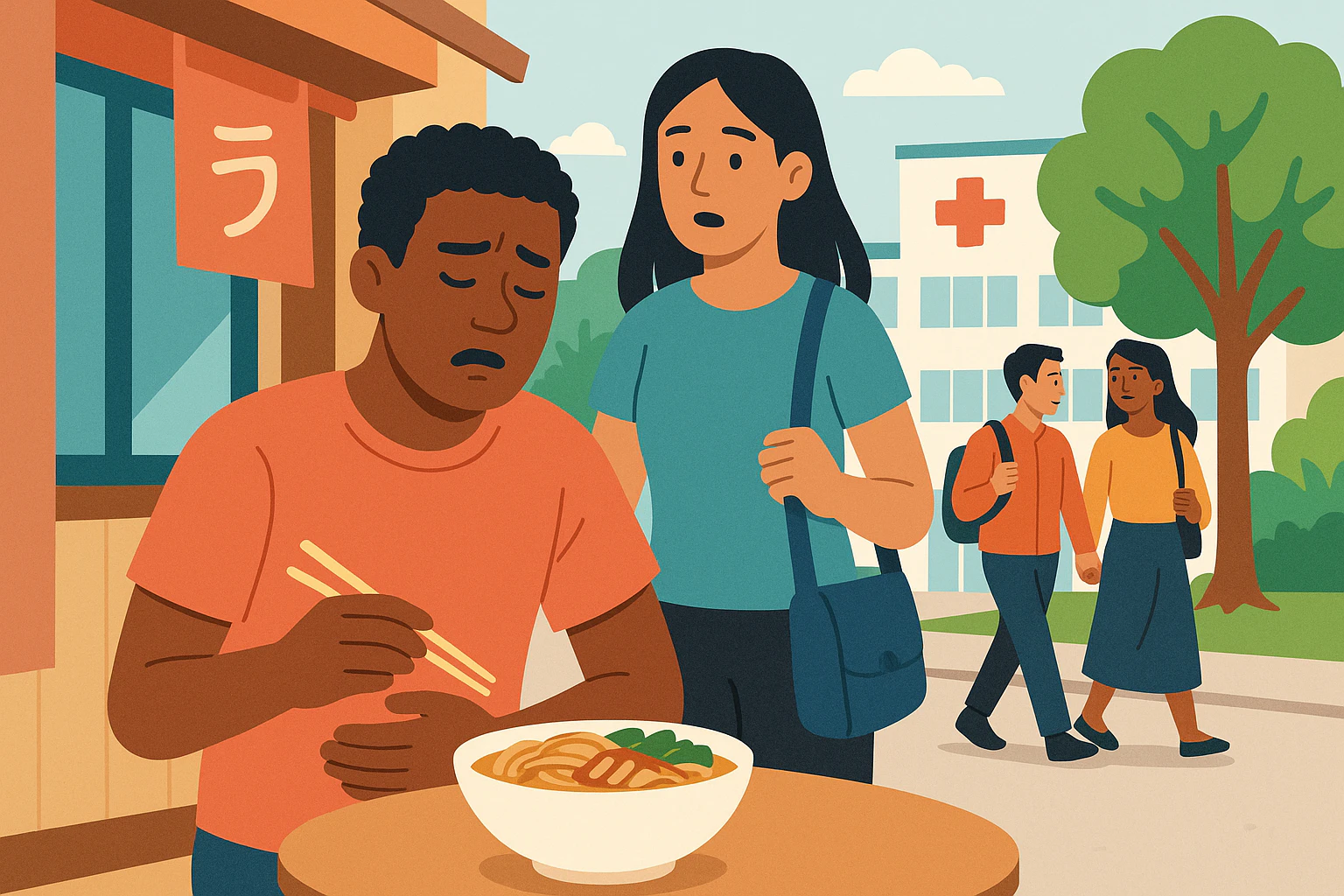
Homesick in Japan? Comfort Food First, Then Real Help
Missing home? Practical ways to feel better in Japan — comfort food, community, hotlines like Yorisoi and TELL, and multilingual counseling.
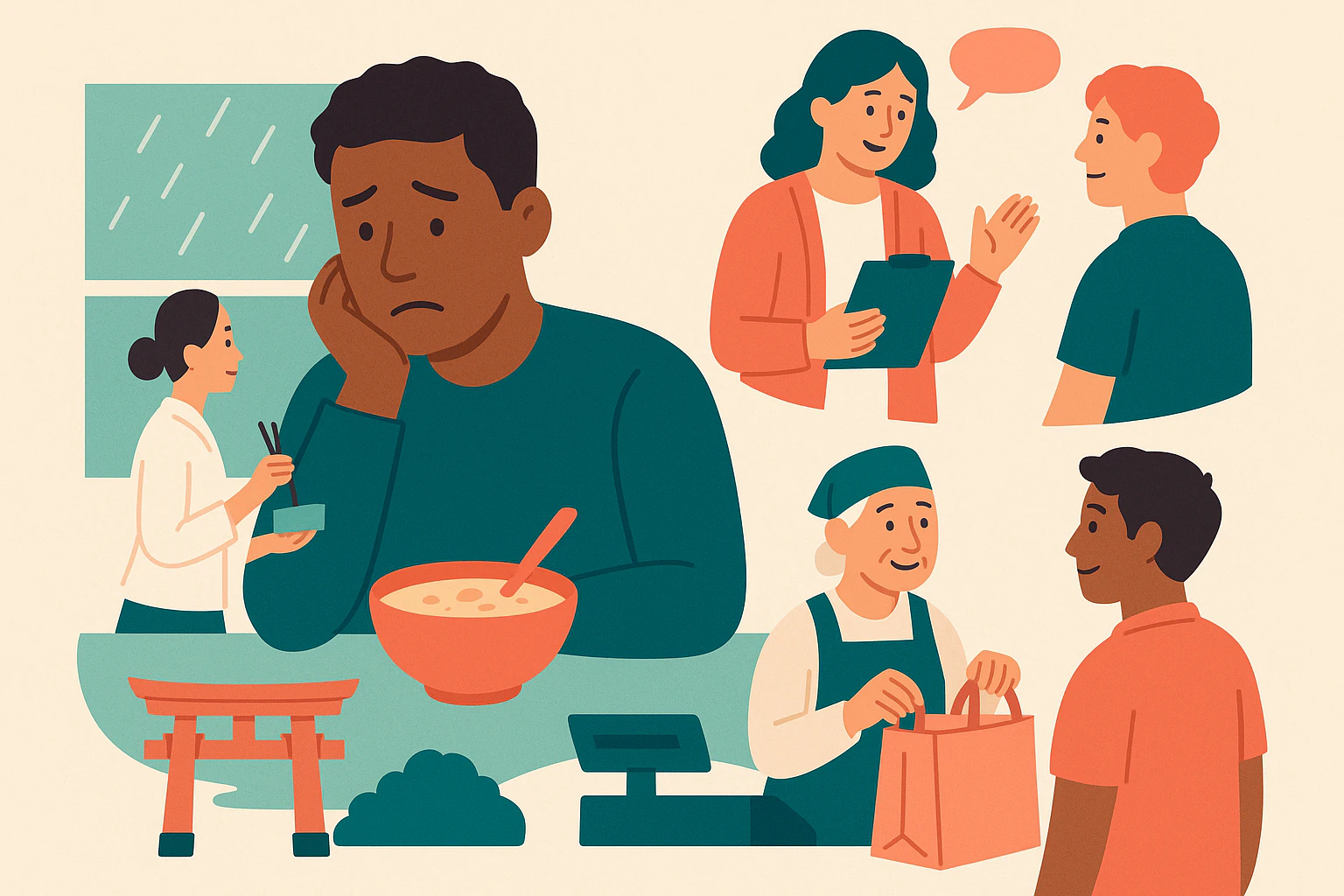
Feeling homesick in Japan can hit hard and fast—sometimes on day one, sometimes after months of “doing fine.” This guide starts with the quickest, most realistic reset many people can actually do immediately: rebuild emotional safety through comfort food in Japan (and the small rituals around it), then moves to clear, practical pathways for multilingual counseling in Japan and public helplines if homesickness turns into chronic stress or depression.
If you’re in immediate danger (you might hurt yourself or someone else), call 110 (police) or 119 (ambulance/fire) in Japan. If you can’t communicate well, say “English please” and stay on the line.
Why Homesick in Japan Can Feel So Intense (Culture, Language, Food)
Being homesick in Japan isn’t “just missing home.” It’s often a stack of smaller stressors that quietly remove your usual sense of safety: how you communicate, how you eat, and how you recover after a tough day.
Culture shock is tiring even when you love Japan. The rules can feel invisible (where to stand, when to speak, how direct to be), and that constant “self-monitoring” drains your nervous system—especially if you’re already working, studying, or raising kids here.
Language fatigue is real. When every phone call, clinic visit, form, and staff meeting requires extra effort, your brain has less capacity left for coping with loneliness, uncertainty, or bad news from home.
Food is often the surprise trigger. Even if you enjoy Japanese cuisine, losing your default tastes and routines can make you feel ungrounded—especially in the first winter, during long work hours, or after a stressful move. When “I just want something familiar” becomes “I can’t feel okay without something familiar,” that’s a signal worth listening to.
Comfort Food Tactics for When You’re Homesick in Japan: Recreate “Home” with Japan-Friendly Ingredients
When you’re homesick in Japan, therapy might help—but today you still need to eat. Comfort food works because it rebuilds a sense of predictability: familiar smell, familiar texture, familiar steps, familiar timing.
The goal isn’t gourmet authenticity. The goal is a repeatable “anchor meal” you can make even when you’re tired, sick, broke, or busy.
Day-one reset: build a “Comfort Food Emergency Kit”
Pick 5–10 items that reliably calm you down and keep them stocked for the weeks you know are hard (busy season, exams, winter, anniversaries, family situations). In Japan, a small kit is easier to maintain than a big shopping fantasy.
- One starch you’ll actually eat: rice, pasta, bread, tortillas, oats
- One protein shortcut: eggs, tofu, canned tuna, rotisserie chicken, natto (if you like it)
- One “home flavor”: hot sauce, chili flakes, curry powder, stock cubes, peanut butter, cheese
- One comfort drink: tea, coffee, cocoa, electrolyte drink
- One “I miss home” snack: cereal, cookies, chips, instant noodles from your region
Japan-friendly ingredient swaps that keep the “home” feeling
Comfort food is about cues, not perfection. If a dish tastes “80% right,” your brain often responds as if it’s 100% safe.
- For Western-style soups/stews: use Japanese carrots, onions, potatoes, plus consommé/stock cubes; add butter or olive oil for familiar richness.
- For tomato-based sauces: combine canned tomatoes with a little ketchup or tonkatsu sauce to round out sweetness/umami.
- For “home-style” sandwiches: try shokupan, bagels, or rolls; add mustard/pickles/cheese to recreate the flavor signature.
- For spicy comfort: keep chili oil, shichimi, gochujang, or your favorite hot sauce on hand.
- For baked comfort (quick version): pancakes/waffles, brownies, or banana bread using supermarket basics (eggs, milk, flour, bananas).
Where people commonly source comfort foods in Japan
You don’t need to travel far to start. Many people use a mix of (1) big supermarkets, (2) import-focused shops, and (3) online delivery to keep familiar staples around.
- Supermarkets: for daily basics (eggs, meat, tofu, vegetables, bread, yogurt)
- Import-style selections: for cereal, peanut butter, salsa, spices, pasta sauces, cookies (availability varies by area)
- Online: when you live rural, have dietary needs, or want your exact brand
Practical tip: don’t try to rebuild your entire home country pantry in one month. Start with one anchor meal, then add one “identity ingredient” per week (the one thing that makes it feel like “your food”).
Mini-plan (7 days): Choose 1 anchor meal → buy ingredients for 3 repeats → eat it at the same time each day → notice what improves (sleep, appetite, anxiety, irritability).
Loneliness to Connection: Use Food to Build a Real Support Network (Homesick in Japan)
One reason homesick in Japan feels so intense is that loneliness gets “quiet.” You might be surrounded by people at work or school, yet still have nobody you can be fully yourself with.
Food is one of the simplest bridges because it gives you an activity, not just a conversation. You don’t have to be witty in Japanese or talk about big feelings—you can just cook, eat, and be present.
Try “low-pressure” shared meal formats
These options work even if you’re shy, busy, or not fluent. Pick the easiest one and repeat it weekly until it becomes routine.
- One-dish potluck: “Bring one thing from your country (or your comfort food).” People love this because it’s story-friendly.
- Cook-with-me night: invite one person to help you make your anchor meal. Give them a job (chop onions, stir sauce) so it’s not awkward.
- Lunch trade at work/school: swap snacks or side dishes once a week (“I’ll bring cookies, you bring onigiri”).
- Same restaurant, same day: a repeating ramen/teishoku night with one friend becomes an emotional stabilizer.
Use food to create “safe language practice”
If Japanese makes you anxious, meals are a smart practice zone. You can learn a small set of phrases and repeat them without the pressure of formal situations.
- At a shop: “Kore wa arimasu ka?” (Do you have this?)
- At a restaurant: “Osusume wa nan desu ka?” (What do you recommend?)
- Inviting someone: “Issho ni tabemasen ka?” (Do you want to eat together?)
When shared meals don’t help (a helpful sign)
If you’re eating familiar food and still feel persistently numb, panicky, hopeless, or unable to function, it may mean homesickness has shifted into chronic stress or depression. That’s not a failure—it’s your cue to escalate from self-care to structured support.
When You Need More Than Self-Care: Multilingual Counseling in Japan + Hotlines for Homesick in Japan
This section is for when homesick in Japan stops being occasional sadness and starts affecting sleep, appetite, work, relationships, or safety. Below are practical nationwide and regional options, plus what to expect when you call.
Step 1: Know the “public system” option (MHLW unified mental health consultation dial)
Japan’s Ministry of Health, Labour and Welfare (MHLW) operates the nationwide “Kokoro no Kenko Sodan (Mental Health Consultation) Unified Dial”, which has been in operation since September 10, 2008. (mhlw.go.jp)
Number: 0570-064-556 (Navi-Dial). The MHLW page lists availability by prefecture/major city, and notes that hours vary significantly by region (the table is labeled “as of October 1, 2023”). (mhlw.go.jp)
Practical procedure: if you can’t get through (or the Navi-Dial doesn’t work for your phone plan), use the direct “IP-phone compatible” numbers shown in the MHLW prefecture-by-prefecture table and call the local center directly. (mhlw.go.jp)
If you want to read the official listing, start here: MHLW: Kokoro no Kenko Sodan Unified Dial (こころの健康相談統一ダイヤル). (mhlw.go.jp)
Step 2: Use a multilingual line if Japanese is a barrier (Yorisoi Hotline English and more)
If language is your biggest obstacle, Yorisoi Hotline is one of the most practical “next calls” for foreign residents. On the official Social Inclusion Support Center site, the foreign-language line is described as available every day from 10:00 a.m. to 10:00 p.m., and you’re instructed to press 2 after the guidance. (since2011.net)
- Nationwide line: 0120-279-338 (free) — press 2 for the foreign-language line (since2011.net)
- If calling from Iwate, Miyagi, Fukushima: 0120-279-226 (separate line shown on the official page) (since2011.net)
- Languages listed (10): English, Chinese, Korean, Tagalog, Portuguese, Spanish, Thai, Vietnamese, Nepali, Indonesian (since2011.net)
Because language availability can rotate, check the latest schedule on the official page: Yorisoi: Helpline for foreign languages. (The page shows month-by-month schedules, including a schedule header for February 2026.) (since2011.net)
Step 3: Add an English lifeline option (TELL Lifeline schedule changes weekly)
TELL Lifeline publishes specific phone and chat hours, and those details matter because it is not a simple 24/7 number. On TELL’s hours page, the phone line is listed as continuous from Saturday 09:00 to Monday 23:00, with additional weekday blocks; chat hours are listed separately. (telljp.com)
- Toll-free phone: 0800-300-8355 (telljp.com)
- Tokyo phone: 03-5774-0992 (telljp.com)
- Check current hours (phone/chat): TELL Hours: Lifeline Phone and Chat (telljp.com)
TELL also reminds callers: if you’re in danger, call 110 (police) or 119 (ambulance/fire). (telljp.com)
Tokyo advantage: use one-stop multilingual consultation (TMC Navi) and Tokyo government advisory calls
If you live in Tokyo, you have multiple “front door” options that can refer you to specialized services (including mental health, legal, residency, family, and daily-life issues).
- Tokyo Multilingual Consultation Navi (TMC Navi): 0120-142-142, Mon–Fri 10:00–16:00, multilingual consultations and interpretation support with public institutions. Details and language list are on Tokyo Intercultural Portal Site (TMC Navi). (tabunka.tokyo-tsunagari.or.jp)
- Tokyo Metropolitan Government Foreign Residents’ Advisory Center (FRAC): English line 03-5320-7744 (Mon–Fri 9:30–12:00 and 13:00–17:00). Official Tokyo page (updated January 20, 2026): TMG: Foreign Residents’ Advisory Center. (seikatubunka.metro.tokyo.lg.jp)
What to say when you call (simple script): “I’m a foreign resident. I’m struggling with stress and homesickness. I want help in English. I also need to know what services exist in my ward/city.” Then ask them to repeat key steps slowly.
Regional examples (Nagoya, Shiga, Nagano, Shimane, Gifu, Saga): where multilingual support is growing
If you’re outside Tokyo, don’t assume you’re alone. Many prefectures and cities run consultation desks through international centers/associations, and some provide three-way interpretation support.
- Nagoya (Aichi): Nagoya International Center offers Free Personal Counseling for foreign residents (appointment required) in English, Portuguese, Spanish, and Chinese. See: NIC: Free Personal Counseling. (nic-nagoya.or.jp)
- Nagoya (government calls with an interpreter): NIC’s Trio-Phone Civic Interpreter Service arranges a 3-way call if you need help contacting a ward office/health center/tax office; the page lists 080-7994-7196 and language schedules. See: NIC: Trio-Phone Civic Interpreter Service. (nic-nagoya.or.jp)
- Shiga: Shiga Foreigner Consultation Center (within the Shiga Prefecture International Association) lists 077-523-5646, Mon–Fri 10:00–17:00, and notes additional languages can be handled via an interpretation call center. See: Nagahama City: Shiga Foreigner Consultation Center. (city.nagahama.lg.jp)
- Shiga (example of time-limited expansions): Shiga Prefecture ran a multilingual phone counseling trial for children/youth and parents July 16, 2025 to September 15, 2025 (17:00–21:00) via three-way calls, phone 077-524-2030. Because this window is in the past, check the page for any new rounds: Shiga Prefecture: Multilingual phone support trial. (pref.shiga.lg.jp)
- Nagano: Nagano Prefectural Multicultural Counseling Center also publicizes the Yorisoi multilingual line (10:00–22:00) and lists a local consultation number 026-219-3068. See: Nagano Multicultural Counseling Center notice. (naganoken-tabunka-center.jp)
- Shimane: Shimane International Center’s “Go-en Shimane” multilingual consultation page explains how to call and request English interpretation, and lists a consultation dial 070-3774-9329. See: Shimane International Center: Go-en Shimane. (sic-info.org)
- Gifu (three-way interpreting model): Gifu Prefecture describes “Triophone,” including steps and the direct line 058-263-8066. See: Gifu Prefecture: Triophone (three-way phone interpreting). (pref.gifu.lg.jp)
- Saga (call-center model used by institutions/municipal offices): Saga Prefecture International Relations Association describes a Multilingual Call Center and notes that individuals generally can’t call it directly from personal devices (it’s used via institutions). See: SPIRA: Multilingual Call Center. (spira.or.jp)
How to decide when to escalate from comfort food to professional help
Use comfort food and connection as your first-line “stability tools,” but escalate if any of the following are true for 2+ weeks: sleep is broken most nights, appetite collapses, panic spikes, you can’t work/study, you’re isolating, or you feel hopeless. Escalate immediately if you have thoughts of self-harm or you feel unsafe.
A simple escalation path: (1) Anchor meal today → (2) Shared meal this week → (3) Call Yorisoi (press 2) or TELL for support → (4) Use Tokyo/regional consultation desks for referrals → (5) Book counseling/clinic support with interpretation if needed.
Need More Help? Ask on LO-PAL
Homesickness gets easier when you stop trying to solve Japan alone. If you want to know more about this topic or need specific local information (the best import shop near your station, how to book an English-speaking clinic, what your city hall offers, or how to call a hotline), ask a local Japanese person on LO-PAL.
LO-PAL is our matching service where foreign residents and tourists in Japan can connect with local Japanese helpers. Post a question or request a task in the app, and people in your area can respond—whether that’s shopping assistance for comfort-food ingredients, help making phone calls, or support understanding local consultation services.
Written by

Founder, LO-PAL
Former Medical Coordinator for Foreign Patients (Ministry of Health programme) and legal affairs professional. Built LO-PAL from firsthand experience navigating life abroad.
Written with partial AI assistance
Read full bio →