How to Apply for Japanese Citizenship Without a Wasted Trip
Naturalization in Japan starts with the right bureau, the right reservation, and the right paperwork. This guide shows how to avoid a wasted first visit.
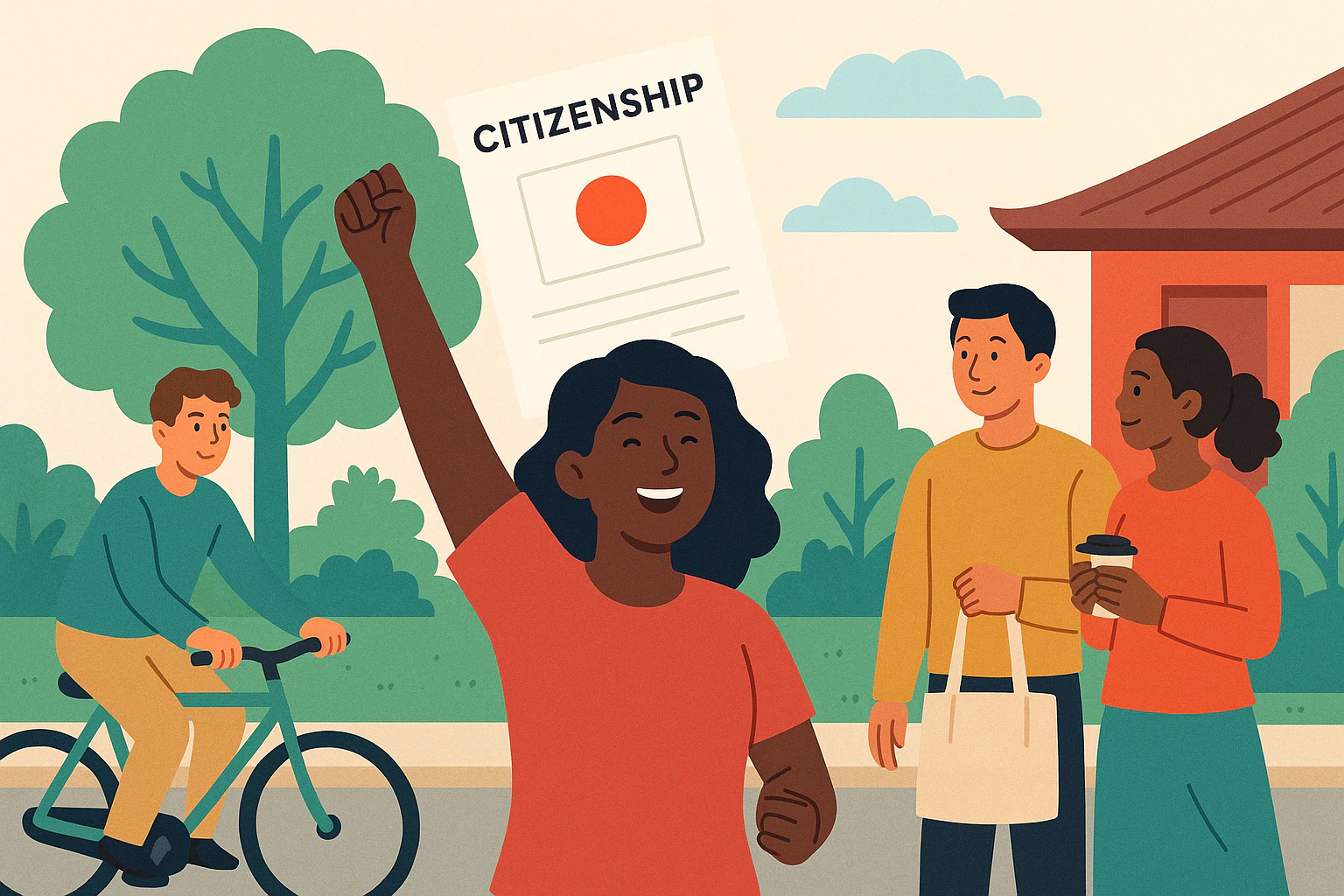
This is not a once-a-year filing system. Your real clock starts when you secure the first, reservation-only consultation at the Legal Affairs Bureau or Regional Legal Affairs Bureau that covers your registered address. Bring the right office, the right originals and A4 copies, and Japanese translations with the translator's details. In some bureaus, the shortest path from first consultation to decision is still about 1.5 years, so one bad visit can cost months.
Information current as of March 2026 based on the Ministry of Justice Nationality Q&A, the Ministry of Justice nationality administration page, the Tokyo Legal Affairs Bureau page updated January 26, 2026, and the Mito District Legal Affairs Bureau process page updated August 5, 2025.
Most English guides to a Japanese citizenship application start with the legal theory. That matters, but it is not where many foreign residents get stuck. I also work as a legal affairs professional in Japan, and in practice the first blocker is usually much simpler: calling the right office, getting the reservation, and showing up with paperwork in the format that office will actually accept.
When I lived in Manchester in my early twenties, I had to call the NHS three times just to book an appointment. That experience stayed with me. The problem was not that the system did not exist. The problem was access. Japanese naturalization often works the same way: the rule may be clear, but the path to the first correct visit is what costs people time.
| item | amount/count | source/as-of date |
|---|---|---|
| General residence condition | 5+ consecutive years in Japan | MOJ Nationality Q&A, accessed March 2026 |
| Age/capacity condition | 18+ and legally capable under home-country law | MOJ Nationality Q&A and Nationality Act translation, accessed March 2026 |
| First consultation example | About 1.5 hours | Mito District Legal Affairs Bureau, updated August 5, 2025 |
| Interview after acceptance example | About 2-3 months later | Mito District Legal Affairs Bureau, updated August 5, 2025 |
| Shortest total process example | About 1.5 years from first consultation to decision | Mito District Legal Affairs Bureau, updated August 5, 2025 |
Who can actually apply for Japanese naturalization
The legal starting point is the MOJ Nationality Q&A and the current Nationality Act translation. For standard naturalization, the Ministry of Justice says the general conditions are at least five consecutive years of domicile in Japan with lawful status, adulthood and legal capacity, upright conduct, stable livelihood, no multiple nationality in principle, and constitutional compliance. The MOJ also says these are only the minimum conditions and meeting them does not guarantee approval.
- Residence: usually 5+ consecutive years in Japan with a valid status of residence.
- Age and capacity: generally 18 or older and legally capable under your home country's law.
- Conduct: taxes, compliance, and your overall record matter.
- Livelihood: this is judged at the household level, not only on your personal salary.
- Nationality: Japan applies a single-nationality principle in naturalization, although exceptional situations exist.
- Constitutional compliance: involvement with violent anti-constitutional groups is disqualifying.
Some applicants have relaxed conditions under Articles 6 to 8 of the Nationality Act, including certain people born in Japan, spouses or children of Japanese nationals, and former Japanese nationals. If you are married to a Japanese national or were born in Japan, do not assume the standard five-year rule is your exact rule. Check the statutory exceptions before you plan your timeline.
One practical point many English articles underplay is language. Local bureau guidance such as the Mito District Legal Affairs Bureau's requirements page says you need Japanese ability sufficient for daily life conversation, reading, and writing, and that guidance during the procedure is given in Japanese. In other words, even if your eligibility is strong on paper, you still need to function in a Japanese administrative process.
Also, this is a Legal Affairs Bureau process, not an Immigration Services Agency filing. The MOJ nationality administration page says nationality consultations and applications are handled by the Legal Affairs Bureau or Regional Legal Affairs Bureau with jurisdiction over your residence, and the applicant must go in person to apply in writing with supporting documents. If you are still choosing between citizenship and PR, compare the trade-offs before you commit by reading Should You Apply for Japan PR Now or Wait in 2026?.
What to prepare before you call the Legal Affairs Bureau
The most important prep is not ordering random certificates. It is making sure you are contacting the right bureau for your address and reading that bureau's guidance before you start collecting documents.
- Confirm jurisdiction by address. Tokyo's page says consultations must be booked with the office covering your residence, not whichever office is convenient. For example, residents of Tokyo's 23 wards book with the Tokyo Legal Affairs Bureau Citizenship Division at 03-5213-1347 on the Tokyo first-consultation page. In contrast, the Saitama Legal Affairs Bureau page says all Saitama residents' nationality consultations and applications are handled centrally by its Nationality Division, not by branch offices.
- Read the guide first. Tokyo, Nagoya, Fukuoka, and other bureaus explicitly say to read the guide to naturalization before preparing forms or ordering attachments. That is the bureau itself telling you not to waste money and time on the wrong sequence.
- Make your own master timeline. Write out every address, school, job, family change, overseas trip, and traffic issue you may need to explain. This will help with the consultation questionnaire, the resume forms, and later interviews.
- Build a first-visit folder. Local bureau pages commonly ask for items such as your passport, residence card, health insurance proof, and income documents. The Saitama page lists passport, residence card, driver's license if any, health insurance card, recent salary slips for the household, withholding slips, and a resume. The Maebashi guidance shows a similar pattern.
- Sort documents by category, not by panic. Think in buckets: identity and status, family and civil status, residence history, employment and income, tax and social insurance, travel history, and any country-specific civil documents such as birth, marriage, divorce, or nationality certificates.
For Tokyo and many other jurisdictions, do not stop at the summary page. The bureau also posts nationality-specific attachment pages, such as the Tokyo checklist for other nationalities and regions, which explains the originals-plus-copies rule, translation format, and category-by-category attachments.
If you need to make the reservation in Japanese, these phrases help:
- 帰化相談を予約したいです (Kika soudan o yoyaku shitai desu) — I would like to book a naturalization consultation.
- 住所地を管轄する法務局を確認したいです (Juushochi o kankatsu suru houmukyoku o kakunin shitai desu) — I would like to confirm which Legal Affairs Bureau has jurisdiction over my address.
- 必要書類と翻訳の要件を教えてください (Hitsuyou shorui to hon'yaku no youken o oshiete kudasai) — Please tell me the required documents and translation requirements.
Not sure what to say on the phone or whether your address falls under the right office? Ask on LO-PAL.
What happens at the first consultation and after
The first consultation is not a formality. It is where the bureau decides whether your case appears ready to proceed and what exact document set applies to your nationality, family structure, and work situation.
- First consultation. According to the Mito process page, the first consultation takes about 1.5 hours. If the officer believes you appear to meet the naturalization requirements, they explain the home-country documents and give you designated forms or instructions.
- Document gathering and corrections. This is why a generic internet checklist is not enough. The Mito FAQ says required documents differ greatly depending on nationality, family composition, and occupation, and that exact document answers are not provided by counter, phone, or email.
- Formal acceptance of the application. Tokyo's page says acceptance happens when the application forms and attachments are all ready. Several bureaus also warn applicants to leave the application date and signature sections blank until reception, because those are completed when the filing is formally accepted.
- Interview after filing. Mito says an interview is typically held about 2 to 3 months after acceptance, usually with the applicant and spouse where relevant. The officer checks points that cannot be confirmed from the documents alone.
- Extra documents may still come later. Even after acceptance, bureaus can request resubmission or additional materials. That is stated on pages such as the Nagoya attachment guidance.
- Decision. If permission is granted, the result is published in the Official Gazette and the bureau gives the next instructions for family-register creation and other follow-up steps. If permission is denied, you receive a written notice.
One foreign resident shared on Reddit that, in Tokyo, trying to submit everything in one go was risky because each office and even each officer could still ask for different additional documents after the first meeting.
Individual experiences may vary.
The lesson is simple: do not book a day off work assuming one appointment equals one submission. In some cities you may move quickly if your file is unusually clean. In many cases, the first consultation is the moment you receive the real checklist.
The translation, tax, and paperwork mistakes that cause delays
This is the part that turns a normal case into a dragged-out one. Most delays are not dramatic legal problems. They are avoidable formatting, sequencing, and disclosure mistakes.
- Going to the wrong office. Jurisdiction is by address. If you move, your handling office may change. Always verify with the bureau covering your current residence.
- Bringing only originals or only copies. The Tokyo 2026 attachment page says documents generally require both the original and a copy, and that copies must be A4, not enlarged or reduced. For items such as passports and licenses that you cannot surrender, Tokyo says to prepare two copies and bring the original for inspection.
- Ignoring formatting details. Tokyo also instructs applicants to prepare copies on A4 paper and leave space on the left side for binding. That sounds minor until you have to re-copy a full pack.
- Missing translation details. Foreign-language documents need a Japanese translation that includes the translator's name, address, and translation date. If you submit a translation without that information, you are inviting a return visit.
- Assuming English documents are exempt. Do not assume that a document issued in Japan in English will be accepted as-is. If the bureau says foreign-language documents need Japanese translations, follow that literally.
- Underestimating tax and social-insurance scrutiny. Conduct and livelihood are judged holistically. That is why bureaus ask for tax, income, pension, health insurance, and sometimes business records. If something is irregular, explain it early rather than hoping it is not noticed.
- Typing what must be handwritten. Some posted form pages, including the Nagoya consultation page, state that the statement of motivation must be handwritten in Japanese by the applicant and cannot be prepared on a computer or by someone else.
- Signing too early. Multiple bureau pages say the application date and signature fields are completed at acceptance. Leave them blank until instructed.
- Failing to report changes after filing. If your address, job, marriage status, or other material facts change while your case is pending, tell the bureau promptly. A pending naturalization file is not something to leave on autopilot.
If you need a counter phrase for the day itself, use this: 原本とコピーと翻訳を持ってきました (Genpon to kopii to hon'yaku o motte kimashita) — I brought the originals, copies, and translations.
Another foreign resident wrote on Reddit that even a document issued in Japan in English still ended up needing a Japanese translation during the naturalization process.
Individual experiences may vary, and official bureau instructions should always control.
If you want the short version, here it is: do not collect documents in random order, do not trust a generic checklist, and do not show up with untranslated or badly copied papers. Start with your bureau, your address, your nationality category, and your household facts. That is how you avoid the wasted trip.
Related Articles
- Should You Apply for Japan PR Now or Wait in 2026?
- Japan Permanent Residency After Marriage (2026): Spouse Checklist
- Residence Card Renewal in Japan (2026): Online & Appointment Guide
Need More Help? Ask on LO-PAL
I built LO-PAL so foreign residents in Japan can connect with local Japanese helpers for exactly this kind of real-world barrier. Do not risk taking time off work only to be sent home because of a missing translation, a wrong office, or a language gap. Book a local helper to call ahead, accompany you to the bureau, translate at the counter, and help you get it done on the first try.
Written by

Founder, LO-PAL
Former Medical Coordinator for Foreign Patients (Ministry of Health programme) and legal affairs professional. Built LO-PAL from firsthand experience navigating life abroad.
Written with partial AI assistance
Read full bio →