Muslim-Friendly Areas to Live in Japan: Halal & Mosques
A housing-first guide to Muslim-friendly areas to live in Japan, with halal groceries, mosques, UR options, and landlord questions.
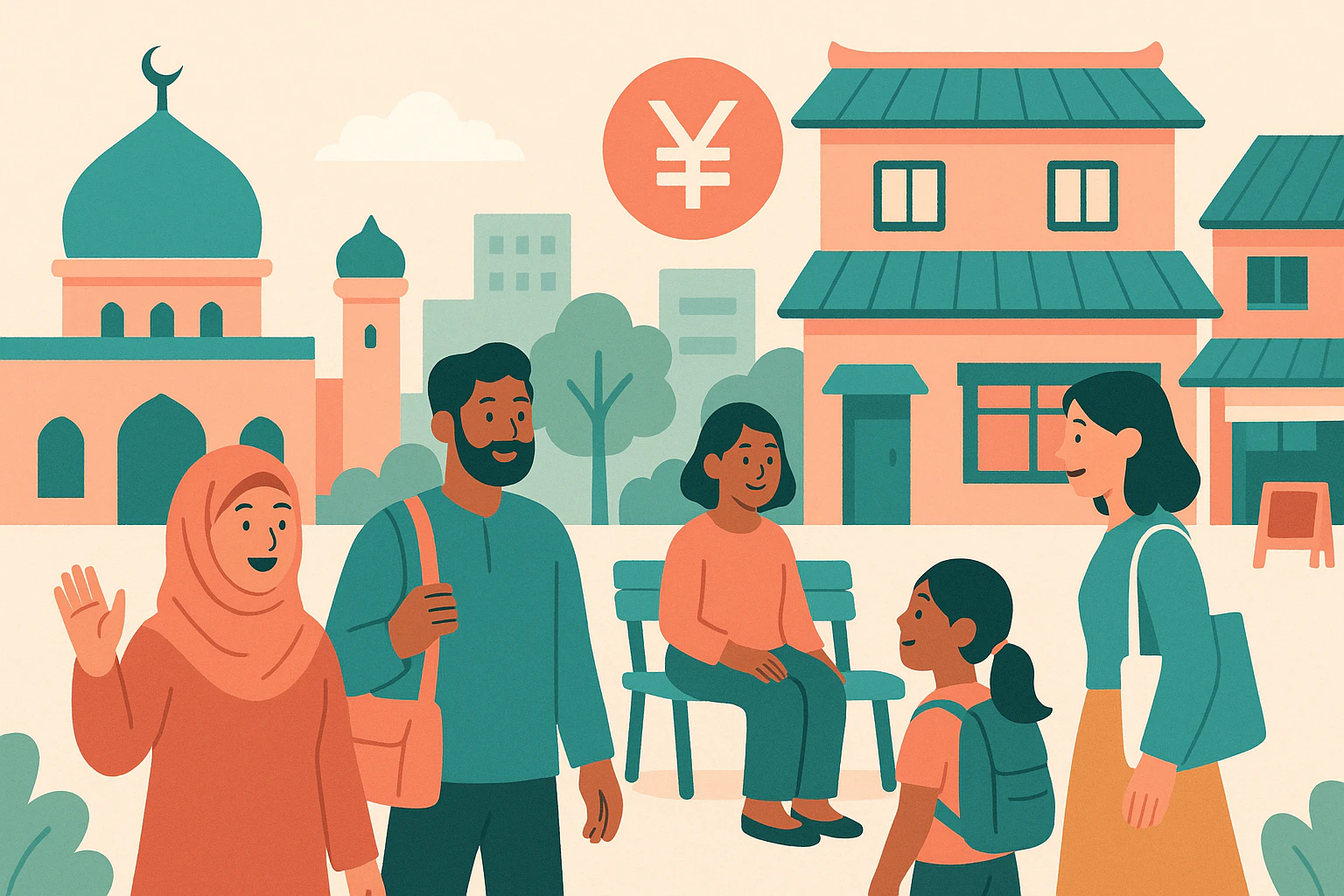
When you search for Muslim-friendly areas to live in Japan, most guides stop at halal restaurants. That helps for weekends, but daily life is different: cooking at home, finding a halal grocery store Japan residents actually use, and having a reliable mosque near me Japan option for Jumu’ah, Ramadan, or just community support.
In this guide, we’ll connect the dots between housing choices (UR/public housing/sharehouses/private rentals) and everyday halal + prayer access. You’ll also get a practical list of questions to ask landlords/agents before you sign—because the “kitchen reality” in Japan can be very different from what you’re used to.
How to use this article: First pick a city/region based on your school/job. Then pick a neighborhood by (1) halal groceries for home cooking, (2) a mosque/prayer space you can reach easily, and (3) a rental system that matches your paperwork situation (guarantor, fees, income checks).
What “Halal / Pork-Free / Muslim-Friendly” means in Japan (and what to watch for)
In Japan, you’ll see many “halal-ish” labels, but they don’t always mean the same thing. Understanding the categories (and the risks) is step one in choosing Muslim-friendly areas to live in Japan, because your neighborhood determines how often you’ll rely on convenience stores vs. trusted shops and community networks.
A very useful framing comes from Kyoto’s official Muslim visitor information, which separates categories instead of treating everything as identical. Their categories include Halal, Muslim Friendly, Muslim Welcome, and Pork-free, each with different assumptions about ingredients and alcohol flavoring. Read their definitions carefully before you “trust the label,” especially when you’re evaluating restaurants near your potential home. Kyoto’s official explanation is here.
Key watch-outs in Japan (even in “pork-free” places): alcohol-based seasonings (mirin/sake), gelatin, lard/shortening, shared fryers, and shared grills. For residents, the biggest problem is not a single meal out—it’s repeat exposure from “small ingredients” in bread, snacks, and sauces that you buy weekly.
For example, halal-friendly shopping streets and shops often exist because residents struggled to find ingredients for home cooking. In Tokyo, Nippon.com notes that Japanese-style bread commonly uses emulsifiers that can contain lard, which is one reason halal alternatives matter for daily life. See the Shin-Okubo halal shopping context here.
Label-reading tip for residents: Japan’s ingredient labels are consistent, but product packaging can change over time. Japan’s Food Labelling Standards were amended by a Cabinet Office Ordinance promulgated and effective on March 28, 2025, and some provisions related to prepared frozen foods take effect on April 1, 2026. Even if you “know” a product, keep re-checking ingredients—especially in frozen/ready-to-eat categories. A clear overview of the 2025–2026 changes is summarized by Label Bank.
Practical takeaway: in Japan, “Muslim-friendly” often means “we can accommodate you if you ask,” not “everything in the shop is halal.” That’s fine—if your neighborhood gives you enough options to ask questions, buy safe ingredients, and avoid emergency shopping when you’re tired after work.
Neighborhood rule of thumb: If you will cook at home often, prioritize (1) halal meat/ingredients access and (2) an easy route to a mosque/community. Restaurants are a bonus, not the foundation.
How to choose a halal-friendly neighborhood in Tokyo vs other regions
Tokyo has the most density of services, but other regions can be easier (cheaper, bigger apartments, calmer life) if you live near the right hubs. The best Muslim-friendly areas to live in Japan are usually not “Muslim districts”—they are transit-friendly neighborhoods that make halal groceries and mosques part of your weekly routine.
Step 1: Decide what you need within 30 minutes
Before you look at listings, decide what must be reachable within about 30 minutes door-to-door. For many residents, that short list is: (1) a halal grocery source (meat + staples), (2) a mosque or prayer space for Jumu’ah, and (3) an area where you can get rental help in English (or with support).
- Halal groceries: not just spices—look for reliable halal meat, frozen items, and everyday staples.
- Prayer access: a “mosque near me Japan” search is useful, but also check facilities (wudu area, women’s space) and whether it’s realistic on a workday.
- Rental support: areas with international communities often have agencies and support organizations used to foreign tenants.
Tokyo: two “daily life” anchors (home cooking + mosque access)
1) Shin-Okubo / Okubo (Shinjuku area): If home cooking is your priority, this is a practical base. Nippon.com describes the area around Shin-Okubo Station as Japan’s most extensive halal shopping street—often called “Islam Alley”—with multiple shops selling halal ingredients. That’s why many residents choose nearby stations on the JR Yamanote line and nearby lines, not necessarily to eat out, but to shop weekly and cook at home. Read the Shin-Okubo “Islam Alley” overview.
2) Yoyogi-Uehara / Shibuya (Tokyo Camii area): Another anchor is Tokyo Camii and its on-site halal market, which can be a “one-stop” place for groceries and community. The Tokyo Camii Halal Market lists its address as 1-19 Oyamacho, Shibuya-ku, Tokyo, about a 5-minute walk from Yoyogi-Uehara Station, with opening hours shown as 10:00–19:00 and a phone number for the market. Living along the Odakyu Line or Tokyo Metro Chiyoda Line can make regular shopping much easier. Tokyo Camii Halal Market contact/access details are here.
Tip: In Tokyo, you don’t need to live “next to” a mosque. You need a commute that makes Friday prayer and weekly grocery shopping realistic without taking half a day off.
Kansai (Osaka/Kyoto/Kobe): choose a city, then live near the mosque you’ll actually attend
Osaka (Ibaraki City): One well-documented mosque hub is Osaka Ibaraki Mosque. Their access page explains it is about a 7-minute walk from Toyokawa Monorail Station and lists the address 4-6-13, Toyokawa, Ibaraki City, Osaka with a telephone number. If you’ll attend regularly, consider living along routes that connect smoothly to the Osaka Monorail / Senri-Chuo area rather than picking an apartment only by “downtown popularity.” Osaka Ibaraki Mosque access/contact details.
Kyoto (Kamigyo-ku area): Kyoto’s mosque and prayer access are more limited than Tokyo’s, so location matters more. Kyoto’s official prayer-space page notes “Masjid Kyoto / Kyoto Mosque” near the Imperial Palace, provides a help phone number, and states the mosque/office is open Tuesday to Saturday, 12:00 to 18:00 (closed Sundays and Mondays). If you’ll rely on that facility, living near central Kyoto with easy transit to Kamigyo-ku can reduce friction. Kyoto’s official prayer-space guidance is here.
Kobe (Chuo-ku / Nakayamatedori): Kobe has a historic mosque and an established community. The official Kobe Muslim Mosque site lists its location as 2-25-14 Nakayamate-dori, Chuo-ku, Kobe City and shows walk-in visiting hours (and Friday closure for visits), which can be helpful when you’re planning community connection. Kobe Muslim Mosque access and visiting hours.
Nagoya and other regions: plan around one strong grocery source + one mosque
In mid-sized cities, you may have fewer options—so you plan differently. Community discussions show the real pattern: students and workers ask about halal access first, then get advised to plan around a specific halal grocery and consider UR housing for easier renting. In one Nagoya thread, residents recommended a specific halal grocery store and explicitly suggested UR Housing as a practical apartment option due to lower upfront costs. Example community discussion (Nagoya) highlighting halal access + UR.
Practical takeaway for smaller cities: don’t try to “optimize everything.” Choose the one grocery you trust, the mosque you’ll attend, and a train/bus route you can repeat weekly—even during bad weather or busy work seasons.
Quick decision checklist: (1) Can I buy halal meat within 30–45 minutes? (2) Can I reach Jumu’ah without using paid leave every week? (3) Is my rental plan realistic without a Japanese guarantor?
Apartment-hunting checklist: UR/public housing, guarantors, and kitchen realities
Your neighborhood choice is only half the battle—your rental pathway is the other half. Many people searching for Muslim-friendly areas to live in Japan get stuck not because the city lacks halal options, but because the rental paperwork doesn’t match their situation (guarantor, fees, documents, income proof).
Know the main rental “systems” you’ll encounter
- Private rentals: widest choice, but often need a guarantor (or a rent guarantee company), plus upfront fees.
- UR rental housing: a major option for foreigners because the process is standardized and (in many cases) simpler.
- Public housing (city/prefecture): lower rent but application windows, eligibility rules, and lotteries are common.
- Sharehouses: flexible for move-in timing, but shared-kitchen realities can be hard for strict halal needs.
UR rental housing: “UR rental housing no guarantor” in plain English
UR (Urban Renaissance Agency) can be a strong option if you don’t have a Japanese guarantor and you want predictable rules. On UR’s official “Merit/Features” page, UR highlights four core points: no key money (礼金ナシ), no brokerage fee (仲介手数料ナシ), no renewal fee (更新料ナシ), and no guarantor (保証人ナシ). It also explains that UR confirms your qualifications by checking required documents (like residence certificate and income proof), rather than requiring a personal guarantor. UR official “Merit/Features” page.
UR also operates at large scale: UR’s site describes UR rental housing as having about 700,000 units nationwide. This matters because it means you can often apply in many different neighborhoods, which helps you choose a place based on halal groceries and mosque access—not just “whatever accepts foreigners.” Example UR prefecture page showing the nationwide scale and basic fees.
Important: UR still has eligibility requirements. For example, Kyoto City International Foundation’s housing guide notes that UR renters must meet requirements and gives a simple rule of thumb used in practice: required income is at least 4 times the rent (and applications are accepted year-round). See KCIF’s explanation of UR rental housing and requirements.
Public housing: cheaper rent, but timing and eligibility can be strict
Public housing can be excellent if you qualify, but you must plan for application windows and lotteries. As a concrete example of how this works, the Kyoto City International Foundation guide explains that Kyoto City Housing accepts applications 4 times a year (April/June/September/December) and uses a public lottery due to high demand, and it lists contact details for the housing corporation. It also notes Kyoto Prefectural Housing accepts applications 6 times a year and may have rules such as “families only” eligibility. KCIF’s public housing overview (Kyoto example).
If you’re in a different prefecture, the concept is similar but the schedule and rules differ. The key is: public housing is not usually a “move next week” solution, so pair it with a realistic short-term plan (temporary apartment or sharehouse) if you’re arriving from overseas.
Use official rental guides so you don’t miss contract traps
Japan’s Ministry of Land, Infrastructure, Transport and Tourism (MLIT) publishes support information for foreign nationals looking for rental housing. It includes practical reference materials, checklists, and sample documents in multiple languages, and it also points to the “JPM living guide for foreign citizens (video)” explaining rental rules and manners in 14 languages. MLIT support page for foreign nationals renting housing.
MLIT’s page also mentions a government registration system for rent guarantee companies (created in October 2017) and provides a list of registered companies with multilingual support. That’s useful if you must rent privately and need a guarantee company rather than a personal guarantor. See the section on registered multilingual rent guarantee companies.
Kitchen realities (and what to ask before signing)
Even in Muslim-friendly areas, many apartments have compact kitchens, limited counter space, and strong-smell rules from neighbors. If halal cooking is central to your life, treat the kitchen inspection like a “religious compliance inspection,” not just a convenience check.
- Cooking equipment: Is it gas or induction? If there’s no stove, is a portable IH cooker allowed?
- Ventilation: Is there a functional range hood? Can you open windows while cooking?
- Storage and separation: Is there space to keep halal cookware separate (especially if you’re moving from a sharehouse)?
- Cleaning rules: Are there building rules about oil disposal and strong odors?
- Sharehouses: Can you request a separate shelf in the fridge/freezer? Is pork cooked in shared pans?
Questions to ask the landlord/agent (copy/paste friendly):
- “Is cooking allowed every day, and are there any odor/ventilation rules in the building?”
- “Can I use a small appliance (electric cooker / toaster oven) if the kitchen is small?”
- “Are there any rules about washing (for wudu) in the bathroom or sink?”
- “If I need a guarantee company instead of a personal guarantor, which companies are accepted?”
- “Can you confirm all upfront costs (deposit, key money, agent fee, renewal fee) in writing?”
Bottom line: The best “Muslim-friendly” apartment is the one that lets you cook reliably and reach your mosque/grocery routine without stress. Fancy interiors matter less than layout, ventilation, and contract clarity.
Daily-life setup: labels, prayer spaces, and getting help from locals
Once you move in, your success depends on systems you can repeat: label-reading, a prayer plan, and a way to get help when Japanese-only paperwork appears. This is where “Muslim-friendly areas to live in Japan” becomes real life instead of a travel checklist.
Label-reading: build a “Japan ingredients” routine
Create a habit of checking ingredients every time you buy a new product (and occasionally re-check old favorites). As noted earlier, Japan’s labeling rules have been updated in recent years, and some changes roll out over time—so packaging and ingredient disclosure can shift. Label Bank’s summary of the March 28, 2025 amendment (and April 1, 2026 provisions) is a good reminder that labels are not static.
Japanese terms many Muslim residents learn early: 豚 (buta / pork), 豚肉 (butaniku), ラード (lard), ゼラチン (gelatin), ショートニング (shortening), エキス (extract), 酒 (sake/alcohol), みりん (mirin). When in doubt, take a photo and ask someone to help you read the ingredient line.
Prayer spaces: don’t rely on guessing—use apps and databases
Searching “mosque near me Japan” on maps is a start, but many residents prefer specialized tools that also list prayer rooms (stations, malls, tourist areas) and facilities. Here are widely used options:
- Halal Navi: focuses on discovering halal places and finding mosques/prayer rooms while you’re out.
- Halal Gourmet Japan: searchable database that includes mosques/prayer spaces by area.
- HaloDish: includes restaurant/store search, prayer space location, and a label-scanning feature for checking ingredients.
- Japan Masjid Finder (via Food Diversity.today): highlights prayer spaces and facility details (useful when traveling within Japan).
Also, some organizations publish area maps (useful when family visits). Halal Media Japan’s service list mentions free “Omotenashi Map for Muslims” downloads for multiple regions (including Asakusa-Ueno, Shinjuku, Osaka, Kyoto, and more). See the Omotenashi Map listing here.
When you’re stuck: use official consultation services (Tokyo example) and community help
If you live in Tokyo and you need help with day-to-day issues (including housing/contract questions), Tokyo Metropolitan Government runs the Foreign Residents’ Advisory Center (FRAC). The FRAC page (updated January 20, 2026) states consultations are free, usually by phone, with face-to-face available by appointment, and lists phone hours and numbers by language: English (Mon–Fri 9:30–12:00 / 13:00–17:00) at 03-5320-7744, Chinese (Tue/Fri) at 03-5320-7766, and Korean (Wed) at 03-5320-7700 (closed on national holidays). FRAC official information (TMG).
Outside Tokyo, look for your city’s international association, your school’s international office, and (often the most effective) your local mosque community. The best “system” is having one place to ask small questions before they become big problems—like how to separate garbage, how to read a contract clause, or how to request a pork-free environment in a sharehouse politely.
Daily-life strategy: Keep a short list in your phone: (1) your mosque contact, (2) your halal grocery, (3) one official consultation service (like FRAC in Tokyo), and (4) one Japanese-speaking helper you can ask to read documents.
Need More Help? Ask on LO-PAL
If you want to know more about Muslim-friendly areas to live in Japan or you need specific local information (for example: “Which UR complex is closest to the halal shops?” or “Is there a prayer space near my workplace?”), ask a local Japanese person on LO-PAL.
With LO-PAL, you can post a question or request a task in multiple languages, and local Japanese helpers can respond—whether you need help calling a real estate agency, checking a supermarket label, or finding the nearest mosque/prayer room that’s actually open when you need it.
Written by

Founder, LO-PAL
Former Medical Coordinator for Foreign Patients (Ministry of Health programme) and legal affairs professional. Built LO-PAL from firsthand experience navigating life abroad.
Written with partial AI assistance
Read full bio →