Garbage Sorting App Japan (2026): English Trash Rules by City
Find your city’s official English trash rules in Japan (2026), set reminders, avoid trash-station conflicts, and get local help fast.
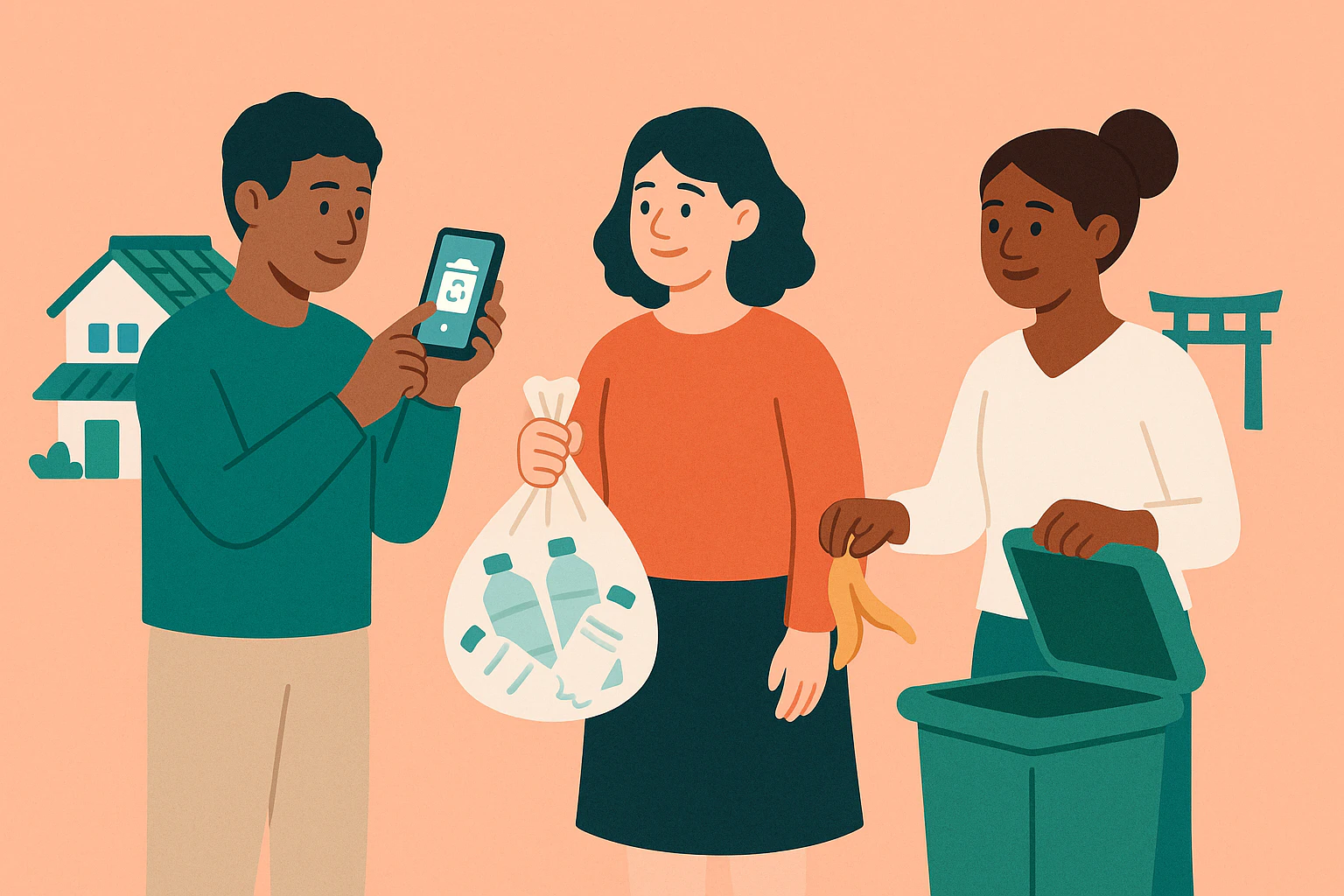
Looking for a garbage sorting app Japan that actually works in real life? The hardest part isn’t downloading an app—it’s that trash rules change by municipality, and even within the same prefecture the categories, bag types, pickup time, and trash-station etiquette can be totally different.
This 2026 guide shows you how to find your city’s official English (or multilingual) trash rules, how to set up a Japan trash pickup calendar in English, and how to avoid the kind of “trash station conflict” that can happen when a bag is rejected or left behind.
Fast checklist (works in almost every city):
1) Find your municipality’s official waste page (in English if available).
2) Download the official PDF/app and confirm your district/area calendar.
3) Turn on reminders (or make your own calendar events).
4) Learn the top “gotcha” items (spray cans, batteries, plastics, glass).
5) If you’re unsure, translate the official page and ask a local before you risk a rejected bag.
Why Trash Rules in Japan Change by City (and Why a Garbage Sorting App Japan Must Be City-Specific)
Japan’s household waste system is run at the local level, so the rules you follow in one city may be wrong just a few train stops away. Some municipalities require officially designated garbage bags, while others allow transparent bags for certain recyclables, and the exact sorting categories can be more detailed than “burnable / non-burnable.”
Even the “same” item can be treated differently depending on where you live. For example, Tsukuba City’s English guide specifies designated bags for burnable garbage and gives detailed handling for categories like PET bottles, plastic packaging, and spray cans.
Some cities also set fees via ordinance for official bags or disposal stickers, which can affect what neighbors expect you to use. As one concrete example of “local rules are real rules,” Tokai City explains that the set prices for designated bags and bulky-waste seals are treated as waste processing fees (条例で定めた「ごみ処理手数料」).
Why etiquette matters: in many neighborhoods, the “trash station” is a shared space managed by residents (sometimes with a neighborhood association/rotation). If a bag is sorted incorrectly, it may be left uncollected, and that can create smell, pests, and immediate tension.
“They just mix everything together… it doesn’t get collected. Stinks…”
The quote above is from a Japan resident describing how unsorted bags led to ongoing neighborhood stress on r/japanlife.
Another common conflict is using the wrong trash collection site. A resident reported being yelled at after months of using a location they were incorrectly told to use, and commenters warned that some people “gatekeep” stations because they’re worried about sorting mistakes. See this thread for a real example of how quickly this can escalate.
Practical etiquette that prevents problems (city rules still come first):
- Confirm your station (and your building’s rules) before your first trash day.
- Don’t put trash out too early if your area is strict (crows/cats are a big reason).
- Rinse containers when your city asks for it (common for cans and bottles).
- Flatten and tie paper/cardboard when required, rather than bagging it.
- If your bag is rejected, don’t ignore it—fix it the same day if possible.
Garbage Sorting App Japan: Find Your Municipality’s Official English Trash Guide or App (Fast Method)
If you only do one thing, do this: start from your municipality’s official site. Many cities now publish foreign-language PDFs, and some provide official apps with reminders and a sorting dictionary.
- Search using the municipality name + Japanese keywords. Copy/paste these into Google: ごみ 分別 (sorting), ごみ 収集 カレンダー (collection calendar), ごみ アプリ (waste app), 外国語 ごみ (foreign language waste).
- Look for language buttons like “English,” “Foreign language,” or a translation tool on the city site.
- Download the official PDF/app and confirm your district (some cities split calendars by neighborhood).
Real 2024–2026 examples of official multilingual support (use these as patterns):
| Municipality | Official English/multilingual resource | Why it’s useful |
|---|---|---|
| Osaka City | “ABC of Waste Disposal Rules” (foreign-language PDFs) | Nepali version added April 1, 2025; includes rules + inquiry contacts. |
| Toki City (Gifu) | San-a-ru multilingual announcement | Multilingual “San-a-ru” service started April 1, 2024 (English, Tagalog, Portuguese, Vietnamese, Chinese, Korean) with notifications. |
| Chiryu City (Aichi) | Revised waste guide for foreigners | Updated February 19, 2026 for rules changing from March 2026; English PDF available. |
| Asahikawa City (Hokkaido) | Classification Guide for Household Garbage (foreign languages) | Official English PDF + clear contact info for the Clean Center. |
| Akiota Town (Hiroshima) | English trash sorting guides + calendars | Great example of rural support via English PDFs (including 2026 calendar versions). |
| Kiryu City (Gunma) | Waste collection schedule in English | English calendar by district—useful if you need a “Japan trash pickup calendar in English.” |
| Tsukuba City (Ibaraki) | Sorting + district calendars (English PDFs) | English calendars for 2025.4–2026.3 and district-based rules like “put out by 8am.” |
When you need to call or email (examples you can copy):
- Toki City Environment Center (about the “San-a-ru” multilingual version): TEL 0572-55-3325. Source.
- Osaka City Environment Bureau (page contact): TEL 06-6630-3226. Source.
- Chiryu City (Waste Reduction Section): TEL 0566-95-0126. Source.
- Asahikawa City Clean Center: TEL 0166-36-2213 (bulky waste reception: 0166-36-5300 per the same page). Source.
- Akiota Town Sanitation Office (衛生対策室): TEL 0826-23-1120. Source.
Garbage Sorting App Japan Setup: Trash Calendar + Sorting Dictionary (and Common ‘Gotcha’ Items)
Once you have the official rules, your next job is to make them “daily-life friendly.” That means: (1) a calendar you actually check, and (2) a sorting dictionary you can search when you’re holding a confusing item.
Option A: Use your city’s official app (best if available)
Many municipalities publish official apps with a collection calendar, push notifications, and an item lookup feature. Even if the interface is in Japanese, the categories usually match your city perfectly—which is the whole point.
San-a-ru app English (where supported): Some municipalities use the waste-sorting app “さんあ~る (San-a-ru)” and offer multilingual support. For example, Toki City started a multilingual version on April 1, 2024 and notes that it can send notifications the day before or on collection day. See the official city announcement.
Another example: Koshigaya City promotes “さんあ~る” as a way to prevent missed collection with alarm notifications, and it also explains that collection calendars are divided by area. See Koshigaya’s calendar/app page.
Option B: Your city only has PDFs (make your own reminders)
If your municipality only provides a PDF (common in smaller areas), you can still build a reliable routine. Use the official PDF as your “source of truth,” then create recurring reminders in your phone calendar.
- Identify your area/district (many cities split schedules by neighborhood). Kiryu City’s English schedule, for example, tells you to select the correct calendar based on your address/district. Kiryu’s English page.
- Create recurring events for each category you put out (Burnable, PET, Plastic packaging, Cans/Bottles, Paper, etc.).
- Add a “put out by” note if your city specifies a time. Tsukuba’s English page says to put garbage out by 8am on the day of collection (and provides calendars for 2025.4–2026.3 by district). Tsukuba guide.
Option C: A standardized municipal app platform (you still must select the right city)
Some apps are adopted by many municipalities, which can make onboarding easier. For example, the official site for “ごみスケ” states that it’s introduced by 150+ municipalities and includes features like calendars and reminders (and even LINE integration). Official site.
Separately, there are broader municipal digital services aiming to add multilingual garbage guidance. A 2024 press release from Bot Express says its “GovTech Express” AI Option released multilingual support for garbage-related services such as sorting guidance, collection calendars, and reminders. Press release.
Common “gotcha” items that cause rejected bags
The fastest way to avoid trouble is to learn the items that cities treat as special cases. Your city’s official guide is the final authority, but these categories are frequent sources of mistakes.
- Spray cans / gas canisters: Tsukuba’s English guide includes steps like emptying completely and puncturing in a safe place with no chance of fire. Source.
- PET bottles vs plastic packaging: Some cities separate PET bottles (labels/lids removed) from “plastic packages and containers” with the プラ mark. Tsukuba’s English guide spells this out and even says to discard doubtful items as burnable in that city. Source.
- Glass and ceramics: Often treated as non-burnable, but the handling (wrapping, labeling, small vs large) varies.
- Batteries and small electronics: Many municipalities have drop-off points or special collection days, not regular burnable/non-burnable.
- Food waste and smell: Some areas expect you to drain liquids well and double-bag if needed.
Mini-procedure: “My bag wasn’t collected—what do I do?”
- Check for a sticker or note on the bag (often explains the mistake).
- Compare against the official calendar (wrong day is the #1 issue).
- Fix the sorting and re-bag using the correct bag type (designated vs transparent).
- If you still don’t understand, call the city (or ask your building manager/landlord). Osaka City’s waste page includes both the Environment Bureau contact and the Osaka City General Call Center hours/number on the same page. Source.
Garbage Sorting App Japan Backup Plan: Translation Workarounds + Ask a Local (LO-PAL)
If your city has no English support, don’t give up—use translation strategically and focus on getting the “decision points” correct: bag type, category, day/time, and station location.
Translation workarounds that work (even for inaka)
1) Use the city website’s built-in “Foreign language” feature if it exists. Some municipalities clearly state they use Google’s translation service and warn it may not be perfect. For example, Tonami City explains its site is translated via Google Translate and notes accuracy may vary. Tonami City translation page.
2) Use browser translation on the official Japanese page. The Ueda multicultural association (AMU) shares a practical step-by-step method for translating pages in Google Chrome (open the site, use the 3-dot menu, choose “Translate,” then choose your language). AMU’s guide.
3) If you need a non-official English directory, use it only as a pointer. One example is “Japan Garbage Disposal Encyclopedia,” which says it compiles official municipal information and shows it was last updated on January 24, 2026—but it also warns readers to confirm final details on official sites. About page.
When a map-style tool helps (but coverage varies)
If your problem is not “what category is this?” but “where do I take this?”, a disposal-location map tool can help—especially for batteries, appliances, or special recycling. A media feature on GOMI-MAP notes the service focused on the Tokyo/Kawasaki/Yokohama regions (with some additions elsewhere), which is a reminder that coverage may be metro-area heavy. Zenbird article.
Need More Help? Ask on LO-PAL
Sometimes the official rules exist, but the real issue is personal and urgent: “Which trash station is mine?”, “What does this sticker say?”, “How do I book bulky waste pickup in this neighborhood?”, or “Can someone call the sanitation center with me in Japanese?”
That’s exactly when you should use LO-PAL. We’re a matching service where foreign residents and tourists in Japan connect with local Japanese helpers—so you can post a question (Q&A) or request task help, and someone in your area can respond.
Because LO-PAL supports multiple languages (including English, Chinese, Vietnamese, Portuguese, Korean, Nepali, Tagalog, Indonesian, and Spanish), you can explain your situation clearly, share a photo of the notice/sticker, and get help interpreting what your municipality actually expects in your specific location.
Summary: The best “garbage sorting app Japan” is the one your municipality actually uses. Start official, confirm your district calendar, turn on reminders, and ask a local before a small sorting mistake turns into a trash-station conflict.
Written by

Founder, LO-PAL
Former Medical Coordinator for Foreign Patients (Ministry of Health programme) and legal affairs professional. Built LO-PAL from firsthand experience navigating life abroad.
Written with partial AI assistance
Read full bio →