Disaster Medical Preparedness in Japan: Meds, 119 & Insurance
Disaster medical preparedness in Japan: 7-day meds, 119/#7119 English help, and insurance/copay relief steps.
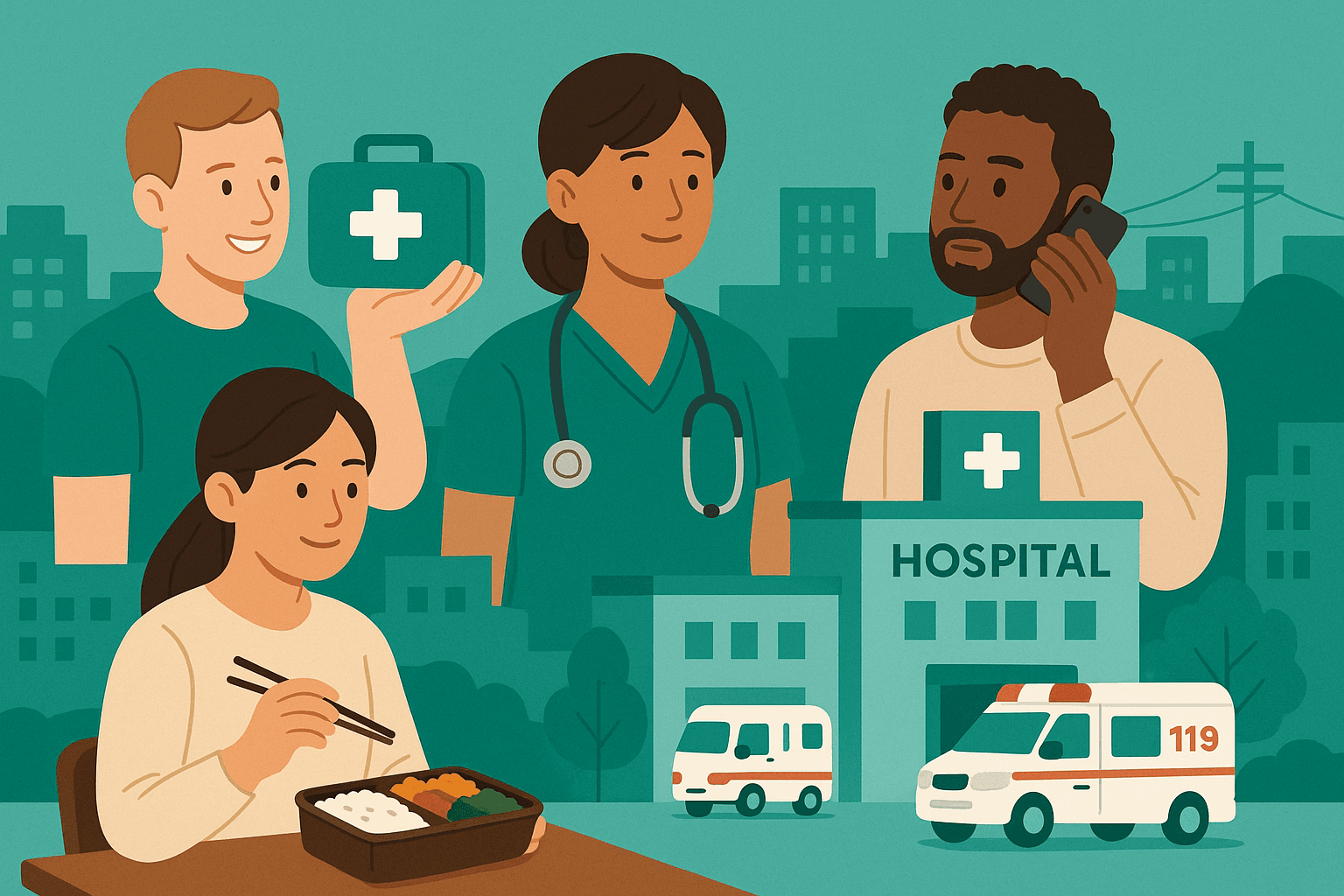
Earthquakes and typhoons in Japan don’t just disrupt trains and daily life—they disrupt medical routines. For foreign residents and travelers, disaster medical preparedness in Japan often breaks down at the exact moment you need it most: when you can’t explain symptoms, you can’t access your prescription history, and you don’t know how costs work when the usual systems are stressed.
Information access is a real pain point. In a Saitama Prefecture survey of 424 foreign residents (surveyed Oct–Dec 2024; published Feb 2025), top disaster anxieties included not being able to contact family/friends (60.8%) and worrying about getting enough information quickly (42.0%). The same report shows many people get disaster info from the internet (65.1%) and that LINE is a key channel (72.4%). (Source: Saitama Prefecture FY2024 Foreign Resident Awareness Survey Report)
Saitama survey snapshot: “Not being able to contact family/friends” (60.8%); “Worry about getting enough information quickly” (42.0%); disaster info sources include internet (65.1%); and LINE use is high (72.4%). Read the full report (PDF)
If you do nothing else: (1) keep at least 7 days of essential meds, (2) maintain a medication record (お薬手帳 or app + photos), (3) know 119 for emergencies and your region’s #7119 triage line, and (4) save links to multilingual medical forms and your insurer’s disaster rules.
Medical Go-Bag Checklist for Japan
Most “go-bag” lists focus on water, cash, and chargers. For disaster medical preparedness in Japan, your biggest risk is medication continuity and communication—especially if you’re managing chronic conditions (asthma, diabetes, hypertension, epilepsy, mental health meds, etc.).
Why “7 days” of meds? A peer-reviewed report from the 2024 Noto Peninsula Earthquake response notes that replenishing medications was difficult in the first week and that having a 7-day medication stockpile is essential. (Source: Tohoku Journal of Experimental Medicine article on the 2024 Noto response)
Core “earthquake emergency medication kit Japan” checklist
- 7+ days of prescription meds (split into: on-body carry + go-bag + home backup, if possible)
- Medication record: paper お薬手帳 (Okusuri Techō) and/or a medication notebook printout
- Medication photos: clear photos of (a) each pill bottle/box label, (b) blister packs, (c) the prescription sticker sheets pharmacies often provide
- Simple med list (printed): generic name (active ingredient), dose, schedule, prescribing clinic, pharmacy name/phone
- Spare medical devices: inhaler spacer, glucometer strips, insulin needles, EpiPen, CPAP supplies (as relevant)
- Basic first-aid: bandages, disinfectant wipes, blister care, tweezers, small scissors
- Infection & shelter health items: masks, hand sanitizer, tissues, small thermometer, oral rehydration salts
- Copies/photos of IDs: residence card/passport, and whatever you use for insurance eligibility (see insurance section below)
- Communication backup card (1 page): name, date of birth, blood type (if known), allergies, conditions, emergency contacts (Japan + abroad), your address in Japanese
Practical packing tips that matter in Japanese disasters
- Keep meds quake-safe: store breakables and liquids in a sealed pouch, inside a rigid case, inside your bag.
- Use Japanese address format: include building name + room number, because ambulances often ask for it. (Example call flow: Yokohama “Calling emergency services”)
- Cash for nights/holidays: even with insurance, after-hours fees and pharmacy payments may be needed immediately.
How to Protect Your Prescription Access in a Disaster
In a major quake or typhoon, the fastest way to lose access to care is to lose your prescription context: what you take, at what dose, and when you last received it. The goal is to make your medication information portable, readable, and verifiable.
1) Use an お薬手帳 (medication record) like it’s your “medical passport”
Japan has a widely used medication record system (commonly your お薬手帳), and disaster medicine research notes that medication records help pharmacists identify needed medicines during major disasters. The same research also highlights that during large disasters, people may be able to access necessary prescription medicines without a prescription under disaster-related exemptions—but only if the needed medicines can be identified. (Source: Cambridge Core, Disaster Medicine & Public Health Preparedness, 2023)
- Paper is still powerful: shelters run out of batteries and networks can fail. Keep at least a paper version.
- Photos are a backup: take photos of your latest pharmacy stickers and medication packaging.
- Write the “can’t miss” meds in big text: insulin, seizure meds, anticoagulants, steroids, etc.
2) Consider an electronic medication notebook + MyNa Portal linkage
Japan’s Ministry of Health, Labour and Welfare (MHLW) explains that if you use a compatible electronic お薬手帳 app, it can link with MyNa Portal (マイナポータル) so you can (with your consent) call up medication records issued by medical institutions and pharmacies. (Source: MHLW “電子版お薬手帳” page)
Disaster reality check: apps help most when you also keep your login info accessible and you have power. If you rely on an app, keep a small paper fallback in your bag.
3) Know Japan’s “4-day rule” so you don’t accidentally lose your meds
This is a common surprise for foreigners: MHLW states that prescriptions issued at insured medical institutions are valid for 4 days including the issue date (weekends/holidays count), unless a doctor/dentist writes a different period due to special circumstances like long travel. (Source: MHLW “処方箋の使用期間にご留意ください”)
- Action step: if a typhoon is coming or you expect transport issues, pick up your meds early.
- If you miss the window: you may need the clinic to re-issue a new prescription (plan ahead before storms/holidays).
4) Electronic prescriptions (e-prescriptions) can reduce “starting from zero”
MHLW describes the electronic prescription system (電子処方箋) as not only an electronic way to handle prescriptions, but also a system that lets medical institutions and pharmacies refer to recent prescribing/dispensing information and run checks like duplicate medication checks. (Source: MHLW “電子処方箋”)
Practically, this means that if you’ve been using e-prescription-enabled clinics/pharmacies, your medication history may be easier to confirm across facilities. MHLW also publishes a map/list of e-prescription-compatible facilities on the same page—use it during normal times to build a “Plan B pharmacy.” (See: MHLW electronic prescription resources and facility map updates)
5) Disaster-mode eligibility checks can help even if you lost your card
MHLW explains that in disaster-affected areas, medical institutions and pharmacies using the online eligibility system may use a “disaster-time medical information viewing function” (災害時医療情報閲覧機能). This can allow viewing of medication information, medical visit information, and health check information even when a patient does not have their My Number card with them, using identifying details such as name and date of birth. (Source: MHLW “オンライン資格確認…災害時・障害時の対応について”)
Don’t bet your life on any single system—carry your own medication information—but it’s good to know Japan has “fallback rails” when a disaster disrupts documents.
Getting Emergency Medical Help in English (119, #7119, interpreter services)
When the ground is shaking or flooding is rising, a perfect Japanese explanation is not the standard. The standard is: get connected, get triaged, and get transported if needed.
119: ambulance and fire (how to call 119 in English in Japan)
In Japan, 119 is the emergency number for fire and ambulances. Shibuya Ward’s multilingual guidance notes ambulance transport is free (treatment costs still apply) and gives simple phrases you can use. (Source: Shibuya Ward “Dial 119”)
What to say (simple script)
- Dial 119.
- Say what you need: “Kyukyu desu” (救急です / medical emergency) or “Fire” if it’s a fire. (Shibuya examples)
- Give your address in Japanese order (ward/city, area, block, building name, room number).
- Explain the situation: consciousness, breathing, bleeding, chest pain, severe allergic reaction, etc.
- Stay available: you may be called back for confirmation (some municipalities advise keeping your phone on after calling). (Shibuya guidance)
Interpreter support varies by city (examples you can copy)
In Yokohama: the city explains that even if you don’t speak Japanese, you can request an interpretation service during a 119 call via a three-way call (caller–fire department–interpreter). The listed languages are English, Chinese, Korean, Portuguese, and Spanish, and it states there is no cost to call 119 and dispatch a fire engine or ambulance. (Source: Yokohama “Calling emergency services”)
In Atsugi (Kanagawa): the city states it has introduced a multilingual interpretation system for 119 calls and on-scene communication, supports 32 languages, and provides 24/7/365 three-way simultaneous interpretation via a telephone interpretation center. (Source: Atsugi City “外国人の方からの119番通報等について”)
Important: not every municipality describes the same setup publicly, and operations can differ. If you live in Japan long-term, look up your city’s fire department multilingual page now (before the next quake) and save a screenshot offline.
#7119: nurse/doctor-led triage advice (regional differences matter)
#7119 is commonly used in many parts of Japan as a “should I go to a hospital or call an ambulance?” line, but availability and operations vary by region.
In Tokyo: the Tokyo Fire Department explains that the #7119 Emergency Consultation Center is for when you’re unsure whether to go to a hospital or call an ambulance, staffed by a consultation medical team (including doctors and nurses) and available 24/7/365. It also provides an English-capable web-based Tokyo Emergency Medical Guide (“Tokyo version emergency medical guide”). (Source: Tokyo Fire Department #7119 page)
In Kanagawa: the prefecture operates the Kanagawa Emergency Consultation Center (かながわ救急相談センター). It lists #7119 plus direct backup numbers 045-232-7119 and 045-523-7119, and notes that some callers (for example, some “042” landlines) should use the direct number instead of the # dial. (Source: Kanagawa Prefecture #7119 page)
Concrete operational-change example (Yokohama/Kanagawa): Yokohama announced that due to a Kanagawa-wide handover, #7119 and 045-232-7119 could be temporarily unreachable during specific work windows, and it provided 045-523-7119 as a backup number. (Source: Yokohama City press release, Oct 29, 2024)
In Osaka: Osaka City provides #7119 for “Kyukyu Anshin Center” and lists 06-6582-7119 as the number for phones that cannot use the # dial. (Example: Osaka City Naniwa Ward English resource list)
Two more practical resources (especially for non-Japanese speakers)
- AMDA International Medical Information Center (medical consultation by phone): the center lists its consultation phone as 03-6233-9266 (Mon–Fri 10:00–16:00). (Source: AMDA International Medical Information Center contact page)
- Tokyo: medical information for international residents: an official Hachioji City English page lists the Tokyo Metropolitan Government Medical Information Service for International Residents as 03-5285-8181. (Source: Hachioji City “Emergency Medical Service”)
Costs & Paperwork: Insurance, Copay Waivers, and Multilingual Medical Forms
In disasters, “can I pay?” becomes a medical issue. The good news is Japan has structured systems for eligibility confirmation and, in some cases, disaster-related cost relief. The hard part is that eligibility and procedures can differ by insurer and disaster declaration status.
Ambulance transport is free, but treatment costs still apply
Municipal multilingual pages commonly emphasize this: Shibuya notes there is no charge for the use of an ambulance, but you still pay medical examination/treatment fees at the hospital. (Source: Shibuya Ward “Dial 119”)
Japan disaster health insurance copayment exemption: what it is and how it’s triggered
Some insurers explicitly explain disaster-related copayment exemptions. For example, the Tokyo Securities Industry Health Insurance Society states that, based on MHLW notifications, it may waive copayments at insured medical institutions and pharmacies for people affected by large-scale disasters who meet conditions such as living in municipalities covered by the Disaster Relief Act and having qualifying damage. (Source: Shoken-Kenpo “To those affected by natural disasters”)
How to use this in real life:
- Check whether your area is under the Disaster Relief Act (your insurer may link the official list).
- Contact your insurer (company health insurance society, National Health Insurance office, etc.) and ask what disaster measures apply.
- Keep proof of damage or hardship if available (but see the Noto example below—sometimes oral declaration is enough at the window during special measures).
Example of special measures: the 2024 Noto Peninsula Earthquake “no payment at the window” guidance
During the 2024 Noto Peninsula Earthquake response, MHLW published guidance stating that affected people could receive care without paying at the medical window if they declare that they fall under certain conditions (for example, home destruction/flooding or loss of income). It also notes that no disaster certificate (罹災証明書) is required at the window and an oral declaration is acceptable. (Source: MHLW Noto guidance page)
This is an example—not a universal rule. But it shows why you should check MHLW and your insurer’s disaster pages when a major event happens.
Multilingual medical forms you can download before you need them
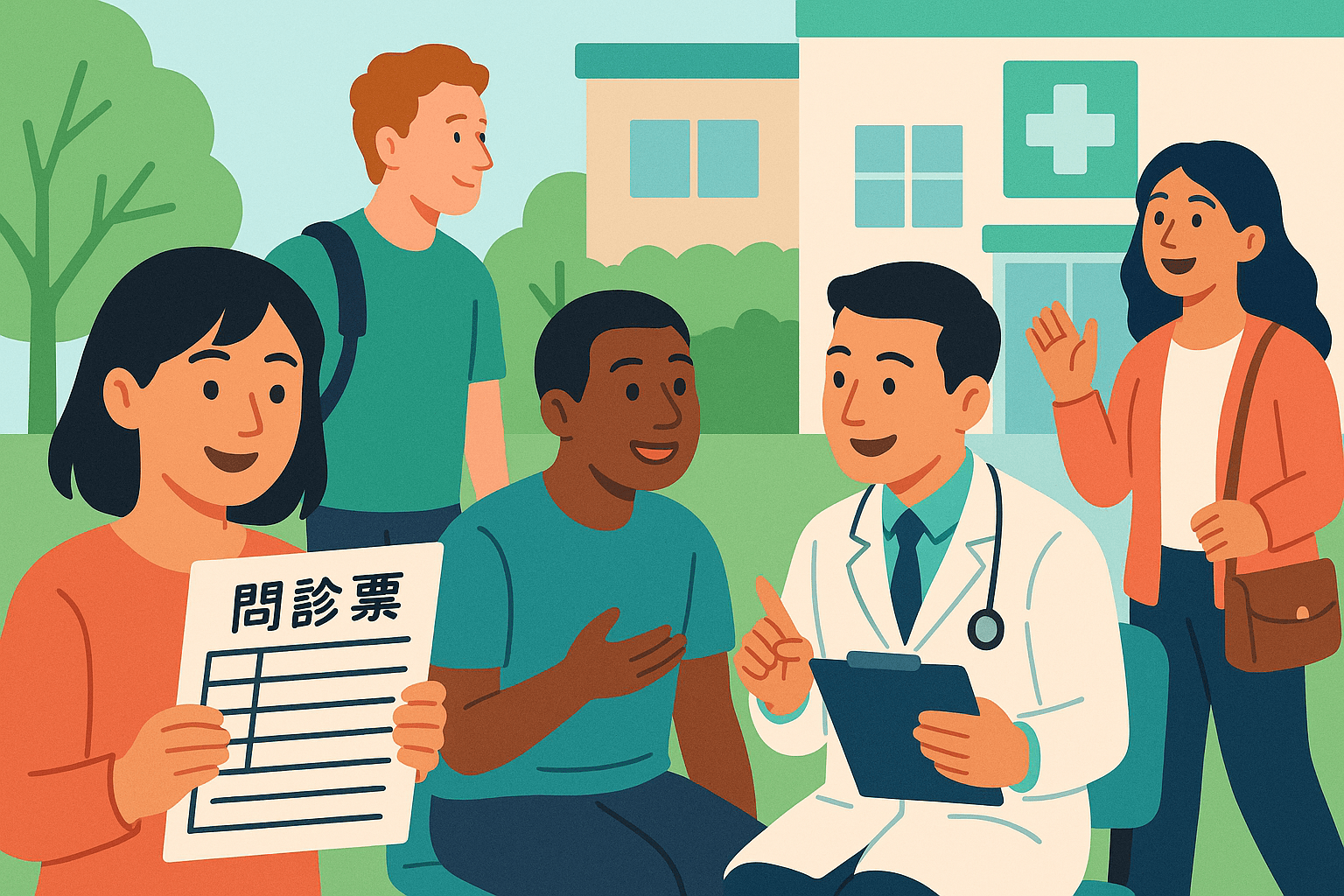
MHLW maintains an official list of downloadable multilingual patient-facing medical documents (intake, consent, testing, surgery, etc.). It also notes that additional languages (including Hindi, Indonesian, Nepali, Tagalog, Thai, and Vietnamese) were added in April 2024, and that a lifestyle-disease care plan document was added in February 2025—useful for chronic conditions. (Source: MHLW multilingual explanation materials list)
- Go-bag move: print 2–3 key forms (intake + consent + symptom explanation) and keep them in a waterproof sleeve.
- Phone move: save the link offline (or screenshot the “forms list” page title and navigation path so you can find it quickly later).
Foreign-language support during disasters can be time-limited
MHLW documented foreign-victim measures during the Noto response, including a time-limited remote medical interpretation support line in the affected prefectures. It listed a dedicated number 03-5366-6076 and the availability period Jan 10, 2024 to Mar 31, 2024. (Source: MHLW information page for foreign disaster victims, Noto)
The key lesson for foreign residents is not that this exact number will always exist—it’s that support programs can appear quickly during declared disasters and you should watch official updates from MHLW, your prefecture, and your city.
Bonus: a multilingual disaster apps/web resource leaflet (secondary, but useful)
If you want a government-curated list of disaster-time apps and websites in multiple languages, the Cabinet Office hosts a downloadable leaflet. (Source: Cabinet Office “Helpful Apps and Websites in the Event of Disaster”)
Paperwork mindset for disasters: carry your medication info yourself, know your emergency numbers, and assume rules may change when the Disaster Relief Act and special measures activate.
Need More Help? Ask on LO-PAL
Disaster medical preparedness in Japan becomes much easier when it’s neighborhood-specific. The best plan isn’t generic—it’s “Which night clinic is actually open near me?” “Which pharmacy can handle my meds?” “What are the evacuation center rules here for medical devices, privacy, and medication storage?”
That’s exactly what we built LO-PAL for. On LO-PAL, you can post a question or request a task, and local Japanese helpers in your area respond—so you can build a practical plan with local context (nearest after-hours clinic, closest pharmacy, what to say on the phone, where your ward posts updates, and what to bring to your designated evacuation site).
If you want, post something like:
- “I live near (station). What’s the nearest night clinic and which pharmacy is open late?”
- “Can you help me make a disaster medical go-bag list for my family (asthma/diabetes/etc.)?”
- “Which number should I call in this area—#7119, a city line, or something else?”
When the next quake or typhoon hits, you’ll be glad you already asked a local.
この記事のライター

LO-PAL 創業者
厚生労働省支援の外国人患者受入れ医療コーディネーター、法務の専門家。自らの海外生活経験と医療現場での知見をもとにLO-PALを設立。
※ 一部AIを使用して執筆しています
詳しいプロフィール →