Mount Fuji Cherry Blossoms 2026: Best Spots After Festival Cancelled

The all-in-one Japanese learning app
From travel phrases to real fluency — all in one app.
All 2,136 standard kanji included. Every feature is free to use.
A 2026-specific guide to Mount Fuji cherry blossoms after the Arakurayama festival cancellation—best photo spots, timing, and logistics.
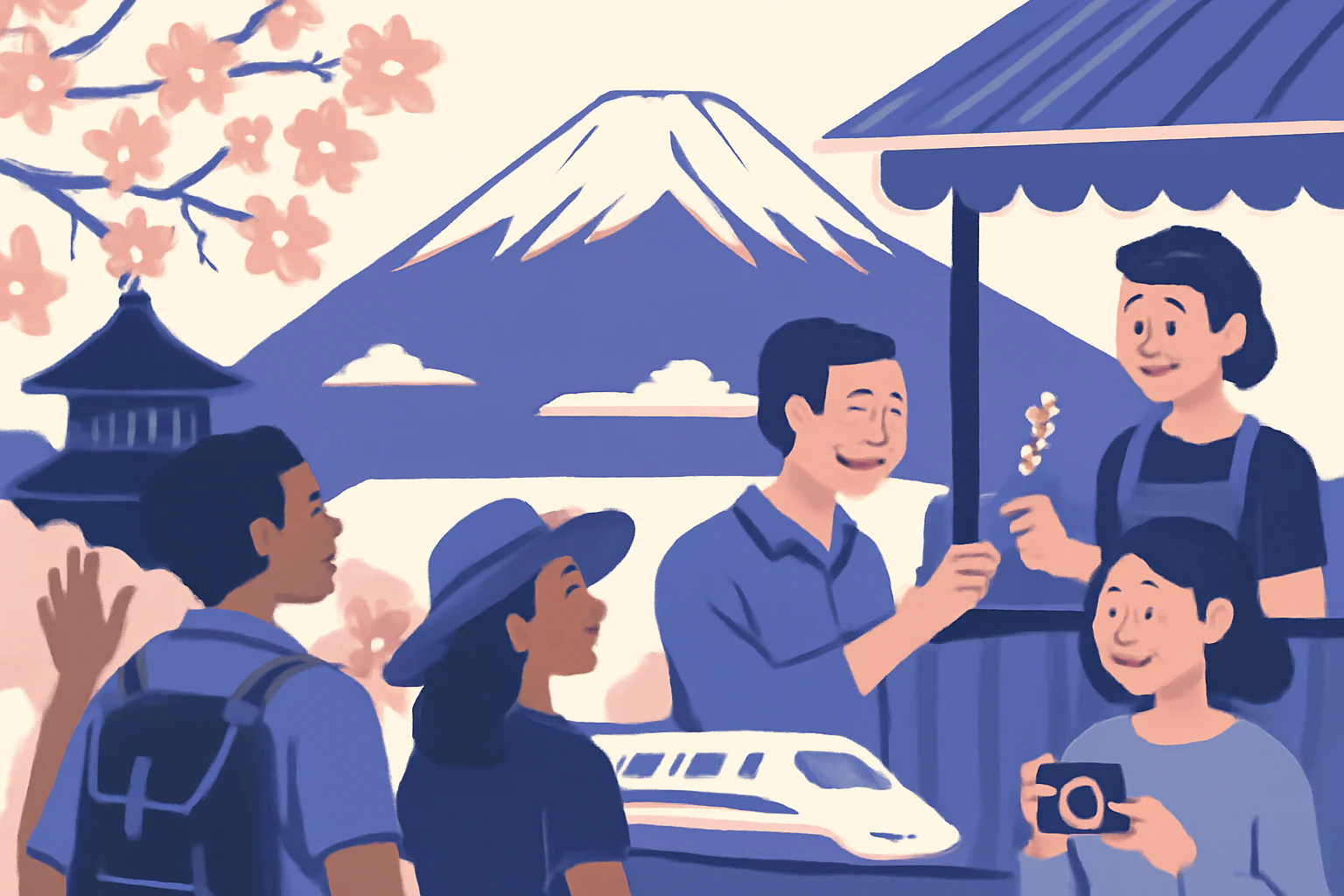
Planning Mount Fuji cherry blossoms 2026 travel and worried you’ll “miss” the iconic Chureito Pagoda shot because the festival was cancelled? Here’s the real situation: the festival is cancelled, but the viewpoint is not—and 2026 will likely feel just as busy unless you plan smarter.
This guide is a 2026-specific, news-driven playbook for foreign visitors: what the cancellation actually changes on the ground, where to go for Fuji + sakura photos with less stress, and how to handle trains, buses, peak-hour queues, and night illuminations.
If you only read one section: In 2026, treat Chureito as a “sunrise-only” photo stop (fast in, fast out), then shift your main hanami time to Lake Kawaguchiko’s north shore (official festival runs March 28–April 12, 2026) for longer, easier lakeside shooting and night lights.
What changed in 2026: Arakurayama Sengen Park festival cancellation (and what’s still open)
The headline in 2026 is clear: Fujiyoshida City cancelled the Arakurayama Sengen Park cherry blossom festival (the Chureito Pagoda area) due to overtourism and resident impact. The decision was reported as announced on February 3, 2026 by city officials, and international outlets highlighted ongoing issues like congestion, trespassing, and sanitation problems.
For background, Japan’s inbound tourism pressure has been intense: JNTO reported 42,683,600 international visitors in 2025, a record-breaking year that pushed many “viral photo spots” past their limits.
So… can you still visit Chureito Pagoda in 2026?
Yes. The cancellation is about the organized festival event (branding, official programming, and crowd-attraction structure), not the existence of the park. Multiple reports note the city still expects huge crowds and will keep safety measures in place during peak bloom.
According to a February 3, 2026 report by DC Watch (Impress), Fujiyoshida will continue safety measures, with a strengthened period from April 1–April 17, 2026, and traffic regulation continuing until April 19, 2026.
What visitors should expect at Arakurayama Sengen Park in April 2026
Even without the festival, plan for controls, detours, and “no stopping” zones. The city has been explicit that crowd management remains necessary, so your experience may feel more like an airport queue than a picnic park.
- Guards and traffic control: Expect on-site guidance, temporary toilets, and managed flows during peak days (especially weekends). Details were reported by DC Watch.
- Parking changes and closures: Fujiyoshida’s official parking notice states that Parking Lot #1 is unavailable April 1–19, 2026, and lists alternative city-run lots and fees. See Fujiyoshida City’s official parking/traffic regulation page.
- Walking is still required: You cannot drive up to the pagoda viewpoint. You should plan for a steep climb and queues.
2026 etiquette isn’t “nice to have”—it’s the point
The festival was cancelled because resident disruption became severe. In Japan, “just stepping into a yard for a photo” can cross into a legal line: Japan’s Penal Code, Article 130 covers breaking into a residence/premises or refusing to leave when demanded.
Practical rule: if it’s not clearly a public path, don’t enter. Also avoid photographing into homes, don’t block sidewalks or station exits, and carry your trash out (bins near popular viewpoints can overflow quickly in peak season).
Best Mount Fuji hanami spots (Kawaguchiko lakeside + quieter alternatives)
If your goal is “Fuji + sakura photos” rather than “one famous staircase,” the Fuji Five Lakes area gives you multiple viewpoints—and in 2026 you’ll enjoy the trip more by spreading your time across them.
1) Chureito Pagoda cherry blossoms (Arakurayama Sengen Park): still iconic, but plan it like a mission
Chureito is still the world-famous frame: five-storey pagoda + Mount Fuji + cherry blossoms. The problem is not the view—it’s the timing, because the viewing deck is small and lines can become multi-hour in peak bloom (reported by DC Watch).
- Go at sunrise (or as close as you can): You’ll get clearer Fuji visibility and dramatically fewer people.
- Know the climb: It’s famously about 398 steps to the pagoda area. Plan shoes and water.
- 24-hour access, but daylight is safest: A regional guide lists Arakurayama Sengen Park as open 24 hours with free admission (see Fujisan Prefecture’s area guide for Arakurayama Sengen Park).
2026 reality check: the festival being cancelled does not guarantee fewer crowds at the viewpoint. Assume the photo spot is still viral, and build your plan around fast entry/exit rather than “hanging out.”
2) Lake Kawaguchiko cherry blossom festival (best “low-stress” Fuji + sakura day in 2026)
If you want room to breathe, prioritize the lakeside. The official Fuji-Kawaguchiko Cherry Blossom Festival is scheduled for March 28 (Sat) to April 12 (Sun), 2026, centered on the north shore walking trail.
On the official event page from the local tourism federation, the festival hours are 10:00am–5:00pm, with cherry blossom light-up from sunset to 9:00pm (see Fuji-Kawaguchiko Sakura Festival official listing).
- Why it’s easier than Chureito: long promenade, many angles, and you can keep walking to escape clusters.
- Best photo styles: “Fuji across water,” “branches over shoreline,” and “lantern-lit blossoms” after dark.
- How to get there without a car: The official page recommends the Kawaguchiko sightseeing bus from Kawaguchiko Station (about 20 minutes) and getting off near the venue area.
If you want to confirm details by phone, an event listing for 2025 published the local contact as Fujikawaguchiko Tourism Division (weekdays 8:30–17:15): 0555-72-3168 (see event listing with contact information), while the official tourism site header lists TEL 0555-28-5177 (see the 2026 official festival page).
3) Quieter alternatives for Mount Fuji + sakura photos (less queue, more “Japan”)
When Chureito is overloaded, your best strategy is to switch to places that have space. You may not get the exact “pagoda frame,” but you’ll get a better trip—and often better photos.
- Oishi Park / lakeside areas (Kawaguchiko): Great for wide Fuji views with seasonal flowers. Use the Kawaguchiko sightseeing bus loops to move around the north shore efficiently.
- Saiko area (west of Kawaguchiko): Fewer tour groups and more nature-forward viewpoints. Pair with a bus ride on the Green Line for a calmer day.
- Oshino area: If you’re mixing “Fuji village scenery” with blossoms, build this into a half-day and return to the lake for sunset.
- “Second angle” at Chureito: If the observation deck queue is brutal, shoot from lower paths and shrine approaches instead of forcing the main platform.
2026 crowd-smart combo: Chureito at sunrise for the “postcard shot,” then Lake Kawaguchiko north shore in late afternoon + after-dark illumination for relaxed walking and night photos.
When to go: 2026 bloom timing, elevation differences, and how to check daily conditions
Cherry blossoms don’t care about your flight dates, so the most useful plan is to choose a target week, then confirm daily conditions as you get closer.
2026 forecast context: start in Tokyo, then move toward Fuji
The Japan Weather Association’s 2026 forecast (Part 1) says the earliest blooms are expected to begin in Tokyo and Fukuoka on March 21, 2026. It also explains the standard bloom definition and the full-bloom timeline used by Japan’s official observation criteria.
In the Fuji Five Lakes area (higher elevation than central Tokyo), blossoms commonly arrive later than Tokyo. For Mount Fuji cherry blossoms 2026, many travelers should plan their “Fuji + sakura” days around early to mid-April, then adjust based on live updates.
How to check day-by-day conditions (Fuji visibility + sakura progress)
In 2026, checking conditions isn’t optional—because your photo success depends on two things lining up: petals + a clear Fuji.
- Check bloom progress: Use the JWA’s sakura forecast tools via tenki.jp’s sakura forecast pages for trend updates and later-season revisions.
- Check “is Fuji visible right now?” Before you leave your hotel, open a live camera. Yamanashi Prefecture provides a Mount Fuji live camera portal with links for Fujiyoshida, Kawaguchiko, Yamanakako, and more.
- Check local festival pages for operational updates: For Kawaguchiko, the official festival page is the fastest way to confirm dates/hours and any day-of notices.
Pro tip for short trips: if Fuji is hidden in the early morning cam, don’t immediately cancel. Clouds can break briefly, and you’ll often get a “window” later—especially on breezy days.
Crowd-proof logistics: trains/buses, photo timing, night viewing, and a simple packing list
This section turns your plan into an actual day you can execute—without guessing ticket rules, showing up too late, or carrying the wrong gear up 398 steps.
Getting to the Fuji area from Tokyo (fastest rail option)
The simplest rail route for many tourists is the direct limited express FUJI EXCURSION between Shinjuku and Kawaguchiko. Fujikyu Railway publishes fares and timetables, listing (one way) ¥4,130 from Shinjuku to Kawaguchiko (adult) and noting that tickets are available from 10:00am one month prior to travel date (see Fujikyu Railway’s FUJI EXCURSION page).
If you’re booking online, JR East’s official guidance also explains that tickets can generally be purchased from 10:00 one month before boarding date (see JR East’s FAQ on ticket purchase timing).
Local transport around Kawaguchiko (best value pass for a 1–2 day visit)
Once you arrive, don’t overpay for taxis unless you need them. The most tourist-friendly option is the color-coded sightseeing buses that loop major viewpoints and museums.
Fujikyu Bus sells a common free coupon covering the Lake Kawaguchiko (Red), Saiko (Green), and Motosu/Shojiko area (Blue) loops: ¥1,500 for a 1-day pass and ¥2,000 for a 2-day pass (adult). See the official details on Fujikyu’s sightseeing bus and free-pass page.
If you want an all-in-one tourist bundle (transport plus attractions), Fujikyu also sells the foreign-traveler-only Mt. Fuji Pass (1 day ¥7,500) with wider coverage and included admissions (see Mt. Fuji Pass details).
Fujikyu Railway payment tip: IC cards work, but stations have business hours
If you use Suica/PASMO or other IC cards, Fujikyu Railway notes IC cards can be used on their trains and also on local transportation in the Fuji Five Lakes area. They also warn that if a station is closed/unmanned and your balance is insufficient, you may need fare adjustment later—so keep enough credit before heading out to rural stops (see Fujikyu Railway’s IC card guidance).
Chureito (Arakurayama Sengen Park) in April 2026: parking and traffic reality
If you’re renting a car, read this carefully: the city’s official notice says Parking Lot #1 is unavailable April 1–19, 2026. It lists alternative city parking and fees, including ¥1,000 for lots #2 and #3 and a ¥750 motorcycle-only lot (see Fujiyoshida City’s 2026 parking/traffic regulation page).
Translation into action: train-first planning is safer in peak sakura week. If you must drive, arrive early, carry cash, and expect traffic-controlled zones where cars without permits can’t pass.
Photo timing that works in 2026 (without fighting the biggest crowds)
- Sunrise to 8:00am: Best chance of clear Fuji + low crowds (ideal for Chureito).
- 10:00am to 2:00pm: Expect the heaviest tour-group density at famous decks and narrow sidewalks.
- Golden hour: Great at Lake Kawaguchiko because you can keep walking until you find space.
- Night viewing: The Kawaguchiko festival’s official light-up runs sunset to 9:00pm (see official festival details).
If you bring a tripod, use it only where it won’t block the flow. In 2026, blocking paths is one of the fastest ways to get stopped by staff—or to create exactly the resident impact that led to the cancellation.
A simple packing list for Mount Fuji cherry blossoms 2026 (what actually helps)
Spring near Fuji is often colder and windier than visitors expect, especially before sunrise. Pack for comfort so you’re not forced into a crowded café just to recover.
- Warm layers: thin down jacket or fleece + windproof shell
- Comfortable shoes: the 398-step climb is real, and paths can be damp
- Water + small snacks: lines can trap you longer than planned
- Portable battery: live cams + photos drain phones fast
- Small trash bag: don’t rely on public bins at peak time
- Cash: useful for parking fees, small shops, and rural vending machines
One-day itinerary from Tokyo (crowd-smart version)
If you only have one day, you can still do it—just don’t try to “wing it” at noon.
- Early train/bus from Tokyo to arrive around sunrise/early morning.
- Chureito first (photo mission: 60–90 minutes total including climb).
- Move to Kawaguchiko for lakeside walking and lunch.
- Late afternoon + night light-up on the north shore during the official festival window.
Need More Help? Ask on LO-PAL
If you want to know more about this topic—or you need specific, local information like “Which bus stop is closest to today’s best bloom area?” or “Are traffic controls active right now near Chureito?”—ask a local Japanese person on LO-PAL.
LO-PAL is our matching service where foreign residents and tourists in Japan connect with local Japanese helpers for quick Q&A and task support. Post your question or request in the app, and local helpers respond in multiple languages (including English, Chinese, Vietnamese, Portuguese, Korean, Nepali, Tagalog, Indonesian, and Spanish).
In sakura season, that “local check” can save your whole day—especially in 2026, when festival cancellations and crowd-control periods change the usual routines.
Written by

Founder, LO-PAL
Former Medical Coordinator for Foreign Patients (Ministry of Health programme) and legal affairs professional. Built LO-PAL from firsthand experience navigating life abroad.
Written with partial AI assistance
Read full bio →