Japan Ramen Festivals 2026: Types, Tickets & Ordering Tips

The all-in-one Japanese learning app
From travel phrases to real fluency — all in one app.
All 2,136 standard kanji included. Every feature is free to use.
Plan Tokyo & Sapporo ramen festivals with ticket-system steps, ramen types cheat sheet, budgets, and crowd-saving tips.
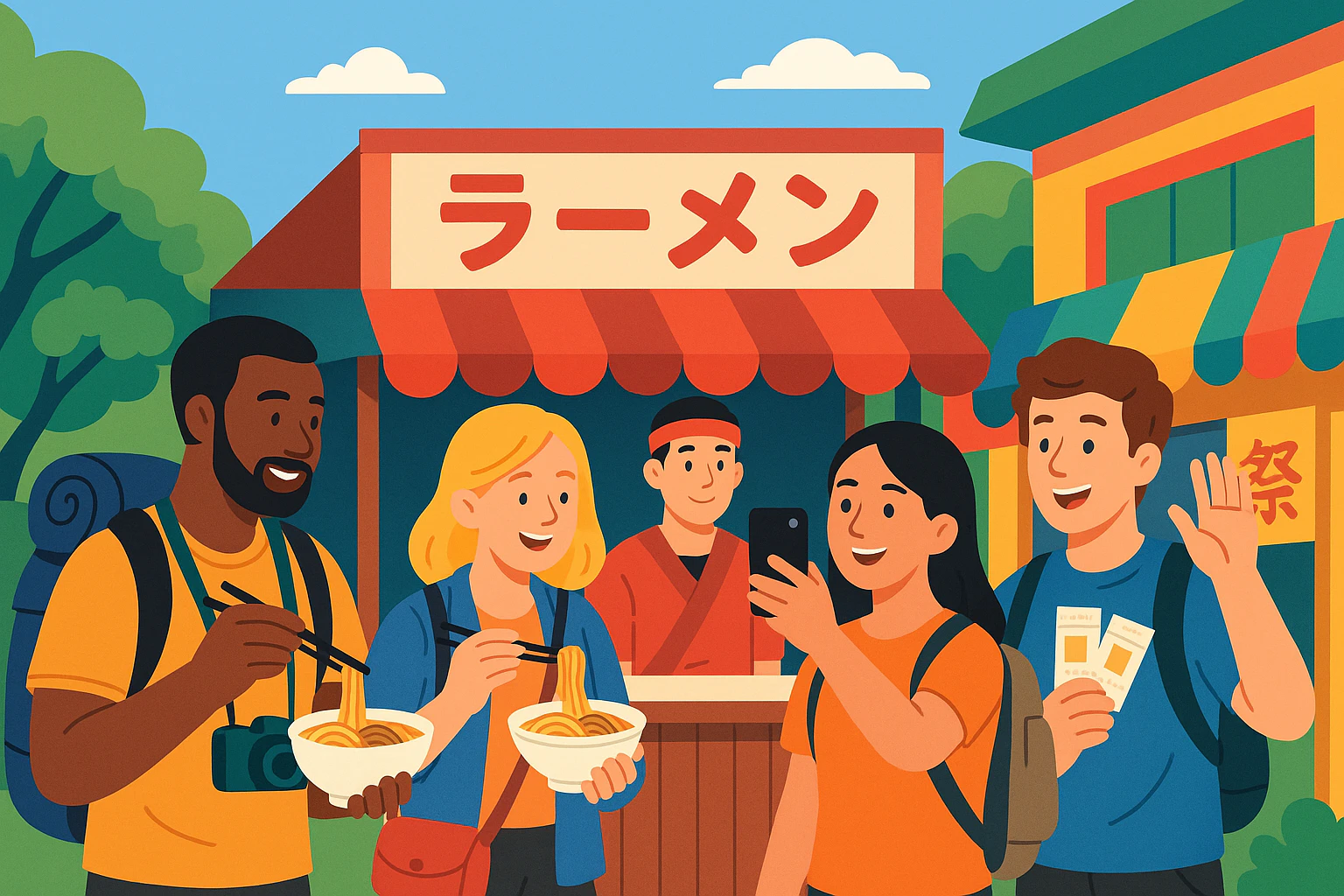
If you’re visiting Japan for the first time, chasing “the best ramen” can turn into a stressful puzzle: long lines, Japanese-only menus, and ordering systems you’ve never seen before. This guide to Japan ramen festivals 2026 gives you a tourist-proof shortcut: sample multiple respected regional styles in one place, on a clear budget, while learning the two ticket systems that confuse most visitors (festival ramen vouchers and ramen-shop meal-ticket machines).
If you remember only 3 things: (1) Many festivals and ramen events use “1 ticket = 1 bowl” vouchers, and booths often don’t sell tickets directly. (2) Many ramen restaurants use a meal ticket (食券) vending machine near the entrance, and cash is still commonly needed. (3) Bring ¥1,000 bills and coins so you don’t lose time when you’re hungry.
Why ramen festivals are the fastest way to find the ‘best ramen in Japan’
Ramen festivals aren’t about one famous shop—they’re about comparison. In a single afternoon, you can try multiple bowls from different regions, notice what you actually like (lighter shio vs rich tonkotsu, thick tsukemen noodles vs thin Hakata-style), and then use that knowledge for the rest of your trip.
Tokyo’s big autumn event is designed for sampling: the official Tokyo Ramen Festa format typically runs in multiple “acts,” with dozens of shops rotating through, and one ticket per bowl. Recent official FAQs also note that bowls are slightly smaller than regular shop portions, which is exactly what you want when you’re tasting more than one style in a day. Tokyo Ramen Festa’s FAQ (English) explains the basic rules (where to eat, ticket use, and crowd restrictions).
In Sapporo, the spring event uses a similar “rotate vendors” approach—meaning you can try ramen you’d normally need cross-country travel to find. The Japan Travel listing for Sapporo Ramen Show describes the event as split into two halves with different vendors each session, which helps you plan if you only have 1–2 free days in Hokkaido.
There’s also a bigger travel trend here: Japanese media has highlighted that hands-on and ‘experience’ food activities (including ramen-related experiences) are popular with foreign visitors. If you’re the kind of traveler who wants an “only in Japan” food memory—not just a meal—festivals and events fit the moment. See the TBS NEWS DIG video segment about experience-style gourmet popularity hosted on Yahoo! Japan.
Japan ramen guide types: shoyu, miso, shio, tonkotsu, and tsukemen (in 5 minutes)
You don’t need a ramen dictionary to enjoy festivals. You just need a fast “base flavor” map, then you can experiment with toppings (egg, chashu, butter, corn, spicy paste) without getting lost.
Shoyu (soy sauce) ramen
What it tastes like: savory, aromatic, often “classic” and balanced. Shoyu can range from light and clean to deep and smoky depending on the tare (seasoning sauce) and broth base (chicken, seafood, pork).
Pick this if: you want an easy first bowl that won’t overwhelm you, especially if you plan to eat multiple bowls the same day.
Miso ramen
What it tastes like: rich, bold, slightly sweet/salty, often hearty. In Hokkaido (especially Sapporo), miso ramen frequently leans warming and filling—great in cooler weather.
Pick this if: you’re visiting in autumn/winter or you like strong flavors and thicker soup.
Shio (salt) ramen
What it tastes like: lighter, clearer, sometimes seafood-forward. “Salt” doesn’t mean “super salty”—it often means a cleaner broth where ingredients stand out.
Pick this if: you want something lighter between heavier bowls (like tonkotsu or miso).
Tonkotsu (pork bone) ramen
What it tastes like: creamy, meaty, often rich. Tonkotsu is famous for its body and aroma, and it’s a must-try for many first-timers. MATCHA’s ramen guide describes tonkotsu as a hearty broth made by boiling down pork bones, and notes that its smell is stronger than other varieties. MATCHA’s ramen guide is a good quick reference for visitors.
Pick this if: you want the “iconic” rich bowl. If you’re doing multiple bowls at a festival, consider splitting one tonkotsu between two people and saving room for something lighter.
Tsukemen (dipping noodles)
What it is: noodles and soup served separately—dip each bite of noodles into a thick, concentrated broth. MATCHA explains that tsukemen noodles are typically boiled, then chilled, and served apart from the soup, and recommends dipping only bite-sized amounts so the soup doesn’t cool too quickly. MATCHA’s tsukemen guide breaks down the “why” and “how” in a very tourist-friendly way.
Smooth finish tip (soup-wari / スープ割り): after you finish the noodles, many tsukemen shops will add hot dashi to your remaining dipping broth so you can drink it. MATCHA notes you can ask staff for “soup wari kudasai.” See MATCHA’s explanation of soup-wari.
Fast festival strategy: Start with a lighter bowl (shio or shoyu) → then go rich (miso or tonkotsu) → then do tsukemen last if you want a texture finale.
If you want a simple gift idea after you’ve found your favorite style, we also have a practical guide to ramen souvenirs and what to buy in Japan.
How to order ramen in Japan: festival tickets vs ramen shop ticket machines
Most tourist confusion comes from mixing up two different systems: (A) event voucher tickets at festivals and (B) meal-ticket vending machines at many ramen shops. Once you know which one you’re dealing with, everything gets easier.
A) Festival system: buy a ramen voucher first, then choose your booth
At major events, it’s common that you do not pay at the booth. You buy a ramen ticket (voucher) at a central ticket area, then line up at the stall you want and hand over the ticket.
For Tokyo Ramen Festa, the official ticket page states: entry is free, and you need a ramen meal ticket at ¥1,100 per bowl. It also notes that booths do not sell tickets, and same-day tickets are sold at the venue’s ticket booth until the evening cutoff. See the official Tokyo Ramen Festa ticket instructions.
One more practical detail that matters for budgeting: the official information also says toppings are purchased in cash at each ramen booth. So even if the event ticket counter supports cashless payment, keep cash ready for extras. The same ticket page spells this out clearly.
B) Ramen shop system: the “ticket machine ramen restaurant” flow (食券)
Outside festivals, many ramen shops use a meal ticket (食券 / shokken) system. A Japanese consumer hotline page for inbound tourists explains the basic rule: in many ramen restaurants, you buy a meal ticket from a vending machine near the entrance and hand it to staff, and these machines often cannot take credit cards or electronic money—so it’s smart to prepare cash. It also advises tourists to ask staff if they don’t know how to use it. Read the consumer hotline’s guidance.
A newer usability trend is that more machines now offer language switching and sometimes IC-card payment. A step-by-step guide from Makimono Manners notes that many ticket machines now support multiple languages (look for a “Language” button), and that some accept IC cards like Suica/PASMO, though cash is still common—so you should carry ¥1,000 bills and coins. See the ticket machine guide.
Travel media also regularly flags this as a “Tokyo first-timer” issue: Condé Nast Traveler’s Tokyo tips mention that ramen shops typically use ticket machines for ordering, and that carrying cash is still important in Japan. See Condé Nast Traveler’s Tokyo tips.
Exactly what to do at a shop ticket machine (tourist-proof steps)
- Before you sit down: look for the machine near the entrance (sometimes outside).
- Scan for English or pictures: check for a “Language” button or photo buttons. If you see prices like “¥900 / ¥1,200,” you’re in the right place.
- Insert money (usually): many machines require cash first. Start with a ¥1,000 bill.
- Pick one base bowl: choose your ramen first, then add-ons (egg, extra chashu, rice).
- Take your tickets + change: you may get 1–2 paper slips.
- Hand tickets to staff: give them the ticket(s). If there’s a question about noodle firmness or richness, you can say “futsuu (normal)” if you’re unsure.
Not sure about your specific case? Ask a local Japanese person on LO-PAL for personalised advice—especially if you’re trying to confirm whether a specific shop is cash-only or how to use a particular ticket machine screen.
Useful “rescue” phrases (even if you don’t read Japanese)
- Sumimasen (excuse me / sorry): a polite opener before any question.
- Kore onegaishimasu (“This one, please”): point to the button or menu photo.
- Shokken wa doko desu ka? (食券はどこですか? / “Where is the meal ticket?”): if you don’t see the machine.
FAQ: ticket mistakes that happen to almost everyone
Q: What if I buy the wrong ticket at a ramen shop?
A: Don’t panic—show the ticket to staff and say “sumimasen.” Many shops will help you adjust, but policies vary, so it’s best to ask before you sit down.
Q: Are ramen shop ticket machines always cash-only?
A: No. Some accept IC cards or cards, and more machines have language options, but cash is still commonly needed—especially at smaller shops. The consumer hotline guidance specifically warns tourists that machines often cannot use cards/e-money.
Q: Is there a place to call if I have a serious consumer problem as a visitor?
A: Japan has an inbound tourist consumer hotline. The ramen ticket-machine guidance page lists the phone number 03-5449-0906, available on weekdays 10:00–12:00 and 13:00–16:00, with support in multiple languages. See details on the hotline page.
2026 ramen festival calendar (Tokyo/Sapporo) + what to bring, costs, and crowd tips
Below is a practical calendar view for short-term visitors. Because some 2026 details may be finalized closer to each event, use the links to confirm the latest updates before you go—especially if you’re scheduling flights and hotels.
Tokyo (autumn): Tokyo Ramen Festa at Komazawa Olympic Park
When (listed): Late October to early November 2026. A widely used event listing shows a 3-session structure across Oct 23–Nov 3, 2026 (sessions Oct 23–26, Oct 27–30, Oct 31–Nov 3). See the Tokyo Ramen Festa 2026 listing.
Where: Komazawa Olympic Park Central Plaza (Setagaya, Tokyo). Official event overviews list the venue as Komazawa Olympic Park Central Plaza with the park address in Setagaya. See the official event overview format (venue/address).
Typical hours (based on official info from the most recent published event format): Many days run 10:30–20:30, with some act opening days starting at 12:00 and the final day closing earlier. The Tokyo official travel guide (GO TOKYO) shows the standard hour structure used recently.
Tickets & cost: Entry free; ¥1,100 per bowl via ramen ticket (voucher). The official ticket page also notes same-day ticket sales cutoffs and that toppings are cash at booths. See ticket purchase details.
Getting there (simple route): GO TOKYO lists Komazawa-Daigaku Station (Tokyu Den-en-toshi Line) as a common access point, with a walk to the park. See the access section on GO TOKYO.
Crowd rules to know: The official FAQ warns that entry can be restricted when crowded, and ticket sales may be temporarily restricted depending on conditions. See crowd/entry restriction notes.
Tokyo budget (per person): 2 bowls = about ¥2,200 in ramen tickets, plus ¥0–¥600 for toppings depending on what you add, plus drinks. If you’re traveling with a friend, consider splitting 3–4 different bowls so you taste more styles without over-ordering.
Sapporo (spring): Sapporo Ramen Show at Odori Park (Nishi 8-chome)
When (expected): Mid to late May 2026. Japan Travel’s listing describes the timing as mid–late May and notes the event is typically split into two parts with different vendors.
Where: The official site for the latest completed event format places it at Odori Park, West 8-chome (札幌大通公園西8丁目). See the official Sapporo Ramen Show site.
Typical hours (based on official info): 10:00–21:00 with last order around 20:30, rain or shine. The official site shows the standard time block used recently.
Ticket price (recent reference): Local coverage for the 2025 event notes a ticket system with bowls priced at ¥1,000, which is useful for setting expectations for your 2026 budget. See STV’s local write-up mentioning the ¥1,000 ticket price.
Getting there: The official site lists walking access from Odori Station Exit 1 (about 5 minutes) and Nishi 11-chome Station Exit 4 (about 3 minutes), plus a walk from JR Sapporo Station (about 20 minutes). See access details.
Contact (helpful if you’re unsure the dates are finalized yet): The official site lists an event office phone number 090-3893-3924 (weekdays 10:00–17:00) and email info@ramen-kyokai.jp. See the contact section.
Sapporo budget (per person): Plan roughly ¥2,000–¥3,000 if you want 2 bowls plus a drink/snack. Odori Park events are easy to combine with nearby sightseeing, so you can do this in a half-day without changing hotels.
Bonus comparison (Osaka, winter): Ramen Expo ticket habits
If you’re traveling through Kansai later in the year, Osaka’s recurring winter event is a good “ticket-system practice run.” Time Out’s listing notes that ramen purchases are made through special tickets available online in advance or on-site, and that on-site ticket purchase is cash only. See the Time Out Osaka listing.
What to bring (so you don’t waste time in lines)
- Cash: ¥1,000 bills + coins for toppings and older ticket machines (even if you use cards elsewhere). The consumer hotline explicitly warns many ticket machines don’t accept cards/e-money. See the guidance.
- An IC card (Suica/PASMO): helpful for transport and sometimes payments. If you’re deciding which one to use as a short-term visitor, read Suica vs PASMO for tourists (2026).
- Tissues/wet wipes + a small hand towel: outdoor seating + broth splashes happen.
- A small trash bag: festival bins exist, but having a backup keeps you moving.
- Allergy prep (if relevant): ramen often contains wheat, egg, soy, fish, and pork, and cross-contact can happen at events. Bring an allergy card and read our food allergy travel guide for Japan (2026) before you go.
Crowd tips that save you 30–90 minutes
- Go at “off meal” times: mid-afternoon is often calmer than lunch/dinner peaks.
- Buy tickets before you queue: for Tokyo Ramen Festa, tickets aren’t sold at booths and have daily sales cutoffs. Confirm ticket rules here.
- Split bowls: festivals are about variety; splitting helps you taste more styles without burning your budget.
- Expect rain plans: major events often run rain or shine, but severe weather can change hours—official sites post updates. Tokyo’s FAQ explains the rain policy and where cancellations are announced.
Related Articles
- Best ramen souvenirs in Japan and how to order like a local
- Suica vs PASMO for tourists (2026): tap-to-pay food + transit
- Food allergy travel Japan (2026): allergy card + safer eating
Need More Help? Ask on LO-PAL
If you want up-to-date, on-the-ground confirmation (for example: “Are Tokyo Ramen Festa tickets already on sale?” “Which exit should I use at Odori Station?” “Is this ramen shop’s ticket machine cash-only?”), we built LO-PAL to connect tourists and foreign visitors with local Japanese helpers.
Post a question or request in the app, and people in the community can respond in multiple languages (including English, Chinese, Vietnamese, Portuguese, Korean, Nepali, Tagalog, Indonesian, and Spanish). It’s the fastest way to turn “I’m not sure” into a clear next step—before you’re standing hungry in front of a ticket machine.
Written by

Founder, LO-PAL
Former Medical Coordinator for Foreign Patients (Ministry of Health programme) and legal affairs professional. Built LO-PAL from firsthand experience navigating life abroad.
Written with partial AI assistance
Read full bio →