Osaka Street Food by Subway: Dotonbori to Shinsekai Day Trip

The all-in-one Japanese learning app
From travel phrases to real fluency — all in one app.
All 2,136 standard kanji included. Every feature is free to use.
A station-exit Osaka food crawl plan—Umeda to Dotonbori, Kuromon and Shinsekai—with pass tips and etiquette.
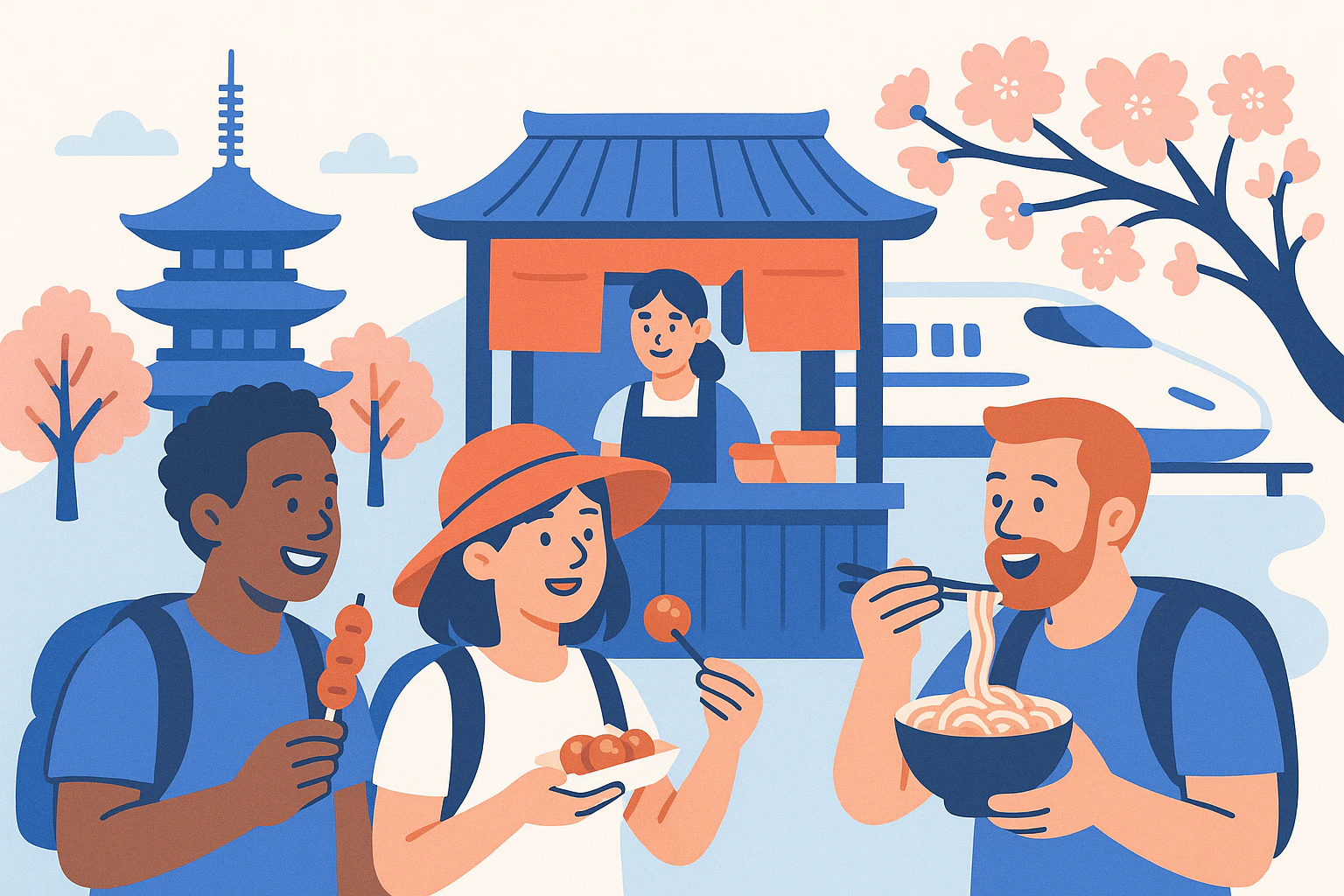
Osaka is built for tabe-aruki (food-hopping), but the transport part can ruin the fun: Namba’s underground corridors feel like a maze, station exits look similar, and it’s easy to buy the wrong pass for the day you’re planning.
In this guide, we’ll do Osaka street food by subway the practical way: a step-by-step, station-exit-level route that starts from today’s newest food hub around Osaka Station (Umeda), then takes you through Osaka Castle → Dotonbori street food → Kuromon Market access → Shinsekai with minimal backtracking.
Today’s plan in one line: Umeda (new food hotspots) → Tanimachi 4-chome (Osaka Castle walk) → Namba (Exit 14/15B for Dotonbori) → Nipponbashi (Exit 10 for Kuromon) → Ebisucho (Exit 3 for Shinsekai/Tsutenkaku) → back to Umeda.
Pick the Right Transport Pass for Osaka street food by subway (Eco Card vs Amazing Pass vs IC)
Before you touch a ticket machine, decide what you’re optimizing for: cheapest rides, attractions included, or maximum flexibility. Osaka has multiple pass brands, and not all of them cover the same trains or buses.
Option A: Osaka Metro 1-day pass (Enjoy Eco Card) = best for a pure “subway + market” day
The Osaka 1-Day Pass “Enjoy Eco Card” is unlimited rides for one day on all Osaka Metro lines (excluding Yumeshima Station) plus Osaka City Bus (with some route exclusions). The adult price is ¥820 on weekdays and ¥620 on Saturdays/Sundays/holidays. (subway-tr.osakametro.co.jp)
What it does NOT cover: it can’t be used on private railways (even if they run through to the subway), and the bus coverage excludes specific routes like buses bound for Universal Studios Japan and some others listed by Osaka City Bus rules. (subway-tr.osakametro.co.jp)
How to buy and use it: purchase it at a subway station ticket vending machine (or other listed sales points). On the day you use it, insert it into the ticket gate; the date prints when you first insert it, and that’s your valid day. Osaka Metro also notes a refund is possible only if unused, with a handling fee. (subway-tr.osakametro.co.jp)
If you’re following this exact “Osaka street food by subway” route and you’re not planning to enter multiple paid attractions, this is usually the easiest value pick. You can confirm details on the official Osaka Metro page for the Osaka 1-Day Pass (Enjoy Eco Card). (subway-tr.osakametro.co.jp)
Option B: Osaka Amazing Pass = best when you’ll use the included attractions
The official positioning of the Osaka Amazing Pass is: unlimited rides plus entry to approximately 40 sightseeing spots. The listed price is ¥3,500 (1-day) and ¥5,000 (2-day). (osaka-amazing-pass.com)
This pass is worth considering if you’re turning your food day into a food + views day (for example: Tsutenkaku observation deck, cruises, museums). It’s also time-sensitive: the official site posts closure/maintenance notices that can change your “value math.” For example, the HEP FIVE Ferris Wheel is listed as closed for renovation from October 14, 2025 to late April 2026—important if you’re in Umeda in early 2026. (osaka-amazing-pass.com)
One more detail tourists often miss: the official info states the digital ticket’s “one day” runs from 3:00 a.m. to 2:59 a.m. the following day. If you plan a late-night Shinsekai finish, this definition matters. (osaka-amazing-pass.com)
To avoid surprises, check the official Osaka Amazing Pass site’s news section on the morning you go. (osaka-amazing-pass.com)
Option C: IC card (ICOCA/Suica/etc.) = simplest if you don’t want “pass rules”
If you’re only in Osaka for a few days and you hate thinking about coverage areas, use a rechargeable IC card. Osaka Metro explains that IC cards can be used on Osaka Metro and Osaka City Bus (with some bus exclusions), and you simply tap at gates/readers. (subway.osakametro.co.jp)
For many visitors in Kansai, ICOCA is the common choice. JR-West notes you can buy ICOCA at ticket machines/ticket offices in the ICOCA area, and a ¥500 deposit is included (refunded when you return the card). (westjr.co.jp)
Quick rule: if you’ll ride a lot in one day (and stay within Osaka Metro/City Bus), choose the Eco Card; if you’ll enter multiple included attractions, choose Amazing Pass; if you want maximum flexibility across different operators, use an IC card.
Start in Umeda/Osaka Station: New Food Hotspots + Easy Metro Entry
Umeda (around JR Osaka Station) used to be “just transport.” Now it’s also a legit first stop for food—and a smarter place to begin your day before diving into Minami (Namba/Dotonbori).
What’s newly trending right now: Grand Green Osaka + Time Out Market Osaka
The Grand Green Osaka redevelopment is a major new draw in the Osaka Station area, and its South Building is set for a grand opening date of March 21, 2025. One headline tenant is Time Out Market Osaka, described in announcements as Time Out Market’s first location in Asia. (prnewswire.com)
Time Out Market Osaka lists its location in Grand Green Osaka South Building B1F and states opening hours as daily from 11am to 11pm (last orders 10:30pm). (timeout.com)
Money tip: the Time Out Market Osaka FAQ says it is cashless and also notes there are no ATMs on site. If you’re planning to load up on cash later for markets, do it before you arrive (or keep a backup card). (timeout.com)
Umeda navigation made easier: the Umekita Underground Exit + airport access
If you’ve heard “Osaka Station is confusing,” that reputation is fading. A redevelopment overview notes Osaka Station opened a new Umekita Underground Exit and passageway, and also states travelers can ride the Haruka Express from Osaka Station to Kansai International Airport without a transfer. (mitsubishi.com)
How to enter Osaka Metro quickly from JR Osaka Station (without getting swallowed by malls)
For this itinerary, you’ll most often use either Osaka Metro Midosuji Line (Umeda Station) or Osaka Metro Tanimachi Line (Higashi-Umeda Station). A practical Umeda-area guide notes that from JR Osaka Station you can follow the red Midosuji Line signs down to Umeda Station, and for Higashi-Umeda you can look for purple Tanimachi Line signs in the Whity underground area. (osakastation.com)
If you want a concrete landmark, Osaka Metro’s own station guide for Umeda (M16) lists exits and nearby connections (including JR Osaka Station areas), which helps if you need to “reset” by heading to a numbered exit. (subway.osakametro.co.jp)
Suggested start time: Arrive in Umeda around 10:30–11:00, grab your first bites at Time Out Market Osaka (opens 11:00), then head to Osaka Castle before the afternoon crowds build in Namba.
The Subway-Based Food Walk Route for Osaka street food by subway: Osaka Castle → Dotonbori → Kuromon → Shinsekai
This route is designed to keep transfers simple and exits obvious. It also “ramps up” the food: lighter snacks first, heavier fried foods later, and photogenic neon at the end.
Stop 1: Umeda → Osaka Castle (Tanimachi 4-chome, Exit 1-B)
Goal: start with a classic Osaka landmark so your day isn’t only eating. From Umeda, your simplest subway-first approach is to get to Higashi-Umeda (Tanimachi Line), ride south, then get off at Tanimachi 4-chome.
For the walk, a major on-site facility at Osaka Castle (MIRAIZA OSAKA-JO) lists that it’s about a 15-minute walk from Exit 1-B of Tanimachi 4-chome Station (among other stations/exits). Use Exit 1-B if you want the most “followable” instruction for your map app. (en.miraiza.jp)
Time + cost planning: Japan guide lists the castle tower hours as 9:00 to 17:00 (entry until 16:30), closed December 28 to January 1, with admission shown as ¥1,200. If you only want photos, the park grounds are free and can be done quickly. (japan-guide.com)
Stop 2: Osaka Castle → Dotonbori street food (Namba Station, Exits 14 / 15B)
Subway move: return to Tanimachi 4-chome Station, then ride toward Namba (your route app may suggest a transfer at Honmachi depending on lines and timing). If you’re unsure, use the official Osaka Metro Route Search to confirm the simplest transfer for that moment. (kensaku.osakametro.co.jp)
Exit-level win: for the classic Glico sign / Ebisu-bashi area, a photo-guide notes the nearest station is Osaka Metro Midosuji Line Namba, and highlights Exit 14 and Exit 15B as the closest exits. If you feel lost inside Namba, this is your “anchor” instruction: get to Midosuji Line Namba first, then aim for Exit 14 or 15B. (we-love-osaka-en.com)
What to eat here: Dotonbori street food is where you hit the Osaka classics—takoyaki, okonomiyaki, grilled seafood, and over-the-top dessert stands. Most places are pay-at-counter, and the busiest queues build after dark; if you want shorter waits, aim for mid-afternoon.
Stop 3: Dotonbori → Kuromon Market access (Nipponbashi Station, Exit 10)
You can walk to Kuromon from Dotonbori, but the fastest low-stress method is one quick subway hop. From Namba area stations, go to Nipponbashi Station.
A practical guide on Osaka.com states Kuromon Market is about a 5-minute walk from Nipponbashi Station Exit 10. That’s the exit number most tourists should memorize for “Kuromon Market access.” (osaka.com)
Hours: Kuromon Market’s hours vary by store; Japan guide summarizes it as typically 8:00 to 18:00, and notes many stores close on Sundays and national holidays (varies). This is why Kuromon is best as a daytime stop, not your last stop. (japan-guide.com)
What to eat here: prioritize a “one-bite” circuit—fresh fruit, grilled scallops, sushi bites, wagyu skewers—then do a second loop only if you still have room. If you want to slow down, some information centers/rest areas in the area can be a good place to sit before you move on. (osakastation.com)
Stop 4: Kuromon → Shinsekai (Ebisucho Station, Exit 3) for kushikatsu + Tsutenkaku
Subway move: from Nipponbashi Station, take the Sakaisuji Line to Ebisucho. Then walk into Shinsekai’s retro streets.
Osaka Metro’s sightseeing media notes Tsutenkaku Tower is about a 4-minute walk from Ebisucho Station Exit No. 3. This is the cleanest exit instruction for Shinsekai when you want to avoid wandering. (metronine.osaka)
Tsutenkaku logistics: Japan guide lists Tsutenkaku Tower hours as 10:00 to 20:00 (entry until 19:30) and an observation deck admission price of ¥1,200. If you want sunset views, time your arrival for late afternoon. (japan-guide.com)
What to eat here: Shinsekai is kushikatsu territory (deep-fried skewers). Most kushikatsu shops are casual, order-as-you-go, and can be crowded at night—consider an early dinner here, then a second round of drinks/dessert back in Namba or Umeda if you still have energy.
How to get back to Umeda after Shinsekai (easy “one-line” return)
To finish your Osaka street food by subway day without complicated transfers, head to Dobutsuen-mae Station and take the Midosuji Line north straight back to Umeda. Japan guide lists Shinsekai as walkable from Dobutsuen-mae, and the Midosuji Line is the simplest north-south spine for tourists. (japan-guide.com)
Budget per person (typical): Eco Card ¥620–¥820 + Osaka Castle ¥1,200 + Tsutenkaku ¥1,200 + street food ¥4,000–¥8,000 (depends on seafood/wagyu).
Common Tourist Problems (exits, etiquette, cash/trash, crowds) + LO-PAL CTA
Even with a perfect route, Osaka can trip you up in very predictable ways. Here are the problems we see most often on a Dotonbori-to-Shinsekai food day—and exactly how to avoid them.
Problem 1: “I’m in Namba, but I can’t find the right exit.”
Fix: use “line-first navigation.” In Namba, don’t start by hunting Exit 14/15B from wherever you stand; first, navigate to Osaka Metro Midosuji Line Namba, then follow signs to Exit 14 or Exit 15B for the Glico/Dotonbori area. That single decision cuts most wrong turns. (we-love-osaka-en.com)
Problem 2: “Can I do tabe-aruki (eat while walking) at Kuromon?”
Fix: treat Kuromon like a crowded market, not a sidewalk festival. Japan guide specifically warns that Kuromon can get crowded and says to not walk while eating, not to obstruct traffic, and to dispose of garbage properly—poor behavior has created complaints from some locals. Buy your snack, step to the side near the stall, finish, and then move. (japan-guide.com)
Problem 3: “Cash, cards, and trash: I’m unprepared.”
Fix: carry both. Kuromon stalls vary, and public trash bins are rare, so plan to carry a small bag for wrappers until you find the right place to dispose of them (often back at the stall). Meanwhile, if you start in Umeda at Time Out Market Osaka, remember the venue states it is cashless and has no ATMs, so you’ll want a working card there even if you plan to use cash later. (timeout.com)
Problem 4: “Crowds are insane—what’s the best timing?”
Fix: shift your order, not your destinations. Go to Kuromon earlier (late morning to early afternoon), do Dotonbori in mid-afternoon for shorter food lines, and save Shinsekai for an early dinner. The sightseeing “view” stop (Tsutenkaku) is easiest before peak dinner rush. (japan-guide.com)
Important disruption note for 2026: Osaka Marathon (Sunday, February 22, 2026)
If you’re reading this right before your trip: Osaka Marathon 2026 is on February 22, 2026 (Sunday). Osaka City Bus has published an operations notice for that day due to traffic regulation, and it provides an official contact number for inquiries: Osaka Metro / City Bus Customer Center 050-3355-8208 (8:00–20:00, open daily). If your day plan relies on buses, build extra buffer or switch to subway-only routing. (citybus-osaka.co.jp)
Need More Help? Ask on LO-PAL
If you want to know more about this topic or need specific local information (for example, “Which Namba exit is fastest today?”, “Which Kuromon stalls are best right now?”, or “Can someone help me buy the right pass at the machine?”), ask a local Japanese person on LO-PAL.
We built LO-PAL as a matching service where tourists in Japan can connect with local Japanese helpers: you post a question or request a task in the app, and locals respond with practical, on-the-ground support. It’s multilingual (English, Chinese, Vietnamese, Portuguese, Korean, Nepali, Tagalog, Indonesian, Spanish), so you can ask in the language you’re most comfortable with—and spend your day eating, not getting lost.
Written by

Founder, LO-PAL
Former Medical Coordinator for Foreign Patients (Ministry of Health programme) and legal affairs professional. Built LO-PAL from firsthand experience navigating life abroad.
Written with partial AI assistance
Read full bio →