Niseko Skiing Guide for Foreigners: Passes, Buses & Safety

The all-in-one Japanese learning app
From travel phrases to real fluency — all in one app.
All 2,136 standard kanji included. Every feature is free to use.
Plan Niseko with exact 2025-26 pass prices, airport bus options, and clear rules for shuttle scans and backcountry gates.
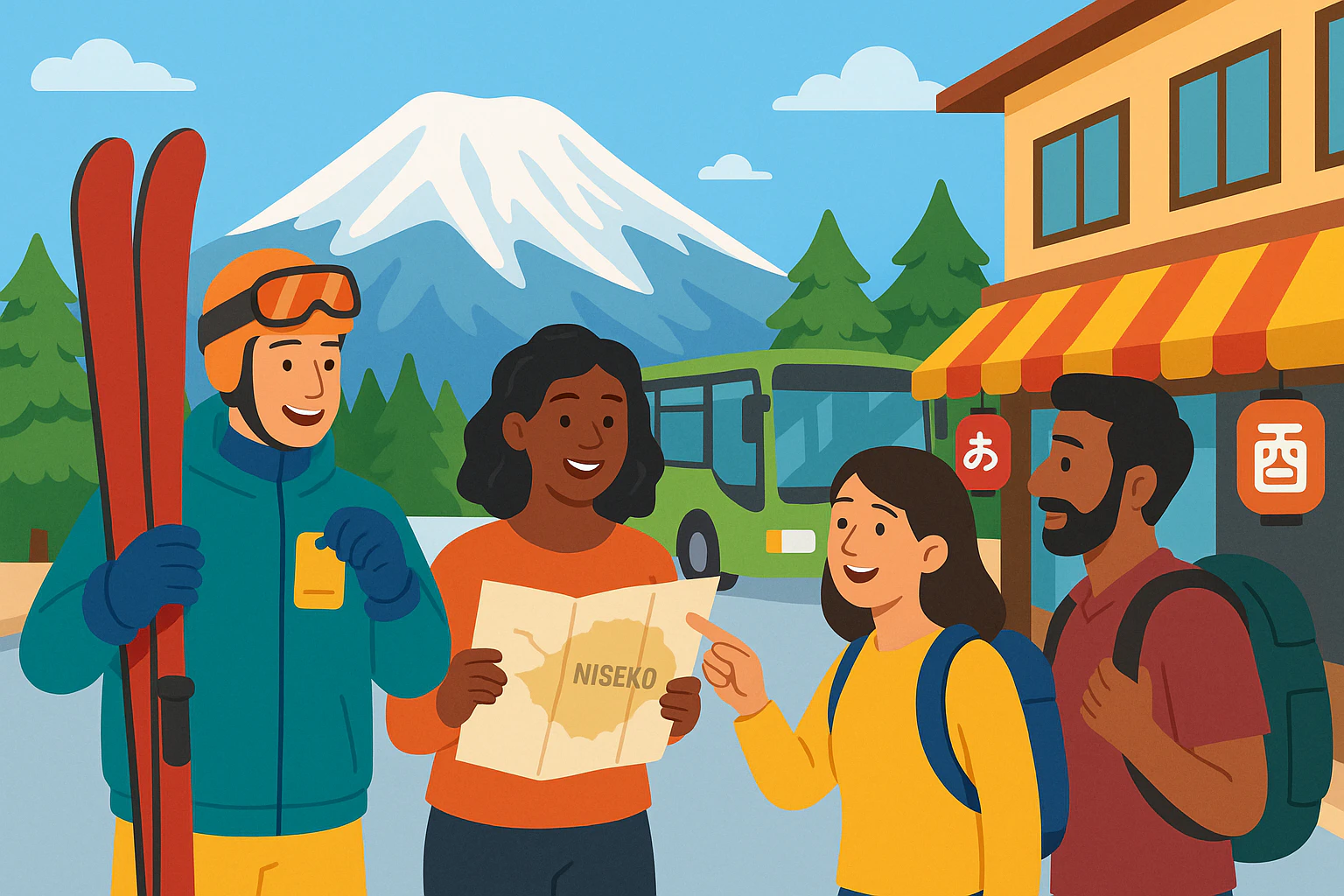
Niseko is one of the easiest ski destinations in Japan for international visitors—until the details trip you up. This Niseko skiing guide for foreigners focuses on the real “oops” moments: choosing the right lift pass, avoiding accidental pass activation on shuttle buses, and staying safe (and legal) with the gate-based off-piste system.
Everything below is written for short-term visitors (1–3 weeks) who want a smooth first day on snow, not a day lost to queues, confusion, or preventable safety risks.
Quick mistake-proof plan: (1) Travel to Niseko the day before you ski if possible (winter delays are real). (2) Buy your lift pass online and pick it up at a machine to skip ticket counters. (3) If you haven’t started skiing yet, don’t scan your pass on the Niseko United shuttle bus—pay the bus fare instead.
When to Go: Niseko Season Dates, Snow, and What to Pack
Niseko’s ticket prices and night skiing are divided into “seasons,” and those dates matter for both budgets and planning. Niseko United publishes the 2025–26 season windows and also notes that opening/operating dates can change depending on snow and conditions, so treat your travel day as a buffer and check official updates before you arrive.
According to the official Niseko United lift pass page, the main ticket seasons are: Early Season (Nov 29, 2025–Dec 12, 2025), Regular Season (Dec 13, 2025–Mar 22, 2026), Spring Season (Mar 23, 2026–Apr 5, 2026), and Final Season (Apr 6, 2026–May 6, 2026). Night skiing is listed as Dec 13, 2025–Mar 22, 2026. Niseko United’s official lift pass page is the best single reference for these dates.
If you’re traveling late season, it’s also worth checking the resort-by-resort closing dates. Niseko United lists operational windows (subject to change) up to May 6, 2026 for some areas, while others end earlier (for example, some sections list an April 12, 2026 end date). Always confirm what’s actually open before you plan your final-day itinerary. Check the “Ski Area Operational Dates” section here.
What to pack (the Niseko-specific essentials):
- Traction for walking: Hirafu and nearby areas get icy. Pack microspikes/anti-slip cleats for sidewalks and parking lots.
- Goggles + spare lens (or at least clear/low-light): visibility can change fast.
- Waterproof boots for walking (snowy streets + slush). Ski boots are not “walking shoes.”
- Power bank: cold weather drains phone batteries faster than you expect.
- Cash (small bills): useful for buses and “quick fixes” when you’re avoiding pass scans.
- Insurance details: keep your travel insurance policy number/screenshots accessible offline.
If you plan to leave resort boundaries via gates (more on this below), pack or rent proper safety gear. The official Niseko Rules state that backcountry users should wear a helmet and carry an avalanche beacon, and strongly recommend beacon/probe/shovel. Niseko Town’s official Niseko Rules (English) explains the expectations clearly.
Getting to Niseko: Airport Transfers, Trains, and Winter Delays
Your biggest enemy on travel day is not language—it’s time. In winter, delays pile up: slow baggage claim, snow on roads, and limited backup routes. If you can, arrive in Niseko the day before your first ski day so a late bus doesn’t turn into a lost lift ticket day.
Most visitors fly into New Chitose Airport (CTS) near Sapporo and then continue by ski bus. The two most commonly used options for short-term tourists are the Resort Liner and the White Liner—this is the core “New Chitose Airport to Niseko bus (Resort Liner / White Liner)” decision.
Option A: Hokkaido Resort Liner (Resort Liner)
- Typical winter operation (example shown by hotels/concierge pages): Dec 1, 2025–Mar 30, 2026. Example timetable and period (Ki Niseko concierge)
- Fare (one-way): Adult ¥6,000 / Child ¥5,000 (example listing for CTS → Hirafu Welcome Center). Fare reference
- Convenience: Some services depart from the International Terminal (limited departures), which can be helpful after long-haul arrivals. See the sample schedule with terminal notes
- Contact (operator): Hokkaido Access Network (Hokkaido Resort Liner) lists TEL +81-11-200-0506 and email info2@access-n.jp. Operator contact details
Connection-time tip (don’t miss the bus): One Niseko transfer page recommends building in enough time, and Niseko-area concierge pages often publish minimum buffers. For a practical baseline, Niseko Central advises allowing at least 50 minutes after a domestic flight lands and 90 minutes after an international flight lands before your bus departure time (to clear procedures, collect bags, and reach the desk). See the suggested minimum connection times (Niseko Central)
Option B: White Liner (direct to Hirafu area)
- Operating period (2025–26): Dec 13, 2025–Mar 23, 2026. White Liner timetable and period (official)
- Fare (one-way): Adult ¥7,000 / Child ¥5,000, with a web-booking discount shown as ¥5,950 adult and ¥4,250 child (15% off) when booked by 16:00 the day before. White Liner web prices and discount deadline
- Big gotcha: White Liner notes that buses do not depart from the International Terminal; you must go to the Domestic Terminal. See “Important Information about Bus Boarding”
- Recommended airport connection times: Domestic minimum 60 minutes / International minimum 120 minutes. White Liner’s recommended connection times
- Contact: TEL +81-11-624-8822 (listed with weekday hours 9:00–16:00 JST). White Liner contact section
If your flight arrives late: have a Plan B. Sometimes the cheapest “insurance” is booking an airport-area hotel for the night and taking a morning coach. If you want a step-by-step survival plan for late arrivals (including where to rest), read Late night Japan airport transfers: cheap options + where to sleep.
Train option (good for scenery, not always good for first-timers): Several hotels summarize the rail route as JR Sapporo → Otaru → Kutchan (Hakodate Main Line), around 2 hours from Sapporo to Kutchan, then you still need a local transfer to your accommodation. One Niseko Resort Towers’ access page outlines the transfers at a high level. Winter rail can also be disrupted, so buses are usually the simplest choice if you have ski bags.
Lift Passes & Rentals: Buy Online, Pick Up Fast, and Save Time
There are two ways people waste half a day in Niseko: lining up at ticket counters and buying the “wrong” pass type (then paying again later). The fix is simple: decide your pass strategy before you fly, and use online pickup machines wherever possible.
Niseko United lift pass 2025-26 prices (Regular Season): Niseko United lists the Regular Season as Dec 13, 2025–Mar 22, 2026. The 1-day All Mountain adult pass is ¥12,000, the 5-day is ¥58,000, and the 50-hour pass is ¥115,400 (noted as online-only). Official Niseko United lift pass prices
Before you choose, use this simple decision rule:
- If you’ll ski 1–3 days: buy day passes (and don’t stress about buying too early).
- If you’ll ski 4–7 consecutive days: a multi-day pass can be cleaner (Niseko notes multi-day tickets are consecutive days). Validity notes on multi-day tickets
- If you want flexibility (rest days, storms, onsen days): the 50-hour option can make sense for some visitors, and Niseko lists it as online-only. 50-hour pass listing
Buy online to skip queues (and usually save a bit): Niseko United’s official online lift pass page says you can skip lift ticket counter lines, and it advertises an average 5% online discount (hourly passes excluded). Official Niseko United online lift pass page
Online purchase steps (the fastest “first morning” workflow):
- Buy online, then you receive a QR code confirmation by email. Online purchase flow (official)
- Pick up at a ticket machine (Skiosk-style) by scanning your QR code, and Niseko says you can collect at any of the four resorts (Grand Hirafu, Niseko Village, Hanazono, Annupuri). Official pickup instructions
- Be aware of fees: the keycard cost is listed as ¥500 (not refundable), and the reissue fee for a lost pass is listed as ¥3,500 (with proof and ID required). Keycard and reissue fee details
- Read the refund rule: Niseko states online lift pass purchases are non-refundable and non-replaceable once paid. Online lift pass terms
The shuttle-bus activation trap (very common): Niseko United explicitly states that an online lift pass can be activated either when you pass a lift gate or when you get on the Niseko United shuttle bus using your online lift pass. If you didn’t mean to start your “Day 1” yet, this can burn a full day. Activation rule (official)
How to avoid accidental activation: Niseko United’s online lift pass terms explain that if activation is unwanted, you should pay the bus fare in cash without scanning (instead of using the lift pass on the shuttle). Cash-payment workaround (official)
Not sure which pass type matches your exact itinerary (or whether you should start skiing on arrival day)? Ask a local Japanese person on LO-PAL for personalised advice.
Need help at the counter? Niseko United lists online lift pass customer service as phone +81 136 55 6068 (9:00–17:00 Japan local time) and email [email protected]. Official customer service listing
Rentals: reserve online, but watch deadlines
Niseko rental shops are used to international travelers, but peak periods still create bottlenecks. Your goal is to book online early enough to lock in inventory and then pick up as efficiently as possible.
- Niseko Sports (Hanazono): operation dates are listed as Nov 29, 2025–Apr 12, 2026, and it states that online bookings can be made up to 4 days before the start date. Niseko Sports rental info (Hanazono official)
- Backcountry safety gear rentals: Niseko Sports lists beacon-only and beacon/shovel/probe/backpack sets with per-day pricing (and notes no advance reservations for some backcountry items). Backcountry gear rental pricing
- Different shops, different cutoffs: for example, Village Sports says it accepts online bookings one day in advance, but warns walk-ins may be turned away during extremely busy periods. Village Sports rental FAQ
Rental time-savers that work in Japan:
- Take screenshots of your booking confirmation and keep them offline.
- Know your boot size in mondopoint (cm) if possible (or at least US/EU + your foot length).
- If your shop offers early pickup, grab gear the afternoon before your first ski day to avoid the 8:00–9:30 rush.
Safety & Etiquette: Niseko Rules, Backcountry Gates, and What Not to Do
Niseko is famous for deep snow, but it’s also serious mountain terrain with a formal system for leaving resort boundaries. If you’re planning any off-piste beyond the ropes, you must understand the local framework first—because “I didn’t know” won’t protect you from danger or consequences.
Niseko backcountry gate rules (Niseko Rules): the non-negotiables
Niseko Town publishes the official Niseko Rules in English. The rules are simple and strict: use designated gates to enter backcountry, do not duck boundary ropes, and do not go out when gates are closed. Niseko Rules (English, official)
Key consequence most tourists underestimate: Niseko Town states a minimum of ¥100,000 can be charged for search and rescue operations in backcountry areas. Official statement
Niseko Town also states that violators may be banned from using resort facilities through lift-pass confiscation and/or refusal to reissue. Rules-violator consequences (official)
How the gate system works (and why it exists): Niseko United explains that boundary ropes are not “suggestions” and that designated gates are the correct way to exit. It also notes that gates close when conditions are dangerous and that out-of-bound skiing is prohibited when gates are closed. Niseko United’s explanation of the backcountry system
Where to check daily conditions: Niseko United points riders to the official regional bulletin, and the Niseko Rules state that the Niseko Avalanche Information is the area’s official information. Check the daily updates at nadare.info (Niseko Avalanche Information) before you consider any gate access.
Minimum gear expectations (don’t negotiate with winter):
- Niseko Town’s Niseko Rules say backcountry users should wear a helmet and carry an avalanche beacon, and strongly recommend carrying beacon/probe/shovel. Gear expectations (official)
- Niseko United emphasizes there is no ski patrol outside the ski area boundaries—leaving is at your own risk. Patrol boundary note
What not to do (the “tourist mistakes” that end trips early):
- Don’t follow tracks through a rope line. Tracks are not proof of safety or legality.
- Don’t argue with closures: if a gate is closed, conditions are considered dangerous and leaving is prohibited. Gate closure rule
- Don’t rely on your phone alone: cold kills batteries and reception can be inconsistent in storms.
- Don’t assume rescue is “free” outside boundaries; the official rules warn you will be charged, with a stated minimum. Rescue cost minimum (official)
If you need urgent help: Japan’s emergency numbers are 110 (police) and 119 (ambulance/fire). On-mountain issues should be reported to resort staff/ski patrol as quickly as possible, and you should follow ski patrol instructions (Niseko Rules explicitly emphasizes obeying patrol authority). Patrol instruction reminder
Useful official resort contacts (addresses + phone): Niseko United lists contact details for each base area, which is helpful if you need to communicate with a taxi or your accommodation.
- Niseko Annupuri Ski Resort: TEL +81-(0)136-58-2080
- Niseko Village: TEL +81-(0)136-44-2211
- Niseko Mt. Resort Grand HIRAFU: TEL +81-(0)136-22-0109
- Niseko Hanazono Resort: TEL +81-(0)136-23-0103
Source: Niseko United access information page
FAQ (Quick Answers for First-Time Niseko Visitors)
These are the questions that most often cause missed buses, wasted lift-pass days, or safety issues.
Q1) Can I buy a Niseko United lift pass online on the day I ski?
A) Niseko United’s online lift pass page states you can purchase online even on the day you ski, and it’s designed for both desktop and smartphone use. Official online lift pass FAQ and “Why purchase online?”
Q2) Will riding the Niseko United shuttle bus start my lift pass day?
A) It can. Niseko United states that the online lift pass can be activated when you pass the lift gate or when you get on the shuttle bus using the pass. To avoid unwanted activation, it instructs riders to pay the bus fare in cash without scanning. Official activation rule and workaround
Q3) Where do I check if backcountry gates are “open” today?
A) Use the official daily bulletin at Niseko Avalanche Information (nadare.info). Niseko United also references it as the place to confirm official mountain conditions. Niseko United guidance
Q4) What’s the minimum rescue cost if I get into trouble outside the resort boundary?
A) Niseko Town’s official Niseko Rules (English) state a minimum of ¥100,000 may be charged for search and rescue operations in backcountry areas. Official Niseko Rules (English)
Q5) What’s the simplest airport bus if I’m arriving on an international flight?
A) White Liner notes it departs from the Domestic Terminal only (so you must transfer terminals), and it recommends a 120-minute buffer for international arrivals. Some Resort Liner services list International Terminal pickups on certain departures (check your exact schedule when booking). White Liner terminal note and connection time and Resort Liner example schedule showing terminal info
Related Articles
If you’re building a winter itinerary (or planning around delays), these guides help you avoid common Japan travel pitfalls:
- Late night Japan airport transfers: cheap options + where to sleep
- Hokkaido seafood in winter: Sapporo & Otaru market guide
- Car-free Hokkaido winter itinerary: Sapporo, Otaru & Niseko
Need More Help? Ask on LO-PAL
If you want to confirm the best bus for your exact flight time, figure out which lift pass won’t activate too early, or understand what a specific gate means on a stormy day, ask a local Japanese person on LO-PAL.
LO-PAL is our matching service that connects foreign tourists in Japan with local Japanese helpers. Post a question (or request help booking/communicating), and our community can respond in multiple languages including English, Chinese, Korean, Spanish, Vietnamese, Portuguese, and more—so you can make decisions with local, on-the-ground context.
Written by

Founder, LO-PAL
Former Medical Coordinator for Foreign Patients (Ministry of Health programme) and legal affairs professional. Built LO-PAL from firsthand experience navigating life abroad.
Written with partial AI assistance
Read full bio →