Shrine Etiquette Japan (2026): Omikuji, Goshuin & Cashless Offerings

The all-in-one Japanese learning app
From travel phrases to real fluency — all in one app.
All 2,136 standard kanji included. Every feature is free to use.
A 2026 etiquette guide for Japan’s shrines: temizuya, omikuji, goshuin, and what’s changing (cashless + tours).
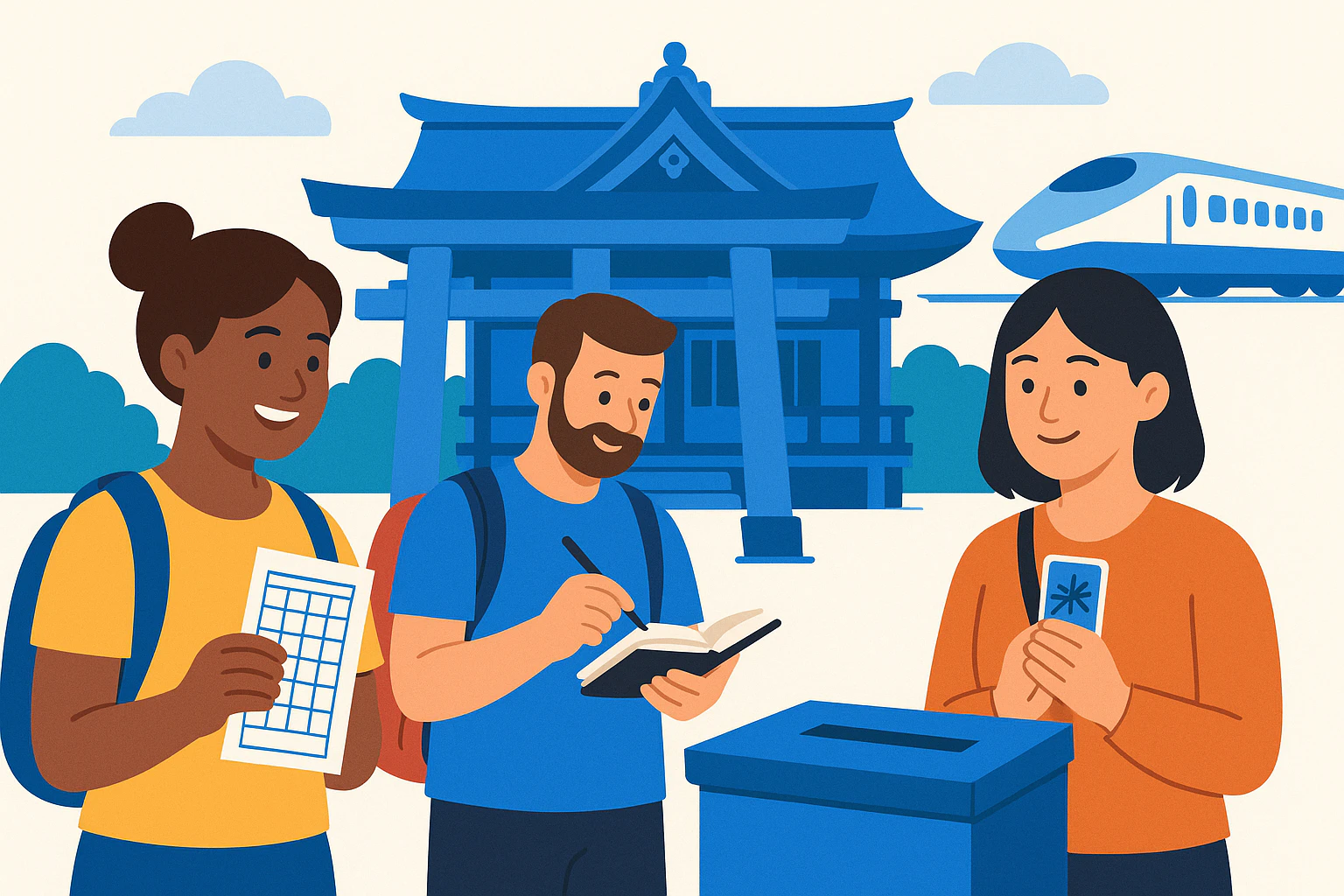
If you’ve ever visited a shrine in Japan and suddenly forgot how to use the temizuya (purification fountain), you’re not alone. Most “shrine etiquette Japan” guides cover the basics, but many travelers still freeze at the gate, misread omikuji, or don’t know how to request goshuin without sounding demanding.
This 2026-focused guide is built for short trips (1–3 weeks): simple steps, polite phrases you can say even if you don’t speak Japanese, and what’s changing right now—like pre-written goshuin sheets, goshuin tour/stamp-rally style campaigns, and limited cashless offering options at select locations.
Before you go (30-second prep): carry a few coins (¥5, ¥10, ¥50, ¥100), bring a small hand towel, and plan to arrive before 4:00 pm if you want goshuin (many counters close earlier than the grounds). If you’re visiting both shrines and temples, consider buying two books (one for shrines, one for temples) to avoid rare but awkward refusals.
Shrine vs. Temple: How to Tell in 10 Seconds (Temple vs Shrine Japan)
In Japan, shrines and temples can look similar at first glance—but the etiquette is different enough that it matters. The quickest way to avoid an awkward moment is to identify where you are before you start praying or clapping.
The Japan National Tourism Organization (JNTO) summarizes the most reliable visual cues: shrines typically have a torii gate marking the boundary to sacred ground, while temples often have a sanmon gate and may feature guardian statues and incense practices. You can review JNTO’s official overview here: Shrine and Temple Traditions (JNTO).
10-second checklist
- Shrine (Shinto): torii gate, shimenawa rope with paper streamers, komainu (lion-dog) statues, purification pavilion (temizuya). Prayer commonly includes clapping.
- Temple (Buddhist): incense burner (often near the main hall), pagoda, statues of Buddha and bodhisattvas, sanmon gate. Prayer is usually hands together silently (no clapping), and some buildings require shoe removal.
Why it matters: At many shrines, clapping is part of the standard worship sequence (more below). At temples, clapping is generally not done, and you may see people offering incense instead. When in doubt, watch what locals do for 10 seconds, then follow.
Step-by-Step Shrine Etiquette Japan: Torii, Temizuya, and the “Two Bows, Two Claps, One Bow”
Think of shrine etiquette in Japan as a flow: enter respectfully, purify, offer, and pray. You don’t need to be perfect—being calm, quiet, and observant covers 90% of “doing it right.”
1) At the torii gate: pause and bow
At many shrines, it’s customary to bow once before passing through the torii because you’re stepping onto sacred ground. JNTO notes that people often avoid walking directly down the center line, which is traditionally reserved for the deity. See: JNTO shrine entry etiquette.
- Do: step slightly to the left or right and walk calmly.
- Don’t: stop in the center to take a photo that blocks everyone behind you.
2) Temizuya (purification fountain): the step tourists overthink
Temizuya etiquette is the #1 “freeze point” for visitors. The good news: the procedure is standardized and easy once you’ve done it once. JNTO outlines the basic steps and the key rule: never touch the ladle to your mouth. Reference: JNTO temizuya steps.
- Hold the ladle in your right hand and rinse your left hand.
- Switch: hold the ladle in your left hand and rinse your right hand.
- Pour a little water into your left palm, rinse your mouth (spit beside the basin, not back into it).
- Tip: many shrines expect you to use one scoop to complete the sequence.
2026 reality check: some shrines may have modified setups (or posted special instructions). Follow the signage on-site. If the water is off or the ladles aren’t available, skip it quietly—don’t improvise in a way that makes staff clean up after you.
3) At the main hall: offerings + the standard prayer sequence
At a typical shrine, you’ll see an offering box (saisenbako) and often a bell rope. JNTO’s shrine prayer sequence is the one most visitors should memorize: toss a coin quietly, ring the bell (if present), then two bows, two claps, one bow. Source: JNTO “Bowing, clapping and praying”.
- Offer a coin (gentle toss, don’t throw).
- If there’s a bell rope: ring it once (not aggressively).
- Bow twice (deep bows from the waist).
- Clap twice (hands together at chest level).
- Pray silently (gratitude first is always appropriate).
- Bow once to finish.
Important exception: some shrines use different clap counts. For example, Izumo Taisha is famous for “2 bows, 4 claps, 1 bow,” and JNTO mentions this pattern in its Izumo coverage: Izumo Taisha (JNTO). If you see a posted instruction board, follow it.
Cashless offerings in 2026: what’s actually changing
Japan is gradually adding cashless options even in cultural spaces, but it’s still location-limited. PayPay announced that it would support offerings and related payments at select shrines and temples starting December 2024, positioned as helpful during peak crowd periods like New Year. Details (including conditions) are in PayPay’s official release: PayPay press release (Dec 23, 2024).
- The offering flow is typically: scan a QR code on-site → enter amount → send.
- PayPay notes offerings are limited to identity-verified users and PayPay Money (not points). See: PayPay “Offerings and more” conditions.
- Even in 2026, many shrines/temples remain cash-only—so carry coins anyway.
Tourist tip: even if you’re a frequent cashless traveler, assume your shrine visit requires cash. Treat cashless as a bonus, not your main plan.
Omikuji & Omamori: Omikuji Meaning, What to Do, and Common Tourist Mistakes
Omikuji and omamori are fun, meaningful, and easy to do respectfully—if you understand what they are (and what they’re not). The biggest tourist mistakes come from rushing, ignoring posted instructions, or treating sacred items like disposable souvenirs.
Omikuji meaning: it’s not just “good or bad luck”
Omikuji are fortune slips, and the large characters (like 大吉) show the general “luck level.” Many travelers stop there—but the detailed advice matters more than the headline. A clear English breakdown of common rankings (大吉, 中吉, 吉, 凶, 大凶, etc.) is here: Rakuten Travel’s omikuji guide.
Typical cost: often around ¥100–¥200 (varies by site). Some shrines/temples also have English omikuji, illustrated omikuji, or themed ones—follow the instructions at the stand.
What to do after you draw omikuji (keep it or tie it?)
Different sites have different preferences, but generally you have two respectful options: keep it with you, or tie it at the designated place (often a rack). Many places now prefer racks instead of trees to avoid damage. For context on the tying practice and how to dispose of an omikuji later, see: Find My Osaka: tie or take home an omikuji.
- If it’s good luck: many people keep it in a wallet or travel journal.
- If it’s bad luck: tie it at the omikuji rack to “leave it behind.”
- Don’t: tie it on random fences, sacred ropes, or anywhere not intended for it.
Omamori (protective charms): how to buy and how to treat them
Omamori are protective charms for things like safe travel, studies, relationships, or health. The key etiquette: don’t open the pouch and don’t treat it like a toy or keychain you can casually toss around. If you’re shopping quickly, it’s okay to point and say, “Kore, onegaishimasu” (This one, please).
Typical cost: commonly around ¥800–¥1,500, but it varies by shrine/temple and design. If you buy multiple omamori, keep them somewhere clean and dry (your bag is fine).
What to do with old omamori (and other sacred items)
A common practice is to return omamori after about a year, especially around New Year, so they can be respectfully handled in a ritual burning (otakiage). Policies differ, but many shrines accept returns, and some explicitly state it’s okay to return to other shrines if you can’t go back to the original. Example guidance from Kyoto’s Mikane Shrine FAQ: Mikane Shrine (FAQ).
Tourist-friendly approach: if you won’t be back in Japan soon, keep the charm respectfully at home. If you do return, bring it back to the original shrine if possible, or ask staff if they accept it before dropping it into a return box.
How to Get Goshuin in Japan (2026): Etiquette, Key Phrases, Fees + New “Goshuin Tour” Trends
Goshuin are one of the best cultural “souvenirs” in Japan—because they’re not really souvenirs. They’re traditionally a record of worship, usually calligraphy plus a red seal, received at shrines and temples after you’ve paid your respects.
Goshuin basics (and where to ask)
Goshuin are typically received at a counter near the main worship area or shrine/temple office. Japan Airlines’ travel guide explains common signage you may see (like 御朱印所 / 納経所 / 社務所) and how to ask where to go: JAL guide to goshuin.
Fees: often around ¥300–¥500 per goshuin (special/limited designs may cost more). A goshuin book (goshuincho) commonly costs around ¥1,500–¥3,000, per JAL’s overview: Goshuincho sizes and typical prices.
Goshuin etiquette: the simple rules that prevent awkwardness
- Pray first, then request: goshuin is proof of worship, not just a stamp collection.
- Queue quietly: don’t talk on speakerphone or eat while waiting.
- Prepare exact change: many places still prefer cash.
- Open your book to a blank page: hand it over gently, with the spine oriented so it’s easy for the staff to write.
- Ask before photographing the counter: some sites prohibit photos at the goshuin desk.
Polite phrases (easy mode)
- Sumimasen. (Excuse me.)
- Goshuin, onegaishimasu. 御朱印、お願いします。 (A goshuin, please.)
- Kore ni onegaishimasu. これにお願いします。 (In this book, please.)
- Arigatou gozaimasu. ありがとうございます。 (Thank you very much.)
If you’re nervous, you can also just smile, present your goshuincho opened to a blank page, and say “onegaishimasu.” The tone matters more than perfect grammar.
2026 change #1: pre-written goshuin sheets (“kakioki”) are common
Even if you bring a goshuincho, you may receive a pre-written goshuin on loose paper instead of having it written into your book. JAL notes that pre-prepared sheets are often used during busy periods and events: JAL on pre-written goshuin sheets.
Some places are explicit about this policy. For example, Mikane Shrine states that goshuin are offered on pre-written sheets and are not directly inscribed into books: Mikane Shrine FAQ (goshuin).
And some “unusual” locations also do paper-only goshuin. Tokyo Tower’s in-deck shrine notes that you receive a seal stamp already printed on paper and they cannot print into a separate goshuin book: Tokyo Tower: goshuin notes.
2026 change #2: “goshuin tours” and digital stamp rallies (do them respectfully)
Goshuin collecting is being packaged as a travel experience—sometimes very explicitly as a “tour.” One Tokyo/Kanagawa example is the Keisei × Keikyu campaign framed as a digital stamp rally that runs from December 1, 2025 to March 1, 2026. You can see the campaign overview here: LIVE JAPAN: Keisei × Keikyu goshuin tour (and the campaign page here: Keikyu campaign site).
A large regional 2026 example is JR Kyushu’s “Special Goshuin” project, with a campaign period shown as February 20, 2026 to October 31, 2026. The official page explains you present an eligible ticket and pay the shrine/temple’s hatsuho-ryo (offering fee) to receive special goshuin: JR Kyushu: Tokubetsu Goshuin Meguri (official).
Logistics to know (JR Kyushu, 2026): the official page states the pass is sold via the JR Kyushu Internet Train Reservation system and you must pick up a physical ticket before riding. Prices shown include ¥3,900 for a one-day pass and ¥14,300 for a 3-day pass (both sold via the reservation system): JR Kyushu ticket details.
Respectful participation rule: even if the campaign feels like a game, the locations are active religious sites. Pray first, keep voices down, and don’t treat the goshuin counter like a merch booth.
A practical 1-day “practice route” (Tokyo) for shrine/temple etiquette
If you want to learn by doing (without rushing), this is an easy day that mixes shrine and temple etiquette. Budget about ¥1,000–¥3,000 per person if you do an offering, an omikuji, and 1–2 goshuin (plus transport).
- Morning: Meiji Jingu (Shrine) — practice torii + temizuya + clapping prayer. Meiji Jingu is free to enter and opens sunrise-to-sunset; the shrine posts monthly opening/closing times. Official info: Meiji Jingu “How to visit”. Phone: 03-3379-5511.
- Midday: Senso-ji (Temple, Asakusa) — practice temple etiquette (no clapping; incense area if you choose). The official site states the Main Hall is open 6:00–17:00 (and 6:30–17:00 from October to March) and lists access plus phone contact details: Senso-ji official site. Phone: 03-3842-0181.
Timing tip: if you care about goshuin, aim to arrive at each site well before late afternoon. Grounds may stay open, but counters often close earlier.
Goshuin pro-tip (stress-free): if you’re collecting both shrine and temple goshuin in one trip, buying two goshuincho books (one for shrines, one for temples) is a simple “no-drama” solution. Also keep a separate notebook for station stamps and souvenir stamps—many collectors avoid mixing those into a goshuincho.
Need More Help? Ask on LO-PAL
If you want to know more about shrine etiquette Japan—or you need specific local details like “Is goshuin available today?”, “Where is the goshuin counter at this shrine?”, or “Does this location accept PayPay offerings?”—ask a local Japanese person on LO-PAL.
With LO-PAL, you can post a question (or request a task) in the app, and local Japanese helpers will respond. We support multiple languages (including English, Chinese, Korean, Vietnamese, Portuguese, Spanish, and more), so you can get practical answers fast—even if you don’t speak Japanese.
Typical travel uses include: confirming goshuin reception hours for a specific shrine/temple, getting a short message translated into polite Japanese, or building a 1-day “goshuin tour” route that fits your hotel location and train lines.
Written by

Founder, LO-PAL
Former Medical Coordinator for Foreign Patients (Ministry of Health programme) and legal affairs professional. Built LO-PAL from firsthand experience navigating life abroad.
Written with partial AI assistance
Read full bio →