Rakuten Card for Foreigners in Japan: Why You Were Rejected (and How to Pass)
Rakuten Card is the most-applied first card for foreign residents in Japan: no annual fee, no PR requirement, no Japanese co-signer. But automated screening rejects sharp filters: short residence period, empty CIC file, name mismatches with 在留カード. This is the foreigner's playbook — issuer-stated rules, six rejection patterns, and what to do if the SMS says no.
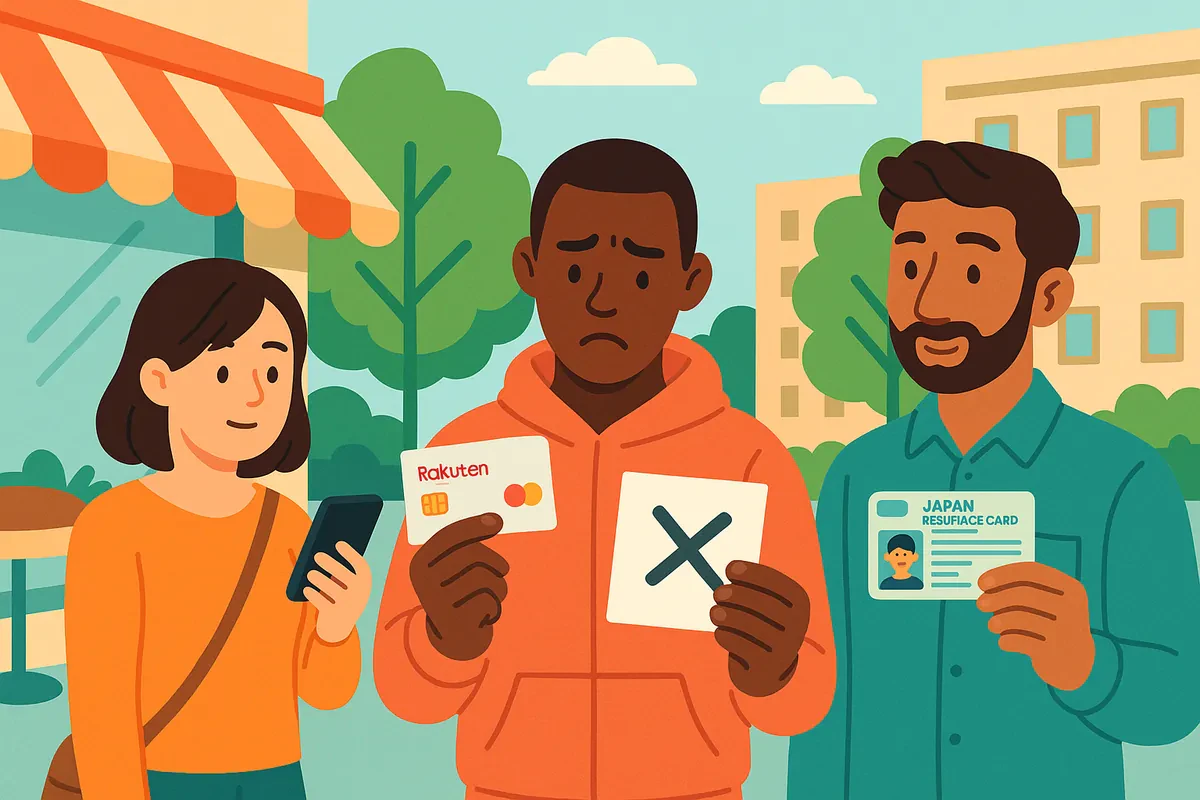
Why Rakuten Card is the most-applied first card for foreign residents: no annual fee, no minimum income line, all-online application that does not require a Japanese co-signer, and an explicit 在留カード handling FAQ on the issuer's site. The catch is that Rakuten reads CIC like every other issuer — if your residence card has under a year remaining or your bureau file is empty, your odds drop sharply.
- Issuer-stated eligibility: 18+. No PR requirement. No "Japanese name only" rule. Source: Rakuten Card application page
- Documents needed: 在留カード or 特別永住者証明書 (both sides), one piece of secondary ID (健康保険証 / driver's license / MyNumber), Japanese bank account, Japanese phone number reachable by SMS
- Decision time: automated screening typically returns within minutes; final approval and card mailing in 7–10 days
- If rejected: 6-month cool-down before reapplying is industry consensus — applying again immediately makes things worse
Information current as of May 2026 based on the Rakuten Card member agreement, the Rakuten Card residence-card submission FAQ, and the 指定信用情報機関 CIC public information page.
Rakuten Card has the largest member base of any single Japanese credit card brand, partly because the application is fully online, fully in Japanese-or-translatable form, and uses a relatively forgiving automated underwriting model. Foreigners on student, work, dependent, and spouse visas are routinely approved. But "routinely" hides a sharp drop in approval rates for applicants whose 在留期間 is short, whose CIC file is empty, or whose income comes from cash sources the underwriter can't verify.
Who actually gets approved
Rakuten does not publish approval-rate data segmented by nationality, and any "X% of foreigners get approved" number you see on a comparison blog is fabricated. What we can say from issuer-stated rules and consistent practitioner reporting:
| Profile | Likely outcome |
|---|---|
| Working-visa holder, 1+ year in Japan, full-time employment, no negative CIC | Routinely approved at ¥300,000–¥500,000 starting limit |
| Spouse-of-Japanese visa holder, dependent income | Routinely approved if Japanese spouse can be listed as 連絡先 |
| Student visa holder, 部活動 part-time work, 28-hour rule compliant | Often approved at ¥100,000–¥200,000 with parent or spouse as backup contact |
| New arrival under 6 months, empty CIC file, ≤1 year remaining on 在留カード | Frequently rejected — try again at 8–12 months tenure |
| Self-employed / freelance under 1 year of 確定申告 history | Rejected more often than employees; see our freelancer card guide |
| Any applicant with 異動 mark on CIC in last 5 years | Almost certain rejection |
The numeric residence-period threshold is not on Rakuten's eligibility page. It comes up in third-party guides because automated underwriting almost certainly weighs remaining 在留期間 against loan term. Treat "1+ year remaining" as practitioner consensus, not as Rakuten policy.
Step-by-step application
- Open a Rakuten ID first at rakuten.co.jp. Card application links to this account, and an existing ID with a few months of purchase history slightly improves the file.
- Go to the application form: rakuten-card.co.jp/card/rakuten-card/. Choose Visa, Mastercard, JCB, or Amex. For most foreigners, Visa or Mastercard is recommended for international acceptance.
- Fill the personal information form in Japanese. Your name must match your 在留カード exactly — including alphabet order and middle names. If your card shows "MARIA SANTOS DA SILVA," type that, not "Maria Silva."
- Employer / income section. Enter your annual gross 年収 in 万円 (e.g., 350 = ¥3.5M). Rakuten cross-checks high-income claims by 源泉徴収票 if asked, but does not require it for the initial application.
- Submit 在留カード and 本人確認書類. Per Rakuten's residence-card FAQ, you upload both sides. Make sure the photo shows the card flat, no glare, with all 16 digits readable.
- Choose payment account. Rakuten accepts most Japanese banks for the monthly direct debit (引き落とし口座). Rakuten Bank gets you points faster for the auto-link.
- Wait for the SMS. Approval or rejection arrives by SMS to the Japanese mobile number you registered, typically within minutes. The card itself ships in 7–10 days.
If you cannot read the form, that's a real friction point — the automated translator built into Chrome will mis-render some fields, and the wrong tick box on residence status will get you rejected. Posting on LO-PAL is free, and a local helper can sit on a video call with you while you fill it in. You only pay if you accept hands-on task help.
Common reasons foreigners get rejected (and what to do)
1. 在留カード expires within 12 months
Rakuten's automated underwriting heavily weighs remaining residence period. There's no fix except waiting. If you're on a 1-year work visa with a renewal coming up, apply after the renewal, when you have 3+ years remaining.
2. CIC file is empty (no record at all)
Counterintuitively, having no record is treated similarly to having a bad record by automated systems. Build a record first: a 携帯分割払い (24-month phone installment) at any major carrier reports to CIC monthly. Six months of clean payments materially improves your odds.
3. Income mismatch with employer type
If you list ¥6M income but your employer is unknown to Rakuten's database (small startup, foreign company, NPO), the automated check may fail. Solution: list your real income, attach 源泉徴収票 in the file-upload step if optional.
4. Application data does not match 在留カード
Misspelled name, wrong birthdate, mismatched address. The automated KYC step compares your entered data to the OCR result on your uploaded card. Tiny mismatches reject. Tip: copy the romanized name exactly as printed.
5. Multiple applications in 6 months
CIC logs every application as 申込情報 (visible to all issuers for 6 months). Three card applications in 90 days flags as "moushikomi blacklist" (申込ブラックリスト) and triggers automatic rejection at most issuers. If your first application was rejected, wait 6 months before the next.
6. Phone or address inconsistency
Your phone area must match your registered address (e.g., a Tokyo address with an Osaka mobile prefix raises a flag). Phone number must be reachable by SMS in real time during the application.
Phrases for support calls
If your application stalls or you need to update information, the Rakuten Card customer center (contact page) accepts Japanese-only calls. Useful phrases:
- 「楽天カードの申込み状況を確認したいです」 (Rakuten Card no moushikomi joukyou wo kakunin shitai desu) — I'd like to check my Rakuten Card application status.
- 「在留カードを更新したので新しいものを送ります」 (Zairyuu kaado wo koushin shita node atarashii mono wo okurimasu) — I renewed my residence card; I'll send the new one.
- 「審査結果について教えてください」 (Shinsa kekka ni tsuite oshiete kudasai) — Please tell me about the screening result.
- 「カードの利用限度額を上げてください」 (Kaado no riyou gendogaku wo agete kudasai) — Please raise my card's usage limit.
Issuers cannot disclose the specific reason for a rejection — this is a Japanese consumer-finance industry norm, not a Rakuten quirk. Asking will produce only "総合的に判断した結果" (we decided comprehensively). Don't take it personally; it's policy.
After approval: limit increases and points
Most foreign applicants start at ¥100,000–¥500,000. Rakuten allows limit-increase requests after 6 months of clean usage via the Rakuten e-NAVI app. Targeted requests succeed roughly 60% of the time according to user reports; unsolicited increases via the app's "AUTO PRO" feature are common after 12 months of usage. Do not request a limit raise within the first 3 months — the algorithm reads it as financial stress.
Rakuten Points (楽天ポイント) accumulate at 1% on most spending and 3%+ inside the Rakuten ecosystem (Rakuten Ichiba, Rakuten Mobile, Rakuten Travel). Points expire in 12 months from last earn — keep using the card to keep them alive. International transactions earn 1% in points but incur a 1.63% foreign-currency surcharge.
If Rakuten rejects you, what next
The 6-month wait rule is firm. In the meantime, consider:
- GTN Epos Card — co-issued with Global Trust Networks specifically for foreign residents, 25-language support, in-person screening at Marui. gtn-mobile.com/s/epos
- Aeon Card — friendly to short-tenure applicants, but no same-day issuance for non-Japanese-nationals per Aeon's AML policy
- Saison Card International — same-day at Saison Counter if you apply by 19:00. Saison FAQ
- Build CIC record first — 6 months of mobile installment payments and a small 携帯分割 phone purchase tend to flip rejections to approvals at the next attempt
For the full menu, see our easy-approval cards comparison. To check what's already on your CIC file before applying anywhere new, see the credit bureau disclosure guide.
Updating your residence card after renewal
The single most common way foreigners lose a Rakuten Card after approval: letting the 在留カード on file expire without uploading the renewed one. Rakuten's FAQ states this is required under the 犯罪収益移転防止法 (Act on Prevention of Transfer of Criminal Proceeds). After renewal at 入管 (immigration), upload both sides of the new 在留カード via Rakuten e-NAVI within 14 days. If you skip it, Rakuten can suspend the card with no warning, which is messy if you have auto-payments running through it.
Related articles
- Credit, Loans, and Mortgages in Japan for Foreigners (2026): The Approval Map
- Easy-Approval Cards for Foreign Residents in Japan
- Credit Bureau Disclosure: How to Read Your CIC, JICC, and KSC Files
- Building Credit History in Japan from Zero
Disclaimer: This article is general information, not financial advice. Card-issuer eligibility rules and screening criteria change without public notice. Verify current rules on Rakuten Card's official application page before applying. Approval is at the issuer's discretion and depends on factors specific to your individual file.
Get Your Application Reviewed by a Local
The hardest part of a Rakuten Card application for many foreigners is not the eligibility — it's filling the Japanese form correctly without triggering an automated mismatch flag. Post your question on LO-PAL for free: a local Japanese person can walk through the form fields with you, double-check your 在留カード upload, and explain anything in the member agreement. You only pay if you accept task help.
Written by

Founder, LO-PAL
Former Medical Coordinator for Foreign Patients (Ministry of Health programme) and legal affairs professional. Built LO-PAL from firsthand experience navigating life abroad.
Written with partial AI assistance
Read full bio →