Japan Contract Employee vs Seishain: The 5-Year Rule Most Foreigners Miss
Contract employee (契約社員) status in Japan carries specific statutory protections most foreign hires never learn. The 5-year 無期転換 conversion right, non-renewal restrictions, and equal-pay-for-equal-work enforcement are real levers — when you know to use them.
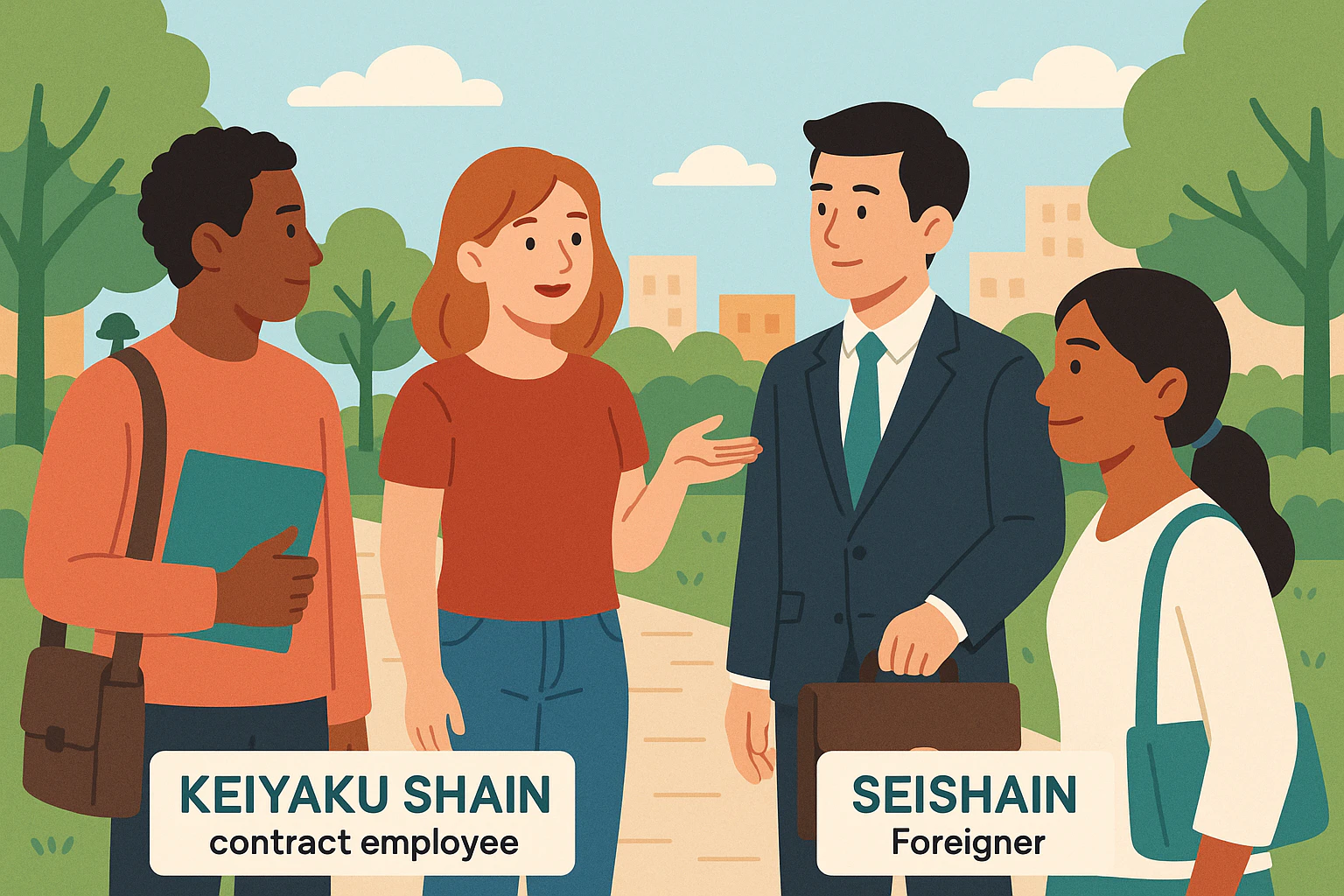
Fast answer: In Japan, the difference between 契約社員 (contract employee) and 正社員 (seishain / regular employee) is not just a salary tier — it's a legally distinct status with different protections. Two rules every foreign contract employee must know:
- The 5-year conversion rule (無期転換ルール): After 5 cumulative years of 有期 contract renewals with the same employer, you have a statutory right to demand conversion to 無期 (indefinite-term). Your employer cannot refuse.
- Same work, same pay (同一労働同一賃金): Since 2020 for large companies and 2021 for SMEs, unreasonable gaps in base pay, bonuses, allowances, and benefits between seishain and contract employees doing similar work are illegal.
The common foreign-hire mistake: accepting "contract employee" status at a tech company with the understanding that "everyone starts as contract" — then finding out five years later that the employer carefully times non-renewals to block conversion.
Information current as of April 2026 based on MHLW 無期転換ルール official page, MHLW 2024 labor contract reform pamphlet, MHLW 雇止め法理 pamphlet, MHLW 同一労働同一賃金 page, and the underlying statutes 労働契約法 and パートタイム・有期雇用労働法.
Foreign professionals often accept "contract employee" offers believing it's a temporary stepping stone. In some companies it genuinely is — a path to seishain after one or two renewals. In others, it's a permanent second tier designed to keep you cheaper and easier to remove. The law gives you three tools to push back: the 5-year conversion right, the non-renewal protection rule, and equal-pay-for-equal-work enforcement. This article walks through each.
What the two statuses actually differ on
Beyond job titles, the practical differences come from the contract structure:
| Feature | 正社員 (seishain) | 契約社員 (有期 contract) |
|---|---|---|
| Contract term | Indefinite (無期) | Fixed term (有期), typically 1 year |
| Termination | 労基法 dismissal standard — very hard | Can be 雇止め (non-renewal) at contract end |
| Salary structure | Usually includes 賞与 (bonus) and 退職金 | Often no 賞与 or reduced; 退職金 rare |
| Benefits | Full set (通勤, 家族, 住宅, etc.) | Historically limited — but 同一労働同一賃金 now constrains this |
| Social insurance | Day-one enrollment if full-time | Same enrollment rules apply |
| Transfer/job change | Broad at employer discretion (2024 reform now limits scope) | Typically role- and location-fixed |
| Path to 無期 | Already 無期 | Statutory conversion right after 5 years (労契法18条) |
The 5-year conversion rule (労契法18条 無期転換ルール)
Enacted in April 2013, 労契法18条 gives any fixed-term employee with more than 5 cumulative years of service under renewed contracts with the same employer the unilateral right to demand conversion to indefinite-term (無期) employment. The employer cannot refuse.
How it works
- Your first contract must have started on or after April 1, 2013 (the law is not retroactive)
- Cumulative service must exceed 5 years across renewed contracts
- You exercise the right by written notice during any contract period after crossing year 5
- The conversion takes effect from the start of the next contract period
- Terms remain the same as your last fixed-term contract — only the "indefinite" status changes. Your salary, role, and benefits do not automatically rise to seishain levels
The cooling-off trap
A 6-month or longer gap between contracts resets the 5-year clock to zero. Some employers deliberately engineer a 6-month break before year 5 to eliminate the conversion right. This is known as 無期転換逃れ (conversion avoidance) and is on 労働局 enforcement radar but is not automatically illegal.
The 2024 notification requirement
As of April 2024, employers must notify you in writing of the 無期転換申込権 at each contract renewal after your 5-year mark. The notice must include (i) that you have the right, (ii) the conditions post-conversion, and (iii) how to exercise. Missing this notification is a labor law violation — and if you are denied conversion because of ambiguity, you have an enforcement path.
The 無期 label vs 正社員 status
Critically: 無期転換 does NOT automatically make you a 正社員. Your post-conversion status is "無期契約社員" or similar — indefinite term, but otherwise the same terms you had. Separately negotiating promotion to 正社員 (with 賞与, 退職金, and broader benefits) is a different conversation.
Non-renewal protection (労契法19条 雇止め法理)
If your fixed-term contract is not renewed at its end, the employer's decision is reviewable under 労契法19条. Non-renewal is void if EITHER of these apply:
- The contract is substantively like a 無期 contract (repeated renewals with no substantive review, long-term work with open-ended tasks)
- You had a 合理的期待 (reasonable expectation) of renewal based on past practice or employer representations
Sources of 合理的期待 that courts have accepted:
- Being told by managers "we expect to renew," "the contract will continue," or "you have long-term work here"
- Completing training that suggests long-term investment
- Having been renewed multiple times without substantive review
- Doing work that is ongoing (not project-based) and identical to 正社員 work
Preserving evidence of 合理的期待 matters if non-renewal is on the table. Keep emails, performance reviews, and any written statements about future employment. Verbal statements are admissible if you can establish them credibly.
If you believe your non-renewal was invalid, the 労働局 provides free 助言・指導・あっせん mediation services. For stronger cases, consult a 弁護士 specializing in 労働問題.
Same work, same pay (同一労働同一賃金)
Under パートタイム・有期雇用労働法 (effective 2020/4 for large companies, 2021/4 for SMEs), employers cannot impose "unreasonable" differences between regular and non-regular employees doing substantively similar work. "Unreasonable" is a balancing test — the gap must reflect a genuine difference in job content, responsibilities, or career-track expectations, not the employment category label.
Items covered
- 基本給 (base salary)
- 賞与 (bonuses)
- 各種手当 (allowances — commuting, family, housing, night shift, etc.)
- 福利厚生 (benefits — cafeteria, recreation, training)
- 教育訓練 (training opportunities)
Supreme Court guidance
The 2020 cases (大阪医科薬科大学事件, メトロコマース事件, 日本郵便事件 series) clarified:
- 賞与: if the bonus reflects overall company performance and individual contribution, denying it to substantially-similar-work contract employees is usually unreasonable
- 退職金: long-term service reward; limited obligation to contract employees whose service is genuinely short-term
- Dangerous-work allowances: if doing the same dangerous work, same allowance is required
- Dependent allowances: contested; often must be extended to contract employees if the employment is effectively permanent
How to use the rule
If your 同一労働 contract-employee pay package is materially below what a seishain at the same role receives, you can:
- Request written explanation from HR (労働者からの求めに応じた説明義務 — employer must explain the differences)
- If the explanation is unsatisfactory, consult 労働局 or a 社会保険労務士
- File 紛争調整委員会 mediation (free) or pursue civil claims
The 特定有期雇用 exception (the ¥10.75M loophole)
Highly-skilled professionals earning ≥¥10.75 million/year on a defined-end project can have their 無期転換申込権 deferred up to 10 years (project duration) under 有期雇用特別措置法. But the exception requires:
- Specific project with defined endpoint
- Employer must obtain 労働局認定 for the arrangement
- Employee must be given the 認定書 on request
Some employers cite this exception to deny 無期転換 without actually having the 認定. Ask for the 認定書. If they can't produce it, the exception doesn't apply and your conversion right is intact.
Before signing a 契約社員 offer
Seven items to verify and negotiate:
- Is this a path to seishain, or a permanent second tier? Ask for the company's conversion history: "How many contract employees have been promoted to seishain in the past 3 years?"
- Contract start date — if before April 1, 2013, the 無期転換 right doesn't apply. Most foreigners don't hit this, but worth confirming.
- Renewal review criteria — request written, measurable standards so non-renewal has to meet them
- 賞与 parity — if seishain get 4 months bonus for similar work, request proportional terms
- Training and career development — exclusion from training is both unfair and potentially illegal
- Post-conversion terms — confirm in writing what your package looks like after 無期転換
- 2024 notification language — the contract should already reflect the reform's required disclosures
What to do if you're approaching year 5
- Track your cumulative service precisely — days matter at the boundary
- Document any employer statements about future employment (emails, messages, performance reviews)
- When you exercise the 無期転換 right, do so in writing with a return receipt (配達証明)
- If the employer attempts non-renewal right before year 5, consult 労働局 immediately — 雇止め timed to avoid conversion often fails the 合理的期待 test
The bottom line
契約社員 status in Japan is not inherently inferior — it's a distinct legal track with specific protections. The 5-year conversion right, 雇止め restrictions, and equal-pay rule are real enforcement levers. Foreign professionals are particularly vulnerable to the "everyone starts as contract" line because they lack the informal network to verify whether conversion actually happens. Insist on written conversion history before accepting a contract role.
For the full contract framework including visa implications: Japan Job Contract Guide for Foreigners. If you're in a freelance/業務委託 situation that feels more like employment, see our Freelance Protection Act guide and freelance tax guide.
Written by

Founder, LO-PAL
Former Medical Coordinator for Foreign Patients (Ministry of Health programme) and legal affairs professional. Built LO-PAL from firsthand experience navigating life abroad.
Written with partial AI assistance
Read full bio →