Japan Status of Residence Change (在留資格変更) 2026: Complete Guide for Foreigners
在留資格変更 is the formal procedure for switching visa categories in Japan — student to work, work to spouse, spouse to work after divorce, and so on. This guide covers the 9 most common transitions, document requirements, processing timelines, the 2-month 特例期間 cushion, and what to do if denied.
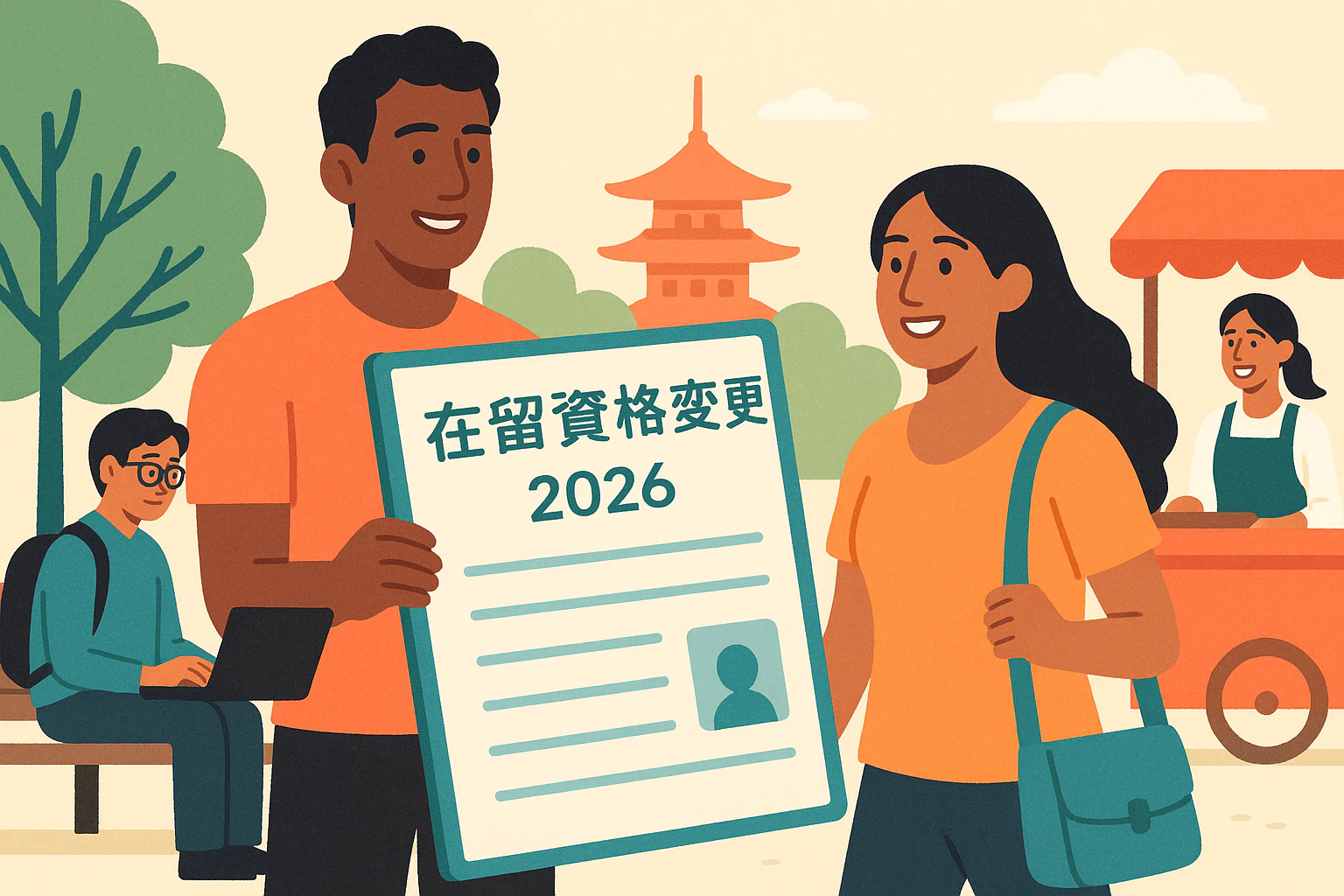
Fast answer: Changing your Japanese residence status (在留資格変更) is the formal process for switching visa categories — student to work, work to spouse, spouse to work after divorce, family dependent to work, and so on. It is governed by 入管法第20条, costs ¥6,000 in person or ¥5,500 online (raised from ¥4,000 in April 2025), and takes 1–2 months for processing.
Three critical rules most applicants get wrong:
- You cannot start the new activity until the new card is issued. A 留学 holder cannot start full-time work while the 技人国 change is pending — doing so is a 資格外活動 violation.
- If your current visa expires during review, a 2-month "special period" (特例期間) covers you — but only if you filed before expiry.
- There is no formal administrative appeal if denied. You refile, apply for 特定活動 as a bridge, or go to administrative litigation. Plan your fallback before submitting.
Information current as of April 2026 based on the ISA 在留資格変更 procedure page, ISA 変更・更新ガイドライン, ISA 特定活動46号, and 2025/12 document-simplification updates for 留学→技人国 transitions.
Every foreign resident's life in Japan eventually involves at least one 在留資格変更: after graduation, after marriage, after a divorce, after switching from dependent family member to independent worker. The process is bureaucratic, partly digitized, and often misunderstood by people used to the visa systems of other countries. This guide walks through the legal framework, the most common transitions, the documents each one requires, and the fallback paths when things don't go as planned.
The legal framework — what 変更 actually is
Under 入管法第20条, a foreign resident wishing to change activities beyond their current residence category must apply for permission (在留資格変更許可). This is distinct from:
- 在留期間更新 (renewal): same category, new validity period
- 在留資格取得 (acquisition): new category without prior status, typically for newborns
- 資格外活動許可 (permission for activities outside status): part-time work within a different category without formally changing status
変更 is a discretionary permission granted by the Minister of Justice (delegated to the regional Immigration Services Bureau). Approval is not guaranteed; the ISA evaluates whether the applicant's planned activity genuinely falls within the requested category, whether supporting documents demonstrate sufficient basis (education, contract, marriage, etc.), and whether any negative factors exist (tax arrears, prior violations, inconsistent history).
Fees and processing time
| Item | Amount / duration |
|---|---|
| Application fee (in person) | ¥6,000 (paid by 収入印紙) |
| Application fee (online via 在留申請オンラインシステム) | ¥5,500 |
| Standard processing time (標準処理期間) | 1–2 months |
| Documents submission | In person at regional Immigration Bureau OR online via the ISA electronic system |
The fee was raised from ¥4,000 to ¥6,000 on April 1, 2025. Processing time can exceed 2 months during peak seasons (March–April for student-to-work transitions, year-end for tax-related category shifts).
The 9 most common transitions
Different transitions have different approval profiles. Here's what to expect for each.
1. 留学 → 技術・人文知識・国際業務
The most frequent transition — new graduates taking up salaried work. Approval likelihood is high if the job duties match the applicant's university major.
Required documents:
- Graduation certificate (卒業証明書) or expected-graduation letter (卒業見込証明書)
- Employment contract showing title, duties, salary (¥250,000+/month is conservative baseline)
- Company registration certificate (履歴事項全部証明書)
- Employer's 法人番号 and tax documents
- Detailed job description matching 技人国 scope
In December 2025, the ISA launched a document-simplification scheme for 留学→技人国 transitions at specific participating companies — if your employer is on the list, several employer documents are waived.
If you graduated but don't have a job offer yet, apply for 特定活動46号 (job-hunting Designated Activities, 6 months renewable to 1 year) as a bridge.
2. 留学 → 特定活動46号 (job hunting after graduation)
Available to graduates of Japanese universities who have not yet secured employment. Valid 6 months, renewable once to 1 year total. Allows 28 hours/week of work and continued job search. Documents: graduation certificate, activity plan, financial evidence.
3. 技人国 → 日本人の配偶者等 (after marriage to Japanese)
Common upgrade path. Approval is straightforward if the marriage is bona fide and well-documented.
Required:
- 戸籍謄本 of Japanese spouse (showing marriage)
- Marriage-bona-fide questionnaire (質問書) — detailed personal history including how you met, cohabitation timeline, Japanese language communication level
- Photos from the relationship and wedding
- Chat/email records if met online
- Both spouses' income/tax records
The 質問書 is the critical document. Brief or inconsistent answers trigger follow-up questions or denial. Put real time into it.
4. 日本人の配偶者等 → 技人国 (after divorce)
A spouse visa becomes invalid when you no longer engage in spousal activities for 6 months. After divorce, the typical path is:
- Immediately file 特定活動 (6 months, for job search)
- Secure employment aligned with a work category (usually 技人国)
- File 在留資格変更 to 技人国
If you have minor children who are Japanese nationals, 定住者 (Long-Term Resident) is often a better landing than 技人国, as it removes work-category restrictions.
For full divorce-and-visa strategy: Divorce in Japan for Foreigners.
5. 家族滞在 → 技人国 or 特定活動
When a dependent family member (spouse or child on a 家族滞在 visa) wants to work beyond the 28-hour/week limit, they change status. Requirements parallel 留学→技人国 (education/experience matching the role).
For dependents who grew up in Japanese schools, a special 特定活動 告示 covers transitions.
6. 技人国 → 経営・管理
Transitioning from employed engineer to entrepreneur or company executive. Requires satisfying 経営・管理 visa requirements including the ¥30 million capital rule effective October 16, 2025. Physical office (virtual not accepted), management experience or business plan, typically a full-time employee.
See: Business Manager Visa 2025: ¥30M Changed Everything.
7. 特定技能1号 → 特定技能2号
Progression within the Specified Skilled Worker visa track. 2号 offers no time limit, family accompaniment, and a path to PR. Available in 11 of the 16 特定技能 fields (excludes 介護 and the 4 fields added in 2024: 自動車運送業, 鉄道, 林業, 木材産業).
Requires passing the 2号 評価試験 (higher skill level) and supervisory/practical experience.
See: Specified Skilled Worker Complete Guide.
8. Work → 留学 (employment to student)
Possible but less common. Requires demonstrating financial capacity for the study period (enrollment documents, funding evidence, plan to return to work afterward). Approval is typically stricter than the reverse direction.
9. 技人国 → 高度専門職 (Highly Skilled Professional)
Point-based transition. 70+ points under the 高度専門職 points system gives you a fast track: 3 years until PR eligibility (80+ points: 1 year). Category 1 types (イ, ロ, ハ) depend on your activity nature. See points table at the ISA 高度専門職 system page.
The 特例期間 (special period) — your cushion
If you file 変更 before your current 在留期間 expires and the ISA hasn't issued a decision by the expiry date, you are automatically covered by the 2-month 特例期間. During this period:
- You remain legally present in Japan
- You can continue your existing authorized activities (i.e., your current visa category)
- You still CANNOT begin the new activity you're applying for
If the application decision comes within the 2 months, you're fine. If not, you must either leave Japan or apply for 特定活動 as an emergency bridge.
What you cannot do during review
The most common violation of 変更 procedure: starting the new activity before the card is issued. The typical scenario:
A 留学 student receives a job offer, signs a contract with a start date in April, files 変更 in February. Processing takes 6 weeks. The student joins the company on April 1 — but the new card arrives on April 15. Those two weeks of full-time work on a student visa are a 資格外活動 violation, even though change was approved.
Correct approach:
- Arrange start date after card issuance
- If start date is fixed and card is delayed, use 資格外活動 permission's 28-hour/week cap to do reduced-hours work until card arrives
- Document everything to explain at future renewal if flagged
When 変更 is denied
Common rejection reasons:
- Job duties do not align with the requested category (e.g., 技人国 requested for a role that's actually basic manual work)
- Education/experience does not support the job category
- Insufficient supporting documents (often fixed by refiling with complete documents)
- Tax/pension arrears on the applicant's record
- Marriage-bona-fide concerns (婚姻の実態 questioned)
- Business plan or capital shortcomings for 経営・管理
There is no formal administrative appeal for 在留資格変更 denials under 行政不服審査法. Options:
- Refile with corrections — most common. Fix the document deficiency or add clarifying evidence.
- Apply for 特定活動 (4-month 出国準備) — gives you time to secure a job or leave with dignity.
- Apply for 特定活動46号 if you're a Japanese university graduate seeking employment.
- Administrative litigation (行政訴訟) — file a 取消訴訟 within 6 months. Expensive, slow, usually requires specialized lawyer.
Documents every 変更 application needs
Regardless of category, every 変更 application includes:
- Application form (様式 specific to the target category)
- Passport (presented at office) + 在留カード
- 3cm×4cm photo taken within 3 months
- ¥6,000 revenue stamp (or ¥5,500 online fee)
- Return envelope (if applying in person)
- Category-specific supporting documents (contract, 戸籍謄本, education certificate, etc.)
Category-specific document lists are available at the ISA procedure page. Each of the 29 residence categories has its own list.
Filing online vs in person
Online filing (在留申請オンラインシステム) is available for most categories since 2023. Benefits:
- ¥500 cheaper (¥5,500 vs ¥6,000)
- No waiting at Immigration Bureau
- Can track application status online
Drawbacks:
- First-time users must register and be linked to Myna card or 在留カード number
- Large attachments (scanned contracts, photos) can take time to upload correctly
- Some categories still require a document exchange at a physical office before completion
For straightforward cases (renewal, 留学→技人国 with clear job match), online is cleaner. For complex cases (marriage, business manager, first-time applicants), in-person filing lets you correct minor issues at the counter.
Special case: status change while overseas
You cannot file 在留資格変更 from outside Japan. If you are overseas when your current visa expires, you must apply for 在留資格認定証明書 (Certificate of Eligibility) at a Japanese embassy, then enter Japan with the new category. This is called 認定 (recognition), not 変更.
If you are in Japan but travel abroad during the review period, obtain a 再入国許可 (re-entry permit) beforehand — otherwise your 変更 application will be terminated upon departure.
Before filing: a 10-minute self-check
- Does your target category genuinely match the activity you plan to do? (Not the activity title, the actual work)
- Do you have all required supporting documents?
- Are your tax, pension, and NHI records clean? If not, clean them up before filing.
- Have you filed the 14-day notification for any recent employer changes?
- Is there a gap in your activity history? If so, prepare a brief written explanation.
- Is your current 在留期間 expiring within 2 months? File early.
- Do you have a fallback plan if denied (refile, 特定活動, leave Japan)?
When to hire a 行政書士 or immigration lawyer
Self-filing is practical for straightforward transitions (clean record, well-matched category, unambiguous documents). Professional help is worth the fee (¥50,000–¥200,000 depending on complexity) when:
- You have past tax/pension arrears or visa compliance gaps
- Your work history is complex (multiple companies, freelance mixed with employment)
- You're changing to 経営・管理 (high stakes, complex capital/office requirements)
- A previous 変更 application was denied
- Your marriage is international, cross-cultural, or remote-origin (met online)
- You're on the margins of a category (e.g., university major doesn't cleanly match the job)
The bottom line
在留資格変更 is the workhorse procedure of long-term foreign life in Japan. It's routine when the category matches, cheap (¥5,500–¥6,000), and usually fast (1–2 months). It fails on three things: category mismatch, documentation gaps, and clean-record problems (unpaid tax/pension/NHI). Check yourself against those three before filing, and keep a 特定活動 fallback in mind.
For the full visa-risk map: Your Japan Visa: The 10 Threats That Cost Foreigners Their Status. For overstay recovery if you've already fallen out of status: Japan Overstay Recovery.
Written by

Founder, LO-PAL
Former Medical Coordinator for Foreign Patients (Ministry of Health programme) and legal affairs professional. Built LO-PAL from firsthand experience navigating life abroad.
Written with partial AI assistance
Read full bio →