How to Divorce in Japan Without Losing Your Kids or Your Visa
Japan's 2026 custody reform changes everything. Mutual consent divorce, visa deadlines, the unknowing divorce trap, and what foreigners must know.

3 dangers foreigners miss: (1) Your Japanese spouse can submit a divorce form without your consent — and it's legally valid unless you've filed a block. (2) You must notify immigration within 14 days or face visa consequences. (3) Losing custody can mean losing your right to stay in Japan entirely. As of April 2026, joint custody is now legally available — but the details matter.
Information current as of April 2026 based on Japan's Ministry of Justice, the revised Civil Code (effective April 1, 2026), and Ministry of Foreign Affairs Hague Convention guidance.
If you're facing divorce in Japan as a foreigner, you're dealing with a system that was designed for two Japanese citizens — and it shows. The paperwork is in Japanese, the defaults favor the parent who acts first, and your visa is tied to a marriage that's about to end. I work as a legal affairs professional in Japan, and the cases that go worst are always the ones where the foreign spouse didn't know the rules until it was too late.
This guide covers the process, the traps, and what changed on April 1, 2026.
4 Ways to Divorce in Japan
| Type | How It Works | Share of Cases |
|---|---|---|
| 協議離婚 (Kyōgi Rikon) | Both sign a form, submit to ward office. No court needed. | ~87% |
| 調停離婚 (Chōtei Rikon) | Mediation at family court with 2 mediators | ~10% |
| 審判離婚 (Shinpan Rikon) | Family court judge decides after failed mediation | ~1% |
| 裁判離婚 (Saiban Rikon) | Full litigation — requires legal grounds (adultery, abandonment, etc.) | ~2% |
For most international couples, kyōgi rikon (mutual consent divorce) is the fastest path. You both sign the 離婚届 (rikon todoke — divorce registration form), take it to the ward office, and the divorce is effective that day. No judge, no waiting period.
At the counter, say:
離婚届を提出したいです (Rikon todoke o teishutsu shitai desu) — I would like to submit a divorce registration form.
You'll need two adult witnesses (Japanese or foreign, age 18+) to sign the form. The foreign spouse's name must be written in katakana.
The "Unknowing Divorce" Trap
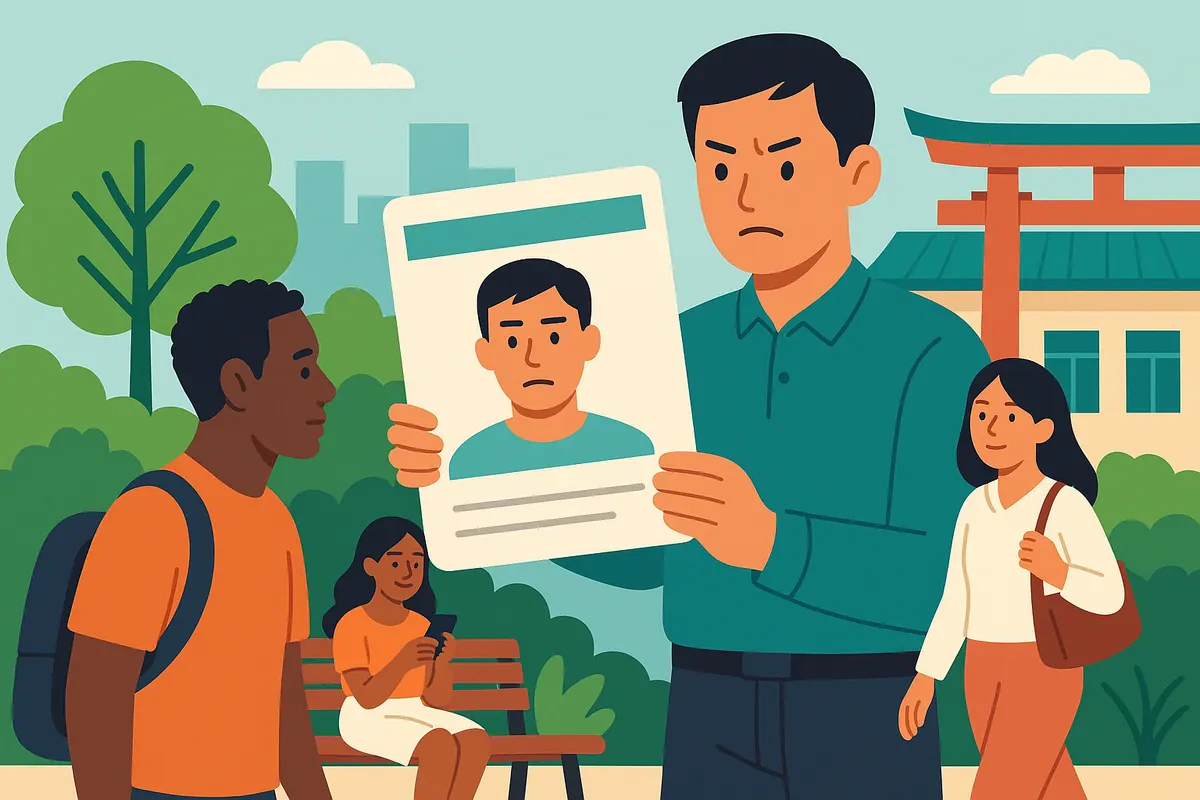
This is the danger that other guides bury in a footnote. In Japan, ward offices do not verify that both signatures on a divorce form are genuine. Your Japanese spouse can fill out the form, forge or coerce your signature, submit it — and you are legally divorced. Your spouse visa is immediately in jeopardy, and if the form includes a custody designation, you may have lost parental rights without knowing.
One foreigner shared on a GaijinPot forum: "I found out I was divorced when immigration asked why I was still on a spouse visa. My ex had submitted the form months ago and checked the box giving herself sole custody." Individual experiences may vary, but this scenario is well-documented.
How to protect yourself: File a 離婚届不受理申出 (rikon todoke fujuri mōshide — petition for non-acceptance of divorce registration) at your local ward office or at the ward office of your spouse's registered domicile (本籍地). Once filed, the ward office will reject any divorce form submitted without your in-person confirmation.
離婚届不受理申出をしたいです (Rikon todoke fujuri mōshide o shitai desu) — I would like to file a non-acceptance petition for divorce.
Bring your residence card and fill out the form at the counter. It's free, takes effect immediately, and remains valid indefinitely (the previous 6-month limit was removed). If you have any suspicion that your spouse might file without your consent, do this today.
2026 Joint Custody Reform — What Actually Changed
On April 1, 2026, Japan's revised Civil Code took effect, ending over a century of mandatory sole custody after divorce. Here's what's new:
- Joint custody (共同親権 — kyōdō shinken) is now an option. Divorcing parents can agree to share legal parental authority, or a family court can order it — even if one parent objects.
- Statutory child support: Even without an agreement, a parent can now claim a minimum of ¥20,000/month per child from their ex-spouse. This is a new legal floor that didn't exist before.
- Priority asset seizure: If your ex-spouse doesn't pay child support, you can seize their assets on a priority basis — up to ¥80,000/month per child. The government is also subsidizing the costs of salary seizure proceedings.
What hasn't changed: Visitation enforcement remains weak in practice. A court can order visitation (面会交流 — menkai kōryū), but there is still no effective penalty for the custodial parent who refuses to comply. High-profile cases — including French father Vincent Fichot's hunger strike and Australian journalist Scott McIntyre's public campaign — highlight that having legal rights and actually seeing your children are still two different things in Japan.
If you're negotiating custody terms and the legal language feels impossible to follow — which is normal, even Japanese parents struggle with family court documents — that's exactly the situation where having a local person in your corner helps. On LO-PAL, you can post your question for free and get guidance from local Japanese people, including those with legal or administrative experience. If you need someone to accompany you to the ward office or family court, you can request that as a task — you only pay when it's done.
Your Visa After Divorce — The 14-Day Clock
If your residence status is Spouse or Child of Japanese National (日本人の配偶者等) or Spouse of Permanent Resident, divorce triggers an immediate obligation:
- Within 14 days: Notify the Immigration Services Agency of your divorce. Failure to report violates Article 19-16 of the Immigration Control Act and can be used against you in future applications.
- 6-month grace period: After notification, you have roughly 6 months to either change your status or leave Japan. Immigration can revoke your residence status if you remain on a spouse visa without being married.
Your options depend on your situation:
| Situation | Visa Path | Key Requirement |
|---|---|---|
| You already have Permanent Residency | No change needed | PR is not affected by divorce |
| Raising a child with Japanese nationality | 定住者 (Long-Term Resident) | Custody of the child + stable income (marriage duration often waived) |
| Married 3+ years, no children | 定住者 (possible) | Stable income + demonstrated ties to Japan |
| You qualify for a work visa | 技術・人文知識・国際業務 etc. | Matching job + degree/experience |
| None of the above | Departure or other status | Consult immigration lawyer |
入国管理局に届出をしたいです (Nyūkoku kanrikyoku ni todokede o shitai desu) — I would like to file a notification with the Immigration Bureau.
Will Your Home Country Recognize the Divorce?
Japan's mutual consent divorce (kyōgi rikon) is fast and cheap — but some countries don't recognize an extrajudicial divorce (one without court involvement).
| Country | Recognition of Kyōgi Rikon | Notes |
|---|---|---|
| USA | Usually recognized, but not settled law | Most states accept foreign divorces; non-judicial divorce recognition varies — confirm with your state |
| Philippines | Requires judicial recognition | Must file a petition in Philippine court — cannot simply register Japanese divorce |
| China | Generally yes | Register at Chinese embassy/consulate in Japan |
| South Korea | Generally yes | Register at Korean embassy/consulate |
| UK / EU | Varies | Some EU countries require court-based divorce; check with embassy |
Philippines nationals: This is especially important. The Philippines does not recognize divorce under its own law. If you divorce in Japan, you must file a petition for judicial recognition of foreign divorce in a Philippine court before the divorce is effective under Philippine law. Without this step, you cannot legally remarry in the Philippines.
Money — Property, Pension, and the New Child Support Floor
Financial matters are negotiated separately from the divorce form itself — kyōgi rikon only requires agreement on custody, not on money. But don't skip this step.
- Property division (財産分与 — zaisan bunyo): The default is a roughly 50/50 split of assets acquired during the marriage. This includes savings, real estate, and investments — but not pre-marriage assets or inheritances.
- Pension split (年金分割 — nenkin bunkatsu): If one spouse was on 厚生年金 (Employees' Pension) during the marriage, the other can claim up to 50% of those contributions. You must file within 2 years of the divorce — miss this deadline and the right is gone.
- Child support (養育費 — yōikuhi): As of April 2026, you can claim a minimum of ¥20,000/month per child even without an agreement. If your ex doesn't pay, the new priority seizure mechanism lets you go after their salary and assets.
Related Articles
- How to Get Married in Japan Without a City Hall Rejection — The procedures you'll now be unwinding
- Japan Spouse Visa Application — Understanding the visa you're about to lose
- Japan Permanent Residency Guide — If you have PR, divorce doesn't affect your status
Book a Local Helper to Go with You
Divorce paperwork in Japan is stressful enough in your native language — doing it in Japanese, with custody and visa consequences on the line, is another level. On LO-PAL, you can find a local Japanese person to accompany you to the ward office or family court, help translate documents, and make sure you don't sign anything you don't understand. Posting your question is free — you only pay when you accept a helper's completed task.
Written by

Founder, LO-PAL
Former Medical Coordinator for Foreign Patients (Ministry of Health programme) and legal affairs professional. Built LO-PAL from firsthand experience navigating life abroad.
Written with partial AI assistance
Read full bio →