Typhoon Delays Your Japan Flight? Rebooking & Where to Sleep

The all-in-one Japanese learning app
From travel phrases to real fluency — all in one app.
All 2,136 standard kanji included. Every feature is free to use.
When a typhoon cancels your flight in Japan, the airline — not the airport — decides what happens next. ANA and JAL rebook for free; LCCs may leave you waiting days. This guide covers rebooking policies, where to sleep at the airport, and how to get out faster.
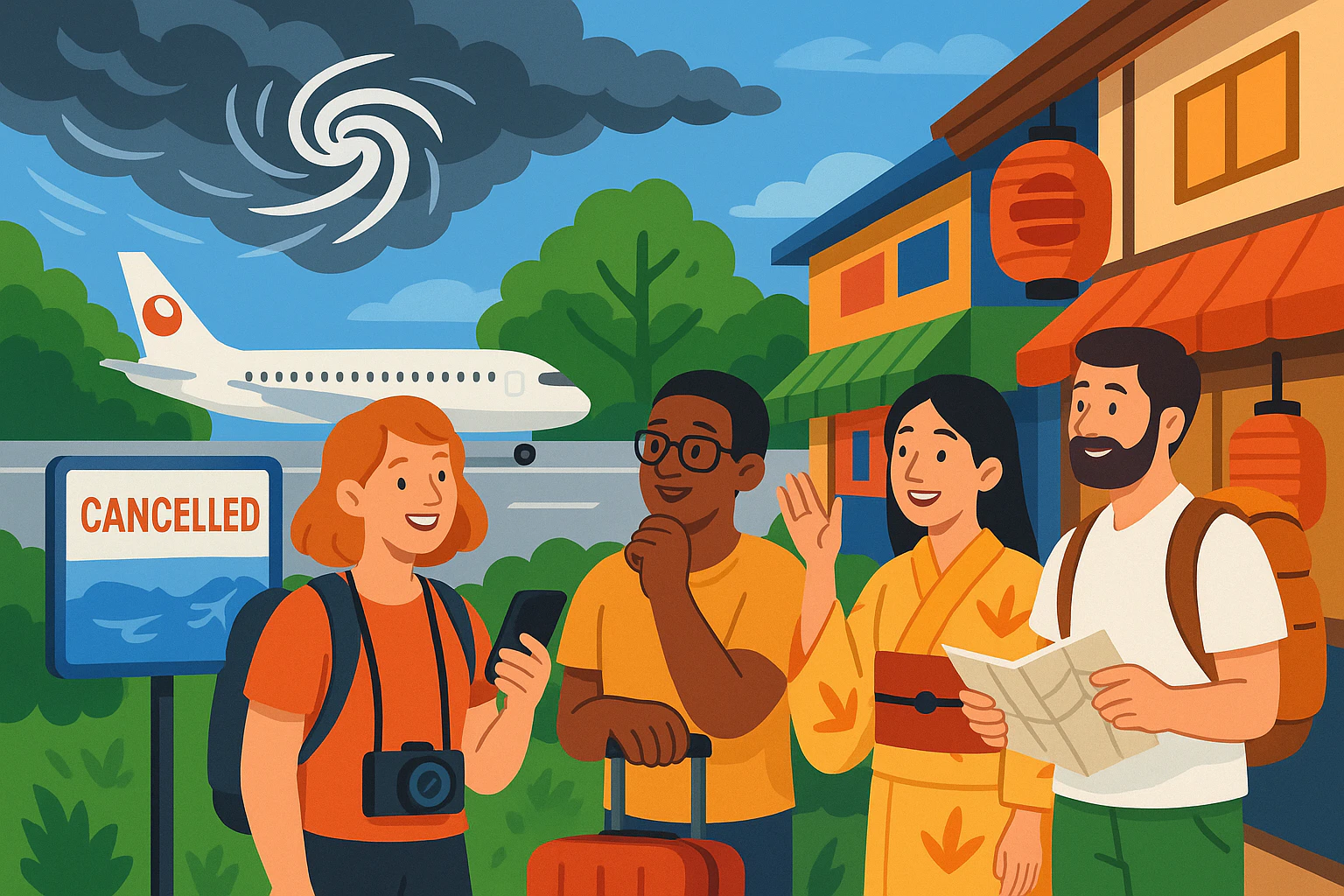
Bottom line: When a typhoon hits Japan, airlines — not the airport — decide whether to cancel your flight. Check your airline's app first, not the airport's departure board. Domestic carriers (ANA, JAL) typically rebook for free during weather events; international carriers and LCCs vary wildly. This guide covers what to do at each stage: before the typhoon lands, when your flight gets cancelled, and where to sleep when every hotel near the airport is full.
Information current as of April 2026 based on airline policies from ANA, JAL, Peach Aviation, Jetstar Japan, and official airport operations pages. I'm Kanaya, founder of LO-PAL — I've helped stranded travelers at Kansai International, Naha, and Narita figure out their options when rebooking counters had 3-hour lines and all the signs were in Japanese.
Typhoon season in Japan: when to worry
Japan's typhoon season runs June through October, with peak activity in August and September. On average, 25 typhoons form in the western Pacific each year, and about 3 make direct landfall on Japan. Even typhoons that don't make landfall can disrupt flights — airports suspend operations based on wind speed, not the storm's center.
The airports most frequently affected:
| Airport | Risk period | Typical disruption |
|---|---|---|
| Naha (OKA) | July – October | Highest risk. Okinawa is the first landfall point for most typhoons. |
| Kansai (KIX) | August – September | Built on artificial island — vulnerable to storm surge and wind. |
| Narita (NRT) | August – October | International flights disproportionately affected. |
| Haneda (HND) | August – October | Domestic hub. Delays cascade nationwide. |
| Fukuoka (FUK) | August – September | Kyushu sees early-season typhoons. |
Before the typhoon: preparation checklist
If a typhoon is forecast 2-3 days out:
- Check the JMA typhoon track forecast: The JMA typhoon tracking page shows the predicted path and timeline. It's the most accurate source for Japan — more reliable than international weather sites for local impact.
- Check your airline's weather waiver: Before a major typhoon, airlines issue weather waivers (特別対応) that let you rebook for free — even on non-refundable tickets. Check your airline's website or app under "flight status" or "weather information."
- Consider rebooking early: If a waiver is issued and you can leave a day early or a day late, do it. Seats fill up fast once cancellations start.
- Download your airline's app: Cancellation notices and rebooking options hit the app before the departure board. Enable push notifications.
- Book accommodation backup: If your flight might be cancelled, book a refundable hotel near the airport before everyone else does. Airport-area hotels sell out within hours of major cancellation announcements.
Your flight is cancelled: what happens next
Full-service carriers (ANA, JAL)
ANA and JAL handle weather cancellations well by international standards:
- Free rebooking to the next available flight — typically within 1-3 days during typhoon season
- Full refund option if you don't want to wait
- Rebooking via app or website — much faster than the airport counter. JAL's app lets you pick your new flight; ANA's similarly allows online changes.
- No hotel or meal vouchers for weather cancellations. This is standard worldwide — weather is "force majeure," so airlines aren't required to cover accommodation.
LCCs (Peach, Jetstar Japan, Spring Japan)
Budget carriers have more restrictive policies:
- Peach Aviation: Offers rebooking to the next available Peach flight or a refund (as Peach Points or to original payment method, depending on fare type). No routing to other airlines.
- Jetstar Japan: Similar — rebooking to next Jetstar flight or refund. Some fare types restrict refund options.
- Spring Japan: Rebooking or refund, but availability on alternative flights is limited due to smaller schedules.
The LCC trap: Budget carriers fly fewer routes with fewer daily flights. If your Peach flight from Naha is cancelled, the next available Peach seat might be 2-3 days away. Full-service carriers have more daily flights and can rebook you sooner. If time matters more than money, consider buying a one-way ANA/JAL ticket to get out.
International carriers
Policies vary widely. Most international airlines will rebook you for free if they've cancelled your flight, but the key differences are:
- Rerouting options: Some airlines can route you through a different Japanese airport (e.g., Haneda instead of Narita). Ask at the counter.
- Partner airlines: Star Alliance carriers (ANA, United, etc.) can sometimes rebook you on a partner airline. Same for Oneworld (JAL, AA, BA) and SkyTeam.
- Contact your home country's customer service: Japanese phone lines at the airport will have long wait times. Call your airline's customer service in your home country — different time zone, shorter queues, English-speaking agents.
At the airport: surviving the wait
Where to sleep
When a typhoon cancels dozens of flights, thousands of passengers are suddenly stuck. Here's where to sleep:
| Option | Cost | Notes |
|---|---|---|
| Airport floor | Free | Airports remain open 24/7 during typhoons. Staff may distribute blankets and water. Narita and Kansai have areas where sleeping is tolerated. |
| Capsule hotels / transit hotels | ¥3,000 – ¥6,000 | Narita has Nine Hours and other capsule options inside the terminal. Kansai has First Cabin (if available). Book online immediately — they fill within hours. |
| Airport-area hotels | ¥8,000 – ¥20,000+ | Book as early as possible. Use Booking.com or Agoda filtered by "free cancellation" in case your rebooked flight departs earlier than expected. |
| City hotels | Varies | If airport-area hotels are full, take a train to the nearest city (Tokyo from Narita, Osaka from Kansai). More availability, but check that trains are running. |
Essentials to have
- Phone charger / portable battery — airport outlets get claimed fast. Bring a portable battery.
- Cash — some airport vending machines and smaller shops are cash-only. ATMs may have long lines.
- Water and snacks — convenience stores inside airports run out of food during mass cancellations. Buy supplies early.
- Your boarding pass or booking reference — you'll need it for rebooking.
Trains and ground transport during typhoons
Japanese rail companies practice planned suspension (計画運休, keikaku unkyu) — they announce train stoppages in advance, usually 12-24 hours before a typhoon arrives. This means:
- Trains stop before the typhoon hits, not during. You may be unable to get to the airport even if your flight hasn't been cancelled yet.
- Trains resume after the typhoon passes, usually within a few hours of wind speeds dropping. Check JR East train status or your local rail company's app.
- The Narita Express and Airport Limousine Bus follow the same planned suspension schedule. If trains are stopped, buses usually are too.
Travel insurance: does it cover typhoon delays?
Most travel insurance policies cover typhoon-related delays, but the specifics matter:
- Covered: Additional hotel costs, meals, and transportation caused by a flight cancellation due to weather — typically after a 6-12 hour delay threshold.
- Usually NOT covered: Voluntarily changing your flight before a cancellation is officially announced. If you rebook early to avoid the typhoon, your insurance may not reimburse the difference.
- Documentation needed: Your airline's official cancellation notice (screenshot the email or app notification), receipts for hotel and meals, and your original booking confirmation.
Stuck at a Japanese airport during a typhoon and can't read the announcements? Post on LO-PAL for free — a local helper can call the airline on your behalf, translate rebooking options, or even meet you at the airport to help navigate the chaos.
This guide is part of our Japan Travel Safety Guide.
Written by

Founder, LO-PAL
Former Medical Coordinator for Foreign Patients (Ministry of Health programme) and legal affairs professional. Built LO-PAL from firsthand experience navigating life abroad.
Written with partial AI assistance
Read full bio →