Earthquake in Japan? What Tourists Should Do Now (2026)

The all-in-one Japanese learning app
From travel phrases to real fluency — all in one app.
All 2,136 standard kanji included. Every feature is free to use.
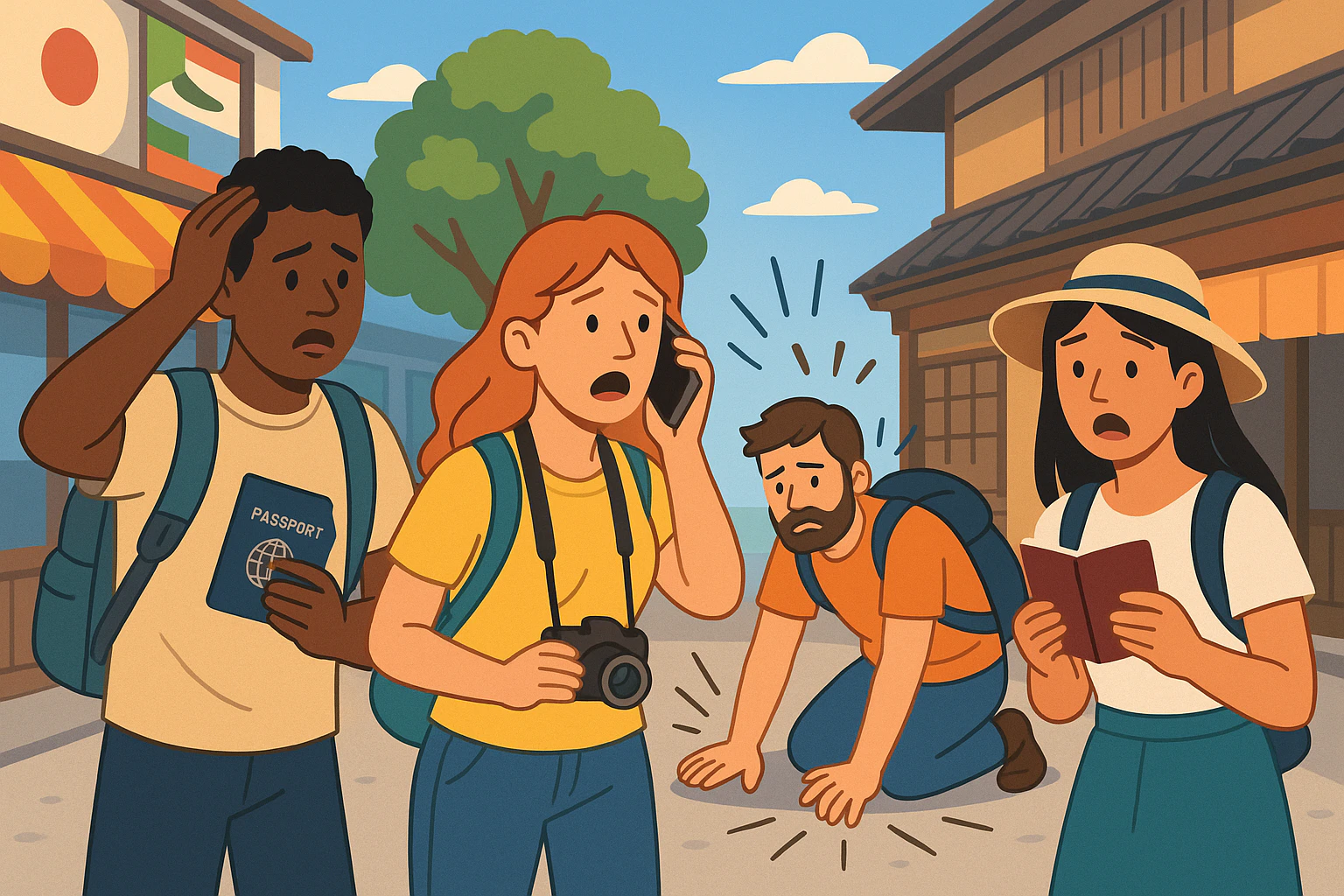
Japan averages over 1,500 felt earthquakes per year. If the ground starts shaking: do NOT run outside. Drop under a table, cover your head, hold on. This guide covers what to do during and after an earthquake, tsunami warnings, evacuation shelters, and how to contact family.
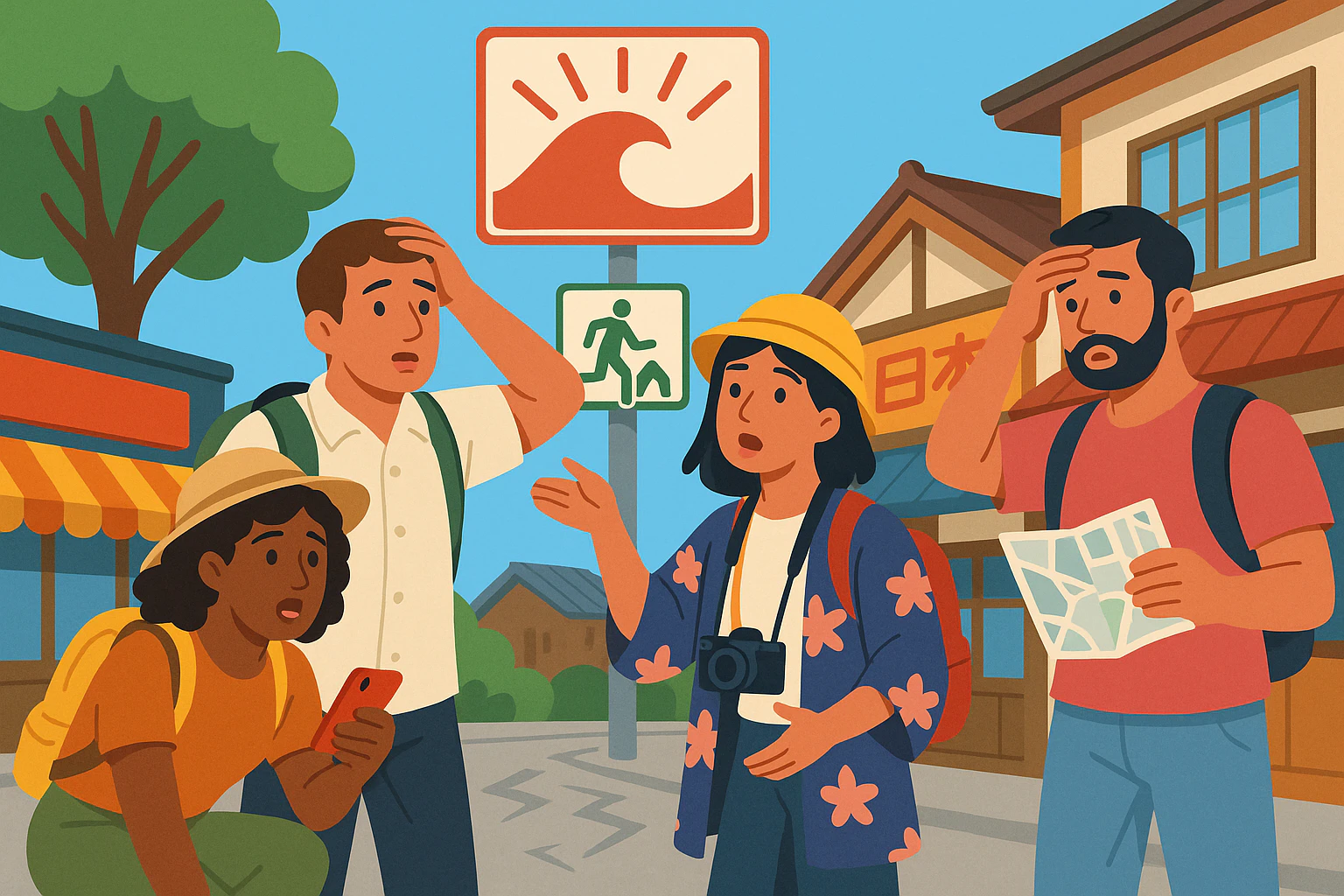
If the ground starts shaking right now: Do NOT run outside. Drop under the nearest table, cover your head, hold on. Shaking usually lasts 10-30 seconds. After it stops: check your phone for tsunami warnings (your phone will blast an alarm if one is issued), move away from the coast if you're near it, and head to the nearest evacuation shelter if the building is damaged. Japan's buildings are designed for earthquakes — you're safer inside than running through falling debris.
Information current as of April 2026 based on the Japan Meteorological Agency (JMA), Cabinet Office disaster prevention, and the Fire and Disaster Management Agency (FDMA). I'm Kanaya, founder of LO-PAL. I was in Osaka during the 2018 earthquake — the first thing I noticed was that the foreigners I knew had no idea what the alarm on their phone meant or what to do next. That's why this guide exists.
During the earthquake: what to do in the first 30 seconds
If you're inside a building
- Drop, Cover, Hold On. Get under a sturdy table or desk. Cover your head and neck. Hold on until shaking stops.
- Stay away from windows, mirrors, and heavy furniture that could fall or shatter.
- Do NOT use elevators. If you're in one when shaking starts, press all floor buttons — get out at the first floor that opens.
- Do NOT run outside. Falling glass, signs, and tiles are the biggest danger. Modern Japanese buildings (built after 1981) are designed to withstand major earthquakes.
If you're outside
- Move to an open area away from buildings, power lines, and vending machines.
- Protect your head with your bag or hands — falling objects are the primary cause of earthquake injuries.
- Watch for block walls (ブロック塀). Older concrete block walls are one of the most dangerous structures in an earthquake — they collapse without warning. The 2018 Osaka earthquake killed a child when a school's block wall collapsed.
If you're on a train
Japan's rail system has seismic sensors that automatically stop all trains when an earthquake is detected. You may feel a sudden hard brake before you feel the shaking itself. Hold the handrails tightly and follow crew instructions. Do NOT try to exit the train unless directed by staff — the tracks may be damaged or electrified.
If you're driving
- Slow down gradually and pull to the left side of the road.
- Stay in the car until shaking stops — the car's suspension absorbs a lot of the shaking.
- Leave your keys in the ignition if you need to abandon the car — emergency vehicles may need to move it.
After the earthquake: the first 10 minutes
Check for tsunami warnings immediately
This is the most important step. Japan's Earthquake Early Warning (緊急地震速報) and tsunami warning system will send an alert directly to your phone — a loud, unmistakable alarm sound that overrides silent mode. The alert arrives in Japanese, but the word 津波 (tsunami) and the alarm tone are unmistakable.
If you're near the coast and a tsunami warning is issued: Move to high ground immediately. Don't wait. Don't go to the beach to watch. Tsunami waves arrive within minutes of an offshore earthquake. Head for terrain at least 10 meters above sea level or go to the 3rd floor or higher of a reinforced concrete building.
Tsunami evacuation buildings (津波避難ビル) are marked with a blue sign showing a wave and an upward arrow. Many coastal cities in Japan have them on every block near the shore.
Download these apps if you haven't already
| App | Languages | Best for |
|---|---|---|
| Safety Tips (Japan Tourism Agency) | 15 languages | Earthquake, tsunami, weather alerts with English push notifications |
| NHK World | English + 17 languages | Live earthquake coverage, news updates |
| Google Maps | All | Finding nearby evacuation shelters ("避難所" in search) |
Find an evacuation shelter if needed
Evacuation shelters (避難所, hinanjo) are located at schools, community centers, and parks throughout Japan. They're open to everyone — including tourists. Look for the green signs with a running figure and an arrow. You can also:
- Search Google Maps for 避難所 (hinanjo)
- Ask at any convenience store — staff will know the nearest shelter
- Check the Safety Tips app, which shows nearby shelters on a map
What to bring if you evacuate: passport, phone, charger, water, medications, cash (ATMs may be down). Shelters provide basic supplies but you may wait hours before food is distributed.
Understanding Japan's earthquake intensity scale
Japan uses its own seismic intensity scale (震度, shindo), which measures what you actually feel at your location — not the earthquake's magnitude. This is what local warnings use:
| Shindo | What you feel | What to do |
|---|---|---|
| 1-2 | Slight shaking, like a truck passing | Nothing — this happens daily in Japan |
| 3 | Noticeable swaying, hanging objects move | Stay alert, no action needed |
| 4 | Strong shaking, unstable objects fall | Get under a table, hold on |
| 5 Lower | Difficult to walk, furniture slides | Drop, cover, hold on. Check tsunami warnings after. |
| 5 Upper | Impossible to stand without holding something | Serious. Prepare to evacuate if building is damaged. |
| 6 Lower | Thrown off your feet, doors jam | Evacuate after shaking stops if safe. Expect aftershocks. |
| 6 Upper - 7 | Buildings may collapse, impossible to move | Major earthquake. Follow all evacuation orders. |
Aftershocks: they keep coming
After a significant earthquake, expect aftershocks for hours or days. Some aftershocks can be nearly as strong as the original quake. The 2024 Noto Peninsula earthquake (M7.6) in Ishikawa Prefecture was followed by hundreds of aftershocks over the following weeks, some above shindo 5.
Do NOT re-enter a damaged building even if shaking has stopped. Aftershocks can cause weakened structures to collapse.
The Nankai Trough: Japan's biggest concern
The Japanese government estimates approximately an 80% probability of a magnitude 8-9 earthquake along the Nankai Trough (南海トラフ) within the next 30 years. This would affect the Pacific coast from Shizuoka to Kyushu — including Tokyo, Nagoya, Osaka, and Kobe. In August 2024, the JMA issued the first-ever "Nankai Trough Earthquake Extra Information" advisory after a M7.1 earthquake off Miyazaki, urging heightened preparedness for one week.
For tourists: this doesn't mean you shouldn't visit Japan. It means you should know the drill. The 30 seconds of knowledge in the first section of this guide could be the difference that matters.
Communicating with family back home
After a major earthquake, phone networks get jammed. Here's the priority order for contacting family:
- Messaging apps (LINE, WhatsApp, iMessage) — use much less bandwidth than voice calls
- Social media — post a status update on Facebook/X/Instagram so multiple people see it at once
- Google/Apple emergency contact features — "mark yourself safe" features activate after major disasters
- Phone calls — try these last, as voice networks are the first to jam
Register with your country's embassy in Japan before your trip. The U.S. has the STEP program, the UK has FCDO registration, and most countries have similar services. This lets your government contact you and send evacuation information if needed.
Quick Japanese for earthquake emergencies
| Japanese | Romanization | Meaning |
|---|---|---|
| 地震 (じしん) | jishin | earthquake |
| 津波 | tsunami | tsunami |
| 避難所 | hinanjo | evacuation shelter |
| 高台に逃げて | takadai ni nigete | run to high ground |
| 大丈夫ですか | daijoubu desu ka | are you okay? |
| 助けてください | tasukete kudasai | please help me |
| 余震 | yoshin | aftershock |
Caught in an earthquake in Japan and need help communicating? Post on LO-PAL for free — a local helper can check on you, help you navigate evacuation shelters, or translate with emergency services.
This guide is part of our Japan Travel Safety Guide.
Written by

Founder, LO-PAL
Former Medical Coordinator for Foreign Patients (Ministry of Health programme) and legal affairs professional. Built LO-PAL from firsthand experience navigating life abroad.
Written with partial AI assistance
Read full bio →