Late Night Japan Airport Transfers: Cheap Options + Where to Sleep

The all-in-one Japanese learning app
From travel phrases to real fluency — all in one app.
All 2,136 standard kanji included. Every feature is free to use.
Missed the last train? Use this survival guide for Narita, Haneda, and Kansai: cheapest late options plus sleep and shower backups.
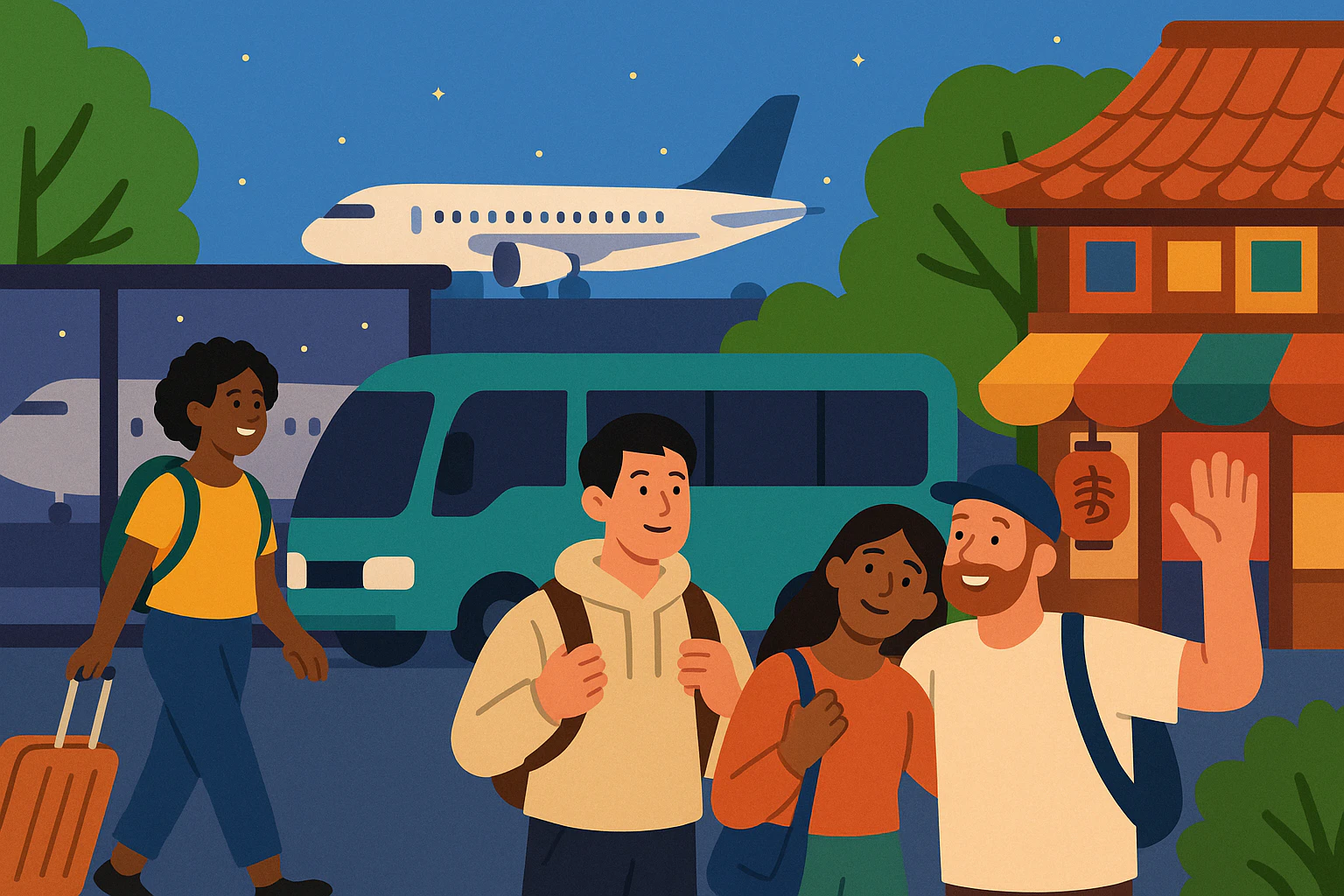
Landing in Japan late is one of the easiest ways to blow your budget on a panic taxi—especially if immigration is slow, baggage is delayed, or you simply misjudged the “last train” time. This guide to late night Japan airport transfers is a missed-last-train survival plan: the cheapest safe options that still run, plus realistic Plan B sleeping (and shower) options at Narita, Haneda, and Kansai.
It’s also more important than it used to be. Japan’s inbound travel has been extremely busy—JNTO reported 36,869,900 international visitors in 2024, an all-time annual record—so queues and sell-outs are a real thing. For the same year, the Japan Tourism Agency reported record inbound spending, which tracks with higher accommodation demand during peak seasons like late March–April. If you arrive late, you want a Plan B before you need it.
For reference, JNTO’s 2024 annual estimate is published in its official release (訪日外客数 2024年12月および年間推計値), and major Japanese reporting also summarized the Japan Tourism Agency’s 2024 spending results (Asahi Shimbun).
Mindset shift: If you land late and the trains are gone, the cheapest “transfer” is often not moving at all until morning—sleep/shower at or next to the airport, then take the first train/bus with a clear head.
What to do first after landing late (a 10-minute checklist)
The first 10 minutes after you clear arrivals determines whether you’ll get a budget ride, a reasonable sleep plan, or a costly mistake. Use this quick checklist before you start walking randomly between terminals.
- Check the actual local time (Japan Standard Time) and your energy level. If it’s already close to midnight, assume you may not make any “last” service.
- Confirm your terminal’s overnight rules (some terminals/areas close). Find the airport’s official “late night / early morning” page and check what stays open.
- Get cash as a backup. Even in 2026, some late-night transport requires cash, or card acceptance is limited at specific points.
- Decide: move now vs. sleep first. If you can only reach a far-away station at 1:00 a.m., that’s not a win—choose a safe sleep option and move at 5:00–7:00 a.m.
- Find the bus/train ticketing point immediately. Late-night routes can be non-reserved and run on queues, so you want to locate the correct counter/stop early.
- Check payment rules before you line up. Some buses take transportation IC cards; some do not accept credit cards onboard; some require mobile tickets.
- Secure your luggage plan: use lockers or keep bags physically attached (strap around leg/arm) if you plan to nap in public seating.
- Message your hotel (if you have one) to note late arrival. If you’ll miss check-in, decide whether to rebook near the airport instead of paying for a room you won’t reach.
- Charge your phone and save offline info: screenshot your hotel address, the morning route, and the first departure time.
- Set two alarms for the morning (phone + watch). If you fall asleep in a lounge/capsule, you still need to catch the first affordable ride.
If you need a quick refresher on transport IC cards for short-term visitors (and how tourists are using them for transit and small purchases), see our guide Suica vs PASMO for Tourists 2026: Tap-to-Pay Food + Transit.
Narita (NRT) to Tokyo late at night: cheapest routes + when to stay put
Narita is the classic “I missed the last train” airport: it’s farther from central Tokyo than Haneda, and small delays at arrival can flip your plan from train to chaos. The goal is to either catch the one budget service that still runs—or stop moving and sleep cheaply at/near the terminals.
Step 1: Confirm what parts of Narita are open overnight
Narita Airport publishes an official “Terminal Use at Night and Early Mornings” page that’s worth bookmarking. It shows that some floors/areas are available 24 hours, while others are limited to roughly 05:00–24:00 depending on terminal and floor. For example, Terminal 1’s 1F and B1F are listed as available 24 hours, and Terminal 2’s 1F, 2F, and B1 are listed as available 24 hours (while some upper floors are not). Check the latest here: Narita Airport: Terminal Use at Night and Early Mornings.
That same page lists a few genuinely helpful 24-hour basics: a 24-hour convenience store in each terminal area (e.g., LAWSON in Terminal 1 B1F, 7-Eleven in Terminal 2 B1F) and 24-hour restaurants like Yoshinoya (Terminal 2) and Matsuya (Terminal 3). These are lifesavers when everything else is closed. Details can change, so always confirm on the official Narita page above.
The cheapest transfer that still runs: Airport Bus TYO-NRT (when you can catch it)
Narita to Tokyo cheapest way late in the day is often the low-cost highway bus brand Airport Bus TYO-NRT, if your arrival matches one of its late-night/early-morning services. The operator positions the standard one-way fare around ¥1,500 (daytime), and notes that late-night/early-morning services are priced at a doubled fare of ¥3,000. See the official fare and riding flow here: Airport Bus TYO-NRT: Riding the Bus / Fare.
Key pain-point details (directly from the operator):
- Tokyo → Narita (e.g., from Ginza): buses are non-reserved, and you pay cash or transportation IC card when boarding. (official riding flow)
- Narita → Tokyo Station: you typically buy a ticket at the terminal ticket counter for a specific bus, and the bus is described as non-reserved seating once onboard. (official riding flow)
- Very last bus rule: for the last bus departing Narita Airport, the operator instructs passengers to go directly to the bus stop and pay on board with cash or transportation IC card—and clearly states credit cards are not accepted. (official riding flow)
Practical advice: if you’re targeting the last/late bus, don’t linger in arrivals. Go straight to the bus stop area, confirm the correct queue, and keep enough cash/IC balance for ¥3,000 per adult.
When it’s smarter to stay at Narita until morning
Staying put is usually the best move if (1) you’re not 100% sure you’ll catch the late bus, (2) you’re traveling solo and tired, (3) you have a lot of luggage, or (4) your only remaining option is a very expensive taxi plus a hotel you can’t properly check into.
Narita’s official overnight access info makes it clear that not every area stays open, so your “stay put” plan should be intentional: choose a 24-hour accessible floor/area, get food/water, charge devices, and decide whether you’re using a capsule hotel or a paid refresh space. Start with the official terminal overnight guidance here: Narita Airport: Night/Early Morning Terminal Access.
Plan B sleep options at/connected to Narita (realistic + budget-aware)
1) “nine hours Narita Airport” capsule hotel (connected to Terminal 2 area)
Narita Airport’s official facility listing describes “nine hours Narita Airport” as a capsule hotel with 24-hour reception and check-in. It’s also explicitly positioned for early flights, late arrivals, and short naps/showers. See the official Narita facility page here: Narita Airport: Capsule Hotel (nine hours).
- Day use: 1,500 JPY for the first hour (then 500 JPY per hour). (official)
- Shower only: 1,000 JPY (up to 1 hour). (official)
- Check-out: 10:00 a.m. (official)
Narita also warns that the capsule hotel may be full on the day of your flight and recommends booking in advance. That warning appears on Narita’s official late-night/early-morning access page: Terminal Use at Night and Early Mornings.
2) Airport Café NODOKA (hourly refresh space with showers/booths)
Narita Airport’s official facility page describes Airport Café NODOKA as a café + refreshment space designed for use “at any time of day or night,” with free drinks, private booths, coworking areas, and separate shower rooms for men and women: Narita Airport: Café & Refreshment Space (NODOKA).
For travelers who want an actual budget number before committing, industry reporting around the facility’s opening in late 2025 noted pricing starting around ¥600 per 30 minutes for open seating and ¥800 per 30 minutes for private rooms (and also described it as 24 hours). See: TRAICY Global: Narita to Open Airport Café NODOKA.
Not sure which Narita terminal/floor you’ll actually be able to wait in (or which transport will still be running for your landing time)? Ask a local Japanese person on LO-PAL for personalised advice.
Haneda (HND) after midnight: Terminal 3 strategy + sleep and shower options
Haneda is closer to central Tokyo, but it has a different late-night trap: some domestic areas close overnight, and “just sleeping on a bench” is not equally possible in every terminal. Your strategy depends on whether you arrived internationally, domestically, and whether you can legally remain in the terminal area overnight.
Know the rule: which Haneda terminals are open overnight?
Haneda Airport Passenger Terminal’s official FAQ states that the domestic flight areas of Terminal 1 and Terminal 2 are generally 5:00–24:00, and that Terminal 3 is open 24 hours a day. It also notes that domestic lobbies close after the last departures/arrivals. See: Haneda Airport Passenger Terminal FAQ (Terminal use).
Crucially, the same FAQ also addresses overnight stays: it says it’s generally not possible to stay in Terminal 1/2 domestic areas after closing, and that while Terminal 3 is open 24 hours, only those who have used or are planning to use international flights can stay inside Terminal 3 overnight under the usage rules. See Q10/A10 here: Haneda terminal overnight stay rules.
Terminal 3 strategy (when you arrive late)
Use this simple playbook:
- If you arrived on an international flight: plan to base yourself around Terminal 3 landside services (food is limited late, but the terminal is the safest “do nothing until morning” option).
- If you arrived on a domestic flight close to/after midnight: assume you may not be able to remain in domestic areas, and be ready to shift to a connected facility (hotel/onsen complex) rather than relying on terminal seating.
- If you’re connecting: confirm whether you’re allowed to remain in the relevant area overnight, and keep screenshots of your itinerary/boarding passes.
Paid showers you can actually use at night
This is where Haneda is surprisingly good: the airport publishes clear shower room information with hours, prices, and phone numbers.
- Terminal 3 Shower Room (24 hours): located in the 2F Arrival Lobby. Fees (tax included): Shower Room ¥1,500/30 minutes (then ¥750 per additional 15 minutes), and Refresh Room ¥3,000/60 minutes (then ¥1,500 per additional 30 minutes). Phone: 03-6428-0684. Source: Haneda Passenger Terminal: Shower Room (Terminal 3).
- Terminal 2 Shower Room (5:00–22:00): located in the 1F Domestic Arrival Lobby. Phone: 03-6428-5831. Source: Haneda Passenger Terminal: Shower Room info.
Tip: Terminal 3’s 24-hour shower room is one of the best “I’m too tired to navigate Tokyo right now” solutions—shower, reorganize your bags, then either sleep in a proper room or wait for morning transit.
Haneda Airport Garden: the easiest “late flight” base (hotel + onsen + buses)
Haneda’s late-night accommodation trend is strongly shaped by Haneda Airport Garden, a commercial/hotel complex adjacent to Terminal 3. Major Japanese reporting described it as opening on January 31, 2023, with shops/restaurants, a hotel, and a bus terminal designed to increase convenience for early and late-night flights. See coverage here: Asahi Shimbun (Haneda Airport Garden opening).
If you want a “shower + real relaxation” option without traveling into Tokyo, the standout facility is the on-site onsen:
- Izumi Tenku no Yu (Haneda Airport Garden): open 24 hours, but baths are unavailable from 10:00–12:30 due to cleaning. Adult fee listed as ¥4,800, child (4 to elementary school) ¥2,000. An automatic late-night extra fee is charged to those entering between 1:00–5:00 (adult ¥4,000, child ¥2,000). Source: Villa Fontaine official: Izumi Tenku no Yu hours & fees.
This is not the cheapest option, but it can be cheaper than an emergency taxi + overpriced last-minute hotel—and it’s dramatically less stressful if you’ve just landed after midnight.
Quick Haneda airport access guide for the morning (budget-first)
For most late arrivals, the cheapest move is simply: sleep/shower, then take the first train. Haneda is served by the Tokyo Monorail and Keikyu Line, and early-morning airport access is generally straightforward once services resume. For official orientation on where to buy cards/tickets and general access options, JNTO’s Travel Japan page is a good starting point: Travel Japan (JNTO): Haneda Airport Access.
Kansai (KIX) late-night/early-morning: Osaka access + new bus routes to know
Kansai International Airport is efficient, but overnight transit to Osaka can be limited because trains and many buses do not run all night. Your goal is to avoid being stranded on the island with no plan—and to know which routes are suspended or newly launched.
First: accept the “KIX reality” and pick a Plan B
KIX maintains a dedicated page for late-night and early-morning passengers and explicitly points out that hotels are located within the Aeroplaza, a short walk from Terminal 1 and the train station—specifically listing Hotel Nikko Kansai Airport and FIRST CABIN Kansai Airport. Start here: Kansai Airport: Information for Late-night / Early-morning flight passengers.
If you miss the last train, sleeping at/near the airport is often the only truly budget-responsible option (compared with a costly taxi to Osaka late at night).
Check suspensions: some “obvious” routes may not be running
KIX’s official late-night/early-morning access page shows that some limousine bus services are suspended—including a Namba → KIX limousine bus listing and a KIX → Osaka (Umeda) limousine bus listing on the page at the time of writing. Always confirm before you assume there’s a late bus waiting for you: KIX official: late-night/early-morning access details.
Separately, Kansai Airport Transportation Enterprise’s route list also flags that the “Nankai Namba Station (Midnight bus)” is marked as cancellation of service, reinforcing that you should not rely on midnight buses as your rescue plan. See the route list here: KATE: Time table/Fares (route list).
New (2026) bus routes you should know: Nihonbashi & Temmabashi
If your trip includes Osaka and you care about early-morning airport access, the biggest update is that Osaka City Bus announced new airport limousine bus routes starting January 27, 2026, connecting Nihonbashi and Temmabashi with KIX at an adult fare of ¥1,800. Official announcement: Osaka City Bus (2026/01/16 notice).
These routes are also shown with timetables on Osaka City Bus’s airport limousine page: Osaka City Bus: Airport limousine bus.
- “Nihonbashi Line”: DOTON PLAZA Osaka ⇔ Kansai International Airport (Terminals 1 & 2). Fare: ¥1,800 adult / ¥900 child. (official announcement)
- “Temmabashi Line”: Temmabashi Station ⇔ Kansai International Airport (Terminals 1 & 2). Fare: ¥1,800 adult / ¥900 child. (official announcement)
From the Kansai Airport Transportation Enterprise (KATE) timetable pages, the Temmabashi line also has an important rule: reservations are required for the lines to Kansai Airport, and for boarding at Temmabashi Station, online booking & a mobile ticket are required. Source: KATE: Temmabashi timetable/fare (TB).
If you want the stop-by-stop details for the Osaka Castle/Nippombashi (DOTON PLAZA Osaka) route (which is also relevant to “Kansai airport to Osaka transport” planning), KATE lists a one-way fare of ¥1,800 and shows it as no reservations required (first-come-first-served), with an approximate required time of about 1 hour. Source: KATE: Osaka Castle/Nippombashi (DOTON PLAZA Osaka) timetable/fare (ON).
Payment clarity (to avoid the “cash only?!” shock at the bus stop)
KATE publishes an extremely useful cashless-payment guide. Highlights that matter when you’re tired and jet-lagged:
- Credit cards: KATE states you can pay by credit card at specific locations such as ticket offices and ticket vending machines at Kansai Airport Terminals 1 and 2. (KATE: Regarding cashless payment)
- Contactless payment: KATE lists routes that accept contactless payment onboard (and includes routes like Osaka Castle/Nippombashi and Temmabashi in its list). It also notes that credit cards cannot be charged on the bus, so you need sufficient balance/authorization. (KATE: Regarding cashless payment)
- Transportation IC cards: KATE indicates IC cards are available on many routes, but clearly states IC cards cannot be charged on the bus, so check your balance beforehand. (KATE: Regarding cashless payment)
Bottom line: at KIX you’re more likely than at some other airports to find card options at official ticketing points, but you still shouldn’t rely on being able to “fix it onboard.”
Where to sleep (and shower) at/near KIX without leaving the airport island
If you’re stuck overnight, KIX is one of the better airports to “pause” at because Aeroplaza has services designed for late-night and early-morning passengers.
- Airport hotels in Aeroplaza: KIX’s late-night/early-morning passenger page points to Hotel Nikko Kansai Airport and FIRST CABIN Kansai Airport as walkable from Terminal 1 and the station. (KIX official)
- KIX Airport Cafe Lounge NODOKA (24 hours): KIX’s official shop listing states it’s open 24 hours, located Aeroplaza 2F (before security), phone 072-456-8161, and offers showers at ¥1,400/40 minutes (with amenity set). (KIX official: NODOKA)
This combination (24-hour lounge + Aeroplaza hotels) is often the cleanest “no panic” solution if Osaka city access is limited late at night.
Late-night safety basics (quick but important)
Japan’s major airports are generally safe, but don’t take risks when you’re exhausted:
- Stay in well-lit areas with staff presence and cameras.
- Don’t leave phones/passports on tables while you sleep; keep valuables on your body.
- Use paid spaces (capsule/lounges) if you’re a light sleeper or traveling solo.
If you’re comparing sleep styles (capsule hotel vs. business hotel vs. airport hotel), see Types of Accommodation in Japan (2026): Ryokan vs Hotel vs Airbnb.
Quick FAQ
Q: Can I sleep overnight inside Haneda Airport?
A: Terminal 3 is open 24 hours, but the airport’s official FAQ says only international passengers (used/planning to use international flights) can stay inside overnight under the usage rules. Domestic areas in Terminals 1 and 2 generally close after midnight. (Haneda official FAQ)
Q: Do Narita budget buses accept credit cards?
A: Airport Bus TYO-NRT’s official riding guide states that for the last bus departing Narita you pay onboard with cash or a transportation IC card, and that credit cards are not accepted. (TYO-NRT official)
Q: Where can I shower at Haneda late at night?
A: Haneda’s official service page lists a Terminal 3 shower room open 24 hours, with pricing and phone numbers. (Haneda Shower Room official info)
Q: Are there new airport buses between Osaka city areas and KIX in 2026?
A: Osaka City Bus announced new limousine bus services starting January 27, 2026 connecting Nihonbashi (DOTON PLAZA Osaka) and Temmabashi with Kansai International Airport, fare ¥1,800 adult. (Osaka City Bus notice)
Q: What’s the easiest “I missed everything” plan at Narita?
A: Narita’s official late-night info highlights 24-hour accessible areas plus a connected capsule hotel (nine hours) and a café/refreshment space; booking capsule space in advance is recommended because it can fill up. (Narita official overnight guidance)
Related Articles
- Japan Airport to City Center: Transfers to Tokyo & Osaka (2026)
- Suica vs PASMO for Tourists 2026: Tap-to-Pay Food + Transit
- Japan eSIM vs Pocket Wi‑Fi (2026): Best Choice for Food Apps
Need More Help? Ask on LO-PAL
If you want to know more about this topic or need specific local information (your terminal, your landing time, your hotel neighborhood, or what’s actually running tonight), ask a local Japanese person on LO-PAL.
We’re a matching service where tourists in Japan can post a question or request a small task, and local Japanese helpers respond with practical, on-the-ground support—available in multiple languages including English, Chinese, Korean, Spanish, Vietnamese, and more.
Written by

Founder, LO-PAL
Former Medical Coordinator for Foreign Patients (Ministry of Health programme) and legal affairs professional. Built LO-PAL from firsthand experience navigating life abroad.
Written with partial AI assistance
Read full bio →