How to Read Japanese Food Labels for Allergies (2026 Guide)

The all-in-one Japanese learning app
From travel phrases to real fluency — all in one app.
All 2,136 standard kanji included. Every feature is free to use.
Budget-first 2026 guide to decode Japan’s 28-allergen labels, shop safely at conbini/supermarkets, and use official sheets.
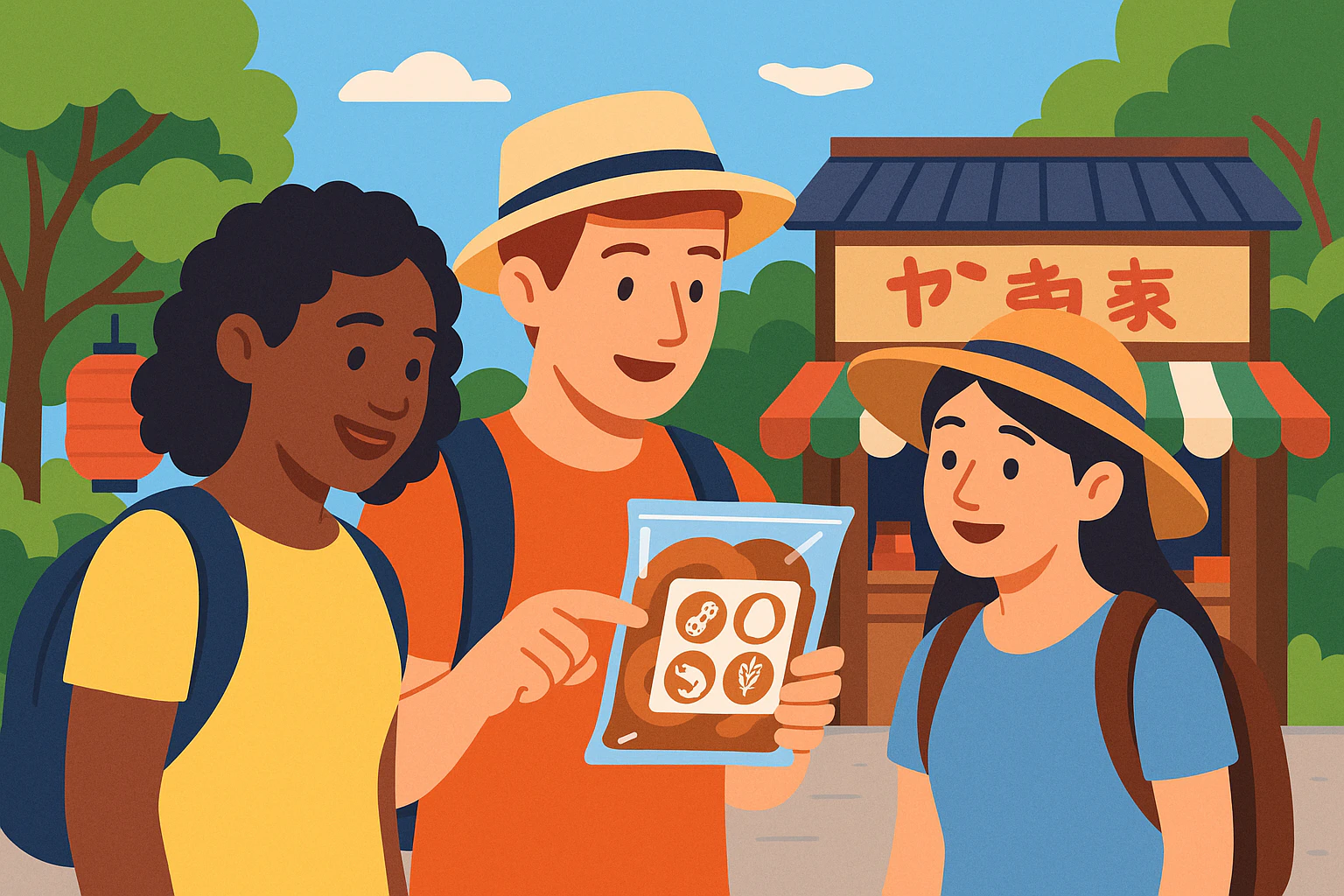
Eating safely in Japan with food allergies can feel like a daily puzzle—especially when you’re trying to keep costs down. Most “food allergy travel Japan” guides focus on restaurants and allergy cards, but the real budget survival move is this: buy packaged foods at convenience stores and supermarkets, and learn how to read the allergen label fast.
This 2026 guide teaches how to read Japanese food labels for allergies using Japan’s official allergen labeling framework (the “28 allergens”), plus the government’s downloadable communication sheet for those moments when you do need to ask staff.
The 30-second strategy: (1) Find 原材料名 (ingredients). (2) Look for “(一部に○○を含む)” / “Contains ○○” allergen notes. (3) Confirm the 8 mandatory allergens first, then check the “recommended” allergens if your allergy is in that group. (4) If it’s counter service or a hotel buffet, switch to the official communication sheet and ask about cross-contact.
Why Japan feels hard with food allergies (and what’s changing)
Japan is actually strong on packaged-food labeling, but restaurants, hotel buffets, and ryokan meals can be hard because ingredient confirmation and cross-contact (shared kitchen tools, fryers, grills) are difficult to guarantee in real time. Japan’s own consumer-facing guidance notes that allergen information is not legally required for restaurants and other non-packaged sales formats, which is why packaged foods are often the safer bet for short-term travelers. (Visitor consumer hotline: Japan’s food labeling system overview). (cht.kokusen.go.jp)
One reason communication breaks down: a CAN EAT press release (Aug 1, 2025) reporting a survey of ryokan/hotel/wedding-industry respondents found that about 70% said their biggest difficulty in allergy対応 was confirming ingredients, with cross-contact measures also ranking as a frequent challenge.
(CAN EAT press release: survey results). (about.caneat.jp)
So what’s changing? Japan’s allergen references are updating, and that can confuse travelers who saved an old screenshot. The Consumer Affairs Agency (CAA) visitor pamphlet now shows 8 mandatory allergens + 20 recommended allergens (the commonly referenced “28”). (CAA: Japan’s Food Labelling System for overseas visitors). (caa.go.jp)
Also, some materials still show older “28” charts because the recommended list has changed in recent years (for example, travelers may still see matsutake on older signage while newer materials emphasize macadamia nuts). (CAN EAT column discussing the “28” list change and mixed old/new charts). (about.caneat.jp)
Finally, keep an eye on upcoming updates: in January 2026, the CAA publicly noted a consultation process to add cashew nuts to the mandatory allergen list (moving it from “recommended” to mandatory), based on national survey evidence and progress toward establishing an official test method. (CAA notice, Jan 13, 2026). (caa.go.jp)
Japan’s allergen labeling system: the “28 allergens” explained (how to read Japanese food labels for allergies)
When you see “特定原材料等28品目,” it’s shorthand for Japan’s widely used allergen labeling framework. In plain English: 8 allergens must be labeled on packaged foods, and 20 additional allergens are recommended (voluntary). The official CAA pamphlet for visitors lists them clearly and is worth saving offline on your phone. (CAA visitor pamphlet PDF). (caa.go.jp)
Important: If your allergen is in the “recommended” group, it may not appear in the allergen summary even when present—so you must still scan the ingredients list carefully. The CAA pamphlet explicitly warns that the label may not show recommended items even if they’re part of a packaged food. (caa.go.jp)
| Labeling is mandatory (8 specified ingredients) | Labeling is recommended (20 items equivalent to specified ingredients) |
|---|---|
|
|
Source: Consumer Affairs Agency visitor labeling pamphlet. (caa.go.jp)
Where allergen info appears on Japanese packages
On most packaged foods, you’ll rely on two parts of the label:
- 原材料名 (ingredients list)
- Allergen note often written as “(一部に○○を含む)” (contains ○○) or “アレルゲン”
The CAA’s visitor pamphlet shows two common patterns: allergens may be listed next to individual ingredients in parentheses, or they may be listed collectively at the end as a “contains” statement. (caa.go.jp)
Cross-contact (“contamination”) is handled differently than in some countries
Japan distinguishes between allergens used as ingredients and unintentional mixing (コンタミネーション). The CAA explains that manufacturers should prevent cross-contact, but if the risk can’t be eliminated, a caution statement is recommended (example: “This product is manufactured in a facility that also produces items containing ○○”). The same CAA document also notes that “might contain” style possibility statements are not allowed. (CAA: allergen labeling overview PDF). (caa.go.jp)
Gluten-free convenience store Japan: what label readers should know
If you’re managing celiac disease or strict gluten avoidance, remember: Japan’s allergen system is built around wheat (小麦) as an allergen, not “gluten” as a single regulated concept. The Tokyo Metropolitan Government’s food labeling guidance warns that a product marketed as “gluten-free” may still require wheat allergen labeling in Japan depending on the wheat protein content—and that can surprise travelers who assume “gluten-free” always means “no wheat label.” (Tokyo: processed food labeling guidance, including gluten-free note). (hokeniryo1.metro.tokyo.lg.jp)
Practical scan terms beyond 小麦 (wheat): look for 大麦 (barley), 麦芽 (malt), and ライ麦 (rye) in the ingredients list if you avoid all gluten grains (not just wheat).
Also note: the CAA visitor pamphlet points out that alcoholic drinks are not required to carry allergen information. If you have severe allergies, treat cocktails, canned drinks, and infused alcohol as “ask-first” items. (caa.go.jp)
Budget survival: what to buy at conbini, supermarkets, and depachika
This is the core budget approach: packaged foods first, staff questions second. For a 1–3 week trip, you can realistically eat 70–90% of your meals from packaged options if your allergy is strict and you don’t want to gamble on kitchen cross-contact.
Typical daily budget (very rough): ¥1,200–¥2,500 per person/day if you rely on conbini + supermarkets (onigiri, yogurt, fruit, simple bento, salads). Depachika tends to raise that to ¥2,000–¥4,000/day due to premium pricing.
Conbini (7-Eleven / Lawson / FamilyMart): the 24-hour label-check hack
Convenience stores are everywhere (often near major station exits) and many are open 24/7. Your win condition is choosing items with a full printed label and avoiding anything that’s served loose from a hot case unless you can confirm ingredients and cross-contact.
- Usually easiest to label-check: onigiri with a full wrapper label, packaged salads, yogurt cups, fruit, bottled drinks, packaged cheese, boiled eggs, tofu packs.
- Often harder: oden, fried foods from the counter, bakery items in open displays, or anything plated by staff.
Quick price anchors: onigiri ¥120–¥200, yogurt ¥120–¥200, simple salad ¥250–¥450, bento ¥450–¥750 (varies by area and inflation).
Supermarkets: cheaper, bigger labels, better repeats
Supermarkets are where you’ll get the best value for repeat-safe meals: larger ingredient panels, more variety, and better fruit/veg pricing. Many city supermarkets run roughly 10:00–22:00 (some open earlier/later), and you can often score markdown stickers on prepared foods in the evening.
Budget tactic: buy two “safe base” breakfasts at once (yogurt + fruit, or rice + simple protein) and use your daytime energy for sightseeing instead of label-hunting three times a day.
- Low-effort staples: plain rice, natto (check sauce packet ingredients), tofu, cooked chicken breast packs, canned fish, bananas, cut fruit.
- Souvenir strategy: if you’re buying snacks to take home, choose items with large printed labels (not individually unwrapped assortments).
Depachika (department store food basements): best discounts late, but ask more
“Depachika” (デパ地下) means the food floors in department stores—usually B1F/B2F. They’re amazing for variety, but they’re also the most likely place you’ll encounter counter-served items where you may need to ask staff for an allergen list.
Typical hours: often around 10:00–20:00 (varies by department store and day). If you go 60–90 minutes before closing, you’ll often see markdown stickers on bento and deli items.
- Good for: clearly packaged bento with full labels, fruit cups, sealed desserts where allergens are printed.
- Riskier without asking: open-case deli salads, croquettes, tempura assortments, and “by weight” counters.
Two traveler pitfalls that break the “packaged is safer” rule
- Inner wrappers may not have labels: some snacks are sold in a big labeled bag with many unlabeled mini packs inside. If you’ll separate them, keep the outer bag.
- Translation apps can miss parentheses: allergens are often shown as “(一部に○○を含む)”. When in doubt, zoom in and look for the kanji/kana for your allergen, not just the translation.
Ask safely: official communication sheets, phrases, and backup help
Even on a packaged-food strategy, you’ll eventually need to ask—at a hotel breakfast, for a depachika counter item, or when the label is unclear. The smartest approach is to use official communication tools so you’re not improvising medical risk in a noisy line.
Food allergy communication sheet Japan (official, smartphone-friendly)
The CAA hosts a smartphone-friendly Food Allergy Communication Sheet in multiple languages. The same CAA pamphlets page includes a critical note for travelers: download the file first, or the checkboxes may not work, and Adobe Reader is recommended for use. (CAA pamphlets page: communication sheets + checkbox note). (caa.go.jp)
- Open the CAA pamphlets page and download the English “(Smartphone-friendly) Food Allergy Communication Sheet.”
- Save it offline (so you can use it underground or in rural areas).
- Pre-check the allergens you must avoid, then show the sheet to staff and point to the icons.
- If you need cross-contact clarification, use the sheet prompts that ask about shared production lines and kitchens.
You should also save the CAA’s “Japan’s Food Labelling System (for overseas visitors)” PDF, which includes the official allergen list and examples of where allergen text appears on packages. (CAA visitor pamphlet PDF). (caa.go.jp)
Local government sheets (Tokyo and Osaka) if you prefer pictograms and many languages
In Tokyo: the Tokyo Metropolitan Government provides downloadable “Allergy Communication Sheets” with pictograms and multiple language sets (including English, Chinese, Korean, Thai, French, Spanish, German, Russian, and more). (Tokyo: allergy communication sheets download page). (hokeniryo1.metro.tokyo.lg.jp)
In Osaka: Osaka Prefecture updated its multilingual sheet on March 13, 2025, describing an A3, foldable, waterproof matte-finished sheet in 11 languages (including English, Spanish, Portuguese, Vietnamese, Thai, French, Indonesian, plus East Asian languages). (Osaka Prefecture: communication sheet details). (pref.osaka.lg.jp)
Essential phrases (short, direct, and copy-paste friendly)
- I have food allergies. 私は食物アレルギーがあります。 (Watashi wa shokumotsu arerugii ga arimasu.)
- Does this contain (wheat/egg/milk/etc.)? これは(小麦/卵/乳)を含みますか? (Kore wa … o fukumimasu ka?)
- I can’t eat even a small amount. 少量でも食べられません。 (Shouryou demo taberaremasen.)
- Is there a risk of cross-contact? コンタミの可能性はありますか? (Kontami no kanousei wa arimasu ka?)
Backup help: hotlines and what to do in an emergency
If you need urgent support while traveling, Japan National Tourism Organization (JNTO) operates the Japan Visitor Hotline 24/7 in English/Chinese/Korean: 050-3816-2787 (from overseas: +81-50-3816-2787). (JNTO: Japan Visitor Hotline). (japan.travel)
For emergencies: call 119 (ambulance/fire) or 110 (police). If you’re dealing with a labeling/consumer issue as a visitor, Japan also operates the Visitor Consumer Hotline at 03-5449-0906, weekdays 10:00–12:00 and 13:00–16:00 (closed weekends/holidays). (Visitor Consumer Hotline page). (cht.kokusen.go.jp)
FAQ (2026)
Q1: Are restaurants in Japan required to provide allergen info?
A: Not in the same way packaged foods are; that’s why this guide prioritizes packaged items and the official communication sheet when you must ask. (cht.kokusen.go.jp)
Q2: What does “28 allergens” mean in Japan?
A: It commonly refers to 8 mandatory allergens (must be labeled on packaged foods) plus 20 recommended allergens that may not always be shown. (caa.go.jp)
Q3: What’s the fastest label text to look for?
A: Start with 原材料名 (ingredients) and then find “(一部に○○を含む)” or “アレルゲン,” plus any manufacturing-line caution statements if you’re sensitive to cross-contact. (caa.go.jp)
Q4: Is “gluten-free” always straightforward in Japan?
A: Not always—Japan’s allergen rules focus on wheat protein labeling, and guidance notes that “gluten-free” claims and wheat allergen labeling can still interact in ways travelers don’t expect. (hokeniryo1.metro.tokyo.lg.jp)
Related Articles
- Food Allergy Travel Japan (2026): Allergy Card + Safe Eats
- Types of Accommodation in Japan (2026): Ryokan vs Hotel vs Airbnb
- How to Order at an Izakaya in Japan (2026): English Menu Tips
Need More Help? Ask on LO-PAL
If you want to know more about this topic or need specific local information (like “Which conbini near Shinjuku Station has the best clearly-labeled salads?” or “Can someone help me check these three snacks for walnuts and macadamia?”), ask a local Japanese person on LO-PAL.
LO-PAL is our matching service where foreign residents and tourists can connect with local Japanese helpers for quick Q&A or practical help—especially when you need accurate, on-the-ground answers fast.
- Before you buy: post a photo of a label and ask what the allergen line says in natural Japanese.
- In-store support: request shopping assistance at a supermarket or depachika to help confirm allergen lists with staff.
- Language comfort: get help in English, Chinese, Vietnamese, Portuguese, Korean, Nepali, Tagalog, Indonesian, or Spanish.
Written by

Founder, LO-PAL
Former Medical Coordinator for Foreign Patients (Ministry of Health programme) and legal affairs professional. Built LO-PAL from firsthand experience navigating life abroad.
Written with partial AI assistance
Read full bio →