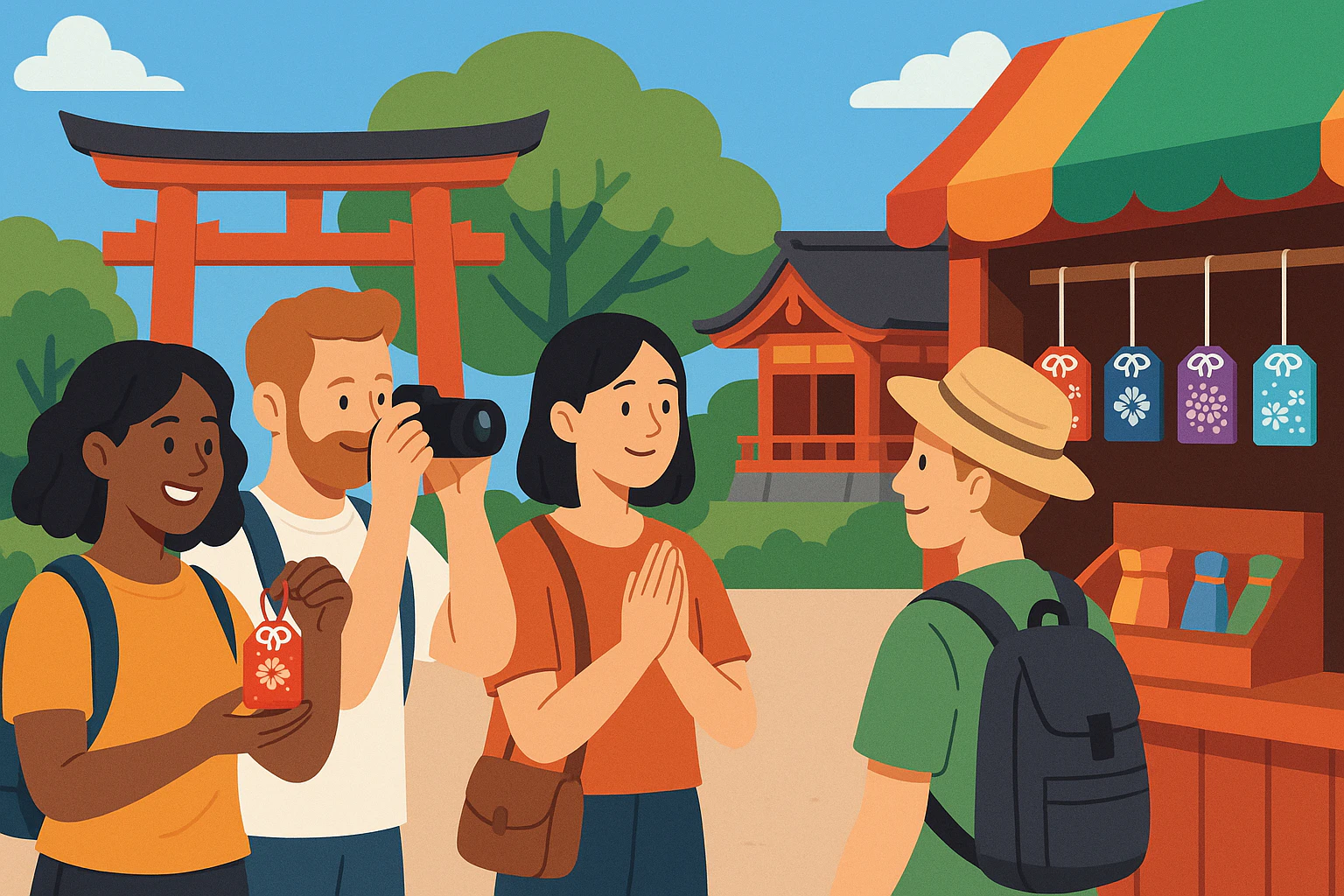
Temple vs Shrine Difference Japan: A 1-Minute Etiquette Guide

The all-in-one Japanese learning app
From travel phrases to real fluency — all in one app.
All 2,136 standard kanji included. Every feature is free to use.
Spot shrines vs temples in 30 seconds, follow the right prayer steps, and recover from common etiquette mistakes—2026 updates included.
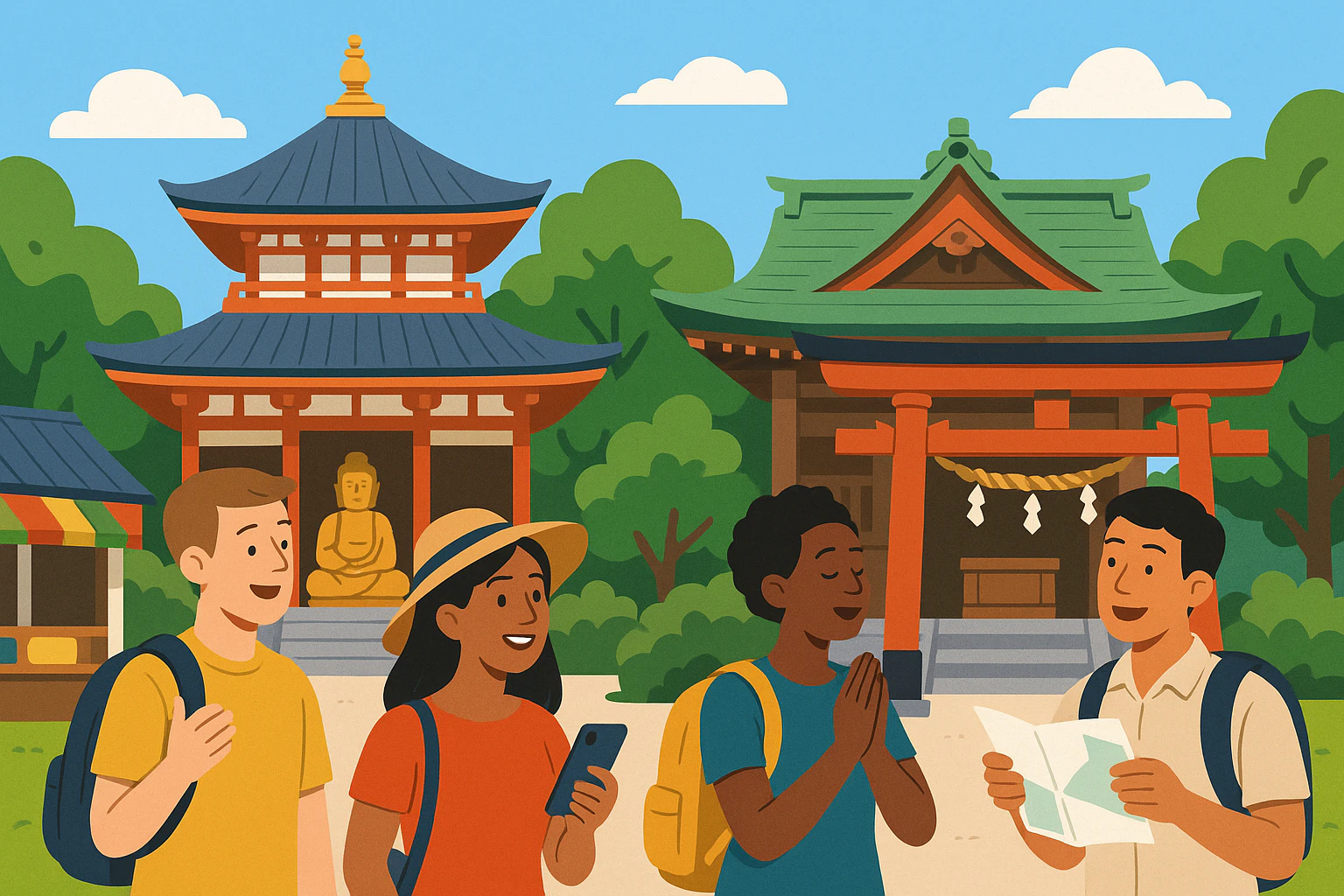
If you’re planning a Japan trip, this is the temple vs shrine difference Japan guide you’ll want open on your phone: a tourist-proof way to identify where you are in under 30 seconds, then follow the right etiquette without stress.
Why this matters: one of the most common etiquette slip-ups is using shrine-style clapping at a Buddhist temple—something many people in Japan notice, especially during busy New Year visits. (nippon.com)
The ultra-safe rule when you’re not sure: do a quiet bow + hands together (gassho), and don’t clap. If the site is a shrine, there will usually be signage showing the bow-and-clap pattern.
Shrine or Temple? A 30-Second Visual Checklist (Torii, Sanmon, Statues, Symbols) — temple vs shrine difference Japan
You don’t need to “know religions” to get this right. Use these fast visual cues—starting from the entrance gate—and you’ll usually know what to do before you reach the main hall.
1) Entrance gate: Torii (shrine) vs Sanmon (temple)
- Torii gate = usually a Shinto shrine. A torii marks the boundary between the everyday world and sacred ground. (japan.travel)
- Sanmon gate = usually a Buddhist temple. Big temples often have a large sanmon at the entrance. (japan.travel)
2) Guardian “bouncers”: Komainu (shrine) vs Niō (temple)
- Shrines often have komainu (lion-dog guardians) near the approach or worship hall. (nippon.com)
- Temples often have fierce Niō guardians at the gate (sometimes in a “Niōmon” gate). (nippon.com)
3) What’s being worshiped: Kami space vs Buddha space
- Shrine clues: you’re generally visiting a place dedicated to kami (Shinto deities). The standard worship form you’ll see posted is bows + claps. (nippon.com)
- Temple clues: you’ll often see Buddhist imagery, and behavior is typically quieter (hands together, no clapping). (japan.travel)
4) Bonus “spot it fast” symbols (helpful, not perfect)
- Incense burner smoke (jokoro / kōro) is a strong temple hint. Many temples have incense and visitors may waft the smoke toward their body. (jal.co.jp)
- Temizuya water basin can exist at both. Don’t use it to decide shrine vs temple—use it to purify first. (jal.co.jp)
- Name endings can help: temple names frequently end in -dera or -ji, and smaller temples may use -in (but there are exceptions). (en.wikipedia.org)
Reality check: some famous sites have mixed Shinto–Buddhist history (shinbutsu shūgō), so you may see “unexpected” elements. When in doubt, follow posted instructions at that site—or choose the no-clap “safe mode.” (nippon.com)
How to Visit a Shinto Shrine: Step-by-Step Etiquette (Temizuya + 2 Bows, 2 Claps, 1 Bow)
This section covers shrine visit etiquette Japan in a simple, repeatable flow. Many shrines follow the same pattern, but some have special local rules—so always follow signs if they differ. (jinjahoncho.or.jp)
Step 0: Timing + logistics (so you don’t miss the “office”)
Most shrine grounds can be entered freely, but the counter for charms and goshuin (often called the shamusho or jukusho) has set hours. If you want a goshuin or to buy an omamori charm, plan to arrive in the daytime (commonly around 9:00–16:00/17:00, depending on the shrine).
Step 1: At the torii gate
- Pause and bow once before entering.
- Walk slightly to the left or right—the exact center is traditionally avoided. (japan.travel)
Step 2: Purify at the temizuya (water basin)
At many shrines you’ll see a ladle (hishaku) and water basin. The key hygiene point: never put your mouth directly on the ladle. (jinjahoncho.or.jp)
- Hold the ladle in your right hand; rinse your left hand. (jinjahoncho.or.jp)
- Switch; rinse your right hand. (jinjahoncho.or.jp)
- Pour water into your left palm and rinse your mouth (spit beside the basin). Do not touch the ladle to your lips. (jinjahoncho.or.jp)
- Rinse your left hand again, then rinse the ladle handle with remaining water and return it. (isejingu.or.jp)
Step 3: At the offering box (saisenbako)
- Gently place your offering into the box.
- If there’s a bell rope, ring it briefly.
- Do two deep bows.
- Do two claps (some people offset their hands slightly). (jinjahoncho.or.jp)
- Pray quietly (you can say your name and where you came from).
- Finish with one deep bow. (japan.travel)
If a shrine’s clapping count is different
Some shrines use different traditions, and signage may instruct a different number of claps or a different flow. The correct move is simple: copy the posted instructions for that shrine. (jinjahoncho.or.jp)
How to Visit a Buddhist Temple: Step-by-Step Etiquette (Incense + Quiet Prayer, No Clapping)
This section answers the high-intent question how to pray at a Buddhist temple in Japan. Temples are typically calmer spaces, and the big “don’t” is clapping (kashiwade)—instead, you’ll usually pray with hands together (gassho). (nippon.com)
Step 0: Timing + possible entry fees
Many temples have visiting hours (especially if there’s a ticketed garden, museum, or special hall). Budget-wise, a basic temple stop can be free, but famous temple complexes often charge admission (commonly a few hundred to around ¥1,000+ depending on what you enter).
Step 1: Entering the temple grounds (gate manners)
At some temples, there’s a tradition of not stepping directly on the threshold when crossing a gate. You’ll also see reminders to keep voices down and follow one-way routes during crowded periods. (jal.co.jp)
Step 2: Purify (if there’s a temizuya) and/or approach the incense burner
Some temples also have a temizuya, and you can purify the same way you would at a shrine. Many temples have incense (osenko), and some let visitors light incense as an offering. (japan.travel)
- If you light incense, don’t blow out the flame; extinguish it by waving your hand. (japan.travel)
- Place the incense properly, then you may see people gently wafting smoke toward their body. (japan.travel)
Step 3: Praying at the main hall (no clapping)
- Place a coin offering in the box (amount is up to you).
- Bow lightly, then bring your hands together in gassho and pray silently.
- Do not clap at the temple hall. (jal.co.jp)
Step 4: Shoes + photography (common temple-specific rules)
Some temples require you to remove your shoes before entering buildings, and photography is often allowed outdoors but restricted inside halls. Look for signs or ask staff if you’re unsure. (jal.co.jp)
Quick recovery checklist (common mistakes):
- You clapped at a temple: stop, do a quiet bow, hands together (gassho), and move on without making a scene.
- You walked through the center at a shrine torii: just shift to the side from now on—no need to “redo” your entrance.
- You used the ladle wrong at temizuya: don’t panic; step aside, let others go, and continue respectfully.
What if the site has mixed Shinto-Buddhist elements?
This happens more than tourists expect because Shinto and Buddhism were historically intertwined in Japan (shinbutsu shūgō). In the Meiji era, the government issued an order legally separating Shinto and Buddhism, but older layouts and local traditions can still leave “mixed” visual cues today. (nippon.com)
What to do on the ground: follow posted instructions for that specific hall, and when you’re unsure, use the no-clap safe mode (bow + gassho). That approach is broadly acceptable at temples and is also historically familiar across shrine/temple visits. (nippon.com)
Common Tourist Questions (Photos, Shoes, Omikuji) + 2026 Reality Checks (Cashless, Limited Goshuin)
These are the questions people ask at the entrance—plus a few 2026 updates that affect what you should carry and how you should plan your timing.
Q1) Can I take photos at shrines and temples?
Usually yes outdoors, often no (or limited) indoors. Many sites allow photos on the grounds but restrict photos inside worship halls, and some locations publish detailed shooting rules. When you see “No Photo” signage, follow it—and if you’re unsure, ask staff. (jal.co.jp)
Q2) Do I need to remove my shoes?
Sometimes—especially in temple buildings. If you see shoe shelves at an entrance, or staff point to your feet, take your shoes off and continue in socks. Some temples provide plastic bags so you can carry your shoes with you. (japan.travel)
Q3) Omikuji: is it okay to do fortunes at both?
Yes—omikuji (fortune slips) are common at both shrines and temples. If your fortune is “bad,” you’ll often see tying racks or designated areas; if you keep it, fold it neatly and take it with you.
Q4) Goshuin: what are they, how much do they cost, and why do people say “availability changes”?
Goshuin are calligraphy-style stamps/inscriptions you can receive at many shrines and temples, usually placed in a special book (goshuinchō). Costs vary by place, but a common range is around ¥300–¥500 per goshuin. (jal.co.jp)
2026 reality check: during peak periods, some sites switch to kakioki (paper-only) rather than writing directly into your book. For example, Kokuryo Shrine in Tokyo announced that from January 1–12, 2026, goshuin would be handled as paper-only, with January 1 starting at 9:00 AM. (kokuryo-jinja.jp)
Q5) Do I need coins, or is Japan “cashless” at shrines and temples now?
Bring coins, but expect exceptions. Cash offerings (osaisen) are still the norm, but cashless options are expanding—especially at major, high-traffic sites. (about.paypay.ne.jp)
PayPay announced that from December 2024 it supports offerings at participating shrines and temples via QR codes. The PayPay release notes that it’s limited to users who have completed identity verification (eKYC), and offerings use PayPay Money (not points). (about.paypay.ne.jp)
Q6) “Site-specific rules” are real: a practical example you can copy
Ise Jingū (Mie Prefecture) explicitly asks visitors to follow walking-direction guidance: Gekū (Outer Shrine) is left-side traffic, Naikū (Inner Shrine) is right-side traffic, along with requests like no eating/drinking in the sacred area and no pets. This is why it’s smart to watch for signs and follow staff guidance even when you already “know the standard etiquette.” (isejingu.or.jp)
A concrete planning example (hours, access, costs): Kasuga Taisha in Nara
If you want an example you can plan around, Kasuga Taisha publishes clear logistics. It lists seasonal opening hours for the main worship area, and notes that charms/goshuin are handled from 9:00 until closing. (kasugataisha.or.jp)
Access-wise, Kasuga Taisha explains routes from JR/Kintetsu Nara Station using Nara Kōtsū buses (e.g., to “Kasuga Taisha Honden,” then get off and you’re close). It also lists a walking option of about 25 minutes from Kintetsu Nara Station. (kasugataisha.or.jp)
For costs, it lists examples like special worship (Tokubetsu Sanpai) at ¥700 (when available) and other optional paid areas. If you’re short on time, you can still enjoy the shrine grounds for free and pay only for what you enter. (kasugataisha.or.jp)
Experience trend (optional, but useful): guided goshuin programs that need booking
Some sites package goshuin as a guided experience with fixed dates and a set fee. Kasuga Taisha, for example, lists a “goshuin meguri” program with scheduled dates (including dates in January–March 2026), a start time of 14:30, a duration of about 120 minutes, and a fee of ¥5,000 per person. (kasugataisha.or.jp)
It also lists booking channels and contact points, including the Nara Visitors Bureau and major travel agencies/OTAs (for example, Nippon Travel’s reservation center at 0570-048-908 and Tobu Top Tours at 03-5843-9600). If you want one of these date-fixed experiences, reserve early—weekend slots can disappear quickly. (kasugataisha.or.jp)
Related Articles
- Shrine Etiquette Japan (2026): Omikuji, Goshuin & Cashless Offerings
- Japanese Shrine Etiquette on a Budget: Omikuji, Goshuin & Costs
- Omamori Meaning & Types: Choose the Right Shrine Charm in Japan
Need More Help? Ask on LO-PAL
If you want to know more about this topic—or you need site-specific rules for the exact shrine/temple you’re visiting (photo restrictions, one-way routes, goshuin hours, cashless offerings, what to do at mixed sites)—ask a local Japanese person on LO-PAL.
LO-PAL is our matching service that connects tourists in Japan with local Japanese helpers. Post a question in your language (we support English, Chinese, Vietnamese, Portuguese, Korean, Nepali, Tagalog, Indonesian, and Spanish), and locals in the area will respond with practical, on-the-ground guidance—so you can visit respectfully and confidently.
Written by

Founder, LO-PAL
Former Medical Coordinator for Foreign Patients (Ministry of Health programme) and legal affairs professional. Built LO-PAL from firsthand experience navigating life abroad.
Written with partial AI assistance
Read full bio →