Onsen Etiquette Japan: Tattoos, Towels & Swimsuit-Friendly Baths

The all-in-one Japanese learning app
From travel phrases to real fluency — all in one app.
All 2,136 standard kanji included. Every feature is free to use.
Onsen etiquette Japan made simple: traditional nude steps, tattoo strategies, and swimsuit-friendly facilities with prices and access tips.
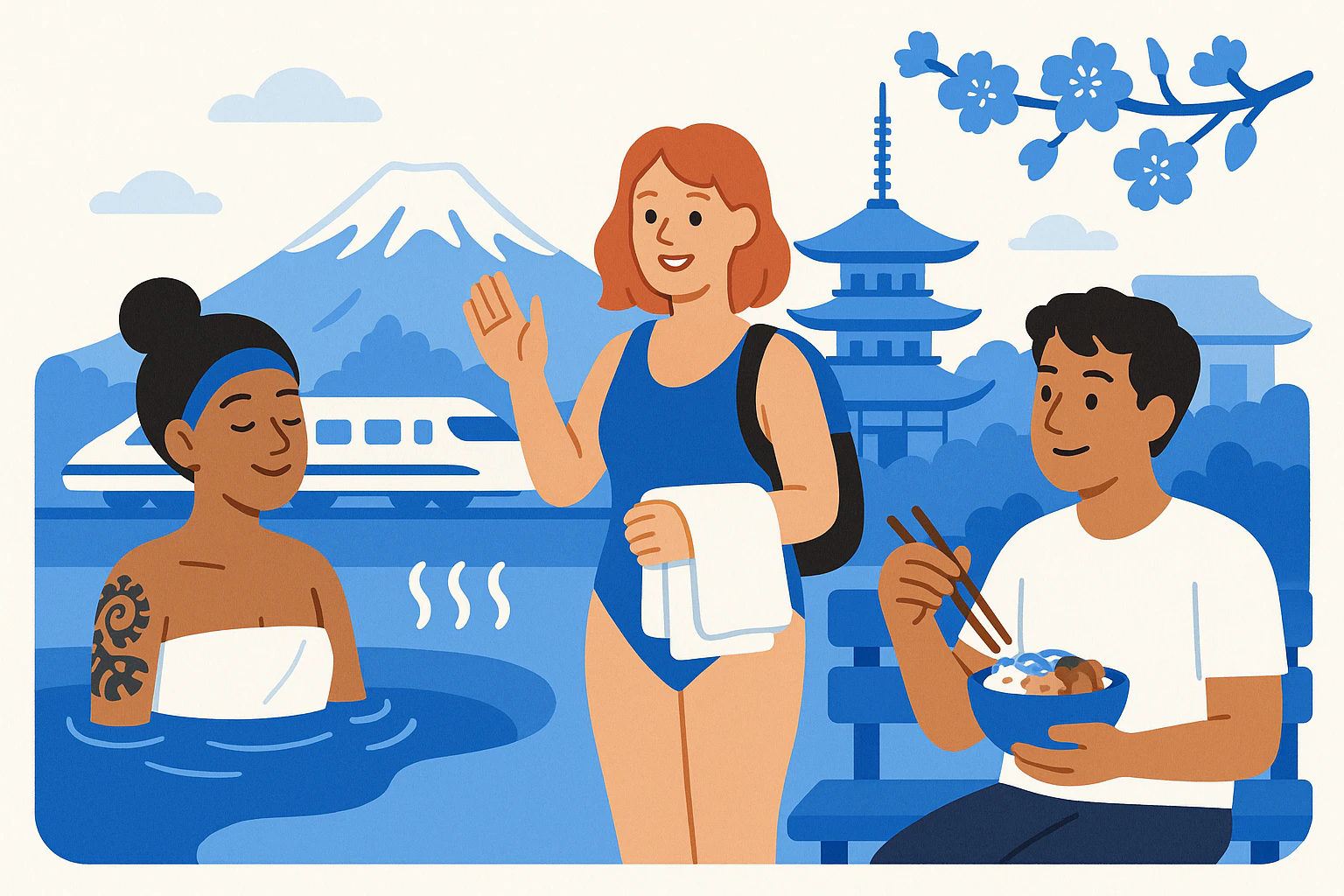
If you’ve been Googling onsen etiquette Japan, you’ve probably noticed two things: (1) the rules sound strict, and (2) tattoo and swimsuit policies change wildly from place to place. This guide won’t just repeat generic manners. Instead, it gives you a choose-your-comfort-level path—traditional nude onsen, private baths, or swimsuit/mixed-gender facilities—plus practical ways to confirm rules fast (so you don’t get turned away at the door).
First, a quick reality check: an “onsen” is legally defined under Japan’s Hot Springs Act (it’s not just “any hot bath”). For a plain-English definition, see the Japan Spa Association explanation of the Hot Springs Act definition and the Japanese government’s overview in Highlighting Japan.
Pick your onsen style: Traditional nude (most cultural, most rules) → Private bath (least stress) → Swimsuit/mixed-gender (best for groups + modesty). Tattoos: always confirm per venue.
The 30-second Onsen Etiquette Japan Checklist (what not to do)
If you remember nothing else about onsen etiquette Japan, remember this list. These are the behaviors that most often upset staff or other bathers.
- Don’t enter the bath without washing first. Onsen water is for soaking, not cleaning. (Wash at the shower stations first—fully.)
- Don’t put your towel in the tub. Keep the small towel on your head or on the side of the bath.
- Don’t let hair touch the water. Tie it up. Many places have hair ties for sale, but bring your own to be safe.
- Don’t splash, swim, or play. Even in casual facilities, the “bath” side is not a pool.
- Don’t talk loudly. Quiet conversation is usually fine; loud group chatter isn’t.
- Don’t bring your phone into a traditional bath area. Privacy is taken seriously, and many facilities prohibit it entirely.
- Don’t take photos in changing rooms or nude onsen areas. For example, Hakone Kowakien Yunessun allows photos in the swimsuit area but not in dressing rooms or the nude onsen area (official Yunessun FAQ).
- Don’t enter drunk. Many facilities explicitly prohibit bathing under the influence (see, for example, the Fukuoka Onsen Resort Association’s etiquette page: Onsen Etiquette).
- Don’t assume tattoos are OK (or NOT OK) without checking. Policies vary: some allow cover-ups, some allow only private baths, and some allow tattoos freely.
- Don’t wear a swimsuit in a traditional nude onsen. Swimsuits are for specific “swimsuit onsen Japan” facilities, not standard onsen.
Quick self-check before you soak: Clean body, hair tied, towel out of water, voice low, no camera/phone, and you’ve checked tattoo/swimsuit rules.
Step-by-step: How to Bathe in a Traditional Japanese Onsen
This is the “classic” how to use an onsen in Japan flow: gender-separated, nude bathing, quiet atmosphere. The exact layout varies, but the steps are extremely consistent nationwide.
1) At the entrance: shoes off, pay, and find the right curtain
Many onsen have a shoe locker right at the entrance. Put your shoes in and take the key (or use the provided shoe rack if it’s a small local bath).
Then you’ll pay at reception or a ticket machine. If there’s a ticket machine, you usually buy a ticket first, then hand it to staff.
Look for curtains/signs: 男 (men) and 女 (women). If you’re unsure, ask before entering.
2) In the changing room: get fully nude, keep valuables secure
In a traditional onsen, you bathe nude—no swimsuit, no underwear. Put everything (including your phone) into a locker or basket.
Take only the small towel into the bathing area. The big bath towel stays in your locker until you’re done.
3) At the wash stations: sit down and wash thoroughly
Most onsen have low stools, handheld showers, and toiletries. Sit down (standing and spraying water is considered rude because it splashes others).
Wash hair and body with soap/shampoo, then rinse until zero soap remains. Japan’s national tourism site gives the same core advice: “shower first, soak later,” and rinse everything off completely (JNTO onsen etiquette guide).
4) Before entering: rinse yourself (optional but common)
Many locals do a quick rinse (sometimes pouring water over themselves) right before stepping in. Think of it as “final rinse + temperature adjustment.”
5) Enter the bath slowly and soak—don’t swim
Onsen can be hot (often around low 40°C). Step in slowly, sit quietly, and enjoy. Keep hair out of the water; don’t dunk your head.
Your small towel should not go into the bathwater—place it on the edge or fold it on your head (JNTO also highlights keeping your towel and hair out of the water: same guide).
6) Leaving the bath: dry off before you re-enter the changing room
Wring out your small towel and use it to reduce dripping on the floor. Many facilities explicitly ask guests to dry off before returning to the dressing area (see the Fukuoka Onsen Resort Association etiquette).
Back in the changing room, use your big towel, get dressed, hydrate, and take a few minutes to cool down before heading back outside.
Tattoos + Modesty: 3 Stress-Free Onsen Options (private, tattoo-friendly, swimsuit)
Here’s the decision tree most travelers actually need. When tattoos or nudity anxiety make traditional onsen feel high-pressure, you still have great options—without disrespecting local rules.
Option 1: Private baths (best “low-stress intro” to onsen culture)
Private baths go by names like kashikiri-buro (reserved bath) or “family bath.” You book a time slot and bathe only with your own group, which is ideal if you’re nervous about etiquette or have tattoos.
Example (Hakone): Hakone Kowakien Yunessun private baths (Mori no Yu)
Yunessun is famous for its swimsuit-friendly area, but it also has a traditional onsen area called Mori no Yu. Their official site lists reserved private baths and states pricing for certain room types at ¥7,000–¥11,000 (tax included), depending on the room type/time plan (Yunessun “Mori no Yu” reserved baths page). For tattooed guests, Yunessun also notes that tattoos are limited in Mori no Yu to reserved rooms (official Yunessun FAQ).
Reservation tip: Popular private baths can sell out on weekends and holidays. If you’re traveling during peak dates (weekends, Golden Week, Obon, New Year), reserve as soon as your schedule is fixed.
Option 2: Tattoo-friendly onsen (or “cover-up OK” onsen)
“Tattoo friendly onsen Japan” does not mean one universal rule. In practice, you’ll see three patterns: (1) tattoos fully allowed, (2) small tattoos allowed if covered, or (3) tattoos only allowed in private baths/rooms. Japan’s national tourism site specifically recommends checking signage, asking staff, covering small tattoos, or choosing private baths if you’re unsure (JNTO: Japanese Onsen and Ink—The Tattoo Taboo).
Fast planning tools (English-friendly):
- Tattoo Japan: a community-driven search platform (English-supported) for tattoo-OK/NG facilities. Start here: Tattoo Japan.
- Official tourism lists (less guesswork): Oita’s tourism site publishes a property-by-property feature with tattoo notes (for example, some places are fully tattoo-permitted while others restrict public baths but allow private baths). See Visit Oita’s tattoo-friendly hot springs feature.
Reality tip: If a facility says “no tattoos,” don’t try to sneak in. Even if you think “it’s small,” you risk being asked to leave (and nobody wants that experience).
Option 3: Swimsuit/mixed-gender facilities (best for groups, couples, and modesty)
If your main barrier is nudity (not the hot water itself), “swimsuit onsen Japan” facilities are often the easiest win. These places typically separate “swimsuit zones” from “traditional nude zones,” so you can choose your comfort level on the same day.
Swimsuit-friendly + tattoo-cover option (Hakone): Hakone Kowakien Yunessun
Yunessun’s official FAQ states: tattooed guests can enter the Yunessun swimsuit area if tattoos are fully covered with swimwear or a rash guard (rental available), while Mori no Yu is limited to reserved rooms for tattooed guests (official Yunessun FAQ).
Logistics (good for a 1-day trip from Tokyo):
- Hours: typically 10:00–18:00 on weekdays and 9:00–19:00 on weekends/holidays for the swimsuit area; Mori no Yu is typically 11:00–20:00 (official hours & fees).
- Budget: Adults are typically ¥2,500 for the swimsuit area only, ¥1,500 for Mori no Yu only, or ¥3,500 for an all-area passport (official fees). Note: Yunessun also uses a variable pricing calendar (A/B/C dates) on its Japanese pricing page, so check the date you plan to go (official price calendar).
- Access: From Hakone-Yumoto Station, take a Hakone Tozan Bus or Izu Hakone Bus to Kowakien bus stop (about 20 minutes); Yunessun is across the road (official access page).
- Phone: 0460-82-4126 (from abroad +81 460-82-4126) (official contact info).
Mixed-gender swimwear zone (Osaka): Spa World
Spa World’s official FAQ explains that the onsen is gender-separated (no swimsuits), but the pool/Bade Zone is mixed-gender and requires swimwear (official Spa World FAQ).
Logistics:
- Hours: the onsen is generally 10:00–8:45 the next day (with a daily inspection window), while pools have different hours by weekday/weekend (official opening hours).
- Budget: general entry is listed as ¥1,500 (middle school and up) and ¥1,000 (elementary and below), including amenities like towels and shampoo (official pricing). Swimwear rental is listed at ¥650 (official pricing).
- Access: It’s right by Exit 5 of Dobutsuen-mae Station (Osaka Metro) per the official ticket/visitor info (official site).
- Important: Spa World’s regulations state that people with tattoos (including tattoo seals) are not allowed (official pricing/regulations section).
Swimsuit-required outdoor baths (Hyogo): Refresh Park Yumura
If you want “everyone together” without the pressure of nude bathing, Refresh Park Yumura is a rare example of a place that explicitly instructs guests to wear swimsuits for its outdoor open-air bath area (with rentals available) (official facility description).
Logistics:
- Hours: commonly listed around 10:00–19:00 with last entrance around 18:30, and open-air baths ending earlier depending on season (Japan47Go listing (updated 2025-12-17)).
- Closed: Thursdays (typically; may open on national holidays) (same source).
- Budget: adults commonly listed at ¥1,000, children (3 years old to elementary) ¥600 (same source).
- Phone: 0796-92-2002 (also listed on the official OK Onsen page’s access section) (OK Onsen official site).
New in 2025: a private, mixed-gender, tattoo-OK “OK Onsen” rental (Yumura Onsen, Hyogo)
If you want a truly low-stress first onsen experience for a group, this is the standout “rule-relaxed” option. A PR TIMES release about the launch explains that this private rental plan explicitly allows: smartphones, lively chatting, mixed-gender bathing in swimsuits, tattoos, and music (PR TIMES announcement (published 2025-09-17)).
Key details to know:
- Start date: operation began on September 19, 2025 (with booking受付 starting September 17, 2025) (same PR TIMES release).
- Time block: 90-minute rental units, for 1 to 20 people (same PR TIMES release).
- How to book: via the official site: OK Onsen.
- Budget guidance (be careful here): your total cost is typically the facility admission (Refresh Park Yumura day-use fee) plus an additional private rental fee that depends on date and group size. For the most accurate total, confirm on the official reservation site before you travel.
Simple rule for tattoos + modesty: If you want maximum cultural authenticity, choose traditional nude onsen (but confirm tattoo policy). If you want maximum comfort, book a private bath. If you want “fun with friends,” choose a swimsuit/mixed-gender facility—and still confirm tattoo rules.
How to Confirm Rules Fast (signs, phrases) + Local Help via LO-PAL
Because policies vary by venue, the best onsen etiquette skill is not memorizing rules—it’s confirming them quickly and politely. Here’s how to do it in under a minute.
Look for these common signs (and what they usually mean)
- 刺青禁止 / タトゥー禁止: tattoos not allowed.
- タトゥーOK: tattoos allowed (sometimes with conditions—still read the full notice).
- 水着禁止: swimsuits not allowed (typical for traditional onsen).
- 水着着用: swimsuit required (typical for some mixed-gender outdoor baths or “spa pool” zones).
- 撮影禁止: no photography.
- 黙浴: “silent bathing” (extra emphasis on quiet behavior).
Useful Japanese phrases (polite, tourist-friendly)
You don’t need perfect Japanese—just ask before paying.
- “Sumimasen, tatoo wa daijoubu desu ka?” (Excuse me, are tattoos OK?)
- “Chiisai tatoo demo dame desu ka?” (Is it not allowed even if it’s small?)
- “Kashikiri-buro wa arimasu ka?” (Do you have a private/reserved bath?)
- “Mizugi wa hitsuyou desu ka?” (Is a swimsuit required?)
- “Koko wa konyoku desu ka?” (Is this mixed-gender?)
Why confirming rules matters more in 2026: resource protection + taxes
Some onsen towns are actively managing hot spring resources. That can mean reduced hours, limited day-use days, or requests to conserve hot water late at night. For example, Wataya Besso in Ureshino Onsen announced it resumed day-use bathing on weekends/holidays from June 1, 2025 and also asked guests to cooperate with hot-water saving from 0:00–5:00 to protect onsen resources (Wataya Besso official notice (published 2025-05-28)).
Also note that some regions adjust onsen-related taxes. Nationwide, an overnight bathing tax (入湯税 / nyutozei) is commonly charged in hot spring areas, and some municipalities have raised rates for sustainability (explained in English by The Asahi Shimbun). Separately, Hakodate has announced an accommodation tax starting April 1, 2026 and a bathing tax revision (their notice shows the bathing tax changing from 150 JPY to 100 JPY on the same date) (Tokyu Stay Hakodate notice).
Need local confirmation (today), in your language? Ask on LO-PAL
If you want to know more about this topic or need specific local information—like “Which onsen near my hotel is tattoo-friendly?” or “Does this facility allow cover stickers?”—ask a local Japanese person on LO-PAL.
With LO-PAL, you can post a question (or request help) and get responses from local Japanese helpers in your area. It’s built for travelers and supports multiple languages (including English, Chinese, Korean, Spanish, Portuguese, Vietnamese, and more), so you can confirm rules fast and plan a low-stress onsen day that matches your comfort level.
Written by

Founder, LO-PAL
Former Medical Coordinator for Foreign Patients (Ministry of Health programme) and legal affairs professional. Built LO-PAL from firsthand experience navigating life abroad.
Written with partial AI assistance
Read full bio →