Lost Your Passport in Kyoto? Police Report + Emergency Passport (2026)
Same-day Kyoto playbook: file the right police report, avoid scams, and get an emergency passport fast via Osaka.

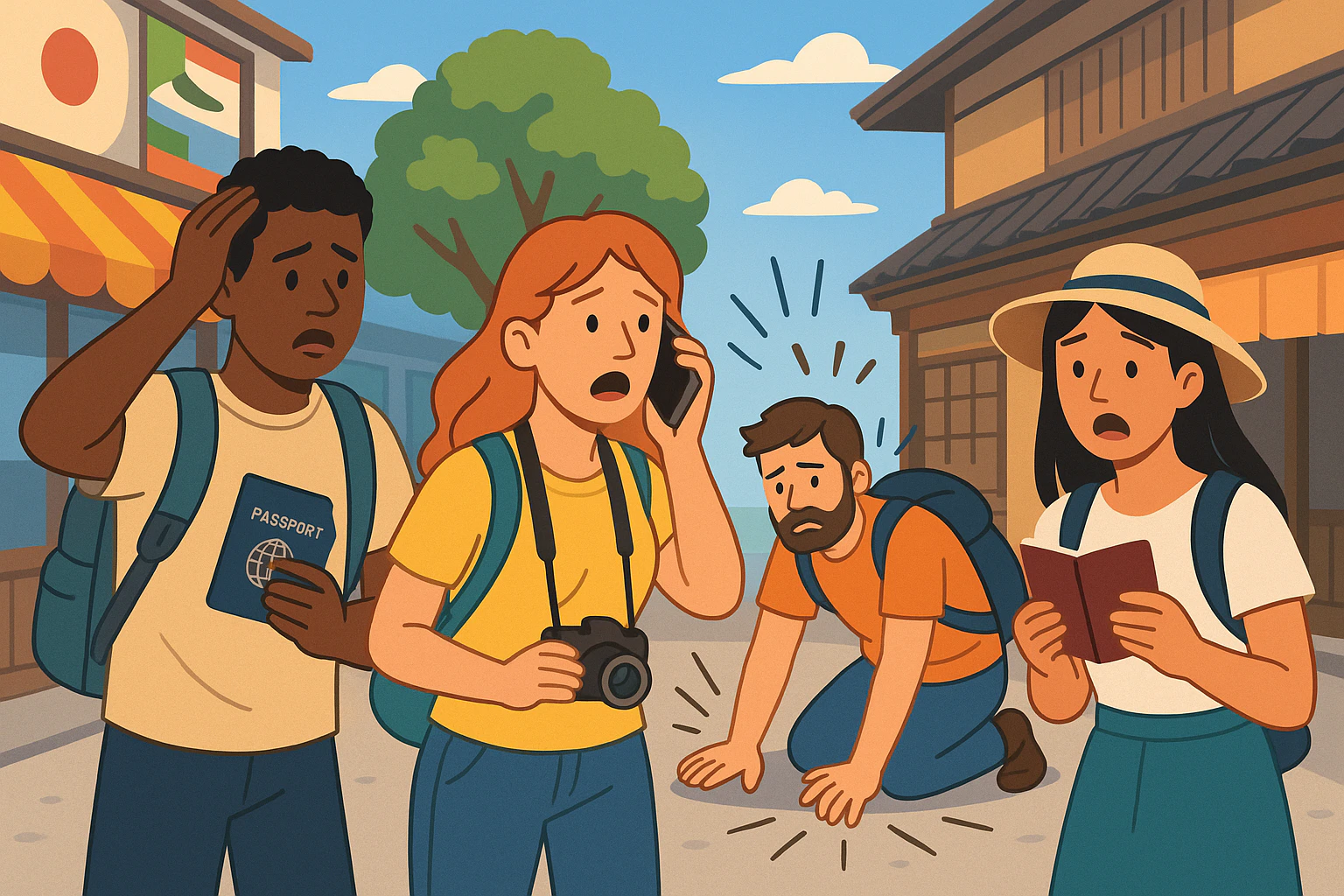
If you lose a passport in Kyoto during sakura crowds, act fast: freeze cards + accounts first, then file a police report in person (don’t rely on online-only if you fly soon).
Go-to counter: the nearest koban (police box) or a full police station; for Kyoto Station-area losses, call the Kyoto Station Front Lost Item Desk today.
Paperwork that matters: get a report acceptance number (受理番号) and ask for a Lost Property Report Certificate (遺失物届受理証明書) if your embassy/insurance needs it.
Emergency travel document: contact your embassy/consulate ASAP (many issue an emergency passport in 1 business day if you’re prepared).
Information current as of March 2026 based on guidance from Kyoto Prefectural Police (page updated Nov 28, 2025), the National Police Agency (NPA) lost-item portal, Kyoto City Official Travel (Kyoto Travel), the Tokyo Metropolitan Police Department (process notes that apply broadly across Japan), and the U.S. Department of State’s Lost or Stolen Passport Abroad guidance (last updated Sep 25, 2025).
I’m Kanaya, and I built LO-PAL because I’ve lived the “language barrier panic” myself—when I moved to Manchester in my early twenties, I had to call an NHS phone line three times just to book an appointment. In Kyoto, the system usually works—but during cherry blossom season, speed and the right paperwork matter as much as doing “the right thing.”
This guide is a same-day playbook for tourists dealing with a lost passport in Kyoto: where to go (koban vs police station), what to ask for, how to avoid fraud, and how to secure an emergency travel document quickly—especially if you’re leaving Japan soon.
Do this in the first 30 minutes (freeze your money + retrace smarter)
The first 30 minutes are about preventing fraud and collecting clues. In sakura-season crowds around Kyoto Station, Gion, Arashiyama, and Fushimi Inari, “retracing your steps” works best when you do it systematically (not emotionally).
- Freeze your money and identity first (5–10 minutes)
- Call your bank and card issuers to lock cards and enable fraud monitoring.
- If your passport was in the same bag as your phone, lock your phone remotely (and secure your email first—email is the key to many accounts).
- Stop using any public Wi‑Fi until your critical accounts (email, banking) are secured.
- Do a 2-minute “is it actually lost?” sweep
- Check: hotel safe, suitcase, laundry bag, coin purse, backpack inner sleeve, and the pocket you “never use.”
- If you wore a kimono or rental outfit: check the shop’s changing area + the bag you used that day (many losses happen during outfit changes).
- Retrace smarter using digital breadcrumbs (10 minutes)
- Open your map timeline / location history and list your last 3 stops.
- Check your last photo timestamp and last cash/IC card top-up location (it narrows the window).
- Write down: time range, places, and what the passport was inside (passport cover color, pouch, folder, etc.). Police and station staff will ask these.
- Hit the “high-yield” lost-property locations (10 minutes)
- Where you sat down: cafés, temple benches, riverside steps (Kamogawa), taxis.
- Where you took something out: ticket gates, IC card recharge machines, ATMs, souvenir shops (showing tax-free passport), coin lockers.
- Transport you used last: train/bus/taxi—call that operator and also file with police (items often move through multiple hands before showing up in the police system).
If you also lost a phone, your first steps are slightly different (remote lock + SIM actions). You may want to keep this separate guide open: Stolen Phone in Tokyo During Cherry Blossom Crowds? Do This First (2026).
Lost vs stolen in Kyoto: where to go (koban vs police station) and what to ask for
In Japan, the “right” report depends on whether your passport was lost (misplaced/left behind) or stolen (pickpocketed/bag taken). The distinction matters for insurance claims, fraud prevention, and what the police will record.
Quick decision rule
- Likely lost (you left it somewhere): go to the nearest koban right away or a police station and file a Lost Property Report (遺失届).
- Likely stolen (bag cut open, obvious theft, hotel room break-in): go to a full police station if possible and ask about filing a theft-related report (often referred to as 盗難届 (Tounan todoke — theft report) or 被害届 (Higai todoke — victim report), depending on the case).
Kyoto’s official tourism safety guidance confirms you can use a koban to report lost or stolen items, and notes that tourist-area koban may have English-speaking officers or use telephone interpreting—but not all koban are staffed 24 hours. If your nearest koban is closed, go to a police station or call 110. See Kyoto Travel’s Emergency page.
Kyoto Station-area: the fastest “first stop”
If you suspect you lost it in or around Kyoto Station, you have three practical options:
- Kyoto Station security police post (Kyoto Station building): listed by Kyoto Prefectural Police as 京都駅(きょうとえき)警備派出所. It’s located on the 1st floor of the station building (north side). (Phone and location are on the Shimogyo Police Station page.)
- Shimogyo Police Station (a full station, good when you need official paperwork): address and access details are published by Kyoto Prefectural Police on the same page.
- Kyoto Station Front Lost Item Desk (a dedicated lost-property contact listed on Kyoto Prefectural Police’s official lost-property page): call the numbers below and ask if a passport has been turned in.
Call these numbers today (Kyoto police + Kyoto Station Front Lost Item Desk)
Kyoto Prefectural Police publishes a lost-property information page (updated Nov 28, 2025) including a scam warning and key phone numbers. Use the table below as your “call list.”
| Item | Amount/count | Source/as-of date |
|---|---|---|
| Emergency police number (Japan) | 110 | Kyoto City Official Travel (Kyoto Travel), Emergency page |
| Kyoto Station Front Lost Item Desk (Kyoto Station area) | 075-351-7151 | Kyoto Prefectural Police, Lost Property page (updated Nov 28, 2025) |
| Shimogyo Police Station (full police station) | 075-352-0110 | Kyoto Prefectural Police, Lost Property page (updated Nov 28, 2025) |
| Kyoto Station Front Lost Item Desk (alternate listed line) | 075-352-0110 | Kyoto Prefectural Police, Lost Property page (updated Nov 28, 2025) |
| Higashiyama Police Station (covers major sightseeing areas) | 075-525-0110 | Kyoto Prefectural Police, Lost Property page (updated Nov 28, 2025) |
| Nakagyo Police Station (central Kyoto) | 075-823-0110 | Kyoto Prefectural Police, Lost Property page (updated Nov 28, 2025) |
Important: the Kyoto Prefectural Police page also asks that inquiries be made on office days (weekdays) during published hours, and it includes a warning about scam calls impersonating Kyoto police regarding lost items.
Fraud prevention: Kyoto police scam-call warning (read this before you pick up)
Kyoto Prefectural Police explicitly warns about scam calls impersonating the police about lost items (for example, calls claiming you lost a smartphone or driver’s license) and attempting to extract bank account information. They state they do not use automated voice guidance for lost-property calls and do not demand money. See the warning on the official Kyoto Prefectural Police Lost Property page.
- If someone calls asking for your bank details: hang up and call the published police station number yourself.
- Never pay “delivery fees,” “verification fees,” or “handling fees” to a caller claiming to be police.
Getting the police paperwork you’ll actually need (plus a simple Japanese script)
This is the part that decides whether you lose half a day (or more). Many travelers “report it” but leave without the details their embassy, airline, or insurer asks for later.
What to request (in plain English)
- A Lost Property Report (遺失届 / Ishitsu todoke) if it was lost.
- A theft report if it was stolen (ask the station officer what’s appropriate for your situation).
- Your acceptance number (受理番号 / Juri bangou) — write it down and take a photo of it.
- A police certificate / report certificate if your embassy or insurance requires it. A commonly referenced name is 遺失物届受理証明書 (Ishitsubutsu todoke juri shoumeisho). Some offices may issue a simpler document plus the acceptance number; what you can receive can vary by case and office.
Tokyo Metropolitan Police’s English guidance (Tokyo example, but widely applicable) notes two details that surprise tourists: they ask for a Japanese phone number for follow-up and as a principle do not make international calls. See TMPD’s “If you’ve lost something”.
Don’t rely on online-only reporting if you fly soon
The National Police Agency’s portal explains that after submitting an online lost-property report, it may take time until it’s accepted. If you are in a hurry, they recommend reporting directly at the nearest police station or koban. (This is the key reason I recommend an in-person report for a passport.) See the note on the NPA’s Lost Item Report / Search page.
Language-barrier workarounds that actually work in Kyoto
- Ask for telephone interpreting: Kyoto’s official travel safety page says officers can use a telephone interpreting service when an English-speaking officer isn’t available. See Kyoto Travel (Emergency).
- Use a translation app in “conversation mode” and keep sentences short (one idea per sentence).
- Bring (or show) a passport copy if you have one. Even a photo helps the officer record the passport number and issuing country correctly.
- Use your hotel as your “Japanese phone number” for follow-up if you don’t have a Japanese SIM (ask the front desk first).
A simple Japanese script (show this at the counter)
Here are practical phrases you can show to the police officer. (You can mix and match.)
- パスポートをなくしました (Pasupooto o nakushimashita) — I lost my passport.
- パスポートを盗まれました (Pasupooto o nusumaremashita) — My passport was stolen.
- 遺失届を出したいです (Ishitsu todoke o dashitai desu) — I want to file a lost property report.
- 盗難の届出をしたいです (Tounan no todokede o shitai desu) — I want to report a theft.
- 受理番号を教えてください (Juri bangou o oshiete kudasai) — Please tell me the acceptance number.
- 遺失物届受理証明書をください (Ishitsubutsu todoke juri shoumeisho o kudasai) — Please give me a certificate that you accepted my lost-item report.
- 日本の電話番号がありません。ホテルの電話番号でもいいですか? (Nihon no denwa bangou ga arimasen. Hoteru no denwa bangou demo ii desu ka?) — I don’t have a Japanese phone number. Can I use my hotel’s number?
Experience box: what foreigners say this feels like (individual experiences may vary)
One traveler in Kyoto shared on Reddit that the police “will connect you with an interpreter” to explain the situation, and later updated that they recovered the passport from the local police.
Another foreign resident described filing a lost item report and said it “took like an hour” for the officer to record details (time, place, appearance of the item, and contact info).
Related Articles
- Lost Item in Japan: What to Do (Koban, Trains, Hotels)
- Emergency Numbers Japan Tourist Guide: 110, 119 & English Hotlines
- Best Temples in Kyoto (2026): 10 Picks + Crowd-Smart Routes
Not sure what to say at a koban—or need help arranging a reachable Japanese phone number for follow-up? Ask on LO-PAL.
Replacing your passport fast: embassy/consulate steps, photos, and timing
Once you have the police report details, move immediately to the consular step. Your goal is to walk into your appointment with everything prepared so you can get an emergency travel document as fast as possible.
Step 1: Find the right embassy/consulate (Osaka vs Tokyo)
Many countries concentrate passport services in Tokyo, but some have consulates in Osaka (which is convenient from Kyoto). Kyoto’s official safety page links to Japan’s Ministry of Foreign Affairs list of embassies/consulates—use it to find your country’s official site and contact details: MOFA: Foreign Missions in Japan.
U.S. citizens (Osaka option): The U.S. Department of State lists the U.S. Consulate General Osaka-Kobe contact details (including the main phone number) on its Japan travel advisory page. See Japan Travel Advisory (U.S. Department of State).
Step 2: Book/secure an urgent appointment (don’t wait for “a free slot”)
Appointment systems vary by country. If you truly have urgent travel (for example, you fly in the next day or two), do not assume the next available online slot is your only option.
For U.S. citizens, the Department of State notes that if you lose your passport abroad, you must apply in person at an embassy/consulate, and if there isn’t enough time you may be offered an emergency passport. See Travel.State.gov: Lost or Stolen Passport Abroad.
Also, the Department of State’s official ACS information site notes that if there are no appointments available and you have urgent travel, you should contact ACS and explain your situation and travel date (emergency passports are not issued outside normal business hours). See Official U.S. Department of State ACS info.
Step 3: Prepare your “same-day ready” document set
Requirements differ by nationality, but most embassies/consulates will ask for the same core items: identity proof, citizenship proof, a passport photo, your itinerary, and (often) police report details.
For U.S. travelers, Travel.State.gov lists what to bring and notes that police reports are not mandatory but can help confirm circumstances; you can provide a copy if you filed one. See Travel.State.gov guidance.
| Item | Amount/count | Source/as-of date |
|---|---|---|
| Passport photo (U.S. example size) | 1 photo (2x2 in / 5x5 cm) | U.S. Dept. of State (Travel.State.gov), last updated Sep 25, 2025 |
| Identification (driver’s license, expired passport, etc.) | 1+ document | U.S. Dept. of State (Travel.State.gov), last updated Sep 25, 2025 |
| Proof of citizenship (birth certificate or photocopy of lost passport) | 1+ document | U.S. Dept. of State (Travel.State.gov), last updated Sep 25, 2025 |
| Travel itinerary | 1 itinerary (flight confirmation) | U.S. Dept. of State (Travel.State.gov), last updated Sep 25, 2025 |
| Police report details | 1 acceptance number (受理番号) + any certificate/copy you received | U.S. Dept. of State (Travel.State.gov), last updated Sep 25, 2025; Japan police practice varies |
Photo tip in Japan: if you’re rushing, look for a “証明写真” (Shoumei shashin — ID photo) booth near major stations. Many booths have a passport/visa mode, but sizes differ by country—confirm your country’s photo rules before printing.
Step 4: Timing reality check (weekends and next-business-day expectations)
Even “emergency” passport services generally run on business days. Travel.State.gov says most U.S. embassies/consulates cannot issue passports on weekends or holidays (though after-hours duty officers exist for life-or-death emergencies), and notes that in most cases a replacement passport will be issued the next business day. See Lost or Stolen Passport Abroad.
If you’re flying tomorrow morning and it’s already late afternoon today, immediately call your airline as well. Some itineraries can be moved by a day; one extra business day can be the difference between chaos and a clean consular process.
Getting from Kyoto to Osaka for consular services (fast, cheap options)
If your embassy/consulate is in Osaka, you can typically reach central Osaka in under an hour. During sakura season, trains can be packed—leave earlier than you think and avoid arriving “just on time.”
| Item | Amount/count | Source/as-of date |
|---|---|---|
| JR Kyoto ↔ Shin-Osaka (base fare, one-way) | ¥580 | JR West (JR Odekake Net) fare table PDF (published Aug 14, 2024) |
| JR Special Rapid Kyoto → Osaka (travel time) | ~27–29 minutes | Osaka.com JR Kyoto Line guide (travel time + fare guidance) |
| Hankyu Limited Express Kyoto-Kawaramachi → Osaka-Umeda (fare/time) | ~¥400 / ~44 minutes | Inside Osaka route guide (fares may change) |
Reference links: JR West fare table (PDF), Osaka.com JR Kyoto Line, Inside Osaka (Kyoto–Osaka).
Critical warning: if you report it lost, you may not be able to use it even if found later
For U.S. travelers, once you report your passport lost or stolen, it is invalidated and cannot be used for travel—even if you find it later. See USA.gov: Lost or stolen passports and Travel.State.gov. This is one reason to focus first on searching/retracing, then report once you’re reasonably sure it’s truly gone (unless you strongly suspect theft).
FAQ: Lost passport in Kyoto
Do I need a Kyoto police report for a replacement passport?
It depends on your country. For U.S. citizens, the Department of State says a police report is not mandatory, but it can help confirm the circumstances and you can provide a copy if you filed one. See Travel.State.gov. Many other embassies do request some form of police documentation or acceptance number, so filing in Kyoto is still best practice.
Can I just submit an online lost-item report and wait?
If you fly soon, don’t rely on online-only. The National Police Agency notes it can take time for an online lost-property report to be accepted, and if you are in a hurry you should report directly at the nearest police station or koban. See NPA lost-item portal.
Will Kyoto police contact me if they find my passport?
They may attempt to contact you, but Japanese police often expect a local contact number. Tokyo Metropolitan Police’s English guidance states they ask for a Japanese phone number and generally do not make international calls. See TMPD guidance.
Where do I get a “certificate” for a lost passport report?
It can depend on the police office handling your report. Tokyo Metropolitan Police notes that the Lost and Found Center does not issue such certificates and you should check with the police station in charge of your Lost Property Report. See TMPD FAQ on certificates for passport reissue.
What’s the #1 fraud risk when you lose a passport in Kyoto?
Impersonation calls. Kyoto Prefectural Police warns about scam calls pretending to be Kyoto police regarding lost items and trying to extract bank details; they state they do not use automated voice guidance and do not demand money. See Kyoto Prefectural Police Lost Property page.
Need More Help? Ask on LO-PAL
If you’re racing a flight, don’t risk losing hours to language barriers or missing paperwork. On LO-PAL, we match you with local Japanese helpers who can accompany you to the police station or consulate, translate at the counter, and help you finish the process on the first try.
Written by

Founder, LO-PAL
Former Medical Coordinator for Foreign Patients (Ministry of Health programme) and legal affairs professional. Built LO-PAL from firsthand experience navigating life abroad.
Written with partial AI assistance
Read full bio →