Ikusei Shuro Philippines Guide: DMW Process, Zero Placement Fee, and the MWO Tokyo Channel
The Philippines has the strongest worker-protection framework of any major sending country to Japan. The Department of Migrant Workers (DMW) prohibits placement fees from workers; the cost is borne by the receiving Japanese employer. The Migrant Workers Office (MWO) Tokyo provides on-the-ground support. Average debt at departure is just ¥153,000 — the lowest among major sending nations. This guide walks through DMW agency verification, the MWO Tokyo endorsement, PDOS, OEC, and what to do if things go wrong.
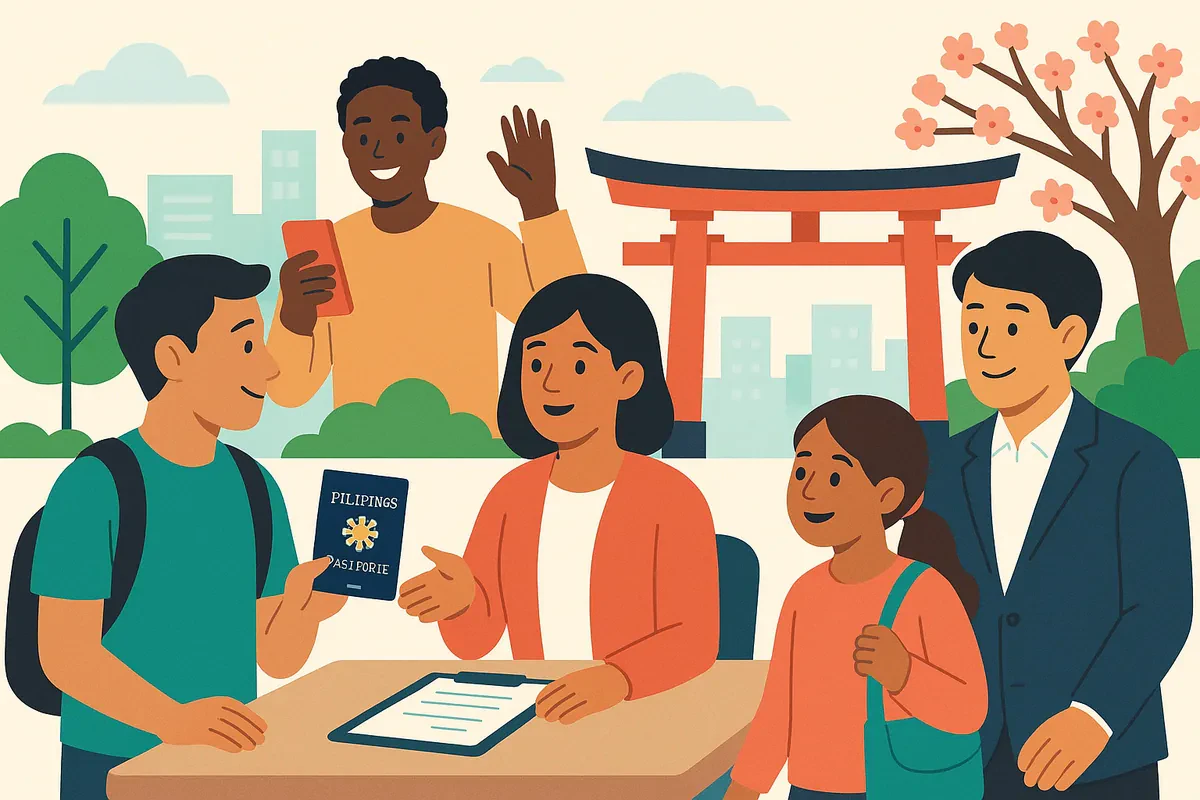
Bottom line: The Philippines has the strongest worker-protection framework of any major sending country to Japan. Three Filipino-specific facts every applicant must know:
- You should pay zero placement fee to your sending agency. The Philippine Department of Migrant Workers (DMW) prohibits land-based principals from collecting placement fees from workers; the cost is borne by the receiving Japanese employer.
- You must complete the DMW process — a DMW-licensed land-based agency, MWO (formerly POLO) endorsement at the Tokyo Migrant Workers Office, PDOS (Pre-Departure Orientation Seminar), and an Overseas Employment Certificate (OEC) — before departure. Bypassing this process turns you into an undocumented worker on arrival.
- The Philippines has the lowest debt-at-departure of any major sending country — average ¥153,000, with only 34.5% of arrivals borrowing — because the no-placement-fee rule actually works in practice.
Information current as of May 2026, based on the Department of Migrant Workers (DMW), the Migrant Workers Office Tokyo, the Immigration Services Agency 2022 fee survey (PDF), and the Ikusei Shuro Q&A. This is general information for Filipino applicants. It is not legal advice. Confirm with DMW, the MWO in Tokyo, or a Philippine consulate for case-specific guidance.
If you are reading this in English, you are probably a Filipino worker already in Japan, a family member supporting an applicant from the Philippines, or a Japanese employer evaluating Filipino candidates. The Philippines is unusual among Japan's sending countries: its worker-protection framework is more developed, English-language capability is generally higher, and the financial mechanics of sending are less predatory. The downside is more paperwork — the DMW process is rigorous.
Why the Philippines is structurally better-protected
Two policy decisions distinguish the Philippines from most other Japan-sending countries:
- Placement-fee prohibition for land-based workers. Under DMW Memorandum Circulars, land-based agencies cannot collect placement fees from workers; instead, the receiving employer pays. (Sea-based work, like seafaring, follows different rules.) For technical-intern and Ikusei Shuro workers — both land-based — the no-fee rule applies.
- Mandatory pre-departure verification. Filipino workers must go through DMW-licensed agencies, secure an MWO endorsement at the Philippine MWO in Tokyo (which reviews the Japanese employer's compliance), complete PDOS, and obtain an Overseas Employment Certificate (OEC) before departure. Each step is a check on the legality of the placement.
The Immigration Services Agency's 2022 fee survey shows the result:
| Indicator | Philippines | Vietnam | Cross-country average |
|---|---|---|---|
| Borrowing rate | 34.5% | ~80% | 54.7% |
| Average debt amount | ¥153,000 | ¥674,000 | ¥547,000 |
| Average paid to sending agency | ¥94,000 | ¥656,000 | ¥521,000 |
Filipino workers arrive with roughly one-seventh the agency-payment burden of Vietnamese workers, and one-quarter the borrowing rate. This is not because the Philippines is wealthier — it is because the no-placement-fee policy is enforced.
The official Philippine regulatory chain
- DMW (Department of Migrant Workers) — established 2022, succeeded POEA (Philippine Overseas Employment Administration). DMW licenses recruitment agencies, regulates fees, manages worker welfare programs, and operates worker support overseas.
- MWO Tokyo (Migrant Workers Office Tokyo) — formerly POLO Tokyo. Reviews the Japanese receiving employer's compliance with Philippine standards before the worker can deploy. Located at the Embassy of the Philippines in Tokyo.
- OWWA (Overseas Workers Welfare Administration) — provides welfare services to migrant workers (insurance, repatriation assistance, scholarships for dependents).
On the Japan side, bilateral cooperation governs the relationship:
- TITP cooperation under bilateral arrangements; updates have been issued periodically.
- The Specified Skilled Worker MOC, signed in 2019.
The deployment process — step by step
| Step | What happens | Approximate time |
|---|---|---|
| 1. Choose a DMW-licensed agency | Verify on the DMW website that the agency is licensed for Japan deployment. DMW agency directory | Day 1 |
| 2. Job matching | Agency proposes a Japanese employer; you review the job offer, wage, location, sector. | 2–6 weeks |
| 3. MWO Tokyo endorsement | The Japanese employer submits documents to MWO Tokyo for review. MWO confirms wage, working conditions, accommodation meet Philippine standards. | 2–4 weeks |
| 4. Visa application | Japanese supervising organization / employer applies for your Certificate of Eligibility (在留資格認定証明書) at the local Immigration Services Agency office. | 4–8 weeks |
| 5. PDOS (Pre-Departure Orientation Seminar) | Mandatory 1-day session covering Japanese culture, labor rights, emergency contacts, and OWWA membership. | 1 day |
| 6. OEC issuance | The Overseas Employment Certificate, processed through DMW's online portal (POPS-BaM, the post-2021 successor to the former BM Online / BMOPS), must be issued before departure. | 1–2 days |
| 7. Departure | You should depart only after all of the above are complete. Boarding without an OEC means you are deploying as an undocumented worker. | — |
Total process: typically 3–6 months from initial application to departure. Workers who try to shortcut this — for example by going on a tourist visa first and then arranging work locally — risk being treated as overstayers under both Philippine and Japanese law.
What the no-placement-fee rule does and does not cover
The DMW prohibition covers placement fees — the recruitment commission. It does not prohibit:
- Passport and document fees (paid to government agencies).
- Medical examination fees (paid to clinics).
- PDOS fees (typically PHP 500–1,000 — paid to OWWA-accredited PDOS providers).
- OEC processing fee (PHP 100–200).
- Personal expenses (e.g., training programs you choose to take voluntarily before departure).
Together, these legitimate costs typically total PHP 5,000–15,000 (¥10,000–¥40,000) — the source of the ¥94,000 average "paid to sending agency" figure in the 2022 survey. (Some agencies do collect "administration fees" that arguably overlap with the placement-fee category; if your agency is asking for amounts above PHP 5,000–10,000 in fees, ask for itemized justification and consider a complaint to DMW.)
Japanese language: JLPT and JFT-Basic in the Philippines
Ikusei Shuro requires CEFR A1 Japanese on entry. Filipino applicants typically meet this through:
- JLPT — administered biannually (July and December) in Manila and Cebu. JLPT N5 satisfies the A1 threshold.
- JFT-Basic — administered year-round by Prometric in Manila, Cebu, and Davao. From August 2026, JFT-Basic separately reports A1, A2.1, and A2 results, making it the most flexible exam for Ikusei Shuro entry.
- Certified 100+ hour training course — completing an approved pre-departure Japanese course can substitute for an exam pass, but be aware that for transfer eligibility later, you'll need an actual exam.
Filipino workers' English fluency is an asset for both adapting to Japanese workplaces (many supervisors prefer to speak halting English when they can) and accessing the underlying primary sources. However, English does not substitute for the A1 Japanese requirement — Ikusei Shuro entry requires demonstrated Japanese capability.
What changes under Ikusei Shuro (vs. technical intern)
| Issue | Under TITP (until 2027) | Under Ikusei Shuro (from April 2027) |
|---|---|---|
| Maximum stay | 5 years (1+2+2) | 3 years, then SSW1 (5 yrs) → SSW2 (indefinite) |
| Placement fee from worker | Prohibited (DMW) | Same — prohibited |
| Job transfer in Japan | Effectively prohibited | Allowed after 1–2 year sector waiting period and 5 conditions |
| Family accompaniment | Not allowed | Still not allowed (only at SSW2) |
| Japanese on entry | None required (caregiving: N4) | A1 / JLPT N5 / JFT-Basic A1 or 100+ hours training |
| Pre-departure verification | MWO Tokyo + OEC | Same — MWO Tokyo + OEC remain |
For Filipino workers, the most impactful change is the transfer right. The Philippines's pre-existing strong protection at deployment means Filipino workers have historically faced fewer arrival-stage disasters than Vietnamese workers — but in-Japan exploitation (wage abuse, harassment) still occurs. The new transfer right gives Filipino workers a lawful path out of bad placements. Full rules in our transfer rights guide.
If anything goes wrong: MWO Tokyo + OWWA + Houterasu
Filipino workers in Japan have a uniquely good support structure:
- MWO Tokyo (tokyo.mwo.dmw.gov.ph) — provides assistance to OFWs in Japan, including legal aid, repatriation in distress cases, and mediation with employers.
- Philippine Embassy in Tokyo — consular services, passport renewal, and emergency support.
- OWWA — membership provides insurance, scholarships for dependents, and reintegration assistance on return.
- OTIT multilingual hotline — covers Filipino (Tagalog) and English; independent of any specific supervising organization. See the OTIT main page.
- Houterasu (Japan Legal Support Center) — free legal triage in Tagalog at Houterasu multilingual hotline.
- Labor Standards Inspection Office — for wage and labor law violations. Has multilingual support in major prefectures.
The MWO Tokyo is often the most useful first contact for Filipino workers because they understand both the Philippine and Japanese contexts.
The 28-hour rule and Filipino students
A reminder for Filipino workers who came to Japan first on a student visa and are considering Ikusei Shuro: student visas allow 28 hours of work per week (more during long vacations). Working beyond this is grounds for visa cancellation. Many sending agencies advise switching directly from student to Ikusei Shuro — but the formal pathway is a status-of-residence change application, which requires meeting Ikusei Shuro's entry conditions (including A1 Japanese). It is not automatic.
The English language asset — use it wisely
Filipino workers' English fluency is consistently rated as a competitive advantage in Japanese workplaces, particularly in:
- Caregiving — increasingly Filipino caregivers are placed in facilities with foreign residents.
- Accommodation / Hospitality — Filipino workers in inns and hotels frequently handle English-speaking guests.
- Manufacturing with international clients — quality-control and shipping documentation often requires English.
This is also why Filipino workers often advance to SSW1 faster than peers from other sending countries: the combination of English ability plus reasonable Japanese substantially increases your value to a receiving company. Use this leverage when negotiating placement or transfer.
Frequently asked questions
My agency is asking PHP 30,000 in "training fees." Is this legal?
It depends. If the fee is for an actual Japanese-language course you are choosing to attend, and you receive a receipt clearly itemizing instruction hours and per-hour rates, it may be legitimate. If the fee is described as "placement fee," "deployment fee," or "agency commission" — it is illegal. Report to DMW.
Can I bring my family on Ikusei Shuro?
No. Family accompaniment is not allowed during Ikusei Shuro. It becomes available only at SSW2, typically reachable after about 8 years total on the work track. See our long-term roadmap.
I'm a current technical intern. Should I switch to Ikusei Shuro?
Almost certainly not. Switching restarts the clock and forfeits the "good completion" SSW1 exemption. Stay on TITP and use the SSW1 transition. See our transition guide.
What is the realistic timeline to permanent residence?
Roughly 10–18 years from first arrival, assuming you complete Ikusei Shuro, transition to SSW1, then SSW2, and meet permanent-residence criteria. Filipino workers typically reach SSW2 faster than peers due to English-language ability and the no-placement-fee starting position. See our long-term roadmap.
What if my Japanese employer is mistreating me? Should I call MWO Tokyo or OTIT?
Both, but MWO Tokyo often acts faster on Filipino-worker cases because they understand both sides. OTIT is the Japan-side regulator and has stronger enforcement powers in serious cases. For wage issues specifically, the Labor Standards Inspection Office is the formal channel. See our wages and deductions guide.
Sources
- Department of Migrant Workers (DMW), Philippines
- Migrant Workers Office Tokyo (MWO Tokyo)
- Overseas Workers Welfare Administration (OWWA)
- Immigration Services Agency — 2022 TITP fee and debt survey (PDF)
- OTIT — multilingual consultation hotline (Tagalog supported)
- OTIT — Approved foreign sending agencies list
- Houterasu — Multilingual legal hotline (Tagalog supported)
- Immigration Services Agency — Ikusei Shuro Q&A
If you are evaluating a Philippine sending agency, verify on the DMW agency directory. If you are in Japan and facing problems, the MWO Tokyo is often the most effective first contact for Filipino workers.
この記事のライター

LO-PAL 創業者
厚生労働省支援の外国人患者受入れ医療コーディネーター、法務の専門家。自らの海外生活経験と医療現場での知見をもとにLO-PALを設立。
※ 一部AIを使用して執筆しています
詳しいプロフィール →