Food Allergy Travel Japan (2026): Allergy Card + Safe Eats
2026 safety-first Japan guide: official allergy sheet, 8 mandatory allergens, label cheat sheet, safer conbini meals, and ryokan tips.
Traveling with food allergies can feel like planning a trip with an invisible threat—especially in a country where your biggest risks aren’t always the obvious “allergen foods,” but broths, sauces, and shared fryers.
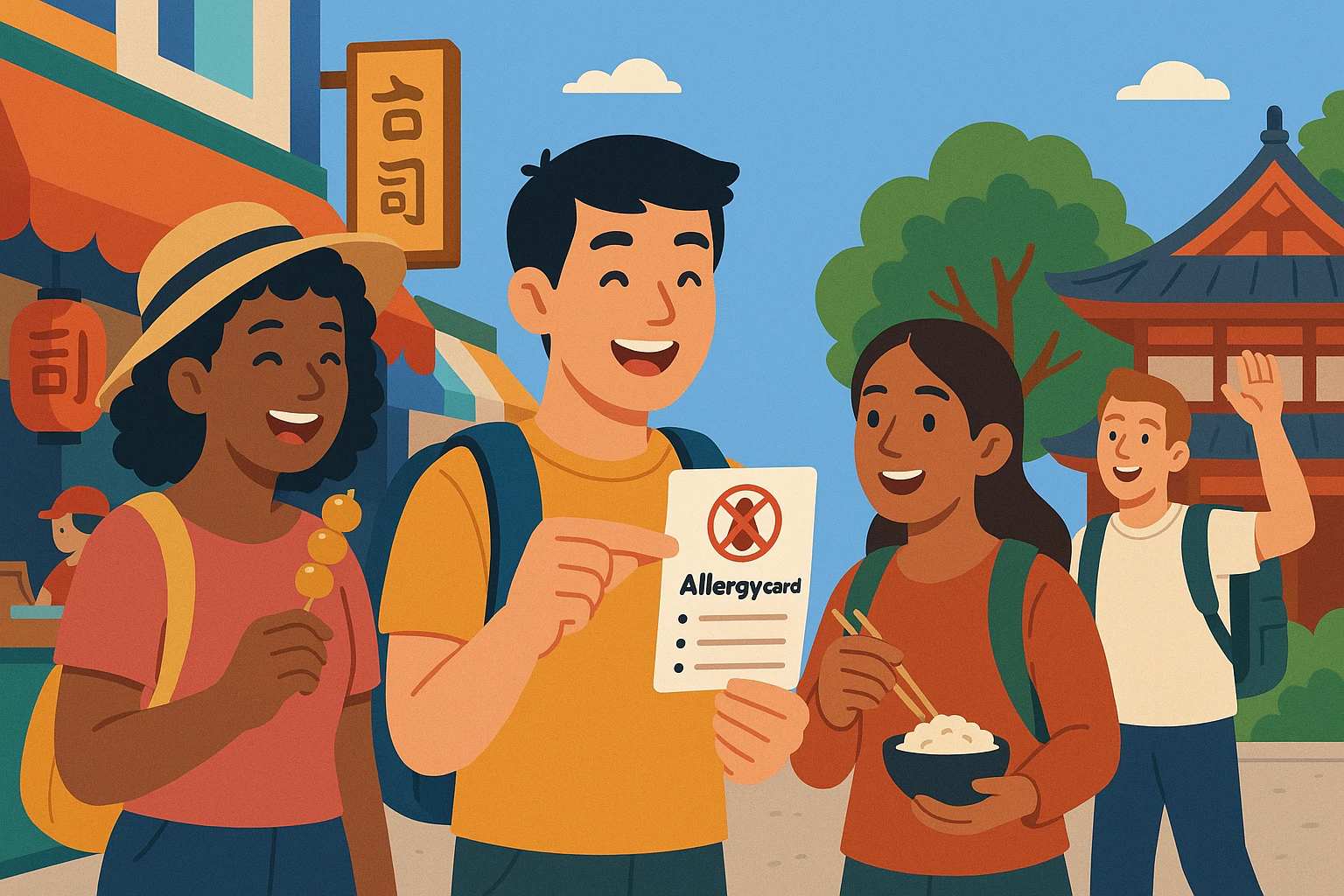
This food allergy travel Japan guide is updated for 2026 and built around Japan’s official smartphone-use Food Allergy Communication Sheet (a government tool you can show to staff). You’ll also get a label-reading cheat sheet for Japan’s 8 mandatory allergens, budget-friendly “safer” meal strategies (conbini + chain restaurants), and a plan for higher-risk situations like matsuri street food and ryokan meals.
Quick takeaway: In Japan, strict allergen rules mainly apply to packaged foods. For restaurants and street food, you must ask proactively, use an official communication sheet, and treat “may contain”/shared-facility info as inconsistent—especially for severe allergies.
Before You Go: Food Allergy Travel Japan Prep Checklist (EpiPen, meds, hotel notes)
Your best safety move in Japan happens before you board the plane: set up medication paperwork, write clear “non-negotiables,” and pre-message hotels so you’re not negotiating at check-in while hungry.
1) Medications & paperwork (U.S. travelers: do this 2+ weeks before departure)
Japan regulates bringing medications into the country. Depending on the medication type and quantity, you may need an Import Confirmation certificate called Yunyu Kakunin-sho (formerly often called Yakkan Shoumei).
- Start here: Read the Embassy of Japan guidance on bringing medications, including the requirement that some travelers need a Yunyu Kakunin-sho and that you should apply at least two weeks in advance.
- Use the official online system: The Ministry of Health, Labour and Welfare (MHLW) runs an English portal called “Application for Import Confirmation”.
- If you carry injectables (including auto-injectors): rules can be stricter. Prepare a doctor’s letter and apply if needed.
Official resources to bookmark now: Embassy of Japan (U.S.): Bringing Medications into Japan, MHLW: Information for those bringing medicines for personal use, and MHLW Import Confirmation online application.
2) Pack an “allergy kit” you can carry all day
For 1–3 week trips, build a day-pack kit you can keep on you even when you’re just “popping out” to a konbini.
- Epinephrine auto-injector(s) (carry on your body, not in checked luggage), plus any prescribed antihistamines/inhalers.
- Doctor’s letter (printed + phone photo) listing your diagnosis, meds, and that epinephrine is medically necessary.
- Two copies of your Japanese allergy card/communication sheet (one in your wallet, one in your suitcase).
- Backup safe snacks for train days (plain rice crackers you trust, sealed protein bars, etc.).
- Thermal considerations: keep meds out of direct sun; summer heat in Japan can be intense.
3) Hotel notes you can send in one message
Send your hotel a short, copy-paste message right after booking. Even if they can’t guarantee kitchen safety, many hotels can still help with logistics.
- Request a mini fridge (or confirm there’s one) and ask if they can store medication temporarily if needed.
- Ask if they can note your allergy in your reservation and advise the breakfast venue.
- If you’re avoiding hotel breakfast, ask where the nearest 24-hour/late-night konbini is and whether there’s a microwave you can use (some hotels have one in a common area).
Copy-paste message: “Hello. I have a severe food allergy to: (list). For safety, please add this note to my reservation. Could you confirm if the room has a refrigerator, and whether staff can help communicate this at breakfast? Thank you.”
4) Know your emergency plan (numbers + where to get English help)
If you have anaphylaxis symptoms, call an ambulance immediately: in Japan, dial 119. In Tokyo, local guidance also explains how to dial 119 from public phones and confirms ambulance transport is free of charge (treatment costs still apply).
- Ambulance/Fire: 119
- Police: 110
- Japan National Tourism Organization (JNTO) emergency medical guide: use their official tools to find medical facilities and consultation contacts by area.
Bookmark: JNTO: Guide for when you are feeling ill.
Japan’s Allergen Labels, Explained: 8 Mandatory Allergens + 2026 Update
Japan’s allergen labeling is strongest on packaged, prepackaged processed foods. This is why conbini meals (with labels) can sometimes be “safer” than restaurants for some travelers—if you know what you’re reading.
The 28 “designated allergens”: 8 mandatory + 20 recommended
Under Japan’s Food Labeling Act framework, Japan specifies 28 allergen items. Of these, 8 are mandatory to label when present in prepackaged processed foods: egg, milk, wheat, buckwheat (soba), peanut, shrimp, crab, walnut. Japan also lists 20 recommended items that companies are encouraged to label (not guaranteed).
Label-reading cheat sheet: the 8 mandatory allergens (Japanese)
On many products you’ll see an allergen line such as アレルゲン or wording like (◯◯を含む) (“contains ◯◯”). Learn these eight first:
| Mandatory allergen | Common Japanese on labels | Fast traveler notes |
|---|---|---|
| Egg | 卵 | Also common in mayo, bread, okonomiyaki batter |
| Milk | 乳 / 乳成分 | Watch for “milk components” in sweets and breads |
| Wheat | 小麦 | Soy sauce often contains wheat (not gluten-free) |
| Buckwheat (soba) | そば / 蕎麦 | High-risk in noodle shops (airborne flour is possible) |
| Peanut | 落花生 / ピーナッツ | Also in some snacks, sauces, and desserts |
| Shrimp | えび | Cross-contact risk in fryers; also in shrimp paste |
| Crab | かに | Often in seafood mixes and some broths |
| Walnut | くるみ | Now fully mandatory; prior grace period ended in 2025 |
2026 reality check: These rules are powerful for packaged foods, but do not automatically apply to restaurant meals or over-the-counter foods sold loose. That’s why your communication sheet matters so much.
2026 update to watch: cashew nut labeling is in the process of revision
In January 2026, Japan’s Consumer Affairs Agency (CAA) publicly announced it had begun formal procedures to revise the Food Labeling Standards, citing increased cashew nut allergy cases in national survey data.
What this means for travelers in 2026: even if you’re used to looking only for the 8 mandatory allergens, you should treat cashew as a high-alert ingredient when buying snacks and desserts. Before you depart, check the latest CAA updates (especially if your trip is after spring 2026) and be conservative with foods where nuts can be “hidden” (cookies, chocolates, granola, pesto-style sauces).
“May contain” and shared-facility notes: helpful, but inconsistent
Japan uses “precautionary” statements such as “made in a facility that produces…” as a form of cautionary information, but these notes are generally voluntary and not guaranteed to be complete or consistent. For severe allergies, don’t treat “no warning” as proof of safety.
Where Tourists Get Tripped Up: Dashi, sauces, cross-contact, and street food
Most incidents for travelers don’t happen because someone eats a whole shrimp by accident. They happen because of broths, sauces, and shared equipment—plus the assumption that a menu icon is “official labeling.”
Dashi (出汁): the invisible ingredient in “safe-looking” dishes
Dashi is a foundational broth. Many versions include fish (commonly bonito) and some include shellfish elements depending on the kitchen and product. This is a common trap for both food allergies and vegetarian eating Japan, because a dish can look like “just tofu/vegetables” but still use fish-based stock.
Sauces and seasonings: wheat, soy, sesame, and alcohol
For gluten-free Japan travel, remember: “gluten-free” is not the same as “no soy sauce.” Standard soy sauce typically contains wheat. Also watch for sesame in dressings and dipping sauces, and for “secret ingredients” like powdered stock in stir-fries.
Cross-contact: fryers, grills, and noodle shops
Cross-contact is a major risk in Japan for travelers with severe allergies. Shared fryers (tempura shops, karaage stands, food courts) can mix shrimp, wheat batter, and other allergens, and grill surfaces can be shared between seafood and meat. Tokyo’s food safety guidance for restaurants emphasizes the need to avoid ambiguous answers and to consider contamination risk when serving customers with allergies.
Matsuri street food: delicious, fun, and high-risk
Matsuri stalls often have limited ingredient documentation, rapid service, and shared tools. If your allergy is severe, plan for the possibility that you may need to skip most street food and build your fun around games, parades, and packaged treats you can verify.
- Safer strategy: eat a verified meal first (conbini label-checked food), then browse stalls.
- Choose simpler items: whole fruit, plain roasted items, or sealed packaged foods with labels.
- Ask one key question: “This contains (allergen)?” plus “Is it cooked in the same oil?”
Ryokan meals: the “set menu” problem
Ryokan dinners (kaiseki-style) are often multi-dish, chef-set meals. That’s culturally amazing—and logistically hard for severe allergies because sauces and broths appear across many dishes and kitchens may not be able to guarantee separation.
- Ask before you book: message the ryokan and ask if they can accommodate your exact allergens and severity.
- Ask about cross-contact control: separate cookware, separate fryer oil, dedicated prep area (if needed).
- Have a Plan B: if they cannot guarantee safety, book “room only” or “breakfast only,” and use conbini + verified restaurants.
Your On-Trip Toolkit for Food Allergy Travel Japan: Official Allergy Card, key phrases, and how LO-PAL can help
In Japan, your goal is to communicate clearly, quickly, and respectfully—and to get a “yes/no” answer you can trust. That starts with Japan’s official tools.
1) Use Japan’s official smartphone-use Food Allergy Communication Sheet (CAA)
The Consumer Affairs Agency provides an official (smartphone-use) Food Allergy Communication Sheet in multiple languages (including English, Chinese, and Korean). Importantly, the CAA notes you should download the file to your device for full functionality (checkboxes may not work if you try to use it only in a browser).
Get it here (scroll to the smartphone-use sheet downloads): CAA: Food labeling pamphlets (includes smartphone-use allergy sheet PDFs).
2) Also carry a printable pictogram sheet (Tokyo / Osaka options)
If you prefer pointing to icons (or you’re speaking with staff who don’t read English comfortably), local governments publish printable pictogram-style sheets:
- Tokyo: The Tokyo Metropolitan Government provides downloadable “Allergy Communication Sheet” PDFs in multiple language sets (including English/Chinese/Korean and other sets). Tokyo Food Safety: Allergy communication sheet downloads.
- Osaka Prefecture: Osaka provides a pictogram-based communication sheet in 11 languages and shares the PDF for printing or tablet display. Osaka Prefecture: Food Allergy Communication Sheet.
3) Key phrases (save these as a phone note)
These phrases help you get the right kind of answer (not just “I think it’s fine”). If possible, show your official sheet first, then use one follow-up question.
- I have a food allergy: 私は食物アレルギーがあります。 (Watashi wa shokumotsu arerugii ga arimasu.)
- I’m allergic to (X): (X)アレルギーです。 (X arerugii desu.)
- Does this contain (X)? これは(X)が入っていますか? (Kore wa X ga haitte imasu ka?)
- Is it cooked in the same oil / fryer? 同じ油で揚げていますか? (Onaji abura de agete imasu ka?)
- I can’t eat even a small amount: 少量でも食べられません。 (Shouryou demo taberaremasen.)
- Please tell me if you are not sure: 分からない場合は「分からない」と言ってください。 (Wakaranai baai wa “wakaranai” to itte kudasai.)
4) Budget-friendly “safer eats” strategy: conbini + chains
If you’re traveling for 1–3 weeks, you can keep daily risk lower (and costs predictable) by mixing label-checked conbini meals with chains that publish allergen info.
- Conbini (typical budget): about ¥500–¥1,200 per meal depending on what you choose (rice balls + salad + drink vs. a larger bento).
- What’s “safer” here: packaged items with full ingredient/allergen labeling (you still must read carefully every time).
- Chain restaurants: many large chains provide allergen charts on their websites or in-store binders. Look for the word アレルゲン on menus or ask: アレルゲン表はありますか? (Arerugen-hyou wa arimasu ka? = Do you have an allergen list?)
5) How LO-PAL helps on the ground (when you need a human, not another app)
Even with the official sheet, the hardest moments in food allergy travel Japan are usually real-world: a ryokan that replies only in Japanese, a restaurant staff member who can’t confidently answer, or a festival stall where you need to ask fast and politely.
That’s exactly why we built LO-PAL: so you can connect with a local Japanese helper who can communicate clearly and help you reduce risk in real time—especially in situations where nuance matters.
- Ask a local helper to call a ryokan and confirm whether your specific allergens can be handled (and whether cross-contact can be avoided).
- Request help finding “safer” chain options near your hotel that have allergen documentation.
- Get support at a supermarket: ask someone to help you interpret labels, including “contains” statements and cautionary notes.
FAQ: Food allergy travel Japan (2026)
These are the questions we hear most from short-term visitors planning a Japan trip.
Do restaurants in Japan have to list allergens on menus?
Generally, no. Japan’s allergen labeling rules primarily apply to prepackaged processed foods. Restaurant meals and over-the-counter foods sold loose don’t have the same standardized labeling obligation, so you must ask proactively and use a communication sheet.
What is the official “Japanese allergy card” I should use?
Use the CAA smartphone-use Food Allergy Communication Sheet, and consider also carrying a printable pictogram sheet from Tokyo or Osaka local government resources. Download the PDF to your device so the checkboxes work reliably.
Is “gluten-free” the same as a wheat allergy in Japan?
No. “Gluten-free” is a dietary approach, while wheat allergy is a medical condition—and sauces (especially soy sauce) often contain wheat. If you have celiac disease or wheat allergy, treat sauces and cross-contact (shared fryers, shared noodle pots) as key risks.
Can a ryokan safely handle severe allergies?
Some can, some cannot. You should ask before booking and request clear answers about ingredients and cross-contact controls. If they can’t confidently accommodate, choose “room only” and rely on label-checked foods and verified restaurants.
What number do I call for anaphylaxis in Japan?
Dial 119 for ambulance/fire. If you’re in Tokyo and unsure whether it’s an emergency, you can also consult #7119 (Tokyo Fire Department Emergency Consultation Center) when deciding whether to call an ambulance.
Related Articles
If you’re building a practical, low-stress itinerary around predictable meals and clear ordering, these guides help:
- How to order at an izakaya in Japan (2026): English menu tips
- Osaka street food crawl (2026): Dotonbori, Kuromon & New Umeda
- Tokyo 1 day itinerary (2026): Asakusa & Shibuya safety tips
Need More Help? Ask on LO-PAL
If you want to know more about this topic—or you need specific local information for your exact itinerary—ask a local Japanese person on LO-PAL.
LO-PAL is our matching service that helps tourists in Japan connect with local Japanese helpers. Post a question (like “Can you call this ryokan and confirm they can avoid wheat and shrimp cross-contact?”) or request a task (like “Please help me find a chain restaurant near Shinjuku with an allergen chart”). Our community responds in multiple languages, so you’re not stuck trying to communicate high-stakes health info alone.
Written by

Founder, LO-PAL
Former Medical Coordinator for Foreign Patients (Ministry of Health programme) and legal affairs professional. Built LO-PAL from firsthand experience navigating life abroad.
Written with partial AI assistance
Read full bio →