How to Order at an Izakaya in Japan (2026): English Menu Tips

The all-in-one Japanese learning app
From travel phrases to real fluency — all in one app.
All 2,136 standard kanji included. Every feature is free to use.
A 2026 step-by-step playbook for how to order at an izakaya in Japan: QR/tablet systems, otoshi charges, and nomihodai rules.
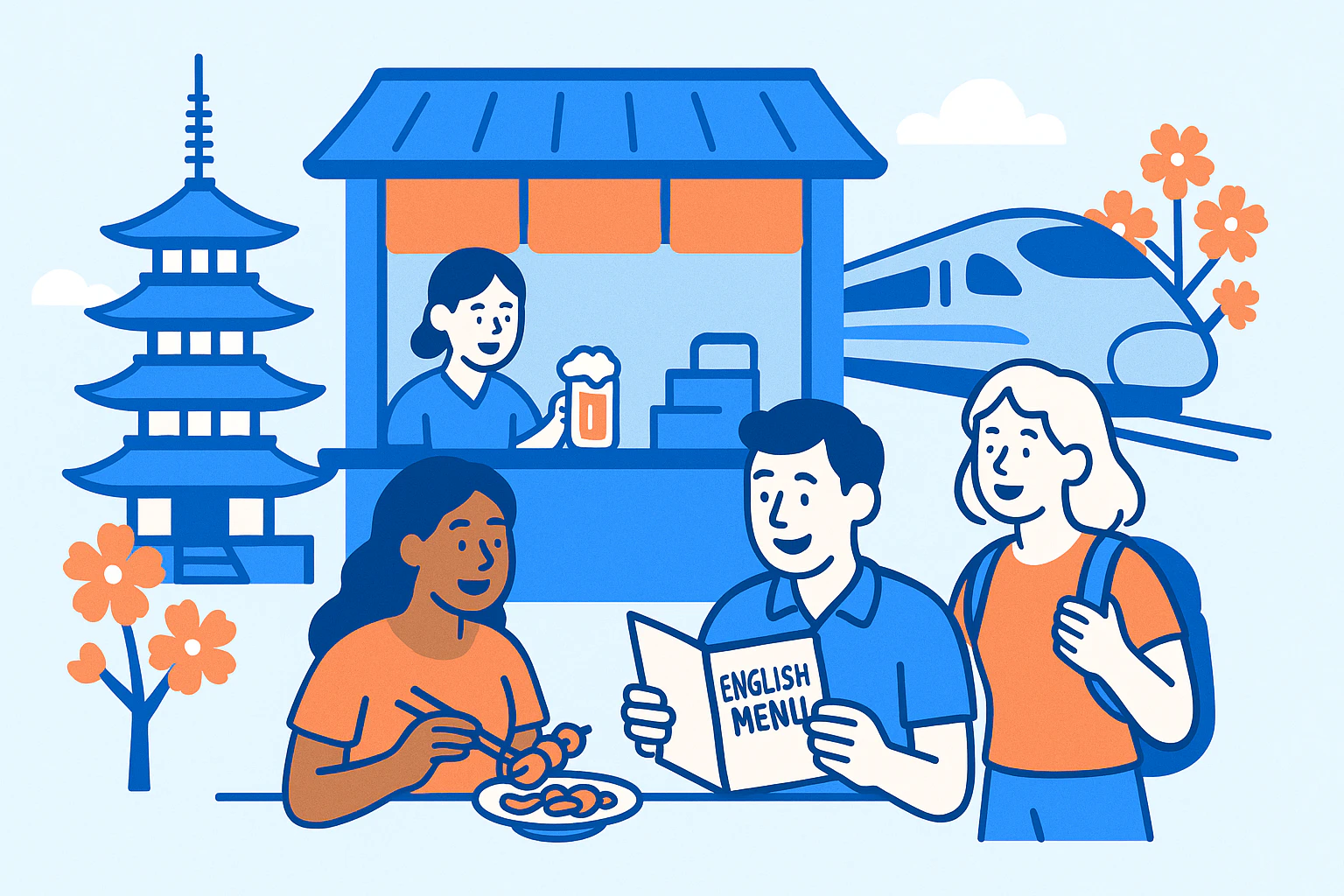
If you’ve been Googling how to order at an izakaya in Japan, you’ve probably noticed most guides focus on what to eat. But the real stress for visitors is the ordering system (call buttons vs. tablets vs. QR), the surprise otoshi table charge, and the fine print behind nomihodai meaning (all-you-can-drink rules).
This 2026-ready guide is a step-by-step “ordering playbook” for short-term travelers (1–3 weeks). We’ll cover exactly what happens from the moment you sit down to the moment you pay—plus what to do when the menu is handwritten and Japanese-only.
The 60-second Izakaya Ordering Playbook (save this): 1) Expect an otoshi small dish (paid) even before you order. 2) Many shops do drinks first, food second. 3) To order, look for a call button, a tablet, or raise your hand and say “Sumimasen!” 4) If you choose nomihodai, confirm time limit + last order + what drinks are included. 5) No tip; ask for the bill: “Okaikei onegaishimasu.”
What to Expect at an Izakaya: seating, otoshi table charge, and the ‘first drink first’ flow
Izakaya are casual Japanese pubs where you share small plates and order in rounds. They’re usually busiest after work (roughly 6–9 p.m.), and many are walk-in friendly—especially outside peak hours.
Typical hours (varies by neighborhood): many izakaya open around 5 p.m. and close around 11 p.m.–1 a.m. In major nightlife areas (Tokyo’s Shinjuku/Shibuya, Osaka’s Namba/Umeda), you’ll also find late-night options.
Seating basics (and what you should do immediately)
When you enter, you’ll usually hear “Irasshaimase!” and be asked your party size (“Nan-mei-sama?”). Some shops seat you at tables; others have counter seating; some have tatami areas where you may need to remove shoes.
Right after you sit, you’ll often receive an oshibori (wet towel). Use it for your hands (not your face), and you’re ready to start ordering.
Otoshi: why a small dish arrives before you order (and why it’s not “free”)
A frequent tourist surprise: you sit down and a small appetizer appears without you ordering it. This is otoshi, and it functions as a table charge at many izakaya.
Japan’s official Consumer Hotline for Tourists explains that otoshi is part of izakaya culture and is charged at the end; it also notes that some shops may add a separate seating charge in addition to otoshi, and you can ask staff to explain the charges before paying.
Practically, assume it’s charged per person. If you have dietary restrictions, communicate immediately (see the survival kit section), because otoshi can include fish, shellfish, or meat.
The “first drink first” flow (why food ordering can feel delayed)
Many izakaya take drink orders first, then food orders after drinks arrive. The same Consumer Hotline for Tourists page notes that drinks-first is common and otoshi is served so you have something to nibble while waiting for food ordering to begin. If you’re hungry, don’t panic—this is normal.
Non-drinker tip: You can still follow the flow by ordering a soft drink first (oolong tea is a classic). You’ll blend in and you’ll often get faster service because the staff can start your table’s “first round.”
Costs to budget (so you’re not shocked at checkout)
Prices vary a lot by city and style, but for a typical casual izakaya dinner, many travelers spend around ¥3,000–¥6,000 per person (more if you add a premium drink plan). Add an extra otoshi charge per person; guides commonly describe otoshi as a few hundred yen, and can be higher depending on the shop.
If you’re watching your budget, order in rounds (2–4 dishes at a time) and keep an eye on “market price” items (時価). When in doubt, ask the price before confirming an order.
How to order at an izakaya in Japan in 2026: call buttons, tablets, and QR-code phone ordering
Here’s the core skill: in Japan, staff usually won’t come to your table repeatedly to “check in.” You’re expected to call them or order using the system provided. In 2026, you’ll see three classic patterns—plus an increasingly common QR flow.
Pattern 1: The table call button (the easiest option)
Many izakaya have a call button on the table. Press it, and a staff member will come to take your order. This is normal and not rude.
If you’re unsure what to say, start with: “Sumimasen” (excuse me) + point to the menu item. You can also just smile and say: “Kore onegaishimasu” (this, please).
Pattern 2: The tablet menu (common at chains)
Chain izakaya often have a tablet at the table. The LIVE JAPAN ordering guide notes that chain shops may provide a tablet, and many are multilingual—so you can select items and press “Order” yourself.
Tablet pro-tip: Before you order, look for language settings (EN/English). Also check for a “nomihodai” tab if you’re considering an all-you-can-drink plan, because those drinks may be listed separately.
Pattern 3: No device at all (the traditional way)
If there’s no button and no tablet, do what locals do: raise your hand slightly and say “Sumimasen!” The same LIVE JAPAN article outlines this as the standard approach in smaller izakaya.
Once staff arrives, ordering can be as simple as pointing and saying “Kore to kore” (this and this). If you want to pause ordering for now, you can say something like “That’s all for now.”
2026 pattern: QR-code phone ordering (scan-to-order)
Restaurant digital transformation has pushed “scan to order” systems—where your phone becomes the ordering terminal. For example, restaurant ordering systems like Seisei’s ordering feature page describes a customer flow where you scan a QR code, browse the menu, and submit orders from your phone, often with multilingual support.
Step-by-step QR ordering checklist (what to do at the table):
- Check your connectivity: QR ordering may require data. If you don’t have an eSIM/pocket Wi-Fi, ask staff if there’s Wi-Fi: “Wi-Fi arimasu ka?”
- Scan the QR using your camera app and open the page.
- Find language settings (if available). If not available, use your phone’s browser translation—but double-check item names.
- Select quantity carefully: many menus default to “1,” but skewers and small plates can arrive quickly.
- Confirm the order status: look for “注文完了” (order complete) or an order history screen.
If the QR menu is confusing: don’t struggle for 20 minutes. Press the call button (or “Sumimasen”) and ask for help. It’s completely normal to say you don’t understand the system.
What to do when the menu is handwritten (and translation apps fail)
This is where many tourists freeze—especially when the “best stuff” is on a handwritten board. A Japan-based guide using Tabelog data reported that only 5.8% of izakaya nationwide (and 12.3% in Tokyo) had English menus as of the end of May 2024, meaning Japanese-only menus are the default. You can see the figures and context in this NinjaKotan Travel post.
Another post (also citing Tabelog) says English-menu coverage for izakaya was around 4.2% nationwide as of July 20, 2025, reinforcing that you should expect Japanese-only or handwritten specials. Source: NinjaKotan Travel (2025 edition guide).
Reality check for 2026: Most izakaya do not have an English menu—so your best “ordering skill” is learning how to order with pointing, simple phrases, and asking for recommendations.
Nomihodai (All-You-Can-Drink) in Plain English: rules, last order, and avoiding extra fees
Nomihodai is where bills can go from “great deal” to “wait, why is it so expensive?” The fix is simple: confirm the rules before you commit, and order only what’s included.
Nomihodai meaning (what you’re actually buying)
Nomihodai (飲み放題) literally means “drink as much as you want,” but it’s not unlimited time or unlimited menu. It’s typically a fixed-price, time-limited plan with a designated drink menu for about 90–120 minutes (rules vary by shop).
As an example of how clearly chains set limits, Torikizoku’s official FAQ states that reservations are limited to two hours from the reservation time.
Common nomihodai rules you should expect
Rules vary, but several guides converge on the same “core” policies. The LIVE JAPAN nomihodai guide summarizes key etiquette such as ordering from the nomihodai menu (or you’ll pay extra), the “one drink per customer” pacing, and a last call typically about 30 minutes before time ends.
- Time limit: commonly 90–120 minutes (sometimes longer).
- Last order / last call: often around 15–30 minutes before the end (店によって違います).
- Included drinks only: anything not on the nomihodai list is charged normally.
- One glass at a time: often you must finish your current drink before ordering the next.
- Food requirement: some places require a course or a minimum food order per person (especially with nomihodai).
Avoiding extra fees: the 4 questions to ask before you say yes
If you’re worried about surprise charges, ask these before you start nomihodai. You can ask in simple English; many staff will understand the keywords “time,” “last order,” and “included.”
- How long is it? (90 min? 120 min?)
- When is last order? (“Rasuto odaa wa itsu?” works too.)
- Is everyone required to join? This matters if someone is a non-drinker.
- Which drinks are included? Point to the nomihodai menu page to confirm.
How to enjoy izakaya even if you don’t drink
You can absolutely enjoy an izakaya alcohol-free. Order a soft drink first, focus on food specialties, and don’t be shy about skipping nomihodai.
Useful phrases:
- “Osake wa nomanai desu.” (I don’t drink alcohol.)
- “Sofuto dorinku arimasu ka?” (Do you have soft drinks?)
- “Oolong-cha kudasai.” (Oolong tea, please.)
- “Non-arukooru wa arimasu ka?” (Do you have non-alcohol options?)
Non-drinker strategy: If your group wants nomihodai but you don’t drink, ask whether one person can order à la carte while others do nomihodai. Some shops allow it; some require everyone to join—so it’s best to confirm early.
No-Japanese Survival Kit: menu translation tips, dietary requests, key phrases + local help
This is your toolkit for the hardest scenario: no English menu, handwritten specials, and a busy room. The goal isn’t perfect Japanese—it’s getting what you want without stress.
Menu translation tips that actually work (especially for handwritten boards)
Translation apps are great for printed menus, but handwritten “today’s specials” can be tough. Use a layered approach:
- Step 1 (fast): Look for photos, sample displays, or set recommendations.
- Step 2 (smart): Ask for recommendations: “Osusume wa nan desu ka?” (What do you recommend?)
- Step 3 (low-risk): Order assortments: “moriawase” (assorted platter) is a safe bet.
- Step 4 (confirm price): If there’s no price or it says 時価, ask: “Kore wa ikura desu ka?” (How much is this?)
If you want a reality check on English menus, the Tabelog-based figures cited above are a good reminder to expect Japanese-only in most places (see May 2024 data and July 2025 data).
Key phrases for ordering (minimal, powerful, tourist-proof)
Memorize these 10, and you can order in almost any izakaya:
- Sumimasen! すみません (Excuse me / to call staff) — highlighted as standard in the LIVE JAPAN ordering guide.
- Kore onegaishimasu. これお願いします (This, please.)
- Kore futatsu. これ二つ (Two of this.)
- Nama hitotsu. 生一つ (One draft beer.)
- Mizu kudasai. 水ください (Water, please.)
- O-susume wa? おすすめは? (What do you recommend?)
- Daijoubu desu. 大丈夫です (It’s okay / no thank you.)
- Okaikei onegaishimasu. お会計お願いします (The bill, please.)
- Eigo no menyuu arimasu ka? 英語のメニューありますか? (Do you have an English menu?)
- Shashin OK desu ka? 写真OKですか? (Is it okay to take a photo?)
Dietary requests: how to communicate allergies, vegetarian needs, and religious restrictions
Izakaya kitchens are busy, and dishes often include hidden ingredients (dashi, bonito, shellfish, etc.). Japan’s Consumer Hotline for Tourists specifically advises travelers to communicate vegetarian, religious, and allergy needs to staff—especially relevant with otoshi and shared plates.
Use short, clear statements and show them on your phone (typed in Japanese if possible):
- “Alerugii ga arimasu.” アレルギーがあります (I have an allergy.)
- “○○ wa taberaremasen.” ○○は食べられません (I can’t eat ○○.)
- “Niku nashi / sakana nashi de dekimasu ka?” 肉なし/魚なしでできますか? (Can you make it without meat / without fish?)
- “Kore ni butaniku arimasu ka?” これに豚肉ありますか? (Does this have pork?)
Important: Even if staff tries their best, cross-contact can happen. If your allergy is severe, consider choosing places with clearer allergen documentation (often chains) or book restaurants that explicitly support your needs.
Reservations and planning (so you’re not stuck wandering at 8 p.m.)
For many izakaya you can walk in, but Fridays and Saturdays can be full—especially near major stations. If you want to lock in a table, these are practical, tourist-friendly options:
- Use major restaurant platforms: Tabelog (English) and TableCheck are widely used for browsing and (for many venues) booking.
- Phone reservation help in English: GURUNAVI Reservation Support lists an English phone line (050-2018-1384 / +81-50-2018-1384) with weekday hours.
- Go early: If you don’t want reservations, aim for 5–6 p.m. seating in busy areas (Tokyo: Shinjuku/Shibuya/Yurakucho; Osaka: Namba/Umeda).
Access route tip: On Google Maps, search “居酒屋” near your station and use “Open now.” Many great izakaya are within a 2–8 minute walk of major train stations.
If you think you were overcharged (or you’re pressured into something)
If you’re in a nightlife district and someone tries to lure you in from the street, be careful. The Tokyo Metropolitan Police Department warns about illegal street hawkers in areas like Shinjuku Kabukicho and notes they may lead customers to rip-off or inappropriate places.
If you’re already inside a restaurant and confused about charges (otoshi, seating, drink plan), ask for an explanation before paying. For consumer trouble, Japan’s official Consumer Hotline for Tourists lists direct support:
Consumer Hotline for Tourists: 03-5449-0906 (Mon–Fri 10:00–12:00, 13:00–16:00; closed weekends/holidays; supports multiple languages). Details on the official Consumer Hotline for Tourists site.
Need More Help? Ask on LO-PAL
If you want to know more about this topic—or you need specific, local help like “Which izakaya near my hotel has a tablet menu?”, “How much is the otoshi at this place?”, or “Can someone help me order from a handwritten board?”—ask a local Japanese person on LO-PAL.
LO-PAL is our matching service that connects foreign tourists and residents with local Japanese helpers. You can post a question (Q&A style) or request task help (for example: menu-reading support, reservation assistance, or on-the-ground guidance), and people in the community respond.
We support multiple languages—English, Chinese, Vietnamese, Portuguese, Korean, Nepali, Tagalog, Indonesian, and Spanish—so you can focus on enjoying the night, even if the menu is Japanese-only.
Your next action: Before your trip (or before tonight’s dinner), post on LO-PAL with your area (e.g., “Shinjuku,” “Namba,” “Kyoto Gion”), your budget (e.g., ¥4,000/person), and whether you drink alcohol. We’ll help you make izakaya ordering feel easy.
Written by

Founder, LO-PAL
Former Medical Coordinator for Foreign Patients (Ministry of Health programme) and legal affairs professional. Built LO-PAL from firsthand experience navigating life abroad.
Written with partial AI assistance
Read full bio →