Japan Garbage Separation Rules in English (2026): Work-Move Checklist
A 2026 checklist to relearn local Japan garbage separation rules in English after moving—pickup days, plastics, batteries, and sodai gomi.
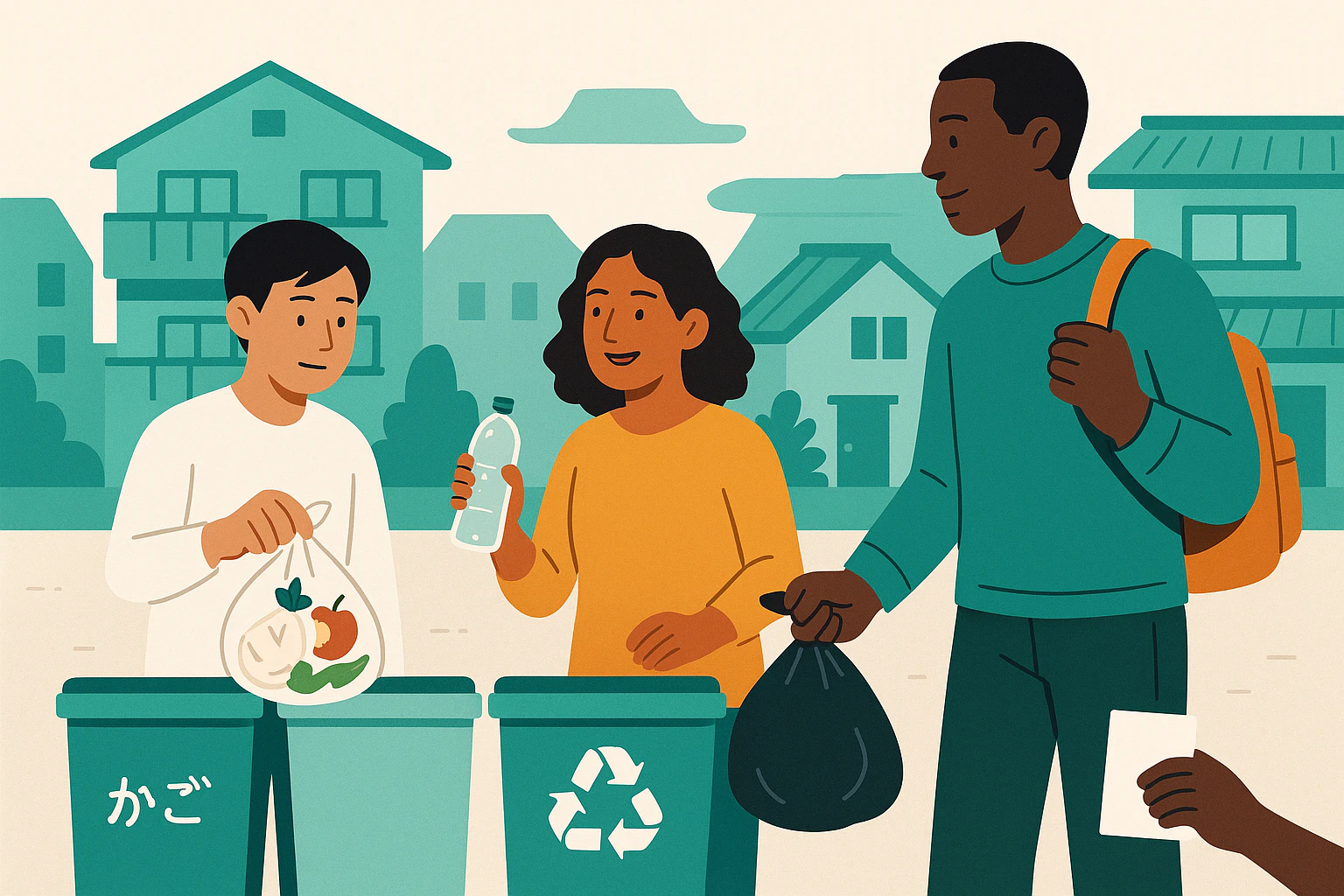
Just moved cities (or even just changed apartments) for a new job? In Japan, that usually means your Japan garbage separation rules in English “reset” overnight—even if you were already comfortable in your last neighborhood.
Rules can change by municipality, by ward, and sometimes by building management. On top of that, many areas require you to put trash out early in the morning (for example, Minato City (Tokyo) says to put sorted trash out by 8:00 a.m., and 7:30 a.m. in special areas), which can be rough when you’re commuting or starting a new role.
This 2026 checklist shows how to re-learn local rules fast using official multilingual resources, plus what to do when your work hours make morning pickup hard. It also covers two “newer” realities: Japan’s push for more multilingual trash signage in apartment buildings, and the latest safety guidance around lithium-ion batteries.
Work-move trash reset checklist (do this in your first 48 hours)
1) Find your city/ward’s official English (or multilingual) waste guide + pickup calendar.
2) Confirm your building’s garbage station location, access hours, and any “house rules.”
3) Identify your local plastics category (it often changes after moving).
4) Set reminders for Japan trash pickup days (calendar/app alerts).
5) Learn your municipality’s exact route for lithium-ion batteries and small devices.
6) If you’re moving out soon: book sodai gomi (bulky waste) early and buy the correct stickers/coupons.
Why trash rules ‘reset’ after a work move (Japan garbage separation rules in English)
When you change jobs, you often change your commute—and that can force an apartment move. In Japan, a move typically means you must relearn garbage rules because the “unit of rules” is local: the city/ward sets the categories, your neighborhood sets the pickup days, and your building sets the practical process.
Even within Tokyo, rules can differ. Minato City publishes its own English waste rules, calendars, and an official sorting app, while Shinjuku City provides foreign-resident pages and points to multilingual guides and an app.
Your building can also “add” rules that aren’t obvious from the municipal PDF: where the garbage station is, whether you can use a 24-hour garbage room, how to bundle cardboard, or whether a net must cover recyclables. If your building is strict, the same city rules can feel totally different compared with your old place.
There’s also a broader trend: municipalities and landlords are investing more in multilingual signage to reduce neighbor conflicts. For example, Kawaguchi City has updated procedures around its one-room apartment ordinance (effective April 1, 2024), and its enforcement rules include requirements to display waste disposal instructions in Japanese plus foreign languages (such as English and Chinese). Local reporting also highlighted a move to seven languages for one-room apartment garbage-rule signage in Kawaguchi City (adding languages like Vietnamese, Tagalog, and Turkish). (Asahi Shimbun, Jan 23, 2024)
If morning pickup conflicts with your work schedule, decide this now:
A) Does your building have a 24-hour garbage room (common in larger apartments)?
B) If not, can you store sorted trash indoors and take it out right before leaving (or ask building management about allowed hours)?
C) If you regularly miss pickup, you need a “missed-day plan” (store safely until next day, not outside).
Find the official rules in English fast: Japan garbage separation rules in English resources (city PDFs, multilingual pages, apps)
The fastest way to avoid problems is to rely on official municipal resources first, then confirm your building’s rules second. Here’s a practical search flow that works in most cities.
1) Start with your city/ward’s foreign-resident or “easy” pages
Many municipalities now maintain an “easy” English/Japanese area (or a foreign resident portal) where waste rules are one of the first 생활 topics. Example: Minato City’s “Waste Disposal Rules and Recycling” page states the morning deadline, provides a phone number (Minato Recycling and Waste Management Office: 03-3450-8025), and links an English PDF guide.
Another example: Shinjuku City’s foreign-language page on recyclables and garbage points to multilingual publications and an app, and it clearly separates household waste from business-related waste (business waste generally requires paid disposal via proper channels).
2) Download the official multilingual PDF guide (and save it offline)
City PDFs are still the most complete “rulebook,” and they’re what building managers often reference. For example, Minato City links its English guidebook PDF here: Sorting Recyclables and Waste Guidebook (Minato City, English PDF).
Shinjuku also publishes many multilingual materials (flyer and booklet versions). If you want a multilingual garbage guide Japan style (official, printable, and building-friendly), Shinjuku’s publications page is a good model: Shinjuku City “How to Separate and Dispose” PDFs in multiple languages.
Outside central Tokyo, updates have continued in 2025. For example, Nishi-Tokyo City updated its foreign-language waste booklet on July 7, 2025 (English/Chinese/Korean) and includes rules for garbage, recyclables, bulky waste, and difficult-to-process items.
3) Get the collection calendar for Japan trash pickup days (your exact neighborhood)
In many municipalities, pickup days vary by neighborhood block, not only by city. Your goal is to find the area-specific calendar and set reminders for each category.
If your city provides an official sorting app, use it—because it typically includes the calendar and an “item search.” Minato City explicitly recommends its Tokyo Minato City Waste Sorting App, including an alert function to prevent missed pickup days.
4) Use municipality-supported apps (but confirm coverage and translation)
Many areas use “San-Aru / threeR” as their sorting and pickup-day app. Shinjuku, for example, promotes the sorting app “さんあ~る” and explains functions like a calendar, item dictionary, and local announcements. (Shinjuku City app page)
On iPhone, you can find it as Garbage Separation Guide app “San-Aru” (threeR). Translation completeness can vary depending on what your municipality uploads, so treat the app as a convenience layer on top of the official PDF.
5) When you’re not sure: call the official number once (and write down the answer)
If you’re choosing between two categories (especially plastics or batteries), one short phone call can save you from repeated “uncollected trash” incidents. Minato City lists its inquiry office number (03-3450-8025) right on the English waste page. (Minato City)
Shinjuku City also provides contact details on its foreign-language portal (main switchboard: 03-3209-1111). (Shinjuku City)
The most common “foreigner mistakes” with Japan garbage separation rules in English (plastics, designated bags, batteries)
Most “foreigner mistakes” aren’t about being careless—they’re about assuming the rules are the same as your last city. Here are the three mistake patterns that cause the most trouble after a work move.
Mistake #1: Mixing plastics categories (and not noticing local changes)
Plastics are the #1 confusion point because the category names can look similar in English: “plastic packaging,” “plastic containers,” “plastic products,” and “recyclable plastics.” To make it harder, Japan has been pushing policy changes around plastics in recent years, and municipalities may implement or adjust categories.
Nationally, the “Plastic Resource Circulation” law (プラスチックに係る資源循環の促進等に関する法律) took effect on April 1, 2022. (METI press release, Jan 14, 2022) Practical takeaway: after moving, always re-check your local plastic category—don’t rely on last year’s habit.
- Do: use your city’s item-search function (official app or PDF index) for “plastic” items you buy often (bento trays, shampoo bottles, cling film, bubble wrap).
- Don’t: assume all plastic goes together—some areas separate “plastic container/packaging” from other plastic items.
- Moving tip: if you still have moving materials, confirm the disposal route for plastic wrap, foam, and tape before your first pickup day.
Mistake #2: Using the wrong bag (or ignoring bag rules)
Bag rules vary widely. Some places accept transparent/semi-transparent bags; others require designated bags by color and category. If you move, your old bags may suddenly be invalid.
For example, Sanda City (Hyogo) explicitly lists color-coded designated bags and reminds residents to put garbage out by 8 a.m. (Sanda City “Collection days of garbage” page) If you don’t know where to buy the correct bags or where the garbage station is, ask your building manager/landlord first.
- Do: confirm whether your city requires “designated bags” and what sizes are common in your neighborhood.
- Do: confirm whether you can put trash out the night before (many places discourage it due to crows/pests).
- Don’t: use leftover bags from your previous city unless the local rules explicitly allow them.
Mistake #3: Throwing lithium-ion batteries (or battery devices) into “non-burnable”
This is no longer just a “sorting mistake”—it’s a safety risk. Japan’s Government Public Relations Online warned on January 27, 2026 that incorrect disposal of lithium-ion batteries can lead to fires in garbage trucks and facilities, and reported that cases requiring fire department extinguishing doubled from 4,260 (FY2022) to 8,543 (FY2023). (Government Public Relations Online)
The Ministry of the Environment has also run national awareness efforts, including a “Campaign to Strengthen Fire Prevention from Lithium-ion Batteries.” (MOE press release, Aug 29, 2025) The Fire and Disaster Management Agency issued a notice dated January 29, 2026 compiling survey results on fires caused by lithium-ion batteries. (FDMA notification PDF)
What you should do as a resident is simple: find your municipality’s exact disposal route for (1) rechargeable batteries, (2) devices with built-in batteries, and (3) “deformed/swollen” batteries. Some municipalities require insulation of the terminals with tape and separate collection, and they may also direct you to drop-off points like JBRC partner store boxes. (Inagi City guidance)
Work-hours problem: what if you can’t make morning pickup?
1) Don’t put trash out early “just in case” unless your building rules allow it—this can trigger complaints and pests.
2) Prepare the night before: tie bags, label if required, and stage them near the door (indoors).
3) Use reminders (official city app, San-Aru/threeR, or your phone calendar).
4) If you miss it, keep it indoors and wait for the next collection day—don’t move it to another station.
5) If you have a real physical limitation (not just overtime), some cities offer assistance programs; for example, Nishi-Tokyo City runs “Fureai Collection” for eligible households who cannot take garbage out and can’t get help from nearby people. (Nishi-Tokyo City)
Bulky waste (Sodai Gomi) in English when moving out: booking, stickers, language help
When you move apartments, “sodai gomi” (粗大ごみ, bulky waste) is where people get stuck—because it almost always requires advance booking and a fee. Don’t wait until your last week, especially during busy seasons.
Step-by-step (common system across many municipalities)
- Measure and identify the item (chair, mattress, suitcase, etc.). Some items become “bulky waste” based on size or type.
- Book collection (or bring-in) in advance via phone or online.
- Pay the fee using the municipality’s required method (often a sticker/coupon you buy at convenience stores).
- Write the required info (sometimes your name or a reception number) and attach it as instructed.
- Put it out at the correct time and place (usually morning of collection day, at the location you agreed during booking).
Concrete example: Itabashi Ward (Tokyo) has 24-hour online booking + multilingual phone support
Itabashi Ward’s official page explains that bulky waste is paid and requires booking. It lists the Bulky Waste Reception Center phone number (03-6747-9353, 8:00–19:00 Monday–Saturday; closed Sundays and year-end) and a 24-hour internet application site (maintenance excepted). (Itabashi Ward bulky waste page)
For foreign residents, Itabashi also answers a key question directly: it offers three-way call interpretation in 11 languages (including English, Chinese, Korean, Portuguese, Spanish, Thai, Vietnamese, French, Russian, Nepali, and Tagalog). (Itabashi Ward FAQ)
Itabashi’s page also includes practical moving-out details like how to handle changes/cancellations and where to call if you need changes outside the web deadline (e.g., Itabashi West Cleaning Office: 03-3936-7441). (Itabashi Ward)
Concrete example: Kawaguchi City (Saitama) and booking URL changes
Bulky waste systems can also change platforms after a system update. Kawaguchi City notes that the URL for bulky waste pickup applications printed in its booklet changed due to a system update, and provides the updated booking site. (Kawaguchi City “How to separate and dispose of household waste” page)
Moving-out reality check: your building may require extra steps
Even if the city says “put it outside,” your building may require a reservation with management, a specific placement area, or a rule about elevators and hallways. If you’re leaving Japan or switching cities for work, confirm this early so you don’t lose your deposit over bulky items left behind.
Timing tip for sodai gomi (bulky waste) when moving for a job:
Book bulky waste as soon as you know your move-out date. Busy periods (end of month, spring moving season) can fill up, and you may not get your preferred pickup day.
Need More Help? Ask on LO-PAL
If you want to know more about this topic or need specific local information (your exact neighborhood pickup days, which bag to buy, where your building’s garbage station is, or how to book sodai gomi in English), ask a local Japanese person on LO-PAL.
LO-PAL is our matching service where foreign residents and tourists in Japan can connect with local Japanese helpers for life questions and task help. Post your question in the app, and helpers in your area can respond—especially useful if you need someone to call a city office in Japanese, confirm your building rules, or double-check how to dispose of batteries and small devices safely.
Written by

Founder, LO-PAL
Former Medical Coordinator for Foreign Patients (Ministry of Health programme) and legal affairs professional. Built LO-PAL from firsthand experience navigating life abroad.
Written with partial AI assistance
Read full bio →