Rejected from Hoikuen? 5 Real Fallback Options in 2026
Even though Japan's national daycare waitlist dropped 91% from 2017 to 2025, some families still don't get a spot. 5 real fallback options: second-round selection, unlicensed daycare, childcare leave extension, universal daycare 2026, or moving to a city with capacity.
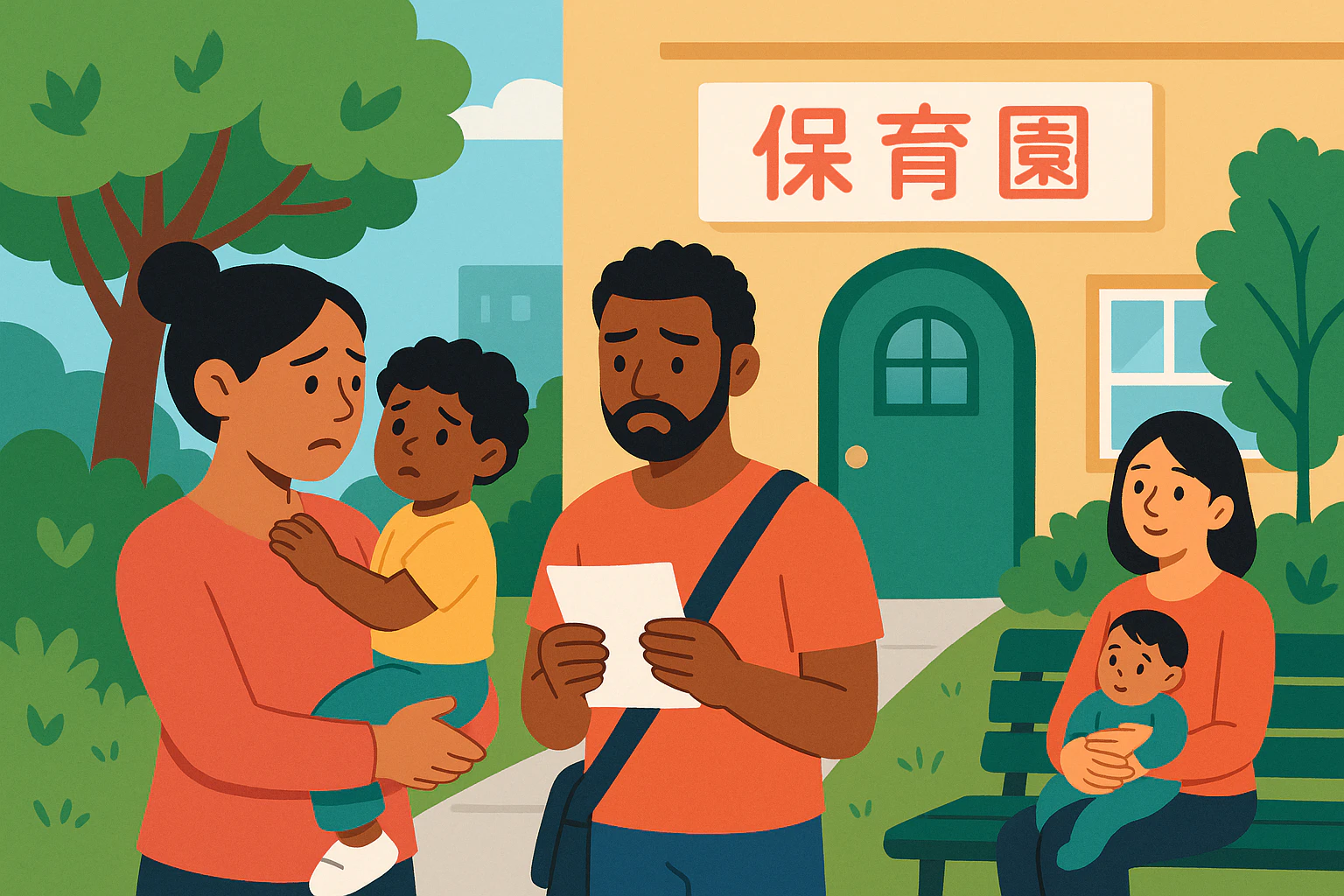
Fast answer: Even though Japan's national daycare waitlist dropped 91% from 2017 to 2025 (down to 2,254 children), some families still don't get a spot — especially in central Tokyo or for 1-year-old slots. You have 5 real fallback options: second-round selection, unlicensed daycare, childcare leave extension, universal daycare 2026, or moving to a city with capacity.
Don't panic: Rejection from the first round is not the end. Most families end up with a workable solution within 2–3 months.
Information current as of April 2026 based on MHLW national waitlist statistics, the Children and Families Agency, and recent ward-level fallback program guides. Each city's specific procedures differ — verify with your city/ward office.
Getting rejected from licensed daycare (or not getting your top choice) is one of the hardest parts of being a working parent in Japan. The first thing to know: this happens to thousands of families every year, and there's a structured set of options. Here's the playbook.
First: confirm what your rejection notice actually says
The result notification you receive in late January will be one of:
- 内定 (naitei) — Accepted at one of your ranked daycares. The notice tells you which one.
- 不内定 (fu-naitei) — Not accepted at any of your ranked daycares for the first round.
- 保留 (horyu) — On hold — You technically didn't get a spot but you're still in the system for the second round.
The terminology is important because it affects your next steps. If you got a 不内定, you can appeal the decision (rare, but possible) and you can keep applying. Either way, the rejection notice itself is a critical document — save it. You'll need it for childcare leave extension and other fallback options.
Option 1: Second-round selection (二次選考)
Most cities run a second selection round in mid-February to early March, after some accepted families decline their spots or change plans. The second round fills the resulting vacancies.
How it works
- The city automatically considers all rejected first-round applicants in the second round (you don't need to re-apply in most cities)
- You can update your daycare ranking — adding facilities you didn't list before, or expanding your geographic range
- Some cities also accept new applications in the second round
Realistic expectations
Second-round vacancies are usually small — maybe 5–15% of the total spots. They tend to be at less popular daycares (further from train stations, smaller buildings, less English support). But for families desperate to start work in April, any spot is better than none.
How to maximize your chances
- Expand your daycare list — if you originally listed 5 in your immediate neighborhood, add 5 more in surrounding areas
- Consider small-scale daycares (小規模保育) — they tend to have more turnover and second-round availability
- Ask your city office which daycares had unfilled spots in past second rounds
Option 2: Unlicensed daycare (認可外)
Unlicensed daycares (認可外保育施設) are privately operated and don't go through the city's point-based selection. You apply directly to the facility, typically year-round.
Pros
- No point system — anyone can apply
- Available year-round (no October application window)
- Often have spots when licensed daycares are full
- Some are international (English-speaking staff, Western curriculum)
- Flexible hours
Cons
- More expensive: typically ¥50,000–¥150,000/month for full-time
- Quality varies widely — research carefully
- Less national regulation
Subsidies that lower the cost
Several subsidies can dramatically reduce your out-of-pocket cost:
- National 3+ free preschool policy: 3–5 year olds get up to ¥37,000/month subsidized at qualifying unlicensed facilities (the facility must meet national standards and be registered)
- Tokyo subsidy for unlicensed daycare (認可外保育施設等利用支援事業): Tokyo wards offer additional subsidies to make unlicensed daycare cost-comparable to licensed. Each ward's exact program differs.
- Some other major cities (Yokohama, Kawasaki, Saitama) also offer partial subsidies
Important strategic move: If you enroll in unlicensed daycare while waiting, this becomes adjustment index points on your next licensed daycare application. The city sees that you're using unlicensed care because licensed wasn't available, and they add 1–2 points to your score. Some families intentionally use unlicensed for one year, then re-apply to licensed for the following year with a higher score.
How to find unlicensed daycares
- Ask at your city/ward office for the list of registered unlicensed facilities (届出済施設一覧)
- Search online for "[city name] 認可外 保育"
- For international/English-speaking options: "[city name] international preschool"
Option 3: Childcare leave extension (育児休業延長)
If you were rejected from licensed daycare, Japan's childcare leave system lets you extend your paid parental leave from the standard 1 year up to 2 years total. Your monthly leave allowance from employment insurance continues during the extension.
How it works
- You receive your daycare rejection notice (不内定 or 保留)
- You apply to your employer/Hello Work for a childcare leave extension, attaching the rejection notice as proof of need
- The leave is extended by 6 months (and if still no spot, by another 6 months — up to 2 years total from the child's birth)
- You continue receiving the childcare leave allowance from employment insurance
Critical: the rejection notice is your proof
You must have a rejection notice for a 4月入園 (April entry). Some families try to get rejection notices on purpose by applying only to high-cutoff daycares, knowing they won't get in. This is technically allowed but the city may catch on if your application is obviously not serious. Be careful.
The full process and traps: How to Keep Childcare Leave Pay After Daycare Rejection →
Option 4: Universal daycare (こども誰でも通園制度)
A new national program launching in April 2026. All children aged 6 months to 3 years can use up to 10 hours per month at participating facilities, regardless of whether their parents work.
Key facts
- Eligibility: All children 6 months–3 years old. No "need for childcare" requirement.
- Hours: Up to 10 hours per month. This is for occasional use, not full-time care.
- Cost: Around ¥300/hour (some municipalities have higher subsidies)
- Application: Through your city/ward office (each city manages its own implementation)
- Participating facilities: Licensed daycares, certified centers, and small-scale daycares that have opted in
What this is good for
- Supplemental care while you're job-hunting or recovering from illness
- Social experience for children of stay-at-home parents
- Bridge care while you wait for a full-time licensed spot
What this is NOT good for
- Full-time working parents — 10 hours/month is not enough for full-day care
- Replacing licensed daycare — Use it as a supplement, not a substitute
Full details: Universal Daycare 2026 →
Option 5: Move to a low-waitlist municipality
This sounds extreme, but it's increasingly common — especially given that 1,489 of 1,741 municipalities (85.5%) now have zero waitlist. Some families relocate within commuting distance of their workplace to a city with available spots.
Where to look
- Outside central Tokyo: Kanagawa (Yokohama, Kawasaki, Sagamihara), Saitama (Saitama City, Kawagoe, Tokorozawa), Chiba (Funabashi, Ichikawa, Matsudo) — most have available spots in 2026
- Most regional cities: Osaka, Nagoya, Kobe, Fukuoka, Sapporo — all have ample capacity
- Suburban towns: Smaller cities like Mitaka, Musashino, Tachikawa often have shorter waits than central wards
Trade-offs to consider
- Longer commute
- Lower rent (often saves ¥30,000–¥80,000/month)
- You may need to break or transfer your current rental contract
- Children's social environment changes
For most foreign families this is a last resort, but if you've been waiting more than 1 year and your career is on hold, it can be the right move.
Hybrid strategies that work
The most successful families combine multiple options:
Strategy A: Unlicensed → Licensed next year
- Year 1: Enroll in unlicensed daycare (use Tokyo subsidy if applicable)
- October Year 1: Re-apply to licensed daycare with adjustment points for current unlicensed enrollment
- April Year 2: Transfer to licensed daycare
Strategy B: Childcare leave → Licensed next year
- Get rejection notice in January
- Extend childcare leave by 6 months
- Re-apply for October midterm if vacancies appear
- If still no spot, apply for the next April with a stronger ranking strategy
Strategy C: Small-scale daycare → certified center
- Enroll in 小規模保育 (small-scale, ages 0-2). Easier to get into than larger licensed daycares.
- At age 3, transition to a 認定こども園 (certified center) — many small-scale facilities have partner centers
What NOT to do
| Don't | Why |
|---|---|
| Quit your job in protest | You lose income AND your point score (which depends on employment) |
| Move address temporarily to game the system | The city checks your residence registry against your application. If they catch you, your application is invalidated. |
| Lie about household composition | Cross-checked against the resident registry. Will be caught. |
| Apply to only your top 1–2 daycares | If you have 5 ranked, you have 5 chances. If you have 2, you have 2. |
| Wait passively for the second round | Use the time to research unlicensed options and adjust your strategy |
Related Articles
- Japan Daycare Guide: Pillar Overview
- Hoikuen Application Step-by-Step
- 5 Daycare Types Compared
- How to Keep Childcare Leave Pay After Rejection
- Universal Daycare 2026
Need More Help? Ask on LO-PAL
Just got rejected from licensed daycare? Need help researching unlicensed alternatives in your area, or applying for a childcare leave extension? LO-PAL matches you with a local helper who has navigated this. Post your request and get matched.
Written by

Founder, LO-PAL
Former Medical Coordinator for Foreign Patients (Ministry of Health programme) and legal affairs professional. Built LO-PAL from firsthand experience navigating life abroad.
Written with partial AI assistance
Read full bio →