5 Japan Daycare Types Compared: Which Hoikuen Fits Your Family
Japan has 5 main types of childcare facilities for kids 0–5: licensed daycare, certified centers, small-scale daycare, corporate-led daycare, and unlicensed daycare. Cost, hours, eligibility, and which to choose for foreign families.
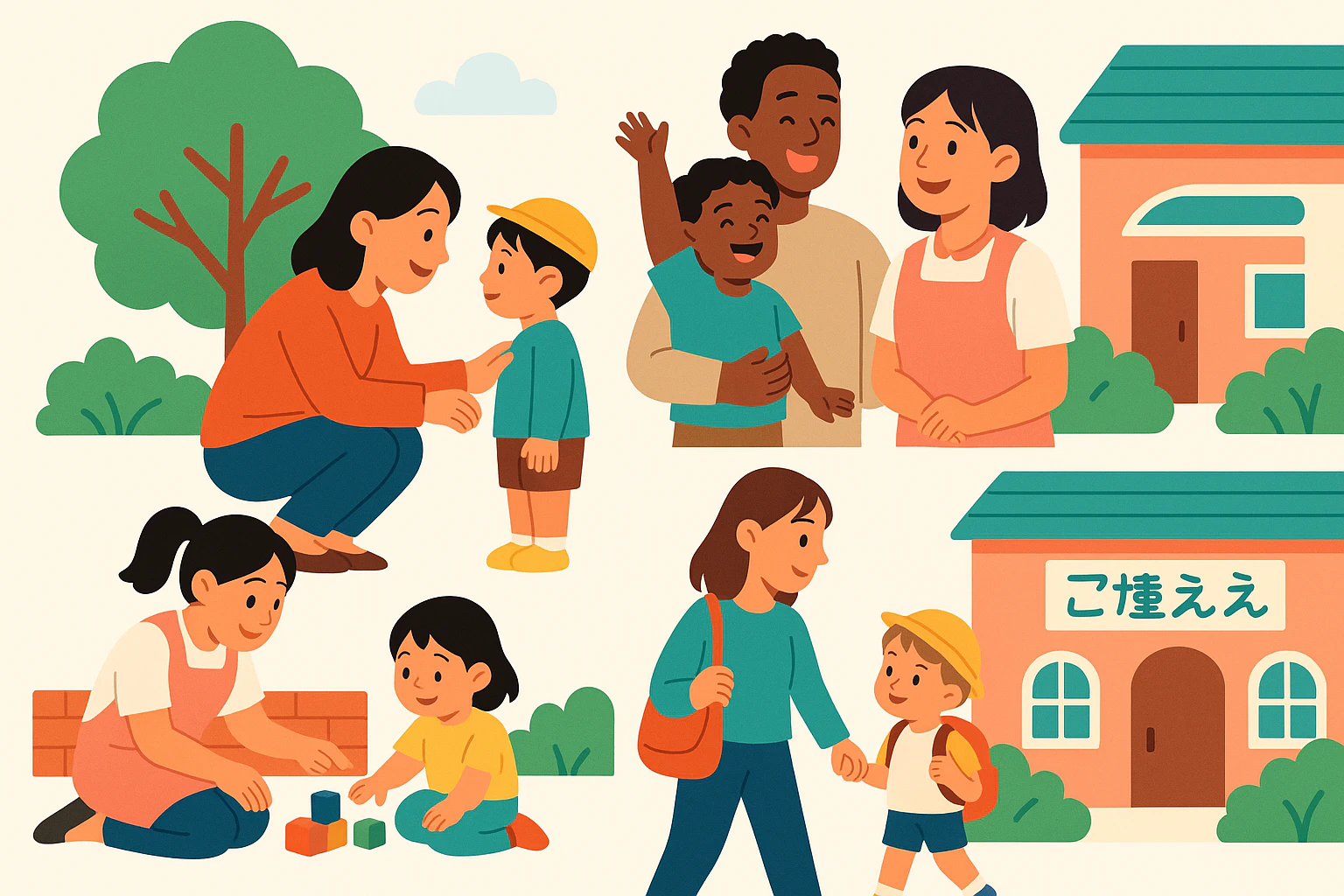
Fast answer: Japan has 5 main types of childcare facilities for kids 0–5: licensed daycare (認可保育所), certified centers (認定こども園), small-scale daycare (小規模保育), corporate-led daycare (企業主導型保育), and unlicensed daycare (認可外). They differ in cost, hours, eligibility, age range, and quality regulation.
For most foreign families, licensed daycare (認可) is the default choice — cheapest and highest quality. The other 4 are fallbacks or specialized options.
Information current as of April 2026 based on the Children and Families Agency overview of certified centers, the free preschool/daycare program, and municipal facility guides.
If you ask "how do I find a daycare in Japan," the answer depends on which type of facility you're talking about. Most foreign families don't realize there are 5 types, each with different rules. This guide compares them so you can choose the right one before applying.
The 5 types at a glance
| Type | Japanese | Ages | Hours/day | Cost (3+) | Cost (0-2) | Application via |
|---|---|---|---|---|---|---|
| Licensed daycare | 認可保育所 | 0–5 | ~8–11 | Free | Income-based | City/ward office |
| Certified center | 認定こども園 | 0–5 | 4–11 | Free | Income-based | City/ward office (most types) |
| Small-scale daycare | 小規模保育 | 0–2 only | ~8–11 | N/A | Income-based | City/ward office |
| Corporate-led daycare | 企業主導型保育 | 0–5 | Varies | Varies | Set fee, often subsidized | Direct to facility |
| Unlicensed daycare | 認可外保育施設 | 0–5 | Flexible | ¥30k–¥150k/mo | ¥50k–¥150k/mo | Direct to facility |
1. Licensed daycare (認可保育所 / ninka hoikusho)
The "default" daycare type. Operated under national licensing standards, regulated by the Children and Families Agency. Approximately 60% of all daycare children attend a licensed facility.
Key facts
- Eligibility: You must prove "保育の必要性" (need for childcare) — both parents working/studying/caring for someone
- Application: Through your city/ward office, by the October–November deadline for April entry
- Selection: Point-based (see point system guide)
- Hours: Standard time (保育標準時間) = 11 hours/day. Short time (保育短時間) = 8 hours/day. Hours assigned based on parent working hours.
- Cost: Free for 3–5 year olds nationwide. For 0–2, depends on family income and city. Tokyo: free for 1st child from September 2025.
- Quality regulation: Strict national standards on staff-to-child ratios, building safety, meal nutrition, etc.
Pros
- Cheapest (often free)
- Highest quality regulation
- Consistent national standards
- Long hours (full working day)
Cons
- Highly competitive in central Tokyo
- Application process is paperwork-heavy
- You can't choose a specific facility freely — the city allocates spots based on your point score and ranked choices
- Almost all communication in Japanese
Best for
Working parents who plan to use full-day care every weekday. Families willing to do the application paperwork to get the best price and quality.
2. Certified centers (認定こども園 / nintei kodomoen)
A hybrid of kindergarten (幼稚園) and licensed daycare (保育所). Created in 2006 to combine the educational focus of kindergarten with the long hours of daycare.
Key facts
- Eligibility: Depends on the "type" of certification (1, 2, or 3):
- 1号認定 (Type 1): 3–5 years old, parents do NOT need to be working. Short hours (~4 hours).
- 2号認定 (Type 2): 3–5 years old, parents working/studying. Long hours.
- 3号認定 (Type 3): 0–2 years old, parents working/studying. Long hours.
- Application: Type 2 and 3 through city/ward office (same as licensed daycare). Type 1 directly to the center.
- Cost: Same as licensed daycare for Types 2 and 3. Type 1: free under the national 3+ free policy.
- Hours: Up to 11 hours for working parents
Pros
- Combines kindergarten education with daycare hours
- Children can stay through age 5 (no transition at age 3)
- Type 1 allows non-working parents to enroll 3-5 year olds
- Same cost as licensed daycare
Cons
- Often more competitive than regular daycare in popular areas
- Some are fundamentally still "kindergarten-style" in feel — fewer hours, more learning emphasis
- Confusing certification system
Best for
Families who want continuity from infant to age 5, or families who want a more education-focused environment.
3. Small-scale daycare (小規模保育 / shoukibo hoiku)
A licensed facility specifically for ages 0–2, with smaller class sizes (typically 6–19 children total). Created in 2015 as part of the "regional childcare" (地域型保育) category.
Key facts
- Ages: 0–2 only. Children must transition to a different facility at age 3.
- Class size: Maximum 19 children
- Application: Through city/ward office, same process as licensed daycare
- Cost: Same income-based fee structure as licensed daycare
- Hours: Standard 11 hours or short 8 hours
Pros
- Smaller, more intimate environment (good for shy children)
- Same low cost as licensed daycare
- Often easier to get into than full licensed daycares (more new facilities have opened)
- Higher staff-to-child ratio
Cons
- You must transition out at age 3. This means a second application/transition for kindergarten or a different daycare. Some small-scale daycares have "partner" facilities (連携施設) that guarantee a spot, but not all.
- Less variety of activities than larger facilities
- Smaller play areas
Best for
Parents of infants who want a smaller environment for the first 3 years and don't mind the age-3 transition.
4. Corporate-led daycare (企業主導型保育 / kigyo shudo gata hoiku)
Created in 2016. Daycares operated by or in partnership with private companies. The company gets government subsidies to provide daycare for its employees. Some spots are reserved for company employees (employee spots / 従業員枠), and some are open to the general community (community spots / 地域枠).
Key facts
- Eligibility: Employees of partner companies, OR community members (if the facility has community spots)
- Application: Direct to the facility, NOT through the city. Each facility has its own enrollment process.
- Cost: Set monthly fee, usually similar to licensed daycare costs (¥30,000–¥50,000) but with employer subsidies that can lower it significantly
- Hours: Vary widely — some operate 24/7 (for shift workers), some have standard hours, some include weekend care
- 3-5 free policy: Yes, the national free preschool policy applies
Pros
- Application bypasses the point system entirely
- Sometimes located inside or near company buildings (convenient for employees)
- Flexible hours (some open 7am–10pm, weekends)
- Less competition than licensed daycares in some areas
Cons
- Quality is more variable — regulation is lighter than licensed daycares
- Some facilities have closed unexpectedly when the operating company exits the business
- Limited number of facilities — finding one nearby is hit-or-miss
- If your employer isn't a partner company, you need to find one with community spots
Best for
Parents whose employer participates in the program. Or parents who can't get into licensed daycare and have a corporate-led facility nearby with community spots.
5. Unlicensed daycare (認可外保育施設 / ninkagai hoiku shisetsu)
Privately-operated daycares that don't meet (or don't apply for) the licensing standards. They include international daycares, after-hours facilities, hotel daycare services, in-home daycare, and budget options.
Key facts
- Eligibility: Anyone can apply directly. No "need for childcare" requirement. No point system.
- Application: Directly to the facility
- Cost: Highest. Typically ¥50,000–¥150,000/month for full-time care. Higher in central Tokyo.
- Hours: Vary widely — some are flexible drop-in, some are full-day, some are after-hours only
- Free preschool policy: 3–5 year olds get up to ¥37,000/month subsidized by the national policy (only at facilities meeting certain standards)
- Tokyo subsidy: Tokyo wards offer additional subsidies for unlicensed daycares (called 認可外施設等利用支援事業), often making them effectively the same cost as licensed
Pros
- No point system — anyone can apply
- Available year-round (no October application window)
- More flexible hours and policies
- Often more international (English-speaking staff, international curricula)
- Good fallback when licensed daycares are full
Cons
- Significantly more expensive without subsidies
- Quality is highly variable — research each facility carefully
- Less national regulation
- Some facilities have had safety incidents
Best for
- Families who can't get into licensed daycare
- Families wanting English/multilingual environments (international daycares)
- Parents needing flexible/non-standard hours
- Mid-year arrivals who can't wait for the April application cycle
Decision tree for foreign families
- Are you planning to use full-day care every weekday and have a regular work/study schedule?
- Yes → Apply to licensed daycare (認可). Default choice.
- No, I need flexible hours → Look at corporate-led or unlicensed.
- Is your child 0–2?
- Yes, and you want a smaller environment → Consider small-scale daycare (小規模保育). Same cost as licensed.
- Yes, and you want to enroll for many years → Apply to a regular licensed daycare or certified center to avoid the age-3 transition.
- Is your child 3+ and you don't qualify for licensed daycare (e.g., you're not working)?
- Apply to certified center Type 1 or a regular kindergarten (幼稚園). Both are free for 3–5 year olds.
- Is English-language daycare a priority?
- Yes → Look at international unlicensed daycares (e.g., Kids Garten, Kids Up, Tots Garden). Higher cost but English-speaking environment.
- Did you apply for licensed daycare and not get in?
What to ask when touring any facility
- How many children per teacher in each age group?
- What are typical drop-off and pickup times?
- What's your sick-child policy? (37.5°C threshold? 38°C?)
- What's the meal plan? (Allergy accommodation? Religious dietary needs?)
- Can parents use English or do you need a Japanese-speaking helper?
- What activities and events do you have monthly?
- What's your fee structure? (Especially for unlicensed and corporate-led)
- How many years has this facility been operating? (Especially for corporate-led — newer facilities have higher closure risk)
Related Articles
- Japan Daycare Guide: Pillar Overview
- Hoikuen Application Step-by-Step
- Point System Decoded
- Rejection Options & Fallback Strategies
Need More Help? Ask on LO-PAL
Need someone to come with you to tour daycares and ask the right questions in Japanese? Or help you compare facilities and decide which type fits your family? LO-PAL matches you with a local helper who knows the differences. Post your request and get matched.
Written by

Founder, LO-PAL
Former Medical Coordinator for Foreign Patients (Ministry of Health programme) and legal affairs professional. Built LO-PAL from firsthand experience navigating life abroad.
Written with partial AI assistance
Read full bio →