Japan Hoikuen Application Guide: Step-by-Step for Foreign Parents
The actual hoikuen application process in Japan, step by step. October–November deadline, required documents, the employment certificate (就労証明書), filling out the application form, and what happens at the city office counter.
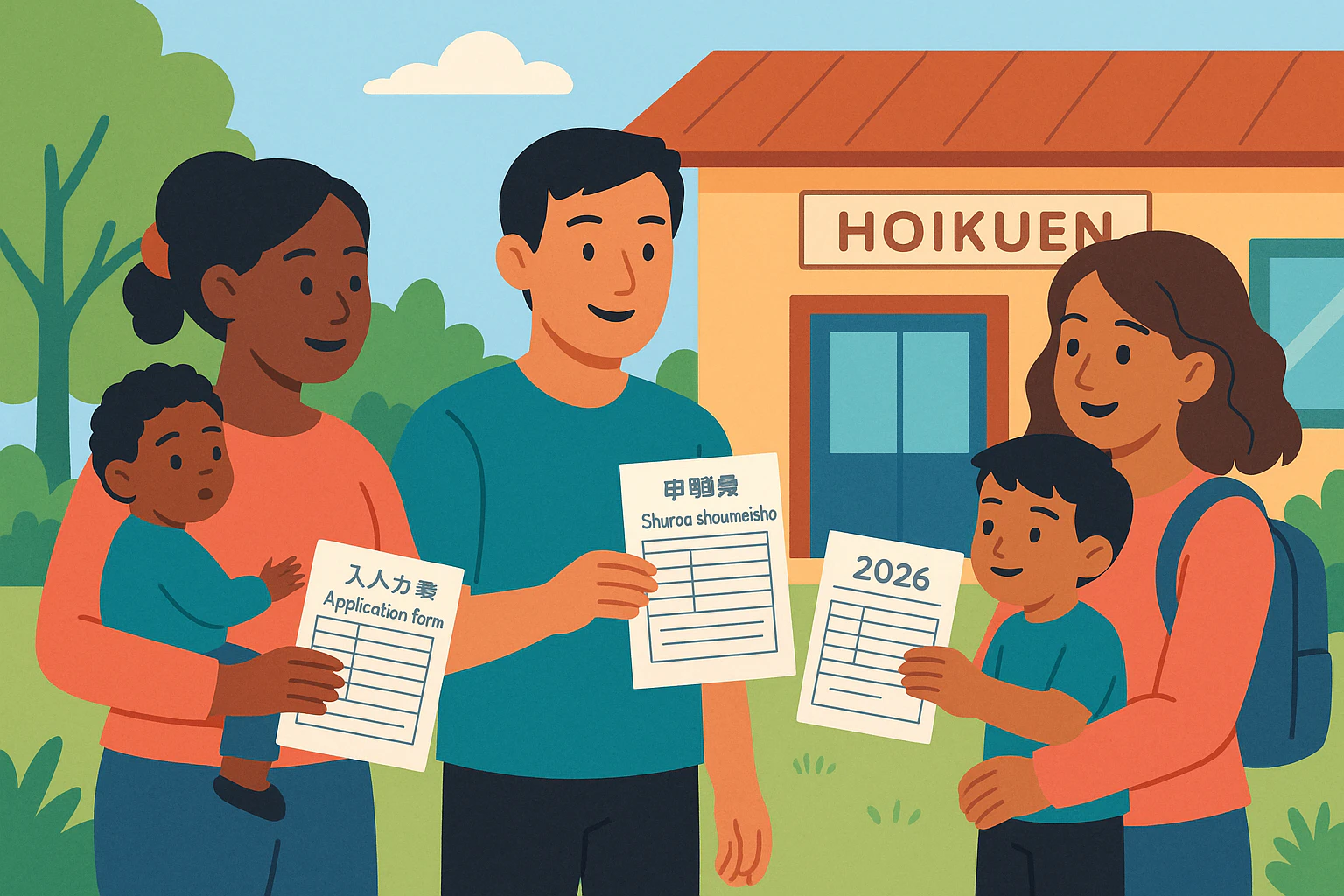
Fast answer: For April entry to a Japanese licensed daycare, you must submit your application in October–mid November of the previous year. The forms, the employment certificate, and the supporting documents are all in Japanese, all municipality-specific, and all due before mid-November.
What you need: Application form (申込書), employment certificate from each parent (就労証明書), residence certificate, child health record, MyNumber proof, and any adjustment-index supporting documents.
Bottom line: The process isn't hard — it's just opaque. Once you know what each document is and where to get it, the application takes about 2–3 hours of your time over a weekend.
Information current as of April 2026 based on application guides published by Tokyo's Kita Ward, Arakawa Ward, Ota Ward, and the Children and Families Agency (こども家庭庁). Your municipality's rules may differ — always verify with your city/ward office.
For foreign families, the daycare application is usually the first time you encounter Japan's full bureaucratic stack: forms in dense Japanese, dropdown options that don't translate cleanly, and stamps and signatures in places you don't expect. This guide walks you through every step.
Step 1: Get the application packet (August–early October)
Each municipality publishes an annual "保育のごあんない" (hoiku no goannai) — "Daycare Information Booklet." This is the master document for the year's application. It contains:
- The full application form (申込書)
- The employment certificate template (就労証明書)
- The point system table (利用調整基準表)
- Application deadlines and timeline
- List of daycares with capacity by age
- Required documents checklist
Where to get it:
- Pick up a paper copy at your city/ward office (子育て支援課 or 保育課 / Childcare Division)
- Download the PDF from your municipality's official website
- Some wards (Setagaya, Suginami) mail it to families with newborns automatically
Get it as early as possible — ideally August or early September. You need time to read it, understand the point system, and visit prospective facilities before applying.
Step 2: Tour daycares (September)
Most daycares allow (and expect) parents to visit in advance. This is called 見学 (kengaku). You typically need to:
- Call the daycare to book a tour (most book up by mid-September)
- Visit during a 30–60 minute slot, usually mid-morning
- See the facility, meet the staff, ask questions
Questions to ask:
- What's your typical day schedule? (1日の流れを教えてください)
- How many staff per child in each age group? (各クラスの保育士の配置は?)
- What's your sick-child policy? (体調不良時の対応はどうなっていますか?)
- Do any staff speak English? (英語を話せる先生はいますか?)
- What's the typical wait/cutoff for this facility? (例年のボーダー指数は?) — staff often won't answer this directly
Visit at least 3–5 daycares. Your application will let you rank multiple choices, and you need to know enough about each to rank them confidently.
Step 3: Fill out the application form (申込書)
The 申込書 (mōshikomisho) is the central document. It's typically 2–4 pages of dense Japanese fields. Here's what each section asks for:
| Section | Japanese | What to write |
|---|---|---|
| Child's information | 児童の情報 | Name (in katakana for foreign names), DOB, gender, current address, citizenship |
| Parent 1 information | 保護者① (父 or 母) | Name, DOB, occupation, employer name, work address, phone |
| Parent 2 information | 保護者② | Same fields as above |
| Household members | 世帯員 | Everyone living at the same address — siblings, grandparents, etc. |
| Reason for application | 保育を必要とする理由 | Choose from: 就労 (work), 求職活動 (job hunting), 妊娠・出産 (pregnancy/childbirth), 疾病 (illness), 介護 (caring for relative), 就学 (student) |
| Daycare ranking | 希望保育施設 | Up to 5–10 daycares in order of preference. Order matters. |
| Desired start date | 入所希望日 | For April entry, write April 1 of the relevant year |
| Hours needed | 保育標準時間 / 短時間 | 標準時間 (11 hours) or 短時間 (8 hours) — depends on each parent's working hours |
| Income/Tax info | 所得情報 | Sometimes pre-filled by the city. Used for fee calculation. |
| Signature/seal | 署名・押印 | Sign your name (Roman or Japanese characters both OK at most cities) |
Tips for filling it out
- Use furigana for foreign names. The application asks for both katakana (フリガナ) and the original spelling.
- Write clearly in pen, not pencil. If you make a mistake, draw a line through it and stamp/sign next to it.
- List 5–10 daycare choices. More choices = higher chance of getting in. Don't only list your top 1–2.
- Be honest about household members. The city will cross-check with the resident registry.
Step 4: Get the employment certificate (就労証明書)
The 就労証明書 (shuurou shoumeisho) is the most important supporting document. It proves you're working (or have a qualifying reason) and is filled out by your employer, not you.
Key facts
- Required from each parent who is working (single parents only need one)
- Must be issued within 3 months of the application date
- Since May 2023, the Children and Families Agency (こども家庭庁) has published a standardized national template. Many cities accept this national format. Some cities still require their own format — check your municipality's instructions.
- The certificate covers: employer name, address, hire date, employment type (full-time, part-time, contract), weekly hours, monthly working days, monthly salary range
How to request it from your employer
Most Japanese employers are familiar with this form — HR departments fill them out routinely in the fall. To request:
「保育園入園申込のため、就労証明書の発行をお願いしたいのですが、可能でしょうか?こども家庭庁の標準様式(または[城市] の指定様式)を使用します。」
"For my daycare application, could you please issue an employment certificate? I'd like to use the Children and Families Agency standard format (or the [city] designated format)."
Allow 1–2 weeks for HR to complete it. Get it back in original paper form with your company's seal (社印).
If you're self-employed
You complete the certificate yourself with your business details. Attach proof of income — typically:
- 確定申告書 (last year's tax return) photocopy
- 開業届 (business opening notification, if registered)
- Recent bank statements showing income deposits
Step 5: Collect supporting documents
In addition to the application and employment certificate, you'll need:
| Document | Japanese | Where to get |
|---|---|---|
| Residence certificate | 住民票 (jūminhyō) | City/ward office. ¥200–¥300. Get the version that includes everyone in the household. |
| MyNumber proof | マイナンバー記載の住民票 OR My Number Card copy | City office or your card |
| Child's health record | 母子手帳 photocopy | You already have this |
| Tax certificate | 課税証明書 (kazei shoumeisho) | City office. ¥200–¥300. Required if you moved into the city in the past year. Used for fee calculation. |
| Adjustment index supporting docs | 調整指数の証明書類 | Varies by claim: medical certificates for illness, divorce documents for single parent, etc. |
Step 6: Submit (October–mid November)
Most cities require in-person submission at the childcare counter (保育課 / hoiku-ka), at least for first-time applicants. Some cities allow mail submission for renewals.
What happens at the counter
- Hand over your packet
- The clerk reviews each document (5–15 minutes)
- If anything is missing or unclear, they ask you to fix it on the spot
- You receive a 受付票 (acceptance slip) confirming your submission
- The clerk explains the next steps and the result notification date
Bring:
- All original documents (some get returned, some get kept)
- Your hanko (印鑑) or be ready to sign
- Your residence card
- A pen
- Cash for any document fees you might still need
If you can't speak Japanese
Most counters have no English-speaking staff. Options:
- Bring a Japanese-speaking friend
- Use a translation app (Google Translate, DeepL) on your phone
- Book a LO-PAL helper to come with you for 1–2 hours
- Some larger cities (Yokohama, Kobe) have multilingual support staff at the main city office — ask in advance
Step 7: Wait for results (December–late January)
The selection process (利用調整 / riyou chousei) takes about 2 months. The city:
- Verifies all submitted documents
- Calculates each applicant's total index score
- For each daycare, ranks applicants from highest to lowest score
- Allocates spots starting from the highest scorers, working down until each daycare is full
Results are typically mailed in late January. The notice will say either "内定 (naitei)" — you got a spot at one of your ranked choices — or "不内定 (fu-naitei)" — you didn't get any spot.
If you got in: next steps
- Attend the orientation (説明会) at your assigned daycare in February or early March
- Receive the supplies list — start buying everything (name labels, futon, bibs, spare clothes)
- Complete intake paperwork — emergency contacts, allergy forms, medical history
- Plan for the acclimation period in early April
What daily life looks like: Hoikuen Daily Life Guide →
If you didn't get in: don't panic
- Apply for the second round (二次選考) — opens mid-February for unfilled spots
- Apply to unlicensed daycares (認可外) directly
- Extend your childcare leave using the rejection notice as proof
- Try mid-year entry for summer or fall slots
Full fallback playbook: What to Do If You Don't Get In →
Common mistakes to avoid
| Mistake | Consequence |
|---|---|
| Listing only your top 1–2 daycares | Lower chance of any spot. List 5–10. |
| Using an old employment certificate (>3 months) | Application rejected. Get a fresh one. |
| Forgetting adjustment index documents | Lower score. Submit single-parent docs, sibling info, etc. |
| Submitting in the last week | If documents are wrong, no time to fix. Submit early November. |
| Not visiting daycares in advance | You can't rank confidently if you've never seen them. |
| Assuming part-time = job-hunting score | Part-time work counts as full work, just at a lower base score. Don't undersell yourself. |
Related Articles
- Japan Daycare Guide: Pillar Overview
- Point System Decoded
- 5 Daycare Types Compared
- Daily Life After Admission
- Rejection Options & Fallback Strategies
Need More Help? Ask on LO-PAL
Need someone to fill out the daycare application form with you? Translate the orientation handouts? Or come to the city office counter for the in-person submission? LO-PAL matches you with a local helper who has done it before. Post your request and get matched.
Written by

Founder, LO-PAL
Former Medical Coordinator for Foreign Patients (Ministry of Health programme) and legal affairs professional. Built LO-PAL from firsthand experience navigating life abroad.
Written with partial AI assistance
Read full bio →