How to Get Married in Japan Without a City Hall Rejection
City-hall-first checklist to stop affidavit, translation, and weekend filing mistakes when registering a legal marriage in Japan.
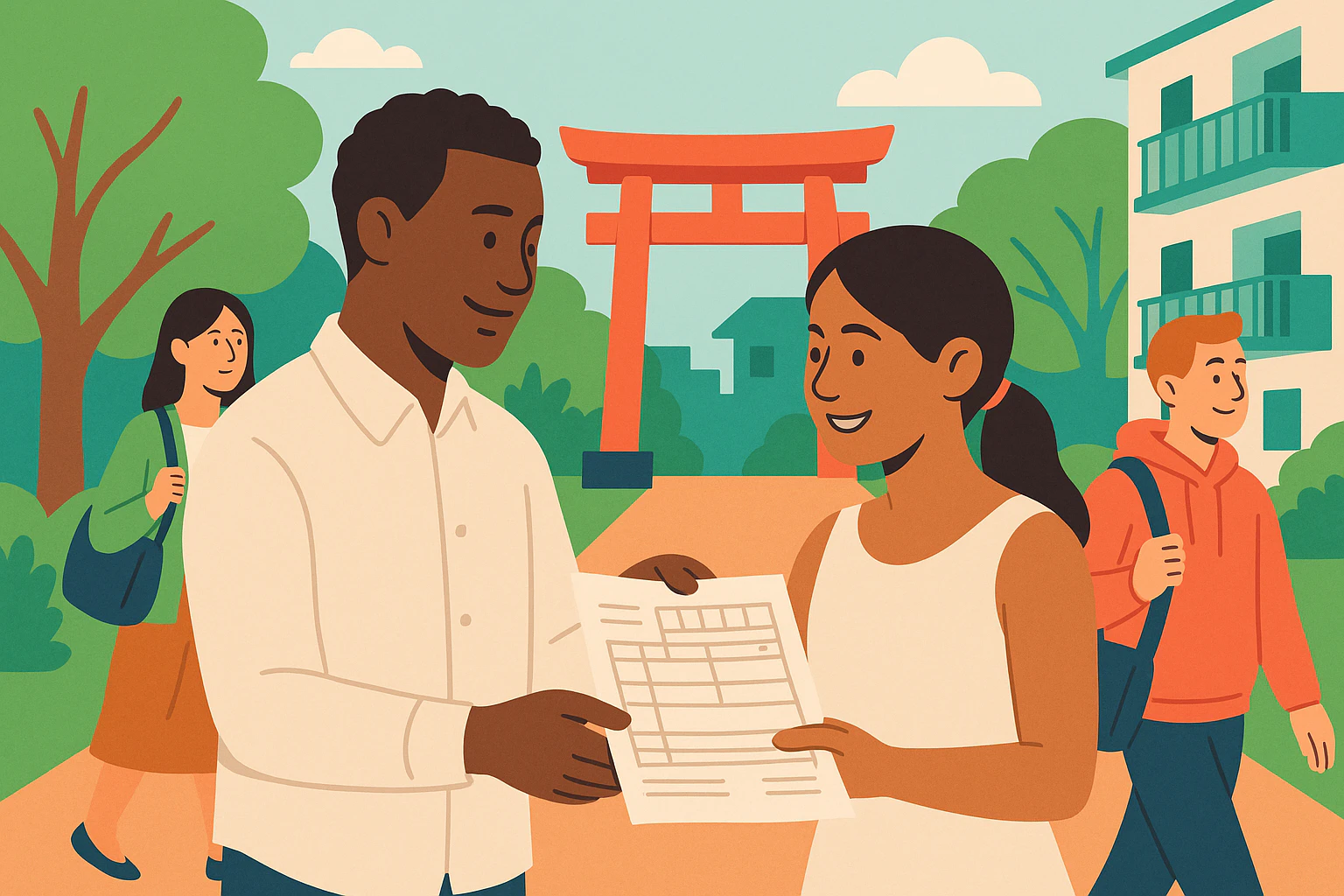
File at: the family registration counter of the city, ward, or town office that will handle your case.
Most common rejection points: the free-to-marry certificate, missing Japanese translations, and office-specific weekend or after-hours rules.
Deadlines after acceptance: if your legal name changes, update your residence card within 14 days; if you move, update your address within 14 days.
Bottom line: before your chosen date, ask the exact office to pre-check every document and confirm how they handle foreign cases.
Information current as of March 2026 based on guidance from the Ministry of Justice, the family registration system overview, the Immigration Services Agency, and municipal family-registration pages published by Chuo City, Yokohama City, Osaka City, and Nagoya City.
If you want to get married in Japan as a foreigner, the biggest risk is usually not the law. It is arriving at city hall with embassy papers that make sense in your country but do not fit the checklist used by the clerk in front of you.
A Japan marriage registration for a foreigner is often fast once the office accepts the file, but it can stall over one translation, one name mismatch, or one office-specific filing rule. This article is a city-hall-first troubleshooting playbook, not a wedding guide.
I also work as a legal affairs professional in Japan, and I see the same pattern repeatedly: couples are probably eligible, but the filing fails because the paperwork is not easy for the counter to verify on the spot. That gap between the system and the person trying to use it is exactly why I built this service.
Who can legally marry in Japan and where you can file
Japan’s legal marriage system is registration-based. The marriage exists when the marriage notification (婚姻届, konin todoke) is accepted by the municipal family-registration counter; a shrine, church, or hotel ceremony is separate from the legal filing.
This guide discusses the current national marriage-notification (婚姻届, konin todoke) system used by city halls for legally recognized marriages under Japanese law. The Ministry of Justice explains that international marriage questions involve both Japanese law and the foreign national’s home-country law, and says detailed cases should be checked with the municipal family-register counter or a Legal Affairs Bureau consultation window.
In practice, a Japanese-foreigner couple usually files at the municipality where one partner lives or where the Japanese partner’s family register is handled. Two foreign nationals can also marry under the Japanese system under certain conditions, but the document set depends heavily on nationality, so the office where you intend to file is the office you should trust most.
If you are choosing the office now, start with the family registration page for that municipality and call before you collect documents. For example, Chuo City lists its Family Registration Subsection at 03-3546-5317, and Yokohama City publishes ward-by-ward family-registry contacts plus a multilingual call center at 045-664-2525.
| Item | Amount/count | Source / as-of date |
|---|---|---|
| Witnesses required on the marriage notification (婚姻届, konin todoke) | 2 adult witnesses | Chuo City, accessed March 2026 |
| Residence card update if your legal name changes after marriage | Within 14 days | Immigration Services Agency, accessed March 2026 |
| Address update after you move | Within 14 days | Immigration Services Agency, accessed March 2026 |
The 5 documents city hall checks most often
This is where most same-day disappointments happen. For a konin todoke foreigner filing, the form itself is usually easier than the supporting documents.
- The marriage notification (婚姻届, konin todoke) itself. It must be completed correctly and signed by two adult witnesses. If you are aiming for a special filing date, do not leave the witness section unfinished until the last minute.
- Passport or other nationality proof. Municipal guides commonly describe a passport as proof of nationality. Bring the original, and bring your residence card too even if the office mainly asked for a passport, because it helps the clerk cross-check your current details in Japan.
- Your free-to-marry document. In Japanese, this is often called a certificate of legal capacity to marry (婚姻要件具備証明書, konin youken gubi shomeisho), but the certificate of legal capacity to marry Japan offices ask for may have a very different title in your country: affidavit, affirmation, certificate of no impediment, single-status certificate, or another equivalent document. The Ministry of Justice and local foreign-resident guides both note that some countries do not issue the standard certificate, so an equivalent document may be used.
- Japanese translations of every foreign-language document. The Ministry of Justice says all foreign-language documents need Japanese translations, the translator’s name must be recorded, and the translator can be the applicant. A missing translator line is a classic rejection trigger.
- Country-specific civil-status extras. Depending on nationality and your history, the office may ask for a birth certificate, divorce decree, death certificate of a former spouse, or similar civil record. Yokohama City says the required documents differ by country, and some municipalities explicitly list birth certificates for certain nationalities.
Do not get trapped by the English title alone. What city hall cares about is whether the paper clearly proves that you are free to marry under your home law and whether the office where you will file agrees that your format is acceptable.
A good example is the UK process. British government guidance says British nationals use an affirmation or affidavit rather than a document literally titled a certificate of legal capacity, and it tells applicants to keep the Japanese Certificate of Acceptance of Notification of Marriage as proof afterward. That is exactly why you should confirm your own country’s document title with your city hall before fixing a filing date.
Not sure whether your affidavit format will pass at your city hall? Ask on LO-PAL.
Real-world warning signs: individual experiences vary, but the same trouble spots show up again and again.
One foreign resident on Reddit described going back and forth with city hall over an affidavit format and said the office would not move forward until the couple showed a notarized statement plus a Japanese translation.Another said their city hall first insisted that international couples could only file on weekdays, even after a pre-check, and only later allowed a weekend submission through the security desk.Individual experiences vary. Use them as warning signs, not as official rules for your municipality.
How to avoid rejection on your chosen filing date
Most rejections are preventable if you treat the filing like a legal document review, not a romantic errand. The safest couples are not the luckiest couples. They are the couples who remove surprises before the date that matters.
- Ask the exact office to pre-check your case. Yokohama City openly says some international marriages cannot be judged on the spot. Bring every document before the chosen date and ask the office to confirm both the document set and the filing method.
- Ask specifically about weekends, holidays, and after-hours. Rules are not uniform. Nagoya’s Midori Ward guidance says after-hours filings may be held by guards and checked on the next business day; if there is no defect, the acceptance date is the day you submitted, but you may be called back for corrections later. Some Osaka wards, such as Suminoe Ward, even offer web reservations for family-register procedures.
- Check how recent your embassy documents must be. Some offices only accept certificates issued within a limited recent period. Confirm that validity window before you lock in your date, especially if your embassy document took time or money to obtain.
- Match names across every page. Check passport spelling, middle names, hyphens, previous surnames, and the order of family and given names. If one document shows an old name, bring the proof that links the old and new versions.
- Keep each original and its translation together. Clip the translation to the original foreign-language document. Put the translator’s name on every translation, and if a legal term is unusual, add a short Japanese explanation rather than forcing the clerk to guess.
- Choose the safest filing time if the date matters. If the exact date is emotionally important, filing during open counter hours after a pre-check is safer than a first-time weekend drop-off. After-hours filing can work, but only if you already know how that office handles foreign documents.
Useful counter phrases:
- 婚姻届の事前確認をお願いします。 (Konin todoke no jizen kakunin o onegai shimasu.) — I would like a pre-check of our marriage notification.
- この書類で受理できますか。 (Kono shorui de juri dekimasu ka?) — Will this document be accepted?
- 時間外提出でも、受理日が提出日になりますか。 (Jikangai teishutsu demo, juribi ga teishutsubi ni narimasu ka?) — If we submit after hours, will the acceptance date still be the submission date?
- 不足書類があれば、今日ここで教えてください。 (Fusoku shorui ga areba, kyo koko de oshiete kudasai.) — If anything is missing, please tell us here today.
I know how demoralizing a counter rejection feels. When I lived in the UK, I was rejected for a bank account because I had no utility bill in my name while homestaying. The problem was not a total lack of system. It was lack of access, and that is exactly what many foreign couples run into at a Japanese city hall counter.
What to do after acceptance with certificates and next steps
Acceptance is not the end of the job. It is the moment to collect proof and do the follow-up steps that people often forget.
- Request a Certificate of Acceptance of Notification of Marriage (婚姻届受理証明書, konin todoke juri shomeisho). This is the Certificate of Acceptance of Notification of Marriage, and it is often the first document your embassy, insurer, bank, or immigration application will want. If you will use it outside Japan, you may also need a translation.
- If one spouse is Japanese, get an updated family register copy (戸籍謄本, koseki tohon) when it is ready. The marriage is recorded on the Japanese spouse’s family register, and that updated copy is commonly needed for later visa or name-related procedures.
- Report the marriage to your embassy or consulate if your country requires it. Official guidance for foreign residents warns that a marriage valid in Japan is not automatically recorded everywhere else, so do not assume city hall finished the foreign side for you.
- Update your residence card if your legal name changed. The Immigration Services Agency requires a mid- to long-term resident to report non-address changes on the residence card, including a name change through marriage, within 14 days.
- Update your address if you move. If the marriage leads to a move, your new municipality needs the address update within 14 days, and your residence card is part of that process.
- Prepare early if immigration is next. Marriage does not automatically change your status of residence. If you will move toward a spouse-related status, read our Japan spouse visa application guide before assuming the hard part is over.
For residence-status questions, the Immigration Services Agency publishes the Immigration Information Center at 0570-013904. If post-marriage name formatting becomes a problem, especially around middle names or surname order, our middle-name issue guide is the practical next read.
Related Articles
- Japan spouse visa application: documents, timeline, and questionnaire
- Is your middle name causing issues in Japan? Here’s how to fix it
- Japan permanent residency after marriage: spouse checklist
Need More Help? Ask on LO-PAL
Don’t risk taking time off work only to be sent home because of one missing translation, one affidavit mismatch, or one misunderstood weekend rule. Book a local Japanese helper on LO-PAL to accompany you to city hall, translate at the counter, and help you get the filing done on the first try.
Written by

Founder, LO-PAL
Former Medical Coordinator for Foreign Patients (Ministry of Health programme) and legal affairs professional. Built LO-PAL from firsthand experience navigating life abroad.
Written with partial AI assistance
Read full bio →