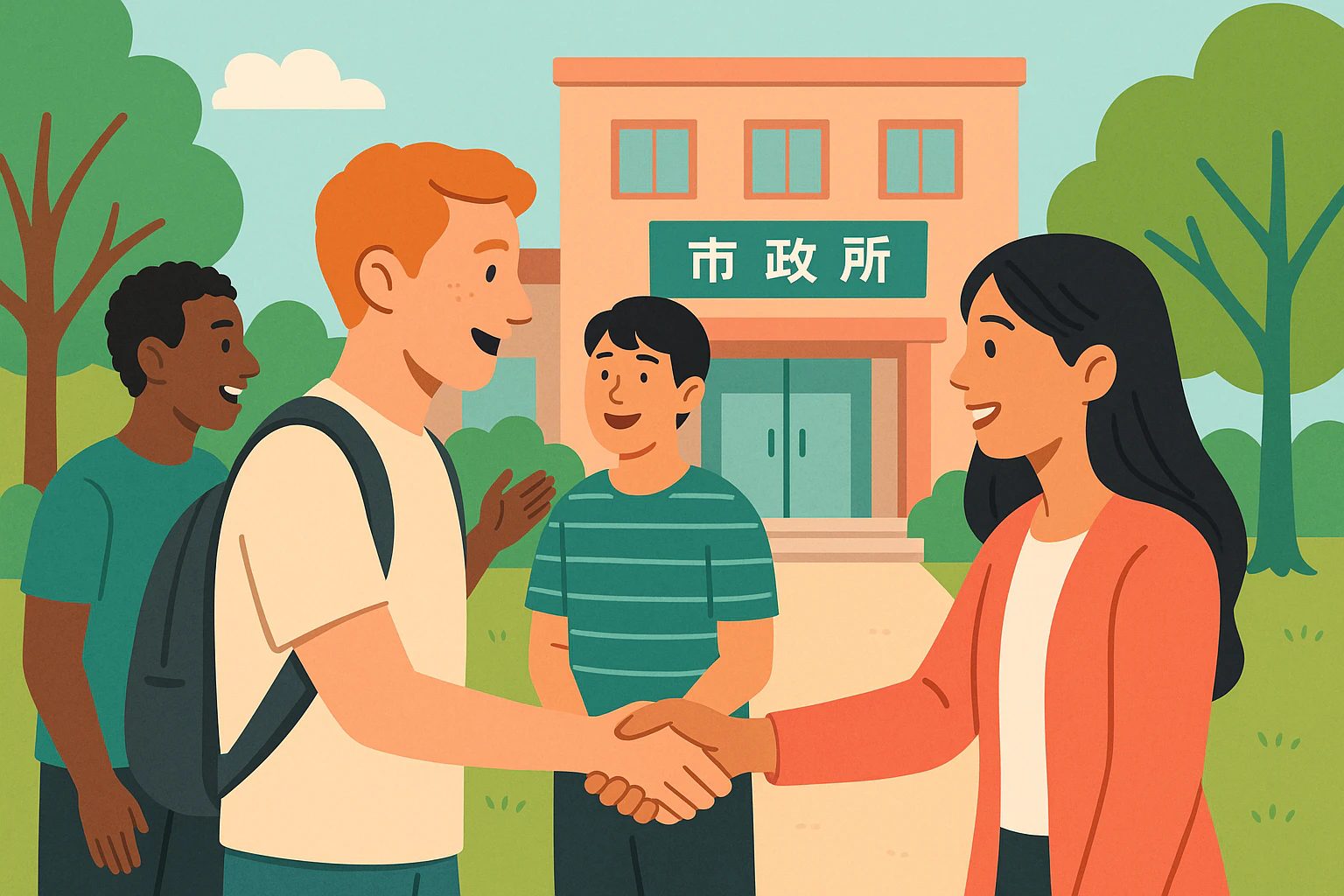
Language Exchange Japan for Foreign Residents: 2026 Local Guide
A 2026 guide to ward/city-run Japanese conversation salons and associations—how to join, message templates, and safety tips.
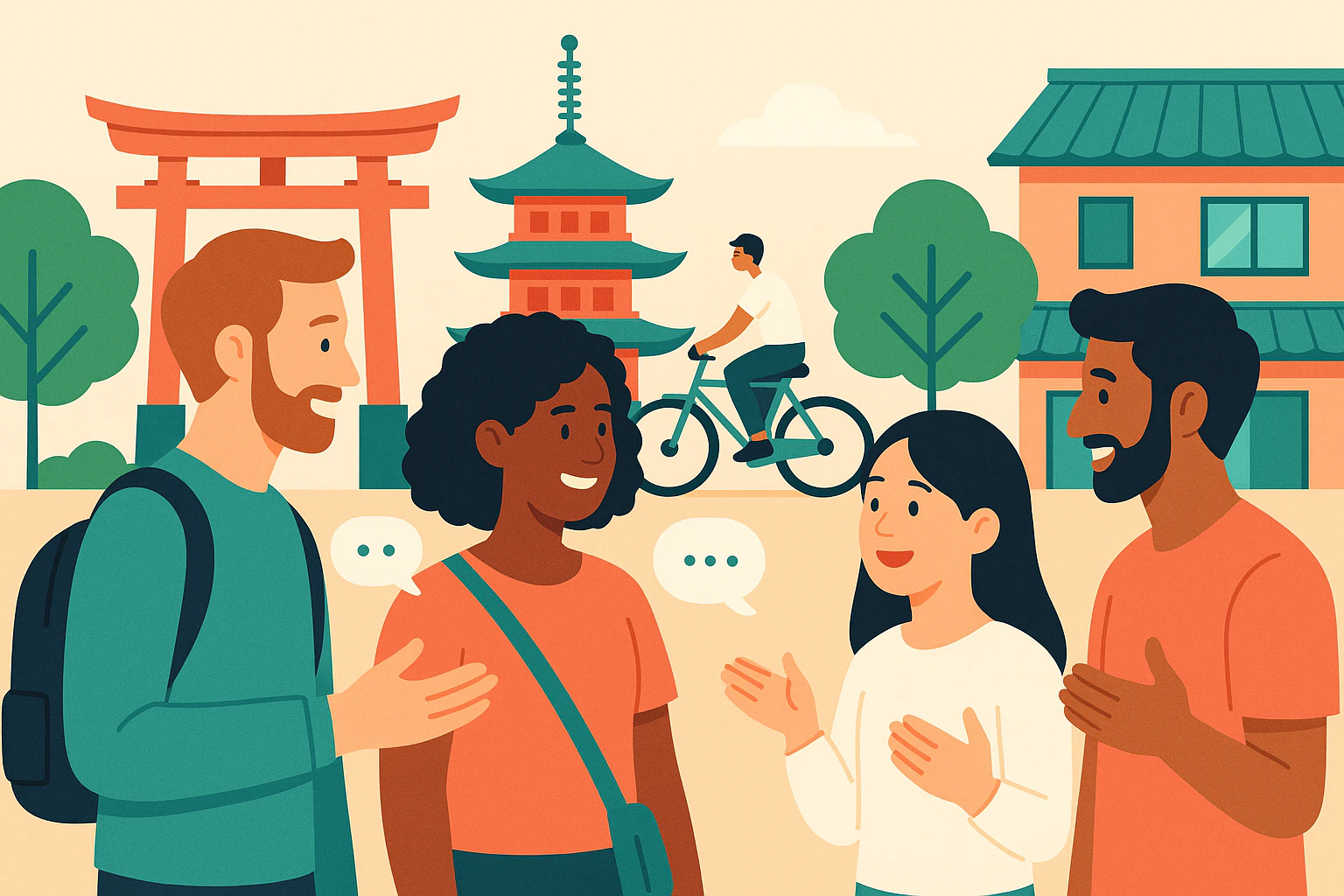
If you search for language exchange Japan, most advice boils down to “try Meetup” or “go to a bar.” That can work—but it’s unreliable for building real friendships, especially if you’re busy, new to Japan, or not into nightlife.
This 2026 local guide shows a more dependable path: recurring, ward/city-run Japanese conversation salons (交流サロン / 日本語サロン) and the international associations connected to city halls. These programs repeat weekly (or by term), attract locals who actually want to talk, and give you the one ingredient friendship needs: consistent re-meetings.
Core idea: Use a weekly Japanese conversation salon as your “home base,” then invite one person at a time into a second setting (coffee, lunch, a hobby, volunteering). That’s how small talk becomes real friends.
What foreign residents struggle with
Many foreign residents can handle daily Japanese (ordering food, trains, work messages) yet still feel socially stuck. People are friendly, but interactions stay polite and one-off—especially in big cities where everyone is busy.
You’ll also see this pattern in “what residents actually ask.” For example, in a recent thread on r/japanlife, an exchange student described trying clubs and language cafés but struggling to turn conversations into ongoing connections.
Language exchange works when it’s structured around repetition. A weekly or term-based salon creates:
- Low-pressure practice: you can show up even when you’re tired and still get value.
- Same faces over time: the “we met before” effect removes awkwardness.
- Safe conversation topics: seasonal events, food, neighborhoods, everyday life.
- A clear social role: “We’re here to chat and help each other” makes it easier to approach people.
The trick is choosing the right format. One-time events are fun, but recurring programs are a better “friendship funnel.”
Where to find city-run conversation salons and local exchange groups (Tokyo vs other regions) for language exchange Japan
In Japan, a huge amount of community support is organized locally. Many cities (and their international associations) run Japanese conversation salons, exchange lounges, and beginner-friendly classes—part of broader “multicultural coexistence” efforts supported nationwide.
For context, Japan’s Ministry of Internal Affairs and Communications notes that it created the Multicultural Coexistence Promotion Plan and revised it in September 2020, and continues to track municipal initiatives.
And at the national level, the Prime Minister’s Office reported that Japan approved a partially revised Roadmap for the Realization of a Society of Harmonious Coexistence with Foreign Nationals (approved June 6, 2025), reinforcing the idea that language support + participation in local communities is an official priority.
How to search (works almost anywhere in Japan)
- Find your municipality’s “international association” page.
- Try English: “(City name) international association Japanese salon”
- Try Japanese: “(市/区名) 国際交流協会 日本語サロン” or “(市/区名) 交流サロン”
- Check three keywords on the page: 対象 (who can join), 申込 (how to apply), 参加費 (fee).
- If it’s unclear, call or email. These offices are used to basic questions.
Tokyo: ward-run salons can be extremely convenient (but rules vary)
Tokyo wards often offer “low friction” salons—yet eligibility and intake can change. Here are real examples you can model your search on.
1) Arakawa (eligibility required + intake can pause)
Arakawa’s international association runs a free Japanese Salon (日本語サロン) held every Wednesday (day and night courses listed). It’s for foreign residents who live, work, or study in Arakawa and can do Japanese conversation. The same page also warns that you cannot join immediately and that they will announce on the website when reception reopens.
It also clearly states a rule you’ll see at many public programs: no political activity, ideological instruction, religious solicitation, or sales. That’s a feature, not a bug—it keeps the space comfortable for everyone.
2) Shinagawa (simple drop-in, no application, no fee)
Shinagawa’s international friendship association (SIFA) runs a weekly exchange salon described as a place to practice Japanese with volunteers: 交流サロン ~にほんごで はなそう~. The page states:
- No application required
- No participation fee
- Time: Fridays 2:00–3:30 p.m.
- Place: SIFA meeting room (2F)
- Telephone: 03-6426-6044
If you want the easiest “show up and start talking” option, programs like this are gold.
3) Itabashi (structured terms + real 2026 schedule and application dates)
Some ward programs are more like classes: they have fixed terms, fees, and application windows. Itabashi’s foundation publishes a detailed 2026 schedule for its Japanese classes and conversation salon: Japanese Class / Conversation Salon (日本語教室/会話サロン).
Examples from the Itabashi page (use these as a checklist for other wards):
- Beginner Japanese class (ICIEF初級日本語教室): applications start March 1, 2026 (counter applications from March 2). Classes run April–September 2026, with weekday morning or evening options, and a listed fee (plus textbook costs).
- Wednesday conversation salon (ICIEF水曜会話サロン): starts April 15, 2026, with morning/evening time slots and a listed fee.
- Eligibility: people who live/work/study in Itabashi, age and child-attendance rules, and capacity limits.
Outside Tokyo: city-hall-linked salons may be the main community hub
In regional cities, an “international exchange salon” can function as a community living room: multilingual books, flyers, consultation desks, and introductions to Japanese classes.
Hikone (Shiga): an international exchange salon with a help desk
Hikone City introduces the Hikone International Friendship Association “SALON” as open for anyone, and notes that a help desk for foreign residents is set up. The city also lists the “International Exchange Salon” details (location, hours, phone) on its Japanese page: 国際交流サロン (phone: 0749-22-5931).
Hakusan (Ishikawa): exchange salon + free Japanese classes + contact info
Hakusan City publishes a clear facility page for the Hakusan International Exchange Salon, including address, hours, and contact details (telephone and email). The salon’s own site also lists free Japanese language classes and notes that some lessons require booking in advance.
Kanazawa (Ishikawa): a prefectural exchange salon space you can use
The Ishikawa International Exchange Association describes the Ishikawa International Exchange Salon in Kanazawa as a place for intercultural exchange that anyone can use (reservation required for events).
Fukuoka City: searchable volunteer classes + a beginner course schedule
If your goal is conversation plus a dependable structure, Fukuoka City International Foundation provides both: a searchable listing of volunteer-taught classes and details for foundation-run courses on its Japanese Language Classes page (including a “Yokatopia Japanese Introductory Course” running February–March 2026, with location, capacity, and fee information).
Osaka and other big cities: international exchange is also a policy priority
Local-government investment isn’t just a Tokyo thing. JICE (Japan International Cooperation Center) reports it ran an Osaka City-commissioned multicultural coexistence area program from December 2023 to March 2025, noting Osaka had about 190,000 foreign residents as of end-December 2024. That kind of program often connects directly to the same “where do I meet people?” infrastructure: salons, associations, and community events.
How to join smoothly: registration rules, first-visit etiquette, and message templates
The biggest mistake people make with a Japanese conversation salon is treating it like a random event. Public programs often have rules (eligibility, capacity, application windows), and you’ll have a better experience if you join like a local.
Step 1: Identify the program type (drop-in vs term-based)
- Drop-in salons (best for busy schedules): “No application,” “no fee,” show up and sign in. Example: Shinagawa SIFA’s salon states no application and no fee on its page.
- Term-based classes/salons (best for steady progress): fixed dates + applications + capacity. Example: Itabashi publishes a 2026 schedule and application start date for multiple courses.
- Paused intake: some programs temporarily stop accepting new people. Example: Arakawa’s page explicitly says you can’t join immediately until reception reopens.
Step 2: Check eligibility and what you might need to prove
Common eligibility patterns include:
- Resident / worker / student requirement in that ward/city (very common in Tokyo wards).
- Age requirements (e.g., 15+ is common in ward programs).
- “Foreigners only” participation, with Japanese volunteers supporting (common for conversation salons).
Practical tip: even if the website doesn’t demand ID, it’s smart to bring something with your local address (a piece of mail, student card, etc.) just in case the reception desk asks.
Step 3: First-visit etiquette (what to do in the first 10 minutes)
- Arrive 5–10 minutes early and look for a sign-in sheet (名簿 / 受付).
- Start with one sentence that explains your purpose: “日本語の会話練習をしたいです” (I want to practice conversation).
- Don’t sell, recruit, or preach. Many programs ban sales and solicitation (Arakawa’s salon spells this out clearly).
- Use “small, safe” topics first: your neighborhood, food, weekend plans, seasonal events, work schedule (without sensitive details).
Message templates (copy/paste)
Use these templates when you email a ward/city foundation or international association. Keep it short; staff and volunteers are busy.
Template 1: Asking if you can join a Japanese conversation salon
件名:交流サロン(日本語サロン)の参加について
はじめまして。◯◯(名前)と申します。◯◯区(または◯◯市)に在住しています。
日本語の会話練習をしたく、交流サロン(日本語サロン)に参加したいです。初回参加の方法(申し込みの有無、参加費、持ち物)を教えていただけますか。
どうぞよろしくお願いいたします。
Template 2: The “next step” invite that turns small talk into friendship
今日はありがとうございました!また来週も行く予定です。
よかったら、今度サロンのあとに15分だけコーヒーしませんか?(◯曜日は空いています)
Friendship tip: In Japan, people often wait for a clear plan. A specific invitation (“15 minutes,” “after the salon,” “Saturday 2pm”) works better than “Let’s hang out sometime.”
Safety + sustainability: avoiding romance-scam patterns and keeping friendships going
Meeting new people is good. Meeting new people safely—and in a way you can sustain week after week—is the real goal.
Safety: scams and pressure patterns to watch for (especially in app-based language exchange)
If you use apps or social media for language exchange, treat safety as non-negotiable. Japan’s Ministry of Foreign Affairs (MOFA) issued a warning (April 30, 2025) about international romance scams, noting that scammers build closeness online (often without meeting) and then ask for money, and that tactics are diversifying.
Japan’s National Police Agency also publicly reported international enforcement related to SNS-based investment/romance fraud (press release dated February 17, 2025), reinforcing that these are real, organized schemes—not just “rare bad dates.”
Red flags that should end the conversation
- They ask for money (any reason), crypto, “fees,” gift cards, or help receiving/forwarding packages.
- They refuse to meet in public after repeated chances, but push emotional intimacy fast.
- They move you off-platform immediately and try to isolate you (“Don’t tell anyone about us”).
- They suddenly introduce “investment” talk, or a “friend” who can teach you trading.
If you’re in Japan and you’re unsure whether something is fraud, you can call the Consumer Hotline 188 (消費者ホットライン) to be connected to a nearby consumer consultation desk (note: call charges may apply).
Sustainability: how to make Japanese friends in Japan from a weekly salon
Public salons are a “starter space.” To build real friendships, you need a simple system you can repeat.
- Commit to four visits. Put it on your calendar like a class. Your first visit is “trial,” your second is “recognition,” your third is “comfort,” and your fourth is where invitations start working.
- Collect small personal facts, not deep secrets. “They like hiking,” “Their kid is in junior high,” “They’re from Kansai.” That’s how you remember people and follow up naturally.
- Make a tiny, easy invitation. Coffee for 15 minutes, a convenience-store snack, a quick walk to the station—right after the salon. Keep it short so it feels safe to say yes.
- Graduate into a second shared activity. Once you’ve met twice outside, suggest a hobby group, local festival, volunteering, or a ward event.
Related Articles
- Making Friends in Japan as a Foreigner: City Hall & Events
- Free Japanese Classes Near Me in Japan (2026): City Hall Guide
- Easy Japanese City Hall Paperwork in Japan: Free Guides (2026)
Need More Help? Ask on LO-PAL
If you want to know more about this topic or need specific local information—like “Is my ward’s Japanese conversation salon accepting new members this month?” or “Can someone help me call and confirm eligibility?”—ask a local Japanese person on LO-PAL.
LO-PAL is our matching service where foreign residents and tourists in Japan can connect with local Japanese helpers. Post a question (Q&A-style) or request task help (errands, shopping assistance, government office help), and people in your area will respond. We also support multiple languages including English, Chinese, Vietnamese, Portuguese, Korean, Nepali, Tagalog, Indonesian, and Spanish.
FAQ: Language exchange Japan (2026)
Q1: Are city-run Japanese conversation salons only for residents?
A: It depends. Some programs accept anyone, but many ward/city programs require you to live, work, or study in that area (for example, Arakawa and Itabashi state local eligibility on their program pages).
Q2: Are conversation salons free?
A: Some are free (Shinagawa’s SIFA salon states no fee), while others charge small term fees (Itabashi lists fees for its classes and its Wednesday conversation salon).
Q3: What should I bring to my first Japanese conversation salon?
A: Bring a notebook, a pen, and (if you have it) something that shows your local address or affiliation. Also bring one or two simple topics (photos, a map, a food recommendation) to avoid awkward silences.
Q4: I went once and it was polite but not friendly. What now?
A: Go back at least three more times. Then invite one person for a short, specific “next step” (15-minute coffee after the salon). Repetition plus a clear plan is what turns small talk into real friendships.
Q5: What if intake is closed?
A: That happens. Arakawa’s salon page, for example, notes you can’t join immediately and will announce when reception reopens. In the meantime, look for another ward/city salon nearby, or a prefectural/city international exchange salon space.
Written by

Founder, LO-PAL
Former Medical Coordinator for Foreign Patients (Ministry of Health programme) and legal affairs professional. Built LO-PAL from firsthand experience navigating life abroad.
Written with partial AI assistance
Read full bio →