Halal School Lunch in Yokohama: How to Request Accommodation (2026)
Yokohama junior-high lunch goes citywide in April 2026. Use this official-process script to request halal-friendly accommodation or opt out.
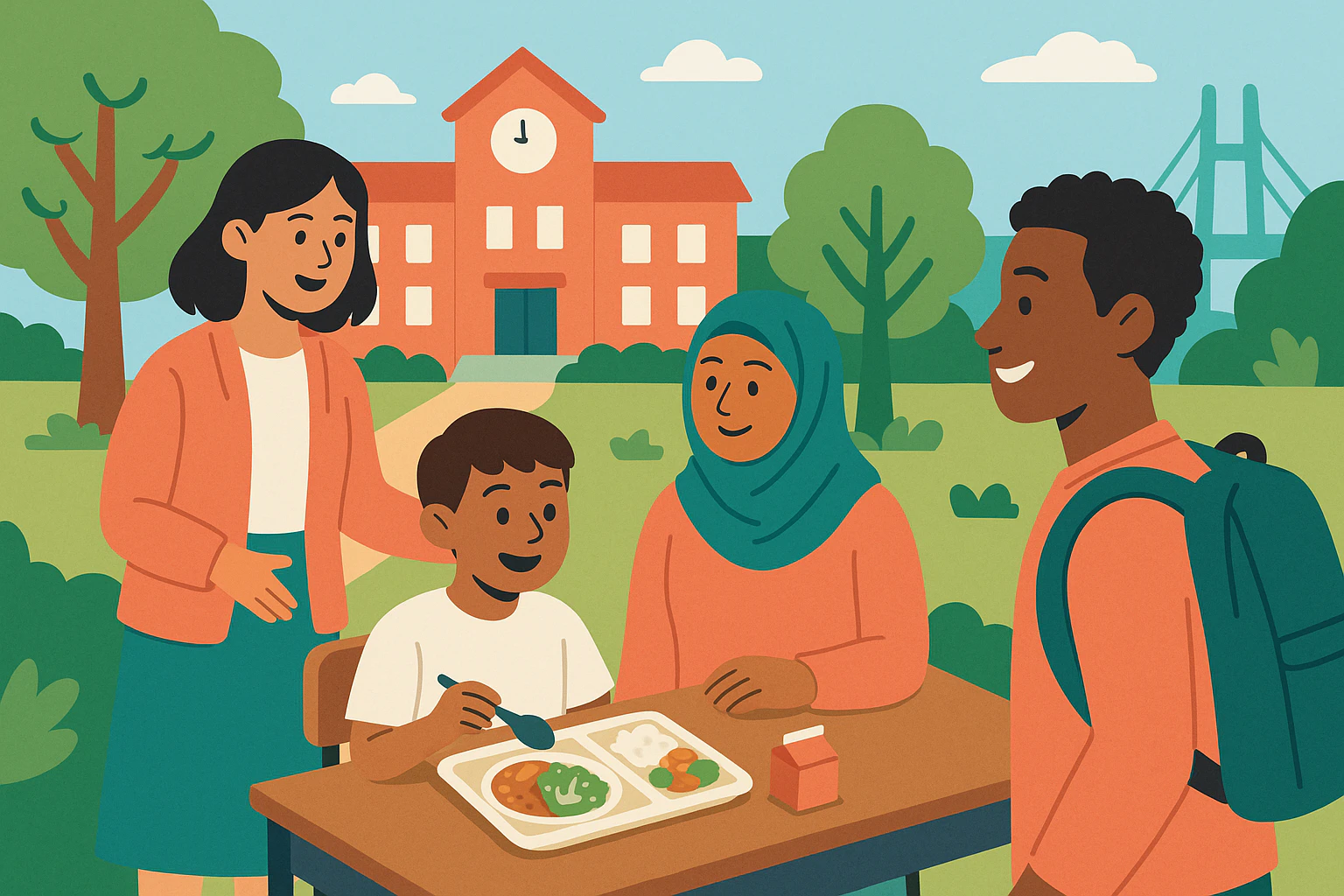
Bottom line (April 2026): Yokohama City’s junior-high “all-student” lunch starts in April 2026, and religious diet requests are handled by a school meeting—not by custom halal meals.
Do this first: Decide your family’s minimum “halal-friendly” line (pork-free only vs. no alcohol/mirin vs. strict halal-certified) and request an accommodation meeting with the school before April 2026.
Key contacts if you get stuck: Yokohama City Junior High School Lunch Support Center 045-550-5400 (weekdays 9:00–17:00) and Yokohama City Board of Education, School Lunch & Food Education Promotion Division 045-671-4635 (official page).
Information current as of March 2026, based on Yokohama City Board of Education guidance for junior-high school lunch and accommodation handling, plus Kanagawa International Foundation’s education resource on Muslim children.
In 2026, a very specific timing problem hits Muslim families in Yokohama: citywide junior-high school lunch becomes the default from April 2026 (FY2026 / Reiwa 8), and many parents realize late that “halal-friendly” is not a checkbox in the usual school paperwork.
I built LO-PAL because I’ve seen how systems can be “available” but still not accessible. When I lived in the UK, I couldn’t even understand the NHS phone line—I had to call back three times just to book an appointment. School lunch accommodation in Japan can feel similar: there is a system, but the real barrier is Japanese-only communication and knowing which request is realistic.
This guide turns Yokohama’s official rules into (1) a practical accommodation plan, (2) a request script you can actually say in Japanese, and (3) an escalation ladder so you don’t get stuck.
| Item | Amount/count | Source / as-of date |
|---|---|---|
| All-student junior-high lunch start (Yokohama City) | April 2026 | Yokohama City Junior High Lunch site (accessed Mar 2026) |
| School lunch fee (junior high) | 330 yen per meal (includes milk portion 55 yen) | Yokohama City “User Guide” PDF (accessed Mar 2026) |
| Automatic withdrawal timing | About the 29th each month; 10 withdrawals/year (no withdrawal in April & September) | User Guide PDF (accessed Mar 2026) |
| Bank account registration deadline for April payments (for April 2026 start) | By March 15, 2026 | User Guide PDF (accessed Mar 2026) |
| Support desk for the junior-high lunch site/portal | 045-550-5400 (weekdays 9:00–17:00) | Yokohama City Junior High Lunch FAQ (accessed Mar 2026) |
| Yokohama City BOE (School Lunch & Food Education Promotion Division) | 045-671-4635 | Yokohama City official page (updated Sep 2025; accessed Mar 2026) |
What “halal-friendly” means at a Japanese public school (choose your minimum standard)
Before you talk to the school, you need to be very clear on one thing: what counts as “halal” in your family. In Japanese public schools, the staff usually want to help—but they can only help if your request is specific and operational.
Kanagawa International Foundation (KIF) points out two important realities for Muslim children in Japanese schools: (1) what is considered haram can vary by family, and (2) some families consider not only cooking sake/mirin, but even small amounts of alcohol in seasonings like soy sauce as haram. That’s exactly why you must define your boundary before negotiating. (KIF: “Understanding Muslim children”)
To make this practical, I recommend choosing one of these minimum standards to bring to the meeting (and writing it down in both English and Japanese).
Minimum Standard A: “Pork-free” (the most realistic in public schools)
This is the most common “halal-friendly” compromise in Japan’s public systems. You ask the school to avoid pork and pork-derived ingredients for your child, and you accept that the lunch is not halal-certified.
- Usually includes: no pork meat, bacon/ham, lard, pork gelatin.
- Usually still includes: non-halal chicken/beef; shared kitchens; shared utensils; and seasonings that may include mirin/cooking sake depending on the menu.
Minimum Standard B: “No pork + no alcohol seasonings” (harder, but sometimes workable via menu selection)
You avoid pork and alcohol-based seasonings (mirin, cooking sake) and try to rely on fish/egg/dairy/vegetarian dishes. This can work only if the school can provide enough transparency (detailed menu/ingredients) for your child to safely select what to eat.
- Usually includes: fish and vegetarian items; milk; eggs; simple rice dishes.
- Usually excludes: dishes cooked with mirin/sake; sauces with alcohol added.
Minimum Standard C: “Strict halal” (expect bento)
If you require halal-certified meat, separate handling, and strong cross-contact control, the most sustainable plan at a Japanese public school is usually opting out of lunch and bringing a bento. This isn’t “failure”—it’s choosing a plan your family can maintain all year without daily anxiety.
Key Japanese phrases to define your boundary (use in the meeting)
- 豚肉と豚由来の成分が食べられません。 (Butaniku to buta yurai no seibun ga taberaremasen.) — We cannot eat pork or pork-derived ingredients.
- 宗教上の理由で、みりん・料理酒も避けたいです。 (Shuukyoo-joo no riyuu de, mirin/ryoorishu mo saketai desu.) — For religious reasons, we also want to avoid mirin/cooking sake.
- 家庭によって基準が違うと思いますが、我が家の基準はこの範囲です。 (Katei ni yotte kijun ga chigau to omoimasu ga, wagaya no kijun wa kono hani desu.) — I know the standard differs by family, but this is our family’s standard.
Yokohama City’s 2026 school lunch system: what the school can do vs. can’t do
Yokohama City’s junior-high school lunch becomes “all-student” from April 2026 (official announcement page). For Muslim families, the most important thing to understand is that religious diet requests are explicitly treated as “non-allergy” requests—and the city sets clear limits.
What schools can do (official options)
Yokohama’s official guidance (for cases like Islam, Hinduism, vegetarianism) says the school will hold a meeting and the principal decides the response. The options that are explicitly listed include: (Yokohama City allergy/health response manual (Reiwa 7 / Sept 2025 revision); also summarized on the Junior High Lunch FAQ)
- Stop all school lunch and bring a bento (no lunch fee collected).
- Stop milk only (milk portion of fees is not collected).
- Provide menu/ingredient info so the student selects what they can eat (fees are still fully collected).
That third option is the “pork-free/halal-friendly” route many families try first—because it avoids full opt-out. But it only works if (1) your child is mature enough to choose consistently, and (2) the school’s menu information is detailed enough for your halal boundary.
What schools cannot do (this is where negotiations often break)
Yokohama City also clearly lists what is not provided for non-allergy reasons, including: (Junior High Lunch FAQ (Q33))
- No individually customized meals to match each student’s personal/religious reason.
- No special dishes/utensils prepared just for that student.
- No partial refunds if the student skips certain dishes (for example, not eating the pork side dish).
In other words: if your request is “Please cook my child a halal version,” the correct answer will usually be “we can’t.” The win condition is choosing one of the official response patterns and getting it documented.
Portal/app reality: monthly confirmation is built into the system
For junior-high lunch, Yokohama uses a dedicated portal (web/app) for procedures and ongoing monthly handling. The city’s manual explains that documents and monthly confirmations are handled via the dedicated portal, with a paper fallback for households without internet access. (Yokohama City manual)
Separately, the 2026 user guide explains that the portal is where parents register lunch-related settings, confirm the next month’s lunch handling, and check fees. (Yokohama City junior-high lunch user guide PDF)
If you only remember one practical tip: your agreement with the school must be sustainable as a monthly routine, not a one-time conversation.
Step-by-step: how to request pork-free/halal accommodation (meeting, forms, fee changes)
This is the workflow that tends to succeed in Japanese public schools because it matches Yokohama’s official process: request a meeting, propose one of the permitted options, confirm how fees will be handled, and get the final decision recorded.
Step 1: Start with a short written request (don’t explain everything in the hallway)
Ask for a formal meeting. In Japan, “face-to-face meeting with the right people” is where decisions get made.
Japanese phrase (copy/paste):
給食について、宗教上の食事制限の相談をしたいので、面談のお時間をいただけますでしょうか。 (Kyuushoku ni tsuite, shuukyoo-joo no shokuji seigen no soudan o shitai node, mendan no ojikan o itadakemasu deshou ka.) — I would like to consult about religious dietary restrictions for school lunch; could we have a meeting?
Who to address: homeroom teacher (担任 / tannin) first, then ask to include the vice principal/principal (教頭 / 校長) and whoever handles lunch coordination at the school (often the school’s nutrition staff, depending on the setup).
Step 2: Bring a one-page “Halal Accommodation Sheet” to the meeting
Keep it simple. Japanese schools are much more likely to act when you present a clear choice and a clear operational rule.
- Must avoid (example): pork (including processed items), pork-derived gelatin/lard, dishes cooked with mirin/cooking sake.
- OK (example): fish, eggs, milk, vegetables; vegetarian dishes; plain rice.
- Your preferred official option: Option (3) menu transparency + student selection, or Option (1) full opt-out + bento.
Japanese phrase:
こちらが家庭の基準(食べられないもの/食べられるもの)をまとめた紙です。学校の運用に合わせて、現実的な方法で相談したいです。 (Kochira ga katei no kijun (taberarenai mono / taberareru mono) o matometa kami desu. Gakkou no unyou ni awasete, genjitsuteki na houhou de soudan shitai desu.) — This is our family’s standard (cannot eat / can eat). We want to discuss a realistic method that fits the school’s operation.
Step 3: Ask the school to choose one of Yokohama’s official response patterns
In negotiation, your biggest advantage is using the city’s own language. Yokohama explicitly lists the permitted responses for non-allergy reasons (religion/vegetarianism, etc.) and also lists what cannot be done. (Junior High Lunch FAQ (Q33))
Japanese phrase (Option 3: transparency + selection):
個別の献立は難しいことは理解しています。献立表や食材情報を詳しく教えていただき、子どもが食べられるものだけ選ぶ形は可能でしょうか。 (Kobetsu no kondate wa muzukashii koto wa rikai shiteimasu. Kondatehyou ya shokuzai jouhou o kuwashiku oshiete itadaki, kodomo ga taberareru mono dake erabu katachi wa kanou deshou ka.) — I understand custom meals are difficult. Is it possible to provide detailed menu/ingredient information so my child selects only what they can eat?
Japanese phrase (Option 1: opt-out + bento):
給食の提供を停止して、毎日お弁当にしたいです。給食費の徴収も停止できますか。 (Kyuushoku no teikyou o teishi shite, mainichi obentou ni shitai desu. Kyuushokuhi no choushuu mo teishi dekimasu ka.) — We want to stop school lunch and bring a bento every day. Can the lunch fee collection be stopped?
Japanese phrase (Option 2: milk only stop):
牛乳だけ停止していただくことは可能でしょうか。牛乳代の減額手続きも確認したいです。 (Gyuunyuu dake teishi shite itadaku koto wa kanou deshou ka. Gyuunyuu-dai no gengaku tetsuzuki mo kakunin shitai desu.) — Is it possible to stop only milk? I also want to confirm the fee reduction procedure for milk.
Step 4: Confirm how fees will work (this is where misunderstandings happen)
Yokohama’s official rules are very clear:
- If you stop all lunch and bring a bento, fees are not collected. (FAQ (Q33))
- If you stop milk only, the milk portion is not collected. (FAQ (Q33))
- If you are using the “student selects what to eat” approach, fees are still fully collected (no partial refunds for skipped dishes). (FAQ (Q33))
Also, for the new 2026 system, the user guide states the per-meal price and fee basics (330 yen per meal including a milk component), and explains automatic withdrawals. (User guide PDF)
Japanese phrase (to lock in the fee rule):
給食費について、今回の対応の場合は「全額徴収」か「徴収停止」か、どちらになるか確認できますか。書面かポータルでも残していただけると助かります。 (Kyuushokuhi ni tsuite, konkai no taiou no baai wa “zengaku choushuu” ka “choushuu teishi” ka, dochira ni naru ka kakunin dekimasu ka. Shomen ka pootaru demo nokoshite itadakeru to tasukarimasu.) — For lunch fees, can we confirm whether this plan means full collection or stopping collection? It would help if it can be recorded in writing or in the portal.
Step 5: Get the decision documented and set a monthly routine
Yokohama’s system is designed around monthly confirmation and portal-based procedures. The 2026 user guide notes that parents confirm the next month’s lunch handling in the portal after next month’s menu is published. (User guide PDF)
So your goal is not only “yes/no,” but:
- What exactly will the student do on pork days?
- Who checks the menu and how far in advance?
- How will the school communicate changes?
- Where is the agreement recorded (portal/paper)?
Japanese phrase (monthly routine):
毎月、翌月の献立を確認して対応を決める必要があると思います。学校側と家庭側の確認方法(ポータル/紙)を決めたいです。 (Maitsuki, yokutsuki no kondate o kakunin shite taiou o kimeru hitsuyou ga aru to omoimasu. Gakkougawa to kateigawa no kakunin houhou (pootaru / kami) o kimetai desu.) — Each month we need to confirm next month’s menu and decide the handling. I want to agree on how the school and family will confirm it (portal or paper).
Not sure what to write or how to explain your family’s halal boundary in Japanese? Ask on LO-PAL.
Rice size reference (useful when your child is skipping dishes)
If your child is skipping some items (for example, any dish that might contain pork extract), consider adjusting rice size and adding a safe “supplement” at home (if your school allows it). Yokohama’s junior-high lunch FAQ publishes rice size guidelines. (FAQ (rice size))
| Item | Amount/count | Source / as-of date |
|---|---|---|
| Rice size (Large) | About 290g | Yokohama JHS lunch FAQ (accessed Mar 2026) |
| Rice size (Medium) | About 230g | Yokohama JHS lunch FAQ (accessed Mar 2026) |
| Rice size (Small) | About 180g | Yokohama JHS lunch FAQ (accessed Mar 2026) |
Real-world note from foreign residents (supplementary; individual experiences vary)
Official rules are one thing, but it helps to know what often happens in practice.
One foreign resident wrote on Reddit that for halal/religious restrictions, the practical outcome they saw was: “The Muslim students simply bring their own food.”
Source: Reddit discussion about Muslim-friendly school lunches (2025). Individual experiences may vary by school and city.
Another person discussing school lunches mentioned: “Somebody I knew couldn’t eat (non-halal) meat for religious reasons,” describing how opting out can be emotionally awkward at first but becomes routine over time.
Source: Reddit thread on opting out of kyushoku (2021). Individual experiences may vary.
If the answer is “we can’t”: the opt-out + bento plan (and how a local can help)
If the school says, “We can’t guarantee pork-free,” or “We can’t support that level of halal,” you still have a fully official path: stop school lunch and bring a bento. Yokohama’s guidance explicitly lists full lunch stop + bento as an option for non-allergy reasons like religion, with no lunch fee collected. (Junior High Lunch FAQ (Q33))
How to propose the opt-out plan so the school can say “yes”
Schools are more comfortable approving bento when you show you’ve thought through operations and safety.
- State the reason simply: religious dietary restriction (宗教上の食事制限 / shuukyoo-joo no shokuji seigen).
- Confirm the fee rule: lunch fee collection stops (給食費の徴収停止 / kyuushokuhi no choushuu teishi).
- Confirm where the decision is recorded: portal or paper.
- Ask about storage rules: whether there is a fridge (often no), and food safety expectations.
Japanese phrase (opt-out confirmation):
宗教上の理由で給食を停止し、お弁当を持参します。給食費の停止手続きと、今後の連絡方法を教えてください。 (Shuukyoo-joo no riyuu de kyuushoku o teishi shi, obentou o jisann shimasu. Kyuushokuhi no teishi tetsuzuki to, kongo no renraku houhou o oshiete kudasai.) — For religious reasons we will stop school lunch and bring a bento. Please tell me the procedure to stop lunch fees and the future communication method.
Escalation ladder (when you’re not getting answers)
If your school communication stalls, escalate politely and in the right order.
- Homeroom teacher (担任): request the meeting and ask who is responsible for lunch handling.
- School leadership: confirm that the principal decides the handling after a meeting (this is how Yokohama’s guidance frames it). (Yokohama City manual)
- Yokohama City Junior High Lunch Support Center: 045-550-5400 (weekdays 9:00–17:00) for portal/site help and general guidance. (FAQ footer)
- Yokohama City BOE (School Lunch & Food Education Promotion Division): 045-671-4635, email ky-gakkoukyushoku@city.yokohama.lg.jp. (official contact block)
Japanese phrase (support center call):
給食ポータル(アプリ)と、宗教上の食事制限による給食の対応について相談したいです。どこに確認すればいいですか。 (Kyuushoku pootaru (apuri) to, shuukyoo-joo no shokuji seigen ni yoru kyuushoku no taiou ni tsuite soudan shitai desu. Doko ni kakunin sureba ii desu ka.) — I want to consult about the lunch portal/app and lunch handling due to religious dietary restrictions. Where should I confirm?
Japanese phrase (BOE email subject line idea):
件名:中学校給食(2026年度全員給食)宗教上の食事制限による対応について (Kenmei: Chuugakkou kyuushoku (2026-nendo zenin kyuushoku) shuukyoo-joo no shokuji seigen ni yoru taiou ni tsuite) — Subject: Junior-high school lunch (FY2026 all-student lunch) – handling due to religious dietary restrictions
Related Articles
- How Osaka City handles halal school lunch requests (2026)
- Shoes-off rules for school visits in Japan (what to bring to meetings)
- Best translation apps for foreign residents in Japan (2026)
Need More Help? Ask on LO-PAL
If you’re trying to negotiate halal-friendly school lunch rules in Japanese—or you need someone to join a meeting so nothing gets misunderstood—I built LO-PAL so you can match with a local Japanese helper who can translate, call, and support you.
Don’t risk taking time off work only to be sent home because of a language gap or a missing document—book a local helper on LO-PAL to accompany you and get the agreement documented the first time.
FAQ (quick answers)
Can Yokohama City provide a halal meal for my child?
Yokohama’s official guidance for non-allergy requests (including Islam) says schools do not provide individually customized meals. The school meeting decides one of the permitted handling patterns (opt-out + bento, milk stop, or menu transparency + student selection).
If my child skips the pork dish, can we get a partial refund?
No. Yokohama explicitly states there is no partial fee reduction based on skipping certain dishes.
Can we opt out completely and bring a bento?
Yes. Yokohama lists stopping lunch and bringing a bento as an option, and in that case lunch fees are not collected.
Who do I call if I can’t use the lunch portal/app?
The Yokohama City Junior High Lunch Support Center is listed as 045-550-5400 (weekdays 9:00–17:00).
Written by

Founder, LO-PAL
Former Medical Coordinator for Foreign Patients (Ministry of Health programme) and legal affairs professional. Built LO-PAL from firsthand experience navigating life abroad.
Written with partial AI assistance
Read full bio →