Shoes-Off in Japan: Slippers & Uwabaki for School Visits
Practical school-visit etiquette: what “uwabaki” means, what to bring, where shoes go, and how one-shoe policies change the rules.
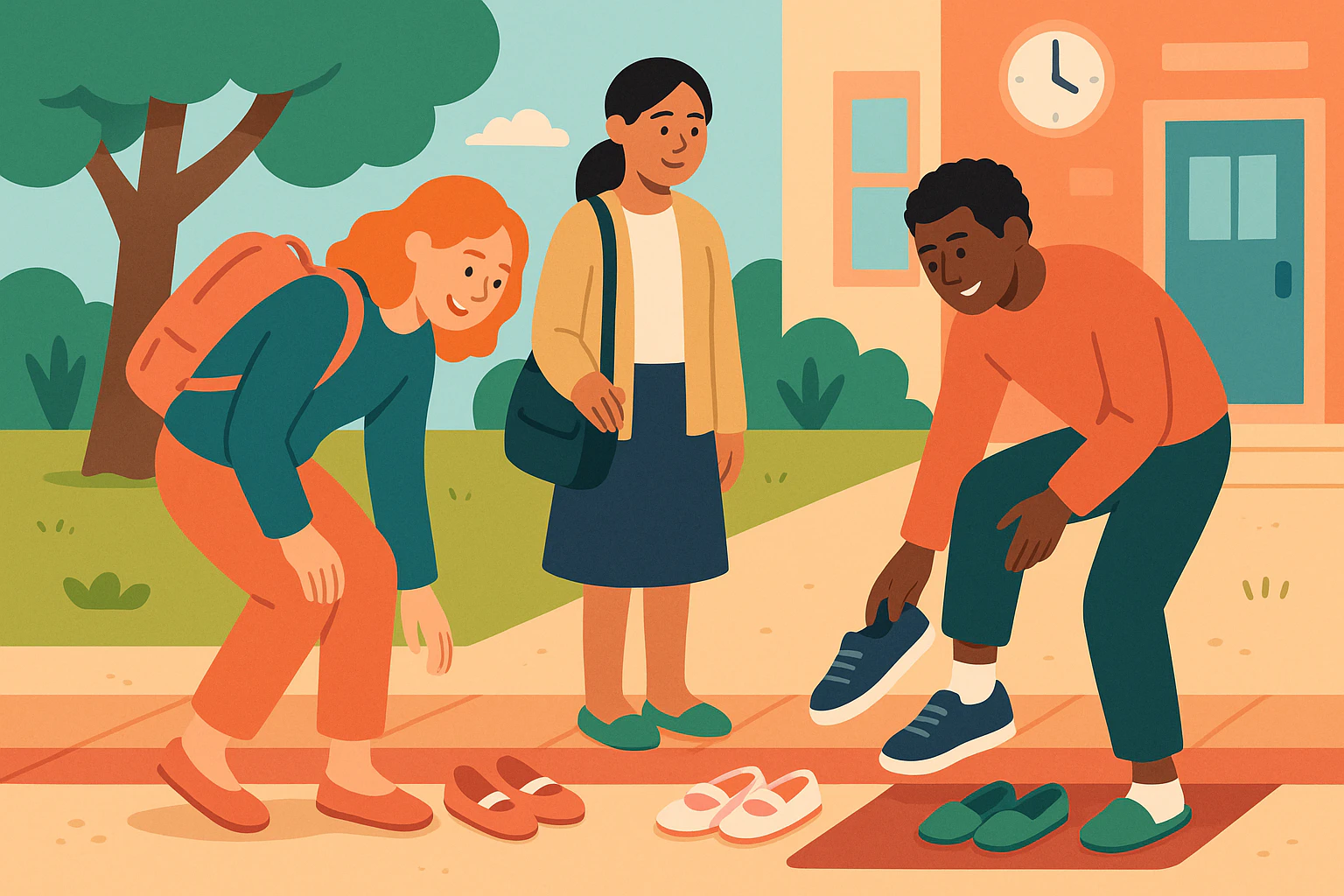
If you’re new to Japan, the shoes off in Japan rule sounds simple—until you’re standing at a school entrance with 50 other parents, holding a tote bag, unsure what to do with your boots.
Most guides stop at “take off your shoes.” This one goes further: how to recognize a shoe-removal space fast, what “uwabaki” actually means in daily life, how school visits work for parents, and why some Tokyo wards/schools are moving toward a “one-shoe” policy (一足制).
Whether you’re attending an open class day, a parent-teacher meeting, or an entrance ceremony, you’ll leave with a practical packing list and a plan for what to do at the door.
The basic rule: how to spot a shoes-off place (genkan, signs, cues)
In Japan, shoe-removal isn’t only for private homes. You’ll also see it in some schools, clinics, traditional restaurants, community centers, and older buildings with tatami rooms.
The quickest visual cue is the genkan: an entry area that is physically lower than the interior floor. Saitama Prefecture’s official living guide explains the genkan is a step lower to prevent dirt from being brought inside, and you remove outdoor shoes before stepping up into the main area (changing into indoor slippers if provided). (A Guide to Living in Saitama, Chapter 11 – Japanese Customs and Etiquette, revised Apr 1, 2025)
Next, scan for signage. Common signs you may see (Japanese → meaning) include:
Please take off your shoes→ Please take off your shoesNo outdoor shoes allowed→ No outdoor shoes allowedPlease use slippers→ Please use slippersIndoor shoes→ Indoor shoes (often for schools)
If there’s no sign, look for “behavior cues”: rows of shoes near the entrance, shoe lockers/cubbies, or a clean interior floor you’d obviously scuff with street shoes. When in doubt, pause at the entrance and copy what the person in front of you does.
Practical door procedure that usually keeps you safe:
- Stop on the lower entry area (before stepping up).
- Remove shoes neatly; avoid blocking the walkway.
- Place shoes where others do (rack/cubby) or into your own shoe bag if everyone is carrying theirs.
- Step up onto the interior floor in socks/indoor footwear as appropriate.
Slippers 101: indoor slippers vs toilet slippers vs tatami rules
“Slippers” in Japan often means three different things, and mixing them up is one of the fastest ways to feel embarrassed.
1) Indoor slippers (house/building slippers)
These are the general-purpose slippers you may be offered at homes and some facilities. The Saitama Prefecture living guide explicitly notes that if your host provides indoor slippers, you should change into them after removing outdoor shoes. (Saitama Prefecture guide, revised Apr 1, 2025)
2) Toilet slippers (restroom-only)
Many homes and some older facilities keep dedicated toilet slippers inside (or right outside) the restroom. The same Saitama guide warns that toilets may have slippers allocated only for restroom use, and you must change into and out of them when entering/exiting. (Saitama Prefecture guide, revised Apr 1, 2025)
3) Tatami rules (no slippers on tatami)
Tatami mats are traditional straw mats used as flooring in Japanese-style rooms. Official guidance in the Saitama guide is clear: take your slippers off before entering a tatami room. (Saitama Prefecture guide, revised Apr 1, 2025)
Fast mental model: Outdoor shoes stay in the entry area. Indoor slippers are for “normal” indoor flooring. Toilet slippers are restroom-only. Tatami is usually socks/bare feet only.
Small “real life” tips that matter:
- Wear socks you’re comfortable showing. School visits often involve sitting, standing, and walking in quiet hallways—people notice.
- If you wear sandals in warmer months, consider bringing socks anyway (tatami rooms and formal events can make bare feet awkward).
- When visiting someone’s home, bringing a small gift is common in Japan; the Saitama guide lists examples like fruit or snacks for home visits. (Saitama Prefecture guide, revised Apr 1, 2025)
School visits in Japan: what parents should bring (uwabaki, shoe bag) and common mistakes
This is where most foreigners get stuck: schools can be stricter than homes, and what’s “fine” at a friend’s apartment can be “not allowed” at a school event.
Uwabaki meaning: uwabaki (上履き) are indoor-use shoes worn in places where outdoor shoes are not allowed—especially schools. They’re typically lightweight and easy to slip on/off. (Uwabaki overview)
For parents, schools may accept simple foldable slippers, but many events explicitly ask for uwabaki/indoor footwear plus a bag for your outdoor shoes. For example, Minato City (Tokyo) publishes junior high school briefing schedules where the “items to bring” include uwabaki and a shoe bag (上履き/靴入れ). (Minato City document: junior high school briefings, includes “uwabaki/shoe bag”)
Yokohama City school handouts can be even more explicit. One elementary school entrance-related document (Yokohama) lists indoor shoes for both the child and the parent and a bag for the parent’s shoes. (Yokohama City school PDF: bring indoor shoes for child/parent + shoe bag)
If you searched something like “Japan school events parents slippers”, you’re seeing the same reality other foreign parents hit: the school assumes you already know to bring indoor footwear and something to carry your shoes.
What parents should pack (safe default for most public-school visits):
- Indoor footwear for you: foldable slippers or slip-on indoor shoes
- Shoe bag (靴袋 / くつぶくろ): a quiet, easy-to-carry bag for your outdoor shoes
- Spare socks (optional but smart in rainy season)
- A4 document folder (many schools hand out papers)
- Any required ID/visitor badge items listed on the notice (varies by school)
Common mistakes (and how to avoid them):
- Assuming the school provides slippers. Some schools state directly they do not prepare slippers/footwear for visitors. For instance, a notice on Minato Ward’s Konan Elementary School site notes there is no footwear such as slippers prepared by the school (so you must bring your own). (Konan ES notice page)
- Bringing the wrong type of indoor footwear. Some programs explicitly require “shoes for inside” and say slippers/sandals are not allowed. A Minato Ward junior high guide for a Japanese class instructs students to bring indoor shoes and says no slippers and sandals are allowed. (Minato Ward junior high guide, 2023: indoor shoes required; no slippers/sandals)
- Not knowing what to do with your shoes. If there are shoe lockers/cubbies, use them. If not, put shoes into your shoe bag and carry them—don’t leave them scattered at the entrance.
- Forgetting toilet slippers exist. If you see them, switch in/switch out (and don’t wear them back into the hallway).
Not sure about your specific case? Ask a local Japanese person on LO-PAL for personalised advice.
Mini script you can use (simple Japanese):
"Do we need indoor shoes? Do we also need a shoe bag?"
(「当日は上履きが必要ですか?靴袋も必要ですか?」)
Regional & school-by-school differences (Tokyo’s “issokusei” trend) + a quick checklist
Even within the same city, rules can differ by ward and by school. Recently, a key change to know is the growing use of 一足制 (issokusei), often translated as a “one-shoe policy.”
Shinagawa Ward assembly materials define issokusei as a facility operation system where, by not using uwabaki, people can use areas like the school building and schoolyard without changing from outdoor shoes. The same document lists benefits like reduced entrance congestion, smoother movement for visitors, and smoother movement during disasters, while noting hygiene exceptions (such as toilets/health rooms) handled via slippers. (Shinagawa Ward assembly materials, Feb 28, 2023)
Minato City (Tokyo) is frequently referenced in discussions of one-shoe approaches. Minato City’s own “citizen feedback” page about elementary school indoor shoes discusses continuing guidance to schools that have introduced issokusei, including hygiene considerations. (Minato City page: elementary school indoor shoes, updated Jun 6, 2025)
In practice, even schools experimenting with one-shoe approaches may still keep indoor shoes for specific rooms/activities. Konan Elementary School (Minato Ward) posted a notice (dated Feb 3, 2025) describing a shift in handling where indoor shoes are generally used only in the gym, with exceptions such as the nurse’s room for health checks. (Konan ES notice dated Feb 3, 2025)
Quick checklist before any school visit
- Read the notice for “Items to bring (持ち物)” and look for
uwabaki,slippers,shoe case, orshoe bag. (Minato City examples explicitly list上履き/靴入れ.) (Minato City PDF) - Pack indoor footwear + shoe bag anyway unless the notice clearly says you don’t need them.
- Assume rules may be room-specific (gym vs classroom vs health room). (Konan ES example)
- Arrive early so you can change footwear without pressure in a crowded entrance.
- If you’re unsure, call the school office (学校) or ask your homeroom teacher via the school’s communication app/print notice.
FAQ (school visits)
Q: Do parents always need to bring slippers?
A: Not always—but many schools do require it, and some explicitly say the school does not provide visitor footwear. When a notice lists uwabaki/shoe bag, treat it as required. (Minato City example)
Q: What’s the difference between slippers and uwabaki?
A: “Uwabaki” generally refers to indoor-use shoes (often school-style). Slippers are looser indoor footwear; some schools/programs don’t allow slippers/sandals and require indoor shoes. (Example: no slippers/sandals allowed)
Q: If a school is issokusei, do I still need indoor footwear?
A: Sometimes yes, because exceptions may exist (gym, toilets, nurse/health room). Policies can also change year-to-year as schools trial new setups. (Shinagawa Ward materials: hygiene exceptions)
Q: Where do I put my shoes during a school event?
A: Follow the local setup: shoe lockers/cubbies if available, or place shoes into your shoe bag and bring them with you. Some Yokohama documents explicitly tell parents to bring a bag for this purpose. (Yokohama City school PDF)
Related Articles
- Moving checklist for foreigners in Japan (including home setup basics)
- Japan school apps for parents (2026): how to catch notices and event instructions
- Japanese apartment etiquette: practical rules for shared living
Need More Help? Ask on LO-PAL
If you want to know more about this topic—or you need specific local information for your ward, your child’s school, or a particular event—ask a local Japanese person on LO-PAL.
On LO-PAL, you can post your question in multiple languages and get answers from local helpers in your area. You can also request task help (for example, someone to read a Japanese school handout with you or help you confirm what to bring).
Written by

Founder, LO-PAL
Former Medical Coordinator for Foreign Patients (Ministry of Health programme) and legal affairs professional. Built LO-PAL from firsthand experience navigating life abroad.
Written with partial AI assistance
Read full bio →