Food Poisoning in Japan: When to Go to Hospital (Foreigner Guide)

The all-in-one Japanese learning app
From travel phrases to real fluency — all in one app.
All 2,136 standard kanji included. Every feature is free to use.
Food-first triage plus Japan-specific escalation: pharmacy options, clinic/hospital steps, and multilingual help lines (Tokyo/Osaka/rural).
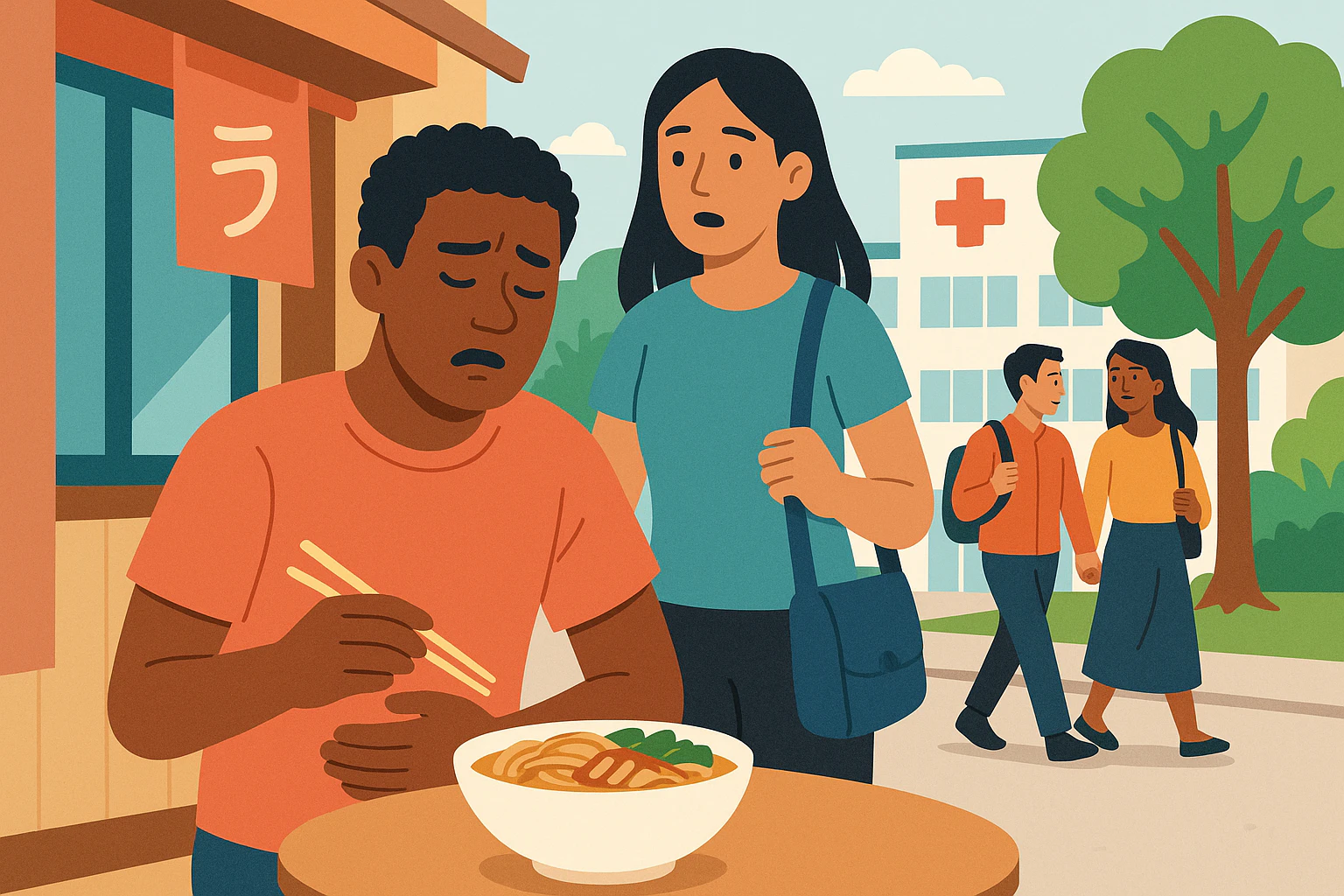
Food poisoning can go from “I feel awful” to “I need help now” surprisingly fast—especially if you can’t keep fluids down. This guide is a food-first triage flow for foreign residents and travelers, focused on food poisoning in Japan when to go to hospital, plus the fastest ways to find multilingual care (Tokyo/Osaka examples and rural-friendly tips).
Important: This article is general information, not medical advice. If someone is confused, fainting, has trouble breathing, has severe belly pain, or you’re genuinely worried, don’t wait—call an ambulance.
Food poisoning in Japan—symptoms, red flags, and when it’s an emergency
Most “food poisoning” cases are actually acute gastroenteritis and improve with rest and rehydration. The key is to spot dehydration and danger signs early, then escalate to a clinic, hospital, or emergency services as needed.
Typical symptoms (and what they usually mean)
Common symptoms include nausea, vomiting, diarrhea, stomach cramps, and sometimes fever. In many mild cases, the biggest risk isn’t the infection itself—it’s dehydration from losing fluids and electrolytes.
If your symptoms started after a meal out, you may suspect a restaurant, but it’s often impossible to confirm without testing. Either way, the first priority is to keep fluids down and monitor how you’re trending over the next several hours.
Food-first triage (first 6–12 hours)
- Hydrate first: Small sips every few minutes are better than big gulps.
- Use ORS if you can: Oral rehydration solution is ideal when you’ve had repeated vomiting/diarrhea.
- Pause solid food if actively vomiting: Focus on fluids until vomiting calms.
- When solids feel possible: Start bland (rice porridge/okayu, udon, toast, bananas).
Quick “should I escalate?” rule: If you can’t keep liquids down, you’re not peeing much, you’re getting dizzy when standing, or you see blood—stop trying to manage it at home and seek medical help.
Red flags: when to go to a clinic or hospital today
Health authorities consistently flag the same “don’t wait” symptoms. The U.S. CDC recommends seeing a doctor for severe symptoms such as bloody diarrhea, diarrhea lasting more than 3 days, high fever, vomiting so often you can’t keep liquids down, or signs of dehydration (very little urination, dry mouth, dizziness when standing). (CDC: Food poisoning symptoms—when to seek help)
The U.S. National Institute of Diabetes and Digestive and Kidney Diseases (NIDDK) also highlights severe belly/rectal pain, black/tarry stools or blood/pus, confusion/mental status changes, or inability to drink enough oral rehydration fluids as reasons to seek care promptly. (NIDDK: when to seek care)
Emergency signs: call an ambulance (119)
In Japan, dial 119 for fire or ambulance. If any of the below are happening, treat it as an emergency:
- Severe dehydration: fainting, cannot stand, confusion, very little/no urination
- Repeated vomiting with inability to keep fluids down for many hours, especially in children or older adults
- Blood in vomit or stool, or stool that is black/tarry
- Severe or worsening abdominal pain, rigid belly, or “pain out of proportion”
- Seizure, severe weakness, or trouble breathing
If you’re unsure whether it’s “ambulance-level,” use a telephone triage line if your area has one (details below). In Tokyo, for example, #7119 is a 24/7 emergency consultation service that advises on ambulance need and can guide you to an open medical facility. (Itabashi City: #7119 and medical info lines)
Higher-risk groups: err on the safe side
You should escalate earlier (even with “moderate” symptoms) if the patient is:
- Pregnant
- A baby/young child
- Over 65
- Immunocompromised or on immunosuppressants
- Living with kidney disease, diabetes, heart failure, or other conditions where dehydration is dangerous
Step-by-step: going to a clinic/hospital in Japan as a foreign resident (what to bring, payment, reservations)
When you’re going to hospital in Japan as a foreigner, the process is usually straightforward—but it helps to know what’s different: clinics often run by appointment/queue rules, payment is typically on the day, and prescriptions are often filled at a separate pharmacy.
Step 1: Decide where to go (clinic vs hospital vs emergency department)
- For mild-to-moderate cases: Start with a nearby clinic (診療所 / クリニック). Look for internal medicine (内科) or gastroenterology (消化器内科).
- If you need IV fluids, tests, or imaging: A hospital (病院) is more likely to handle it quickly.
- Night/holiday worsening: Use your city’s night/holiday duty doctor info, or a triage line (Tokyo #7119, Nara #7119, etc.).
Japan has a nationwide facility search called Medical Information Net (Navi-i) (医療情報ネット「ナビイ」). It lets you search for medical institutions and pharmacies by location, services, foreign-language support, and night/holiday availability. (MHLW: Navi-i overview)
Step 2: What to bring (so you don’t get stuck at reception)
- ID: Passport (travelers) or residence card (residents)
- Insurance: If you’re insured in Japan, bring your My Number Card registered as a health insurance card or your certificate of eligibility (資格確認書 / shikaku kakuninsho), as Japan transitioned away from standard insurance cards. (Digital Agency: health insurance card expiration and what to use)
- Cash + card: Many clinics prefer cash; card acceptance is more common at major hospitals.
- Medication list: A photo of your prescriptions or a note with drug names and allergies
- Translation support: A symptom note in Japanese/English (even a simple checklist helps)
For a practical visual walkthrough (reception → exam → payment → pharmacy), JNTO’s “Guide for when you are feeling ill” explains the typical flow and notes that credit cards are mainly accepted at major hospitals, while clinics generally accept cash. (JNTO: procedure from reception to payment)
Step 3: Reservations and after-hours care (what surprises most foreigners)
Reservations: Many clinics operate on same-day queueing or require booking by phone/online. If you arrive without a reservation, they may still see you, but you might wait longer—or be asked to come back later.
After hours: On nights, weekends, and holidays, don’t just “guess a hospital.” Use (1) Navi-i filters for night/holiday, (2) your city’s holiday duty doctor list, or (3) a telephone triage line where available.
Regional systems vary. Tokyo lists its 24-hour “Himawari” medical institution information line (03-5272-0303) and a foreign-language medical information service (03-5285-8181, daily 9:00–20:00 in multiple languages). (Itabashi City: Himawari and foreign language medical info)
Not sure about your specific symptoms, where to go tonight, or how to explain it in Japanese? Ask a local Japanese person on LO-PAL for personalised guidance in real time.
Step 4: What happens at reception (and why you may go to a pharmacy afterward)
Typically, you’ll (1) check in at reception, (2) fill out a short form, (3) wait to be called, (4) see the clinician, (5) pay at the cashier, and then (6) take your prescription to a dispensing pharmacy (調剤薬局).
If you receive a prescription (処方箋 / shohosen), the clinic/hospital often does not give you the medicine directly. You take the paper to a nearby pharmacy and pay separately there—this is normal in Japan.
How to find English/multilingual medical help (Navi-i, local hotlines, #7119, AMDA, JNTO)
When you’re sick, the “search cost” is the real enemy. Below are the fastest, most reliable ways to find an English-speaking doctor Japan (or multilingual support) without calling ten clinics.
1) Use the official nationwide search: Medical Information Net (Navi-i)
Navi-i (医療情報ネット「ナビイ」) is run by Japan’s Ministry of Health, Labour and Welfare and lets you search nationwide for hospitals, clinics, dental clinics, and pharmacies by detailed criteria. (MHLW: Navi-i)
- Go to Navi-i (official search)
- Filter by location and time/day (night/holiday if needed)
- Filter by department (内科 / 消化器内科)
- Check the facility’s language support field, then call to confirm
A useful reminder: local governments sometimes post step-by-step instructions for using Navi-i and emphasize confirming hours by phone before visiting. (Himeji City: how to use Navi-i)
Some professional resources also note Navi-i’s multilingual support and that it includes foreign-language対応 and night/holiday information. (Japan Pediatric Association resource: Navi-i features)
2) Tokyo: Himawari + #7119 (fastest “where do I go?” combo)
If you live in Tokyo, save these:
- Himawari (24-hour medical institution info, Japanese): 03-5272-0303
- Foreign Language Medical Information Service: 03-5285-8181 (daily 9:00–20:00; multiple languages)
- Tokyo Fire Department telephone triage: #7119 or 03-3212-2323 (24/7)
These are listed by Tokyo municipalities as official ways to locate open medical care and decide whether an ambulance is appropriate. (Itabashi City: Himawari and #7119)
3) Osaka: ask the clinic/pharmacy if they can use remote medical interpretation
Osaka Prefecture runs a 24-hour multilingual remote medical interpretation service for participating medical institutions and pharmacies (8 languages). The prefecture notes the phone number changed due to a contractor change starting June 1, 2025, so facilities should use updated contact details. (Osaka Prefecture: 24-hour multilingual remote medical interpretation)
Practical tip: when you arrive, you can say (or show) “Can you use telephone interpretation?” and ask staff to use their facility’s interpretation workflow if available.
4) #7119 is regional (examples: Tokyo, Nara, Hyogo) — check your prefecture
#7119 is not uniform nationwide. Some prefectures run their own version with alternate numbers for IP phones. For example, Nara Prefecture’s #7119 is 24/7, and it lists an alternate number for IP/dial lines (0744-20-0119). (Nara Prefecture: #7119 details)
Services can also expand or temporarily change numbers due to maintenance. Kobe City announced Hyogo’s expansion to a prefecture-wide #7119 service starting July 11, 2025 (and noted a temporary alternative number during the switchover hour). (Kobe City: #7119 expansion notice)
5) AMDA (practical backup when you don’t know where to go)
The AMDA International Medical Information Center publishes a multilingual consultation phone number: 03-6233-9266, with service hours listed as weekdays 10:00–16:00. (AMDA: multilingual consultation phone)
6) JNTO Japan Visitor Hotline (24/7, works even for residents in a pinch)
JNTO operates the Japan Visitor Hotline 24/7/365 for tourist info and support during accidents/illness (English/Chinese/Korean): 050-3816-2787. (JNTO: Japan Visitor Hotline)
Calling an ambulance: what to do (and language support)
If it’s an emergency, dial 119. You’ll be asked your location, what happened, and patient details. Many dispatch centers support interpretation, but coverage varies by city.
A clear official English example is Saitama City, which states that 119 is for medical emergencies, ambulances are dispatched free of charge, and over-the-phone translation services are available in several languages (while medical fees at the hospital still apply). (Saitama City: calling 119 + translation + costs)
Municipalities also explain “three-way” simultaneous interpretation for 119 calls. Tokushima City notes 119 calls are free and dispatch is free (treatment costs are separate), and describes the three-party interpreter workflow. (Tokushima City: 119 multilingual interpretation)
Very recent example: Tanabe City (Wakayama) states it uses simultaneous multilingual telephone interpretation for 119 calls and lists 24-hour language availability (page updated Feb 27, 2026). (Tanabe City: 119 multilingual interpretation, updated 2026-02-27)
Another example is Toyooka City, which states it has supported 119 calls in 21 languages since July 1, 2020 and instructs callers not to hang up while the interpreter joins. (Toyooka City Fire Department: 119 multilingual support)
If you searched “calling ambulance in Japan 119 foreigner” and worried you’ll be stuck without Japanese: the safest approach is to call anyway, speak slowly, and say “Ambulance, please.” In many areas, interpretation support exists—but if you’re in a rural area, it may be limited, so provide clear landmarks and keep the line open.
Pharmacy + recovery foods in Japan (ORS, easy meals) + useful English/Japanese phrases
If you’re not at emergency level, a good pharmacy visit plus smart rehydration is often the fastest way to feel human again. Japan’s pharmacists can also recommend whether you should seek medical care immediately.
What to buy at a Japanese pharmacy or drugstore
- Oral rehydration solution (ORS): Look for ORS drinks (commonly sold at drugstores). If you can’t find ORS, choose a sports drink plus salty food.
- Thermometer: A real fever changes the triage decision.
- Acetaminophen (for fever/pain): Ask the pharmacist what’s suitable, especially if you’re dehydrated or have kidney issues.
- Anti-diarrheal / gut medicines: Only with pharmacist guidance—avoid “stopping” diarrhea if you have fever or blood in stool.
- Probiotics: Some people find them helpful during recovery; your mileage may vary.
If you’re in Osaka (or visiting during Expo-related busy seasons), Osaka Prefecture provides downloadable materials for pharmacy counter communication with foreigners, covering basic conversation, symptom confirmation, and medication usage guidance. (Osaka Prefecture: pharmacy foreigner対応 manual downloads)
Recovery foods you can easily find in Japan
Once vomiting calms and you can sip fluids, move to bland, easy carbs and light protein. Convenience stores and supermarkets make this simple.
- Rice porridge (okayu), thick wheat noodles (udon), plain toast
- Rice ball (onigiri) (choose plain/salmon; avoid heavy mayo fillings at first)
- Bananas, applesauce-style snacks, plain crackers
- Tofu, clear soup, miso soup (watch salt if you’re vomiting a lot)
Avoid alcohol, very fatty foods, and spicy meals until you’re clearly improving. If dairy worsens symptoms, pause it for a day or two.
Useful phrases (English → Japanese you can show on your phone)
- I think I have food poisoning.
(食中毒かもしれません。 Shokuchuudoku kamo shiremasen.) - I have vomiting.
(吐き気があります。 Hakike ga arimasu. / 嘔吐しました。 Oto shimashita.) - I have diarrhea.
(下痢です。 Geri desu.) - I can’t keep liquids down.
(水分が飲めません。 Suibun ga nomemasen.) - There is blood.
(血が出ています。 Chi ga dete imasu.) - Please call an ambulance.
(救急車を呼んでください。 Kyukyuu-sha o yonde kudasai.)
FAQ
Q1: Can I just go to any hospital?
A: For non-emergencies, you can choose—but hours, departments, and language support vary. Use Navi-i to filter and call ahead.
Q2: Will an ambulance cost money in Japan?
A: In many cities, ambulance dispatch is stated as free, but you still pay medical fees at the clinic/hospital. See official city guidance such as Saitama City’s 119 page.
Q3: What if I can’t speak Japanese on a 119 call?
A: Many municipalities use interpretation services (availability depends on area). Examples include Tokushima City and Tanabe City. If unsure, call anyway and speak slowly.
Q4: I’m insured in Japan—what do I show at reception in 2026?
A: Japan shifted away from traditional health insurance cards. The Digital Agency explains that after December 1, 2025, you should use a My Number Card registered as a health insurance certificate or a certificate of eligibility. (Official policy page)
Q5: What’s the fastest multilingual help line I can call right now?
A: If you’re in Tokyo, try the foreign-language medical info line (03-5285-8181, 9:00–20:00). (Tokyo example via Itabashi City) If you’re stuck elsewhere, JNTO’s Japan Visitor Hotline is 24/7: 050-3816-2787.
Related Articles
- Disaster Medical Preparedness in Japan: Meds, 119 & Insurance
- Japan Disaster Alerts in English: Apps, Hazard Maps, Shelters
Need More Help? Ask on LO-PAL
If you want help explaining symptoms, deciding whether to call #7119 (where available) vs 119, or finding a nearby clinic that can handle your language, we built LO-PAL for exactly this kind of real-life situation.
LO-PAL is our matching service where foreign residents and tourists connect with local Japanese helpers. Post a question (Q&A-style) or request a task (like making a call, checking which clinic is open, or helping you communicate at a pharmacy), and locals in your area respond—across multiple languages including English, Chinese, Vietnamese, Portuguese, Korean, Nepali, Tagalog, Indonesian, and Spanish.
Written by

Founder, LO-PAL
Former Medical Coordinator for Foreign Patients (Ministry of Health programme) and legal affairs professional. Built LO-PAL from firsthand experience navigating life abroad.
Written with partial AI assistance
Read full bio →