
Sick in Japan? What No One Tells Foreigners About Medical Care

The all-in-one Japanese learning app
From travel phrases to real fluency — all in one app.
All 2,136 standard kanji included. Every feature is free to use.
Japan's medical system is world-class but built for Japanese speakers. Clinic vs hospital, the ¥7,000 referral fee, intake forms, pharmacy flow, and how to find a doctor who actually speaks English.
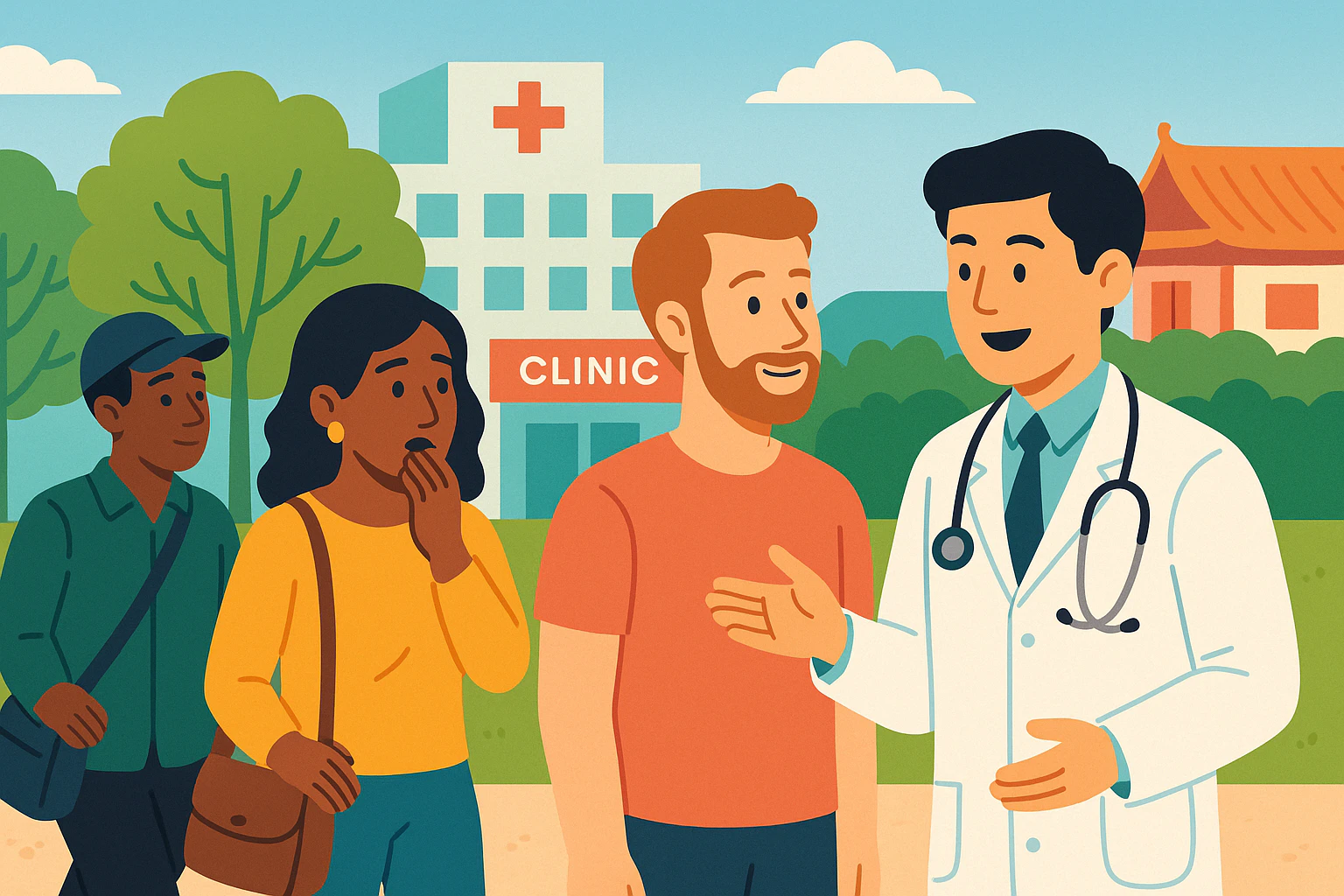
Bottom line: Japan has one of the best healthcare systems in the world — but it's built for Japanese speakers who already know the rules. Foreigners walk into the wrong facility, skip the referral letter, can't read the intake form, and end up paying more or waiting longer than they should. This guide walks you through how the system actually works, from choosing between a clinic and a hospital to understanding your bill — written by someone who spent years helping foreign patients navigate it from the inside.
Information current as of March 2026 based on MHLW, municipal government, and hospital administration sources. I'm the founder of LO-PAL, and before that I worked as a Medical Coordinator for Foreign Patients at a hospital in Osaka. I sat with patients at reception, translated between doctors and confused families, and watched people make the same avoidable mistakes over and over. This guide is everything I wish I could have handed them on day one.
The biggest mistake: going to a hospital when you need a clinic
In most countries, "go to the hospital" is the default advice when you're sick. In Japan, that's wrong — and it can cost you.
Japan deliberately separates medical care into two tiers:
| Clinic (クリニック / 診療所) | Hospital (病院) | |
|---|---|---|
| Size | Under 20 beds (most have 0) | 20+ beds |
| Role | First-line care: colds, fevers, minor injuries, prescriptions, routine checkups | Specialist care: surgery, complex diagnosis, inpatient treatment |
| Referral needed? | No — walk in | Large hospitals (200+ beds) charge an extra fee without a referral letter |
| Extra fee without referral | None | ¥7,000+ (選定療養費) at hospitals with 200+ beds |
| Wait time | Usually 15–60 min | Often 2–4 hours without an appointment |
| English availability | Rare outside major cities | Some have international departments |
I once saw a foreign resident come to the neurosurgery department of our hospital in Osaka — for a common cold. He waited three hours, paid the extra referral fee, and was told to go to a local clinic. A 5-minute visit to a neighborhood clinic would have cost ¥2,000–3,000 with insurance and taken 30 minutes total.
For a detailed breakdown of when to choose which, and a decision flowchart, see our clinic vs. hospital guide.
How to find a doctor who actually speaks English
This is where I need to be honest, because the official picture is misleading.
Japan's government maintains lists of "multilingual medical institutions." Prefectures and cities register hospitals and clinics that claim to offer foreign-language support. The problem: many of these registrations are aspirational, not operational.
At the hospital where I worked in Osaka, we were registered as "English-capable." In reality, when I wasn't there, the staff couldn't handle an English-speaking patient. This is not unusual — it's the norm. Unless a hospital has a dedicated international department (国際診療部) with full-time multilingual staff, "multilingual support" usually means "we have one person who studied English in college and they might be available."
How to actually verify before you go
- Call ahead and ask in English. If they can't handle the phone call, they can't handle your appointment. This is the single best test.
- Look for hospitals with a dedicated international department (国際診療部 / 国際医療部). These have full-time staff whose job is to handle foreign patients. Examples include Rinku General Medical Center in Osaka and St. Luke's International Hospital in Tokyo.
- Use AMDA International Medical Information Center (03-6233-9266, Mon–Fri 10:00–16:00) — a free multilingual hotline that can help you find an appropriate facility. Languages: English, Chinese, Korean, Portuguese, Spanish, Thai, Vietnamese, Filipino.
- In Tokyo: Use HIMAWARI (03-5285-8181) — Tokyo Metropolitan Health and Medical Information Center, available in English daily.
If calling in Japanese is the barrier — and for most people it is — that's exactly what LO-PAL is for. Post your question and a local Japanese helper can call the clinic, confirm they can actually see you in English, and even book the appointment.
For Osaka specifically, where there's no equivalent of HIMAWARI, see our guide to finding English-speaking doctors in Osaka.
What happens when you walk into a Japanese clinic
Knowing the flow removes 80% of the anxiety. Here's what to expect:
Step 1: Reception (受付 / uketsuke)
Hand over your insurance card (or Myna Hokensho / Shikaku Kakuninsho — see our Myna Hokensho guide). If it's your first visit, you'll be given an intake questionnaire.
Step 2: The intake questionnaire (問診票 / monshin-hyō)
This is the part that terrifies people. It's a paper form — usually only in Japanese — asking about your symptoms, medical history, allergies, and current medications. Some larger hospitals offer English versions, but most clinics don't.
We've created a Medical Japanese cheat sheet with a full translation of every common questionnaire item, so you can fill it out correctly even without Japanese ability.
Step 3: Wait
Japanese clinics operate mostly on a first-come, first-served basis. Some accept reservations. Expect 15–60 minutes at a clinic, longer at hospitals.
Step 4: Examination (診察 / shinsatsu)
The doctor will review your questionnaire and ask follow-up questions. Japanese medical consultations tend to be shorter than in Western countries — 5–10 minutes is normal. This doesn't mean you're being rushed; it's the standard pace. If you need more time, ask.
Step 5: Payment (会計 / kaikei)
After the exam, return to the reception area and wait for your name to be called at the payment counter. With insurance, a typical clinic visit costs ¥2,000–5,000 (your 30% copay). You'll receive a receipt (領収書 / ryōshūsho) and a prescription (処方箋 / shohōsen) if medication was prescribed.
Step 6: Pharmacy (薬局 / yakkyoku)
In Japan, the pharmacy is almost always a separate building from the clinic — usually right next door or across the street. Hand over your prescription, wait 10–20 minutes, pay for your medication (also 30% copay), and you're done.
See our prescription guide for details on refills, bringing medication from abroad, and what to do when your home country's medication isn't available in Japan.
Emergency care: when to call 119
For genuine emergencies — chest pain, difficulty breathing, severe injury, loss of consciousness, stroke symptoms — call 119 (fire and ambulance). The ambulance is free in Japan.
What happens after you call:
- The dispatcher will ask your location, symptoms, and name. They may have limited English — speak slowly and clearly.
- An ambulance arrives (average response time: ~8 minutes nationally).
- Paramedics assess you on-site and contact hospitals to find one that can accept you. This can take 10–30 minutes — the ambulance may sit outside while they call around. This is normal in Japan, not a sign of neglect.
- You're transported to the accepting hospital's emergency department.
Important: Japanese emergency rooms are for genuine emergencies. Using the ER for a fever, cold, or minor injury will result in a long wait and potentially the extra non-referral fee. For after-hours non-emergencies, see our urgent care guide.
For a complete guide to emergency numbers including police (110) and the English-language emergency hotline, see our emergency numbers guide.
How much does it actually cost?
With insurance (30% copay), typical costs:
| Visit type | Your cost (30% copay) | Notes |
|---|---|---|
| Clinic visit (cold, fever) | ¥2,000–3,000 | Consultation + basic tests |
| Clinic visit + medication | ¥3,000–5,000 | Including pharmacy |
| Hospital outpatient (with referral) | ¥3,000–10,000 | Depends on tests/specialist |
| Hospital outpatient (no referral) | + ¥7,000 extra | 選定療養費 at 200+ bed hospitals |
| Emergency room visit | ¥5,000–20,000 | Higher at night/weekends; plus extra fee if non-emergency |
| Hospital stay (per day) | ¥5,000–15,000 | Standard shared room; private room adds ¥5,000–30,000+ |
| Ambulance | Free | Always free in Japan |
Without insurance: You pay 100% — multiply the above by roughly 3.3x. A clinic visit becomes ¥7,000–10,000. An ER visit can be ¥20,000–60,000+. This is why enrolling in health insurance is critical.
If you face a large hospital bill, Japan's 高額療養費制度 (kōgaku ryōyōhi seido) caps your monthly out-of-pocket at roughly ¥80,000–90,000 depending on income. See our guide to capping hospital bills.
The referral letter system (紹介状 / shōkaijō)
If a clinic doctor decides you need specialist care at a hospital, they'll write a referral letter (紹介状). This letter:
- Waives the ¥7,000+ extra fee at large hospitals
- Gets you a faster appointment (often days instead of weeks)
- Includes your medical history and test results so the hospital isn't starting from scratch
The referral letter itself costs about ¥750 (30% of ¥2,500). Compared to the ¥7,000+ you'd pay without it, it's always worth getting.
Can you go straight to a hospital without a referral? Yes — nobody will turn you away. But at hospitals with 200+ beds, you'll pay the 選定療養費 on top of your normal copay. Small hospitals (under 200 beds) don't charge this fee.
What foreigners specifically need to know
- Bring your residence card (在留カード) to every medical visit. Some facilities ask for it alongside your insurance card for identification.
- Medications from your home country may not be available. Some common drugs abroad are restricted or banned in Japan (notably certain stimulant ADHD medications and some opioid painkillers). Bring a doctor's letter listing your current medications with generic names. See our prescription guide.
- Mental health care works differently here. Psychiatry (精神科) is covered by insurance; standalone counseling with psychologists usually isn't. The system distinguishes between psychosomatic medicine (心療内科, shinryō naika) and psychiatry (精神科, seishin-ka). For details, see our mental health guide.
- Dental care is covered but limited. Basic fillings and extractions are covered; implants, ceramics, and orthodontics are not. See our guide to what insurance doesn't cover.
- After-hours and weekend care: Most clinics close by 6–7pm and are closed Sundays. For non-emergencies outside business hours, many cities have designated night clinics (夜間急病診療所). See our urgent care guide for how to find them.
Useful Japanese at the clinic
| English | Japanese | Romaji |
|---|---|---|
| This is my first visit | 初めてです | Hajimete desu |
| I have insurance | 保険があります | Hoken ga arimasu |
| Where is the reception? | 受付はどこですか? | Uketsuke wa doko desu ka? |
| I have a fever | 熱があります | Netsu ga arimasu |
| It hurts here (point) | ここが痛いです | Koko ga itai desu |
| I'm allergic to [medicine] | [薬]にアレルギーがあります | [kusuri] ni arerugī ga arimasu |
| I take this medication daily | 毎日この薬を飲んでいます | Mainichi kono kusuri o nonde imasu |
| Do you have an English intake form? | 英語の問診票はありますか? | Eigo no monshin-hyō wa arimasu ka? |
| I need a referral letter | 紹介状をお願いします | Shōkaijō o onegai shimasu |
| Where is the pharmacy? | 薬局はどこですか? | Yakkyoku wa doko desu ka? |
| Can I pay by credit card? | クレジットカードで払えますか? | Kurejitto kādo de haraemasu ka? |
For a comprehensive list of 50+ medical Japanese phrases — including how to fill out the intake questionnaire — see our Medical Japanese cheat sheet.
Related articles
- Clinic or Hospital? The ¥7,000 Mistake Foreigners Make
- English-Speaking Doctors in Osaka: The Real Guide
- Medical Japanese Cheat Sheet: 50 Phrases for the Clinic
- Need Urgent Care Tonight?
- Find an English-Speaking Doctor in Tokyo
- Health Insurance: 5 Mistakes That Cost Foreigners
- How to Cap a Huge Hospital Bill
- Emergency Numbers: 110, 119 & English Hotlines
Need help navigating a medical visit in Japan? Post your question on LO-PAL for free — a local Japanese helper can call the clinic to confirm English availability, accompany you to the appointment, or help you understand your diagnosis and prescription.
Written by

Founder, LO-PAL
Former Medical Coordinator for Foreign Patients (Ministry of Health programme) and legal affairs professional. Built LO-PAL from firsthand experience navigating life abroad.
Written with partial AI assistance
Read full bio →