Renrakucho Guide: Write to Your Child's Japanese School Teacher
The renrakucho (連絡帳) is a daily notebook between home and school. Copy-paste Japanese templates for absences, late arrivals, health notes, and how to read teacher entries.
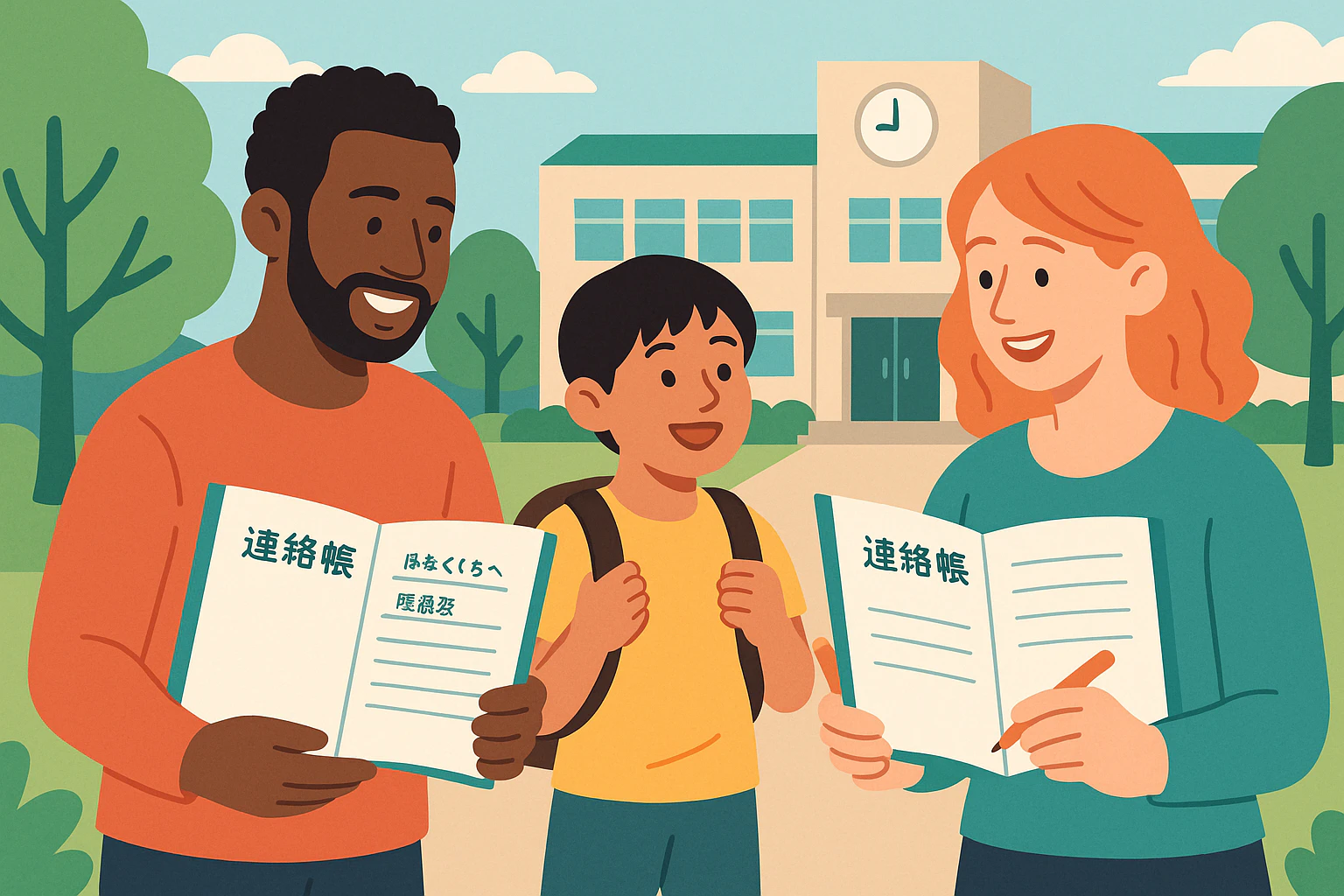
What this is: The renrakucho (連絡帳) is a communication notebook that travels between your child's school and home every day. The teacher writes in it. You write back. Everything is in Japanese.
What you need: Copy-paste Japanese templates for absences, late arrivals, early pickup, and health notes. Plus how to read teacher entries you can't understand.
Bottom line: You don't need perfect Japanese. You need the right phrases for the 5 situations that come up over and over.
Information current as of March 2026 based on guidance from renrakucho.net, Nishi-Tokyo City's foreign parent guidebook, and interviews with parents using the system in Tokyo, Osaka, and Gunma.
The renrakucho is probably the most stressful daily task for foreign parents in Japanese schools. Not because it's complicated — but because it's every single day, it's handwritten, and you need to respond in Japanese to a teacher you want to make a good impression on.
This guide gives you ready-to-use Japanese templates for the most common situations, plus practical tips for reading the teacher's notes when you can't understand the handwriting.
How the renrakucho works
The renrakucho is a small notebook (usually B5 size) that your child carries in their randoseru every day. The basic flow:
- Morning: You write any messages for the teacher (health updates, schedule changes, absence notices)
- At school: The teacher reads your message, writes a response or daily notes about your child
- After school: Your child brings it home. You read the teacher's notes.
- Repeat.
Some schools are moving to app-based communication (Tetoru, Classi) for absence notifications and urgent messages. But many schools still use the physical renrakucho for daily notes, homework records, and individual communication. Even at app-enabled schools, the renrakucho often coexists with the app.
Templates: what to write (copy and use)
Below are ready-to-use Japanese phrases for the most common situations. Write them in the renrakucho exactly as shown. Teachers are accustomed to non-native handwriting — legibility matters more than calligraphy.
1. Absence due to illness
いつもお世話になっております。
○○は発熱(体調不良)のため、本日お休みさせていただきます。
よろしくお願いいたします。
Translation: Thank you for always taking care of [child's name]. [Child's name] has a fever (is not feeling well) and will be absent today. Thank you for your understanding.
Variations:
- Stomach ache: 腹痛(ふくつう)のため
- Cold: 風邪(かぜ)のため
- Vomiting: 嘔吐(おうと)のため
- Headache: 頭痛(ずつう)のため
2. Late arrival (hospital, appointment)
いつもお世話になっております。
○○は病院受診のため、本日△時頃に登校します。
よろしくお願いいたします。
Translation: [Child's name] will arrive at school around [time] due to a hospital visit.
3. Early pickup
いつもお世話になっております。
○○は本日△時に早退させていただきたく存じます。
迎えに参ります。よろしくお願いいたします。
Translation: I would like [child's name] to leave early at [time] today. I will come to pick them up.
4. Health note (after illness)
いつもお世話になっております。
○○は回復しましたので、本日より登校いたします。
まだ少し咳が残っておりますので、体育は見学させていただけると助かります。
よろしくお願いいたします。
Translation: [Child's name] has recovered and will attend school from today. They still have a slight cough, so it would be helpful if they could observe PE class instead of participating.
5. Acknowledgment (when teacher writes something)
ご連絡ありがとうございます。確認いたしました。
Translation: Thank you for the message. Confirmed.
6. Request for information
いつもお世話になっております。
○○について教えていただけますでしょうか。
(遠足の持ち物 / 宿題の内容 / 来週の予定)
よろしくお願いいたします。
Translation: Could you please tell me about [topic]? (field trip items / homework details / next week's schedule)
7. Apology for forgetting something
いつもお世話になっております。
昨日○○(体操服 / 提出物 / 給食袋)を忘れてしまい申し訳ございません。
本日持たせましたのでご確認ください。
よろしくお願いいたします。
Translation: I apologize that [child's name] forgot their [gym clothes / submission / lunch bag] yesterday. I've sent it with them today — please confirm.
How to read the teacher's entries
Teachers write by hand, often quickly. If you can't read the handwriting:
- Google Lens (camera translation): Open Google Lens → point at the text → select "Translate." Works surprisingly well even on handwriting.
- Google Translate handwriting input: Open Google Translate (Japanese → English) → tap the handwriting icon → redraw the characters you see. Useful for individual kanji you can't identify.
- Take a photo and ask: Photograph the page, send it to a Japanese-speaking friend or a LO-PAL helper, and ask "What does this say?"
Common teacher phrases you'll see repeatedly
| Japanese | Reading | Meaning |
|---|---|---|
| がんばっていました | ganbatte imashita | [Your child] was working hard |
| 元気に過ごしていました | genki ni sugoshite imashita | [Your child] had a good/energetic day |
| お友達と仲良く遊んでいました | otomodachi to nakayoku asonde imashita | [Your child] played well with friends |
| 少し疲れているようでした | sukoshi tsukarete iru you deshita | [Your child] seemed a bit tired |
| 明日持ってきてください | ashita motte kite kudasai | Please bring [item] tomorrow |
| お大事にしてください | odaiji ni shite kudasai | Please take care (get well soon) |
| ご確認ください | go-kakunin kudasai | Please confirm/check |
| 保護者の方の署名をお願いします | hogosha no kata no shomei o onegai shimasu | Please have a parent/guardian sign |
Digital renrakucho: when apps replace (or supplement) the notebook
Schools across Japan are increasingly using apps for functions the renrakucho used to handle:
- Absence notifications: Many schools now accept absence reports via Tetoru or Classi Home instead of requiring you to write in the renrakucho or call the school
- Schedule announcements: Event dates and schedule changes come via app push notification
- Fee collection: Tetoru's fee collection feature (added April 2025) lets schools collect payments through the app
But the physical renrakucho often continues alongside the app for:
- Individual teacher-parent communication about your specific child
- Homework recording (children write assignments in it)
- Daily health checks (temperature, symptoms)
For app-specific setup and translation tips: Japan School Apps for Parents →
Practical tips from foreign parents
- Write simply. Short, polite sentences are better than complex grammar with mistakes. Teachers appreciate clarity over formality.
- Use the opening/closing. Always start with 「いつもお世話になっております」and end with 「よろしくお願いいたします」. These bookend phrases cover 90% of social expectations.
- Don't worry about kanji. Writing in hiragana is completely fine. Teachers read hiragana faster than poorly written kanji.
- Keep a cheat sheet. Print the templates from this article and tape them inside the renrakucho cover. Having the phrases in front of you saves time every morning.
- When in doubt, keep it short. 「確認しました。ありがとうございます。」(Confirmed. Thank you.) is a perfectly acceptable response to almost anything.
- For urgent matters, call. If your child will be absent and you find out the morning of, call the school directly rather than writing in the renrakucho (your child won't be there to deliver it). The school number is on handouts or the school website.
Related Articles
- Japan Public School Guide for Foreign Parents
- Japan School Apps for Parents: Tetoru & Classi
- How to Enroll Your Child in Public School
Need More Help? Ask on LO-PAL
Can't read what the teacher wrote? Need someone to translate a week's worth of renrakucho entries? Or help you draft a message about a sensitive topic (bullying, special needs, schedule conflict)? LO-PAL connects you with a local helper who can translate, draft messages, or even call the school on your behalf.
Written by

Founder, LO-PAL
Former Medical Coordinator for Foreign Patients (Ministry of Health programme) and legal affairs professional. Built LO-PAL from firsthand experience navigating life abroad.
Written with partial AI assistance
Read full bio →