Kobe for Foreign Families 2026: A City That Supports Your Kids
Kobe hosts 64,134 foreign residents (Jan 2026). A family guide to wards, rent, daycare, schools, child medical support, and spouse/PR visas.
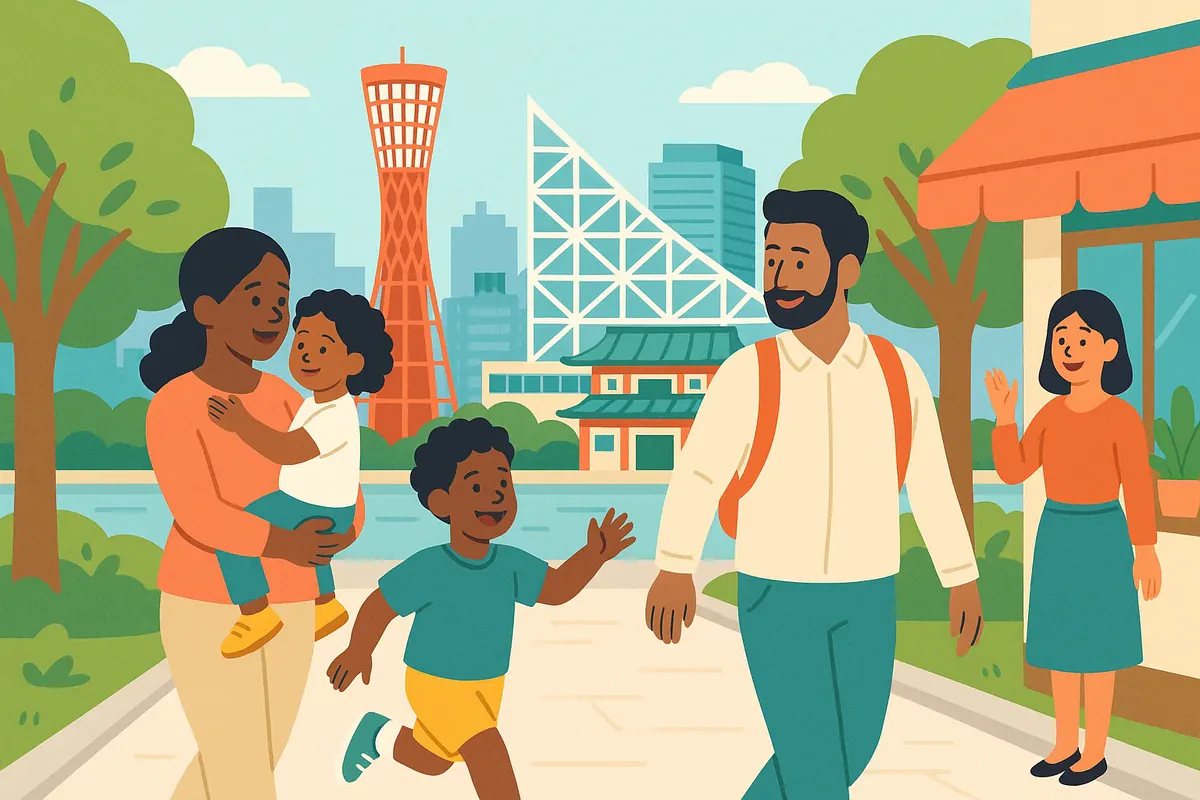
Moving to Kobe with your family is a very different experience from arriving alone. Once you have children, the questions stack up fast: which ward to live in, whether the local daycare will take a child who does not yet speak Japanese, how much a doctor's visit costs, and whether your spouse's visa is secure. Kobe is one of the better places in Japan to work through all of this, because it did not discover foreign residents recently. It has been raising foreign families for generations.
The prefecture, Hyogo, is the seventh-largest in Japan by foreign population (out of a national total of 4,125,395 as of 31 December 2025), and Kobe City itself is home to 64,134 foreign residents (resident register, 1 January 2026) — about 4.3% of its 1,496,041 people. This guide is written for parents. It covers the communities you will meet, where families actually live and what rent costs, daycare and school, having a baby, health insurance, and the spouse and permanent-residence visas that keep the whole family here. It is the family-focused companion to our broader guide on living in Hyogo as a foreigner; if you are still comparing regions, start with our best prefectures for foreigners ranking.
2026 quick takeaway: Kobe subsidises children's medical care from birth through the end of high school, with no household income limit, so every family qualifies (Kobe City, updated 1 July 2026) — children aged 0–2 pay nothing at the doctor, and children from age 3 pay at most ¥400 per clinic per day, capped at twice a month. It is one of the strongest family benefits in Kansai. Because every municipality sets its own rules and revises them, always confirm the current terms for your ward.
Kobe's settled foreign communities: Nagata, Nankinmachi, and Korean roots
What sets Kobe apart for families is depth. The largest foreign nationalities across Hyogo are Korean (34,477), Vietnamese (31,788), and Chinese (24,081), followed by Nepali, Filipino, and Indonesian communities (as of 31 December 2024) — a mix built over more than a century, not a recent wave. For a newcomer parent, that means the schools, welfare offices, and civic groups here have decades of practice serving foreign families.
Nagata Ward and the Vietnamese community. Nagata is home to 8,889 foreign residents, about 9.5% of the ward (1 January 2026), and its Vietnamese population of 1,834 traces back to Japan's acceptance of Indochinese refugees. The government agreed to permanent settlement of Vietnamese refugees by cabinet decision in 1978 and opened the Himeji Resettlement Promotion Center in December 1979 (the centre closed in March 1996), and many families settled around Nagata's small chemical-shoe and leather workshops. Today that history shows up as established Vietnamese groceries, temples, and neighbours who have already navigated Japanese schools and city hall in your shoes.
Nankinmachi and the Chinese community. In central Chuo Ward, Chinese residents are the largest single nationality at 6,257. Chuo is home to Nankinmachi, one of Japan's three great Chinatowns alongside Yokohama and Nagasaki, which grew after the opening of Kobe's port in 1868. For families it is a practical resource as much as a tourist strip: Chinese groceries, nearby bilingual clinics, and weekend food.
The Korean oldcomer community. Hyogo's Korean population is the prefecture's largest, and a large share are Special Permanent Residents (32,443 in Hyogo, the single largest residence status as of 31 December 2024) — families who have been here three or four generations. In Nagata, Koreans are the largest foreign nationality in the ward (3,345). This long-settled community is a big reason the city's family services are as mature as they are.
Where foreign families live in Kobe: wards and rent
Kobe stretches along the coast between the mountains and the sea, and its nine wards vary a lot in price and character. The table below compares family-sized units using SUUMO's advertised averages (updated 10 July 2026). SUUMO groups floor plans, so the "2LDK" column blends 2LDK, 3K, and 3DK listings — treat these as guide prices, not exact figures.
| Area | Family 2LDK–3DK | Larger 3LDK–4K+ |
|---|---|---|
| Chuo (central) | ¥115,000 | ¥162,000 |
| Higashinada (east) | ¥98,000 | ¥120,000 |
| Hyogo Ward | ¥90,000 | ¥100,000 |
| Nagata | ¥80,000 | ¥82,000 |
| Suma (west, coastal) | ¥71,000 | ¥80,000 |
| Akashi (next city west) | ¥68,000 | ¥80,000 |
| Himeji | ¥62,000 | ¥70,000 |
Chuo Ward is the international heart of the city — Sannomiya station, the historic Kitano foreign-residence district, and Nankinmachi — and it has the highest foreign share of any ward at 10.9% (1 January 2026). It is also the priciest: a family 2LDK averages around ¥115,000 (SUUMO, 10 July 2026). Great for access and atmosphere, hard on a single income.
Higashinada and Nada, the eastern wards, are the classic family choice: quieter residential streets, a strong school reputation, and an easy commute to Osaka. Nada — home to Kobe University — has a foreign share of about 4.0%. Nagata and Suma, to the west, are where your money goes furthest: Nagata's family units sit near ¥80,000, well below central Kobe, and it has the deepest multilingual support network in the city (more below). If you need space at a lower rent, look here, or step just outside the city to Akashi and Himeji, where family units fall to roughly ¥62,000–¥68,000.
Rent tables only tell you so much. Before you commit to a ward or sign a lease, it helps to hear what daily life is actually like from someone already raising children there — on LO-PAL, you can ask a local Kobe resident your specific question.
Daycare and schools for foreign children
Daycare (hoikuen). Licensed daycare places in Japan are allocated by the city on a needs-based points system, and you apply through your ward office — in Kobe, the child-welfare section of each ward's health and welfare department. Kobe publishes a multilingual "Guide to Using Childcare Facilities" and a "point-and-communicate sheet" that lets non-Japanese-speaking parents and daycare staff understand each other, both provided by Kobe City. Availability varies by ward and by year, so apply early. Our guide to daycare for foreign parents explains the points system and application timing in detail.
Public school. Foreign children are welcome in Japanese public elementary and junior high schools, and Kobe has built real infrastructure for them. Its Kobe Children's Japanese Support Center dispatches native-language supporters and Japanese-language instructors to schools, offers online tuition, and assesses each child's Japanese on transfer to build a study plan. That is far more than many cities offer. For the enrolment process, costs, and what to expect on day one, see our guide to public school for foreign parents.
Having a baby in Kobe: costs, allowances, and child medical support
If you are expecting, most of the system runs through your health insurance and your ward office. National health insurance covers a lump-sum childbirth benefit and the routine costs around delivery; our guide to having a baby in Japan as a foreigner walks through the paperwork step by step.
Once the child arrives, two things shape the family budget. First, Japan pays a monthly child allowance (jido teate) to families raising children; see our child allowance guide for current amounts and how to claim it at your ward office. Second — and this is where Kobe stands out — is the child medical subsidy. As noted above, Kobe covers care from birth through high school with no income limit: free for ages 0–2, then capped at ¥400 per clinic per day, twice a month, with further visits that month free. For a family with young children who catch every cold going around daycare, that removes a real and recurring worry. Because these subsidies are set by each municipality and revised periodically, confirm your ward's current terms when you register.
Health insurance for your family
Everyone living in Japan must be enrolled in public health insurance, which pays 70% of most medical costs. If you work for a company you are usually on employees' insurance (shakai hoken); if you are self-employed, a student, or otherwise not covered through work, you enrol in National Health Insurance (kokumin kenko hoken) at the ward office. How this works for foreign residents is covered in our health insurance guide.
For families, the key point is dependents. On employees' insurance, a non-working spouse and your children are generally added as dependents at no extra premium — a major saving over enrolling each person separately. Combined with Kobe's child medical subsidy, a typical visit to a paediatric clinic ends up costing very little. If a language barrier makes a hospital visit daunting, Hyogo runs a dedicated medical-interpreting service: the non-profit Multilingual Center FACIL provides trained medical interpreters — ¥1,650 for remote interpreting or ¥2,750 to accompany you (per patient, per day) — with partner hospitals including Kobe City Medical Center General Hospital, Hyogo Prefectural Kobe Children's Hospital, and Kobe University Hospital.
Spouse visas and permanent residence for the whole family
For many families, visa stability is the quiet worry underneath everything else. Hyogo already hosts a large settled family population: as of 30 June 2025 the prefecture was home to 29,367 Permanent Residents, 10,604 people on Dependent (family-stay) visas, and 4,415 spouses of Japanese nationals. You are far from alone.
Which visa your family holds shapes daily life. A working parent on a status such as Engineer/Specialist in Humanities can bring a spouse and children on Dependent visas; the spouse of a Japanese or permanent-resident partner holds a Spouse visa. Our guides to the spouse visa and the route from a spouse visa to permanent residence explain the requirements and timelines. Permanent residence removes visa-renewal stress entirely and gives the whole family more security, though it carries income and residence-length conditions. Immigration rules change, so verify current requirements with the authorities before you file. Kobe's cases are handled by the Kobe Branch of the Osaka Regional Immigration Bureau, at Kaigan-dori 29 in Chuo Ward (about 10 minutes' walk from JR Sannomiya), which covers all of Hyogo.
Muslim and faith-based families in Kobe
Kobe's port history has made it one of Japan's more religiously diverse cities, and its foreign community includes families from Muslim-majority countries — Hyogo is home to 5,440 Indonesian residents (as of 31 December 2024), alongside Bangladeshi and other communities concentrated in Chuo and Hyogo wards. For a Muslim family, the practical questions are halal food, prayer space, and school lunches. Central Kobe has long-established halal grocers and restaurants, and the multilingual desks below can help you find them and arrange school meals — Japanese public schools can often accommodate dietary needs if you speak with the school early. For a broader view of which neighbourhoods and cities are easiest for Muslim families, see our guide to Muslim-friendly areas to live in Japan.
Where to get help: multilingual desks in Kobe
You do not have to work any of this out in Japanese alone. Kobe and Hyogo run two layers of free multilingual support for foreign residents:
- Kobe International Community Center (KICC) — the city's one-stop desk, with consultations in 11 languages (English, Chinese, Vietnamese, Korean, Spanish, Portuguese, Filipino, Indonesian, Nepali, and Thai, plus tablet interpreting). It sits in Nagata (tel 078-742-8705), in the heart of the community, and is a natural first stop for family questions.
- Hyogo Multicultural Information Center — the prefecture-level desk run by the Hyogo International Association, reachable at 078-382-2052 for living, legal, and immigration-procedure advice in a dozen-plus languages via phone interpreting, with a separate weekend NGO desk (神戸外国人救援ネット, tel 078-232-1290).
Between these desks, the Children's Japanese Support Center for schools, and FACIL for hospitals, Kobe gives a foreign family more places to turn than most Japanese cities. Settling in still takes time, but you are joining a city that has been doing this for generations. Whatever your situation — choosing a ward, applying for daycare, or planning for permanent residence — you can ask a local Japanese resident your exact question on LO-PAL before you make a big decision.
Written by

Founder, LO-PAL
Former Medical Coordinator for Foreign Patients (Ministry of Health programme) and legal affairs professional. Built LO-PAL from firsthand experience navigating life abroad.
Written with partial AI assistance
Read full bio →