How to Get Your Newborn’s Japan Visa Within 30 Days
Fast, panic-proof newborn paperwork in Japan: city hall within 14 days, immigration by day 30, and passport-delay fixes.
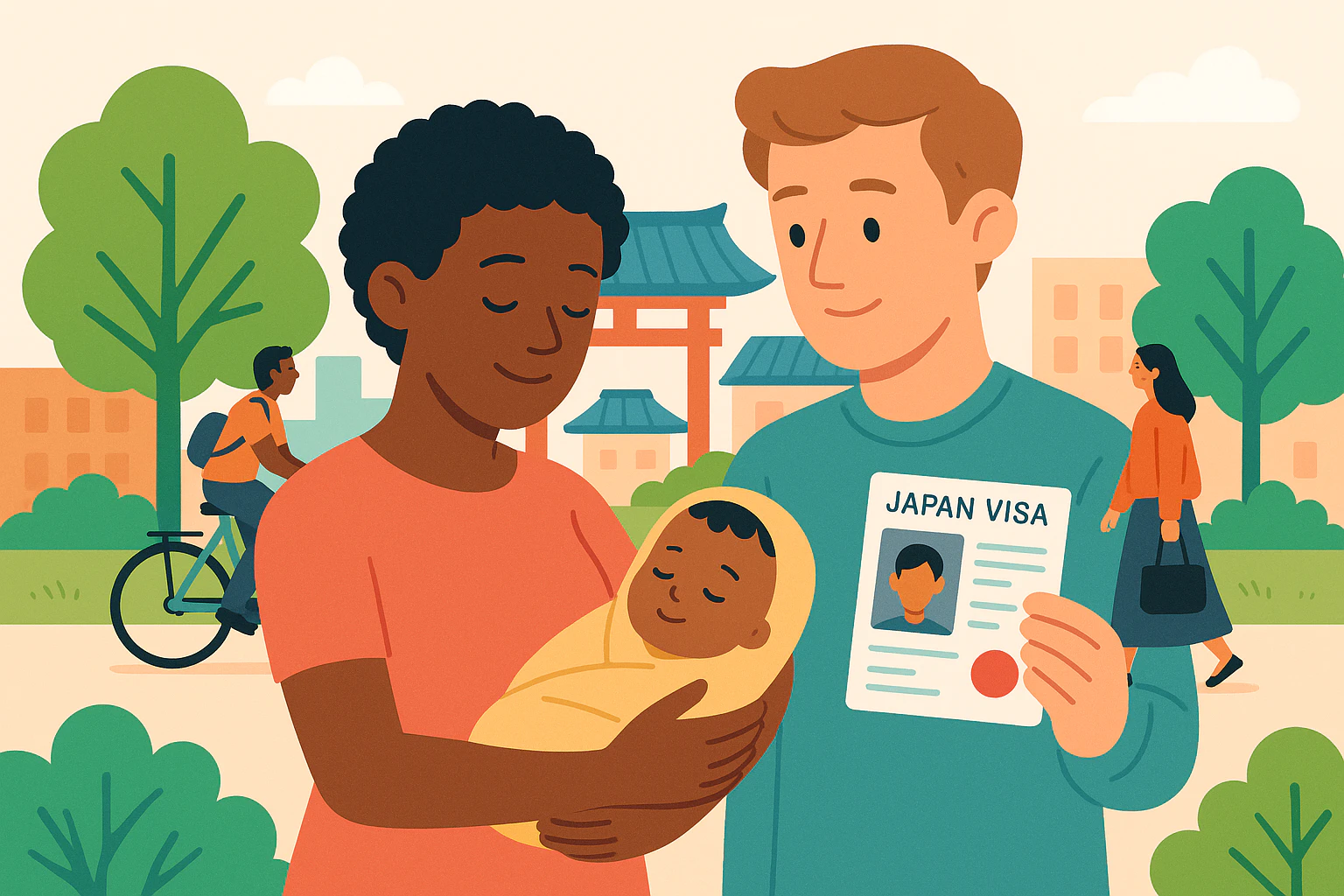
Deadlines: The Immigration Services Agency’s English guidebook says a child born in Japan without Japanese nationality may stay for up to 60 days after birth, but if the child will stay longer, the parent must apply for permission to acquire status of residence within 30 days. City guidance says the birth notification itself must be filed within 14 days.
Sequence: Do city hall first, then start the embassy or consulate passport process, then file at immigration before day 30 if your baby will remain in Japan.
Main counters: Ward or city hall handles the birth notification and proof-of-birth certificates. The regional immigration office handles the Application for Permission to Acquire Status of Residence.
Bottom line: Do not wait for the passport if day 30 is approaching. The Immigration Services Agency’s document list says the passport is needed if one has already been issued.
Information current as of March 2026 based on the Immigration Services Agency, Ministry of Justice, and city-government guidance from Tokyo, Osaka, and Nagoya.
If you searched for baby born in Japan visa, the panic usually starts after the birth, not before it. Parents know there is a 30-day immigration deadline, but the real problem is the order: city hall first, embassy next, immigration after that, and somehow all of it has to happen while you are exhausted and sleep-deprived.
I also work as a legal affairs professional in Japan, so I see the same pattern again and again. The issue is rarely the law itself. It is access to the right counter, in the right order, with the right document on the right day.
Does your baby need a Japan visa or not?
Start by separating nationality from immigration status. In Japan, being born here does not automatically make a child Japanese. Under the Nationality Law, a child is Japanese at birth if, for example, either parent is Japanese at the time of birth.
If both parents are foreign nationals, your baby usually needs a Japanese residence status only if the baby will remain in Japan beyond 60 days. The Immigration Services Agency guidebook and the official procedure page both say you must apply within 30 days from birth if the child will stay more than 60 days.
Also, what most parents call a “visa” here is usually not a new visa sticker from a Japanese embassy abroad. Inside Japan, the procedure is normally Permission to Acquire Status of Residence. That distinction matters, because it tells you which office you actually need: immigration in Japan, not a Japanese embassy overseas.
| Item | Amount/Count | Source / as-of date |
|---|---|---|
| Birth notification at ward/city office | Within 14 days of birth | Shinjuku City, Osaka City, City of Nagoya / March 2026 |
| Application to acquire status of residence if baby will stay in Japan | Within 30 days of birth | Immigration Services Agency guidebook / March 2026 |
| Stay allowed without that application | Up to 60 days after birth | Immigration Services Agency guidebook, Nagoya University / March 2026 |
| Special permanent resident route for newborns | Within 60 days of birth | Shinjuku City, Osaka City / March 2026 |
So the short answer is this:
- If either parent is Japanese, this is usually not the newborn status-of-residence route. You still file the birth notification, but you are dealing with nationality and family-register procedures instead of this immigration application.
- If both parents are foreign nationals and the baby will live in Japan, file the birth notification first and then the immigration application within 30 days under the status-of-residence acquisition procedure.
- If the baby will leave Japan within 60 days, the Nagoya University guidance says the status application is not necessary.
- If a parent is a special permanent resident, follow the special permanent resident newborn route at the ward or city office within 60 days, as shown by Shinjuku City and Osaka City.
Step 1: File the birth notification at city hall within 14 days
This is the step that unlocks everything else. The Shinjuku City foreign residents page, Osaka City’s guide, and the City of Nagoya page all repeat the same basic rule: file the birth notification within 14 days.
You can usually file it at the municipality of the birth place or the parent’s address. Shinjuku City’s detailed page notes that filing outside your home municipality can delay resident-record creation and related child benefits, so if possible, use the office tied to your actual address.
The documents listed on official city pages commonly include the birth notification form with the doctor or midwife’s birth certificate section completed, the Maternal and Child Health Handbook, and if applicable your National Health Insurance card. See the checklists on Osaka City and Nagoya City.
The most important practical move at city hall is to ask for proof you can take to immigration and your embassy. The Nagoya International Center recommends getting either a Certificate of Acceptance of Birth Registration or a Certificate of Birth Notification Details. The Immigration Services Agency guidebook also points parents to a birth-related municipal certificate before the immigration filing.
Useful phrases at the counter:
- 出生届を出したいです (Shussho todoke o dashitai desu) — I would like to file the birth notification.
- 出生届受理証明書をください (Shussho todoke juri shomeisho o kudasai) — Please give me the certificate of acceptance of the birth notification.
- 住民票をください (Juminhyo o kudasai) — Please give me a copy of the resident record.
Step 2: Apply at immigration before day 30
Once the birth notification is filed, move to immigration fast. The Immigration Services Agency guidebook says the core documents are the application form, proof of birth, documentation showing the child’s planned activity in Japan, and a copy of the parents’ resident record. The official procedure page and the official application form are the pages to bookmark.
This is also where parents panic about the passport. Here is the important part: the Immigration Services Agency guidebook lists the passport as required “if one has already been issued”. In other words, the official checklist itself assumes there are cases where the baby does not yet have a passport.
That means your sequence should usually be: file at city hall, start the passport process with your embassy or consulate, and do not wait for passport issuance if waiting could push you past day 30. The Nagoya International Center says parents may need to apply for status of residence before the child’s passport has been issued.
In practice, parents often bring extra evidence that the passport process has started, such as an embassy appointment email, a receipt, or a short explanation letter. That add-on is not the core official rule, but it is a smart way to show the case is moving. Not sure about your case? Ask on LO-PAL.
The status category itself usually follows the parent’s situation in Japan. The Nagoya International Center notes that categories such as Dependent, Spouse or Child of Permanent Resident, Long-Term Resident, or Permanent Resident may apply depending on the parents’ status. If one parent is a permanent resident, confirm the correct newborn route with your regional office before filing.
Useful immigration phrases:
- 子どもの在留資格取得許可申請をしたいです (Kodomo no zairyu shikaku shutoku kyoka shinsei o shitai desu) — I would like to apply for permission to acquire status of residence for my child.
- 旅券はまだ申請中です (Ryoken wa mada shinseichu desu) — The passport is still under application.
- 必要書類を確認したいです (Hitsuyo shorui o kakunin shitai desu) — I would like to confirm the required documents.
What other parents report when the passport is delayed
Experience note: Individual experiences vary by office and nationality. Use the examples below as practical context, not as the official rule.
One foreign resident shared on Reddit:
“City hall needs to be first since you need to register your child first.”Another parent in the same discussion wrote:
“We submit a simple letter explaining the baby passport is under application.”Tokyo, Osaka, and Nagoya tips that prevent a wasted trip
The biggest city-specific mistake is mixing up your ward office with your immigration office. Your local ward or city office handles the birth notification, but immigration must be filed at the regional office that has jurisdiction over where you live, as city guides such as Shinjuku’s explain.
| Item | Amount/Count | Source / as-of date |
|---|---|---|
| Tokyo Regional Immigration Services Bureau (Shinagawa) | Weekdays 9:00-16:00; about 13 minutes by bus from JR Shinagawa Station; phone 0570-034259 | Tokyo Regional Immigration / March 2026 |
| Osaka Regional Immigration Services Bureau | Weekdays 9:00-16:00; about 3 minutes on foot from Cosmo Square Station Exit 3; phone 0570-064259 | Osaka Regional Immigration / March 2026 |
| Nagoya Regional Immigration Services Bureau | Weekdays 9:00-16:00; about 1 minute on foot from Koko Station; phone 0570-052259 | Nagoya Regional Immigration / March 2026 |
- Tokyo: Check jurisdiction before assuming Shinagawa. The Tokyo bureau page covers the main office and branches. Tokyo also has a public application reservation system, but its published terms are technical enough that newborn cases should be checked carefully before you rely on it. If you need pre-visit clarification, the FRESC consultation service in Yotsuya is useful.
- Osaka: The Osaka City guide is clear on the order: ward office first, then Osaka immigration within 30 days if the baby will remain in Japan. The Osaka immigration page warns that parking is limited, so use public transport.
- Nagoya: The City of Nagoya requires the birth report within 14 days, and the Nagoya University guide adds one very practical reminder: if the baby will leave Japan within 60 days, the status application is not necessary. If you want an English-language advisory source, the Nagoya International Center is one of the clearest explanations online.
For document questions before you go, the official Foreign Residents Information Center is the safest first call. It publishes the nationwide consultation number as 0570-013904, with 03-5796-7112 for IP phones or calls from overseas.
As for waits, do not build your deadline plan around somebody else’s lucky same-day result. Some parents on Reddit reported very fast processing at lighter offices or on lighter days, but busier counters in major cities can be very different. The safe play is simple: go early, go on the correct day, and go with a complete file.
Related Articles
- Having a Baby in Osaka City as a Foreigner (2026 Checklist)
- Join Family Health Insurance Fast in Japan
- How to Enroll Your Child in Public School in Japan Fast
Need More Help? Ask on LO-PAL
Don’t risk taking time off work only to be sent home because of a missing document or a language barrier. On LO-PAL, you can ask a question or book a local Japanese helper to accompany you to city hall or immigration, translate at the counter, and help you get the process done on the first trip.
Written by

Founder, LO-PAL
Former Medical Coordinator for Foreign Patients (Ministry of Health programme) and legal affairs professional. Built LO-PAL from firsthand experience navigating life abroad.
Written with partial AI assistance
Read full bio →