Rental Car Accident in Okinawa? What to Do (Police & Insurance Steps for 2026)
A calm checklist for tourists: 110/119 calls, police paperwork (jiko shomeisho), rental insurance/NOC, and hospital steps in Okinawa.
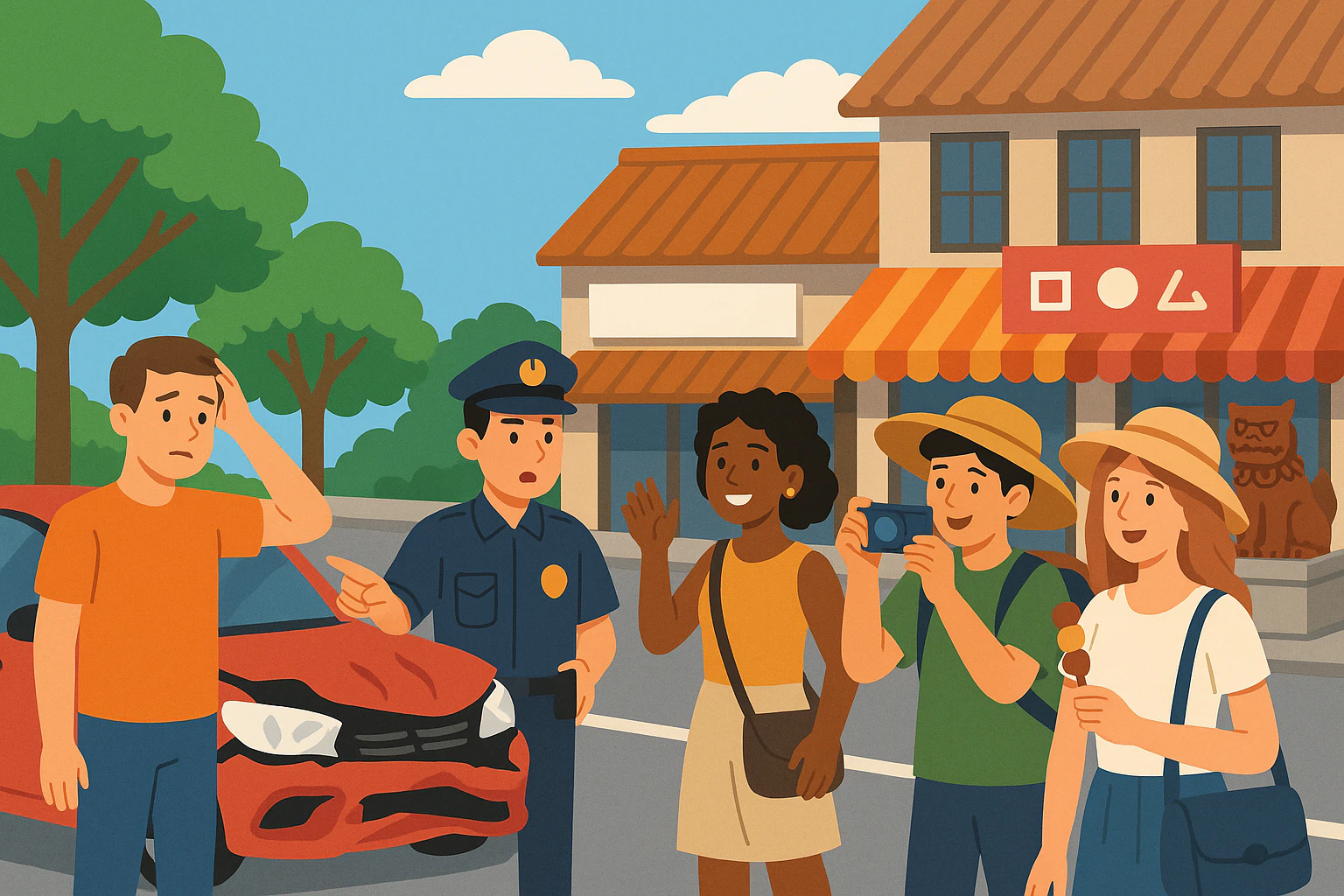
Do this first: Stop safely, check injuries, and don’t leave the scene. If anyone is hurt, call 119 (ambulance). Otherwise call 110 (police) and then your rental company.
Bottom line: In Japan, a police report is normally required for insurance—many rental plans won’t apply without it.
Paperwork tip: The Traffic Accident Certificate (交通事故証明書 / Jiko Shomeisho) is issued later by the Japan Safe Driving Center, and mail delivery often takes around 10 days.
Okinawa counter: Japan Safe Driving Center (Okinawa office) is inside the Okinawa Prefectural Police Driver’s License Center in Toyosaki, Tomigusuku City.
Information current as of March 2026, based on the Road Traffic Act (Article 72), the Ministry of Land, Infrastructure, Transport and Tourism (MLIT) guidance on accident certificates, the Japan Safe Driving Center (JSDC) application rules/fees, and major rental company procedures such as Nippon Rent-A-Car and TOYOTA Rent a Car.
If you’re googling “Okinawa rental car accident what to do”, you’re not alone. Tourists panic here even after a tiny scratch, because Japan’s insurance process is paperwork-driven—and if you skip the police step, you can end up paying out of pocket.
I built LO-PAL because I’ve lived the “systems exist, but access is the problem” reality. After returning to Japan, I worked as a Medical Coordinator for Foreign Patients at a hospital in Osaka, and I saw how quickly stress spikes when someone can’t explain what happened in Japanese—especially in urgent situations.
What to do in the first 10 minutes (safety, 119/110, don’t leave)
The first 10 minutes are about safety, legality, and protecting your insurance coverage. Even if the damage looks small, treat it as “do-the-procedure-now,” not “deal with it later.”
1) Stop, secure the scene, and prevent a second accident
- Turn on hazard lights and stop in the safest place you can.
- If it’s safe, move the car out of traffic to avoid blocking the road (Japan expects you to prevent road hazards after an accident).
- Set out a warning triangle if your rental has one.
2) Check for injuries (including passengers and the other party)
Adrenaline masks pain. Ask everyone directly: headache, neck pain, dizziness, numbness. If you suspect any injury, treat it as an injury case and call an ambulance.
3) Call the correct number: 119 (ambulance) and/or 110 (police)
Ambulance/Fire: 119. Police: 110. Japan’s national tourist support hotline can also help guide you: Japan Visitor Hotline (JNTO) is 24/7.
Many local government guides note that ambulance service is free of charge, although hospital treatment is not. For example, Ogaki City’s English guidebook states ambulance transport is free but hospital care is charged. (source)
Japanese phrases you can say on the phone (copy/paste friendly)
- 交通事故です (Koutsuu jiko desu) — There has been a traffic accident.
- 救急車をお願いします (Kyuu kyuu sha o onegai shimasu) — Please send an ambulance.
- けが人がいます (Kega nin ga imasu) — There is an injured person.
- 場所は__です (Basho wa __ desu) — The location is __.
- 英語をお願いします (Eigo o onegai shimasu) — English, please.
If you can’t explain your location, give a landmark (a convenience store name, a hotel name, a beach/parking lot name). If you have data, share your map pin with your rental company too.
4) Don’t leave—even for a “tiny scratch”
Under Japan’s Road Traffic Act (Article 72), drivers involved in a traffic accident must stop, take measures such as aiding injured persons and preventing hazards, and report key details to police. This is one reason rental companies in Japan repeatedly tell renters to report accidents to police from the scene.
If you hit a parked car and can’t find the owner, do not “wait until the rental return.” Call 110 and your rental company—otherwise it can look like a hit-and-run.
Police process in Okinawa: what they’ll ask + getting an accident certificate
In Okinawa, the police process is usually straightforward—but it’s stressful if you don’t know what the police will ask or what documents you actually receive.
What police typically ask at the scene
Expect questions like:
- Where and when did it happen?
- Is anyone injured?
- Which vehicles/people are involved?
- What was damaged (cars, guardrails, signs, property)?
- Your ID details (license/IDP, name, address in Japan if available, contact number).
Bring out what you have: passport, International Driving Permit (if you’re driving on an IDP), and your rental agreement. The faster you can show documents, the smoother this goes.
What you get that day (and what you don’t)
You may not receive a “certificate” on the spot. In Japan, the document that insurers often want later is the Traffic Accident Certificate (交通事故証明書). MLIT explains that you should report the accident to police because a certificate will not be issued for accidents that have not been reported. (MLIT guidance)
What’s most important at the scene is to record:
- The police station that handled it (name/location)
- Any reception/case number you are given
- The officer’s name (if possible)
How to get the “Japan accident certificate” (Jiko Shomeisho / 交通事故証明書)
The Traffic Accident Certificate is issued by the Japan Safe Driving Center (JSDC) based on police-held accident data. JSDC states that if the accident is not reported to police, the certificate cannot be issued. (JSDC application method)
In practice, tourists usually obtain it in one of these ways:
- Ask the rental company/insurer what they prefer (some companies retrieve paperwork directly for claims handling).
- Apply online via JSDC’s individual application site. (JSDC online application portal)
- Apply via post office using the JSDC transfer form (forms are available at police stations/koban and other places, per JSDC).
- Apply in person at a JSDC office (fastest if the police data has already reached JSDC).
Okinawa: where to apply in person
JSDC publishes an office list that includes the Okinawa office location and phone number:
- Japan Safe Driving Center, Okinawa Office — 〒901-0225 豊見城市字豊崎3-22 (inside Okinawa Prefectural Police Driver’s License Center), Tel: 098-840-2822. (JSDC office list PDF)
- Okinawa Prefectural Police Driver’s License Center address and contact details are on the official site. (Okinawa Prefectural Police)
If you are leaving Okinawa soon, tell your rental company immediately and ask how they want to handle the certificate and claim while you’re traveling.
| Item | Amount/Count | Source / as-of date |
|---|---|---|
| Traffic Accident Certificate (交通事故証明書) fee | ¥1,000 per copy | JSDC “Application method” page (as of March 2026): JSDC |
| Typical mail delivery time after applying | About 10 days | JSDC “Application method” page (as of March 2026): JSDC |
| Old vs new certificate fee change (context) | ¥800 → ¥1,000 (effective Oct 1, 2025) | Example prefectural police notice (published July 30, 2025): Miyazaki Prefectural Police |
Language reality check: calling 110 and explaining “a tiny scratch” is where many tourists freeze. If you can say “koutsuu jiko desu” and give a landmark, you’ve already done 80% of the job.
Not sure about your case? Ask on LO-PAL.
Rental company + insurance: why “no police report = no coverage” and NOC traps
This is the part that surprises most visitors: you can buy “full coverage,” but it still comes with conditions. In Japan, a very common condition is: report to police and report to the rental company from the scene.
Call your rental company from the accident site
Major rental companies explicitly instruct you to respond from the spot. For example, Nippon Rent-A-Car warns that insurance/indemnity and waivers may not apply without the required steps, including contacting police and contacting the company. (Nippon Rent-A-Car accident instructions)
Say this to the rental company:
- 事故を起こしました。今、__にいます (Jiko o okoshimashita. Ima, __ ni imasu) — I had an accident. I’m at __ now.
- 警察に連絡しました (Keisatsu ni renraku shimashita) — I contacted the police.
- けが人はいません/けが人がいます (Kega nin wa imasen / Kega nin ga imasu) — No one is injured / Someone is injured.
Why “no police report = no coverage” is so common
Rental company terms often say that if a police accident report/certificate is not issued, insurance may not cover the accident. TOYOTA Rent a Car’s English guide notes that insurance may not cover accidents for which an accident report has not been issued by a police officer. (TOYOTA Rent a Car important items)
So even if the other driver says, “It’s fine, let’s not call police,” you should still call. It’s not about being dramatic—it’s about preserving the option to claim properly.
The Okinawa rental car “NOC” trap (Non-Operation Charge)
NOC (Non-Operation Charge) is a business interruption charge: if the car needs repair/cleaning and can’t be rented out, the rental company may charge you a fixed amount. Importantly, NOC can apply even if you bought CDW, unless your plan specifically waives NOC.
TOYOTA Rent a Car explains NOC as compensation for business interruption and lists typical amounts depending on whether the car can be driven back. (TOYOTA Rent a Car)
| Item | Amount/Count | Source / as-of date |
|---|---|---|
| NOC (car is drivable, returned to shop) | ¥20,000 | TOYOTA Rent a Car guide (as of March 2026): TOYOTA Rent a Car |
| NOC (car is not drivable / not returned) | ¥50,000 | TOYOTA Rent a Car guide (as of March 2026): TOYOTA Rent a Car |
| Example CDW add-on cost (24 hours) | ¥1,100 (tax incl.) | TOYOTA Rent a Car guide (as of March 2026): TOYOTA Rent a Car |
| Example “full” package that covers NOC (24 hours) | ¥1,650 (tax incl.) | TOYOTA Rent a Car Double Protection Package (as of March 2026): TOYOTA Rent a Car |
Important: NOC rules and “full support” package names vary by company. Always check your specific rental contract.
What to collect from the other party (and what not to do)
- Take photos: wide shot, damage close-up, license plates, road signs, and the surrounding area.
- Exchange basics: name, phone, vehicle plate number, and (if possible) insurance company.
- Do not do a private cash settlement at the scene. It can complicate later insurance handling (and may violate rental contract terms).
Real foreigner voices (experience boxes)
These are individual experiences shared publicly online; your situation may differ.
One traveler wrote that their rental T&Cs said: “In the event you discover any new scratch/damage to the car, call the police and make a report immediately… Otherwise, CDW will not cover the damage.” (Reddit thread)
Another traveler, after a minor accident, worried because “a traffic accident certificate… can take up to 10 days” while they were leaving the region in two days. (Reddit thread)
If anyone feels pain later: hospital visit and changing the case to “injury accident”
Neck, back, and shoulder pain often appears later (especially after a low-speed impact). If there’s any chance of injury, handle it early—medically and procedurally.
Go to a hospital/clinic and explain it’s after a traffic accident
If you need an ambulance, call 119. If it’s not an emergency but you feel pain later, go to a clinic/hospital as soon as practical and tell them it’s related to a traffic accident.
- 交通事故のあと、痛みがあります (Koutsuu jiko no ato, itami ga arimasu) — I have pain after a traffic accident.
- 診断書をお願いします (Shindansho o onegai shimasu) — I need a medical certificate.
- 領収書をください (Ryoushuusho o kudasai) — Please give me a receipt.
If you have travel insurance, contact them early and ask what documents they want (some insurers require itemized receipts and doctor notes).
Changing the police classification from property damage to injury
Many accidents are initially handled as property-damage-only if no one reports injuries at the scene. If a doctor later confirms an injury, you may need to ask the police to treat it as an injury accident for appropriate handling.
A lawyer explanation on Asahi’s traffic accident site describes the general process as: go to the police station that has jurisdiction over the accident location and submit a medical certificate (診断書), stating you want to switch to an injury accident. It also notes there is no legal deadline, but earlier is generally better for credibility and documentation. (Asahi “Traffic Accident Compass” (lawyer article))
In practice, you should:
- Get examined and obtain a 診断書 (shindansho).
- Call or visit the police station that handled the accident and ask what they require.
- Inform your rental company and your insurer that an injury was confirmed.
Important: I’m not your lawyer, and procedures can vary by prefecture and by case. If you’re unsure, ask the police/rental company directly and follow their instructions.
FAQ
These are the questions tourists ask most often after an Okinawa rental car incident.
Do I really need to call police (110) for a small scratch?
In Japan, drivers have a legal duty to report traffic accidents to police, and rental/insurance terms commonly require a police report for coverage. When in doubt, call 110 and your rental company and follow instructions.
Will the police give me the accident certificate at the scene?
Usually no. The Traffic Accident Certificate (交通事故証明書) is issued later by JSDC based on police data. (MLIT)
How long does the Jiko Shomeisho take?
JSDC notes that after applying, it often takes around 10 days to reach you (especially by mail). (JSDC)
What is NOC in Okinawa rental cars?
NOC is a fixed non-operation charge for business interruption while the car is repaired/cleaned. Typical amounts are often around ¥20,000 (drivable) or ¥50,000 (not drivable), but confirm your rental contract.
Is an ambulance ride really free in Japan?
Many official/local guides state ambulance transport is free, while hospital care is charged. See Ogaki City’s English guidebook note on ambulance service being free of charge. (source)
Related Articles
- Emergency numbers in Japan (110, 119) and English hotlines
- Japan eSIM vs pocket Wi‑Fi (so you can actually call for help)
- Late-night Japan airport transfers and where to sleep (if your car is towed and plans collapse)
Need More Help? Ask on LO-PAL
If you’re stuck after an Okinawa rental car accident—especially with Japanese phone calls or paperwork—post a question or task on LO-PAL and get matched with a local Japanese helper who can support you (including on-the-spot help when available).
Written by

Founder, LO-PAL
Former Medical Coordinator for Foreign Patients (Ministry of Health programme) and legal affairs professional. Built LO-PAL from firsthand experience navigating life abroad.
Written with partial AI assistance
Read full bio →