
Japan Money & Tax Guide for Foreigners (2026): The System Nobody Explains
The complete financial map for foreign residents in Japan: banking, payslip decoding, year-end adjustment vs tax return, 2026 tax changes, furusato nozei, international remittance, and the pension/tax steps when leaving Japan.
Who this is for: Foreign residents in Japan who earn income, pay taxes, and need to manage money across borders. Whether you just arrived or you're planning to leave, this is the map nobody gave you.
What this covers: Banking, payslip decoding, year-end adjustment vs tax return, 2026 tax changes, tax-saving strategies, international remittance, and the pension/tax steps when leaving Japan.
Bottom line: Japan's financial system for foreigners is not one problem — it's a sequence. Each step has its own deadline, its own counter, and its own paperwork. Miss one, and the next one gets harder. This guide puts them in order.
Information current as of March 2026 based on the National Tax Agency, the Ministry of Finance FY2025 tax reform outline, and official municipal tax guidance. This is practical guidance, not individualized tax or legal advice.
If you searched for how money and taxes work in Japan as a foreigner, you've probably already hit the same wall: dozens of articles on individual topics, but no single guide that shows you the order things happen in. That's the real problem. It's not that any one step is impossible — it's that nobody tells you Step 3 depends on Step 1, and you only find out when Step 3 fails.
I work in legal affairs in Japan, and I've watched this pattern repeat with every new foreign resident I've helped: the bank says come back in six months, the tax office sends a notice you can't read, the pension refund deadline passes because nobody mentioned it before your flight. This guide is the sequence I wish someone had handed me on arrival.
Your financial timeline in Japan: what happens when
Think of your financial life in Japan as a timeline with hard deadlines. Here's what happens, roughly in order, from the day you land to the day you leave:
| When | What happens | Your action |
|---|---|---|
| Week 1–2 | Register address at city hall, get residence card updated | Get juminhyo (住民票) immediately — banks need it |
| Week 2–4 | Open a bank account (or try to) | Japan Post Bank is the most newcomer-friendly. Full bank account checklist → |
| Month 1–6 | 6-month rule limits some banking features | No international transfers until ~6 months of residence. If you don't have a phone number yet → |
| Monthly | Salary arrives. Deductions taken automatically. | Learn to read your payslip (see below) |
| November | Employer distributes year-end adjustment forms | Fill them out — this is how most employees settle their tax (see below) |
| December 31 | Furusato nozei donation deadline | Furusato nozei guide (avoid 3 costly mistakes) → |
| January 31 | Employer issues gensen choshuhyo (源泉徴収票) | Keep it. You need it for tax returns and job changes. If it's missing → |
| Feb 16 – Mar 16 | Kakutei shinkoku (確定申告) filing window | Full tax return guide + e-Tax walkthrough → |
| June | Resident tax notice arrives (住民税決定通知書) | Check your furusato nozei deduction. Check your total tax amount. |
| Before departure | Appoint a tax agent (納税管理人) if leaving before June | Shinjuku tax agent guide → |
| After departure | Claim pension refund within 2 years | Pension refund guide (don't lose 20.42%) → |
The rest of this article expands on each stage. If you already know which step you're stuck on, jump to that section.
Banking: opening your first account (and keeping it open)
Your bank account is the foundation. Without it, you can't receive salary, pay rent via transfer, or use most financial services. But the process has friction points that surprise almost every newcomer.
The 3 things you need before walking into a bank
- Registered address — Go to city hall within 14 days of arrival and file your 転入届 (moving-in notice). Get a juminhyo (住民票の写し) on the spot. Banks quietly treat this as non-negotiable.
- Japanese phone number — Most banks require SMS verification. If you don't have one yet, Japan Post Bank's in-branch process can sometimes bypass this. → How to break the phone-bank catch-22
- Residence Card — With your address printed on the back (done at city hall).
The 6-month rule
Major banks (MUFG, SMBC, Mizuho) typically restrict international transfers and some online banking features for accounts held by foreign residents with less than 6 months of residence. This is bank policy, not law. Japan Post Bank is generally more lenient (often allowing accounts with 3+ months).
For the full step-by-step — including which banks to try first, what documents to bring, and what to do when your visa expires — see our Japan Bank Account 2026 Checklist.
2026 update: account freezing and IC chip verification
Banks have started freezing withdrawals from accounts held by foreign residents whose visa has expired, following a December 2024 National Police Agency directive targeting account fraud. Always notify your bank before your visa expiry date, even if your renewal application is pending.
From April 2027, remote (non-face-to-face) account openings will require IC chip scanning from your My Number Card or driver's license — photo/photocopy submission will no longer be accepted.
Understanding your Japanese payslip: where your money goes each month
Your first Japanese payslip will have a lot of numbers you didn't expect. Here's what's being deducted and why:
| Deduction (Japanese) | What it is | Typical rate/amount |
|---|---|---|
| 健康保険 (kenkou hoken) | Health insurance premium | ~5% of salary (employer pays the other half) |
| 厚生年金 (kousei nenkin) | Employees' pension premium | ~9.15% of salary (employer matches) |
| 雇用保険 (koyou hoken) | Employment insurance | ~0.6% of salary |
| 所得税 (shotokuzei) | Income tax (withheld monthly) | Varies by income bracket (5%–45%) |
| 住民税 (juuminzei) | Resident tax (starts June of 2nd year) | ~10% of previous year's taxable income |
Why resident tax doesn't appear immediately
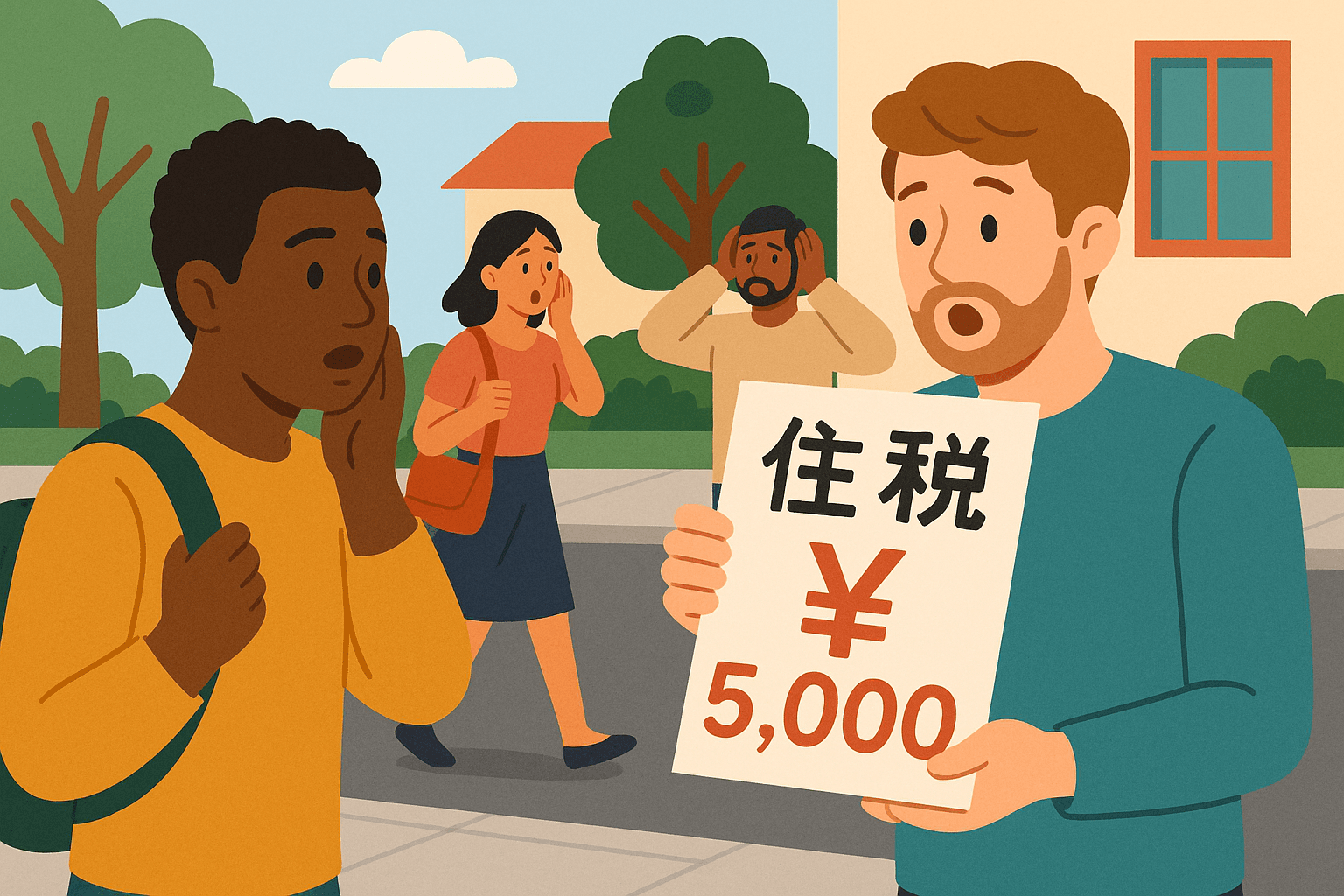
Resident tax is calculated on your previous year's income and charged from June. If you arrived in Japan in April 2025, you'll see zero resident tax until June 2026. Then it appears — and it's based on your entire 2025 income (from your start date to December 31). This surprises many people because the amount seems to come from nowhere.
The rate is a flat 10% of taxable income (6% municipal + 4% prefectural), plus a per-capita levy of ¥5,000/year (including the ¥1,000 forest environment tax introduced in FY2024). Your employer withholds it in 12 monthly installments from June through May (特別徴収). If you're self-employed, you receive a bill and pay in 4 quarterly installments.
The January 1 rule: Resident tax is assessed by the municipality where you were registered on January 1. If you leave Japan before January 1 — and deregister your address — you're not liable for that year's resident tax. If you leave after January 1 but before the June notice, you need a tax agent (納税管理人) to receive and pay it.
Social insurance: you're probably paying more than you think
Combined, health insurance + pension + employment insurance take roughly 15% of your gross salary before income tax is calculated. Your employer pays a matching amount on top. The key thing to know: these are not optional. If your employer is not enrolling you in shakai hoken (社会保険), that's a legal violation — and from June 2027, Japan will check insurance and pension payment status during visa renewal.
Year-end adjustment vs tax return: which one do you need?
This is the single most confusing part of Japan taxes for foreigners, because both processes exist and most English guides only explain one.
| Year-End Adjustment (年末調整) | Tax Return (確定申告) | |
|---|---|---|
| Who does it | Your employer | You, at the tax office or via e-Tax |
| When | November–December | February 16 – March 16 |
| Purpose | Settle the year's income tax based on actual deductions | Report income and claim deductions the employer couldn't handle |
| Required? | Yes, for most salaried employees | Only in specific situations (see below) |
| Result | Refund or extra charge in Dec/Jan paycheck | Refund to your bank account, or tax bill |
Year-end adjustment: what your employer needs from you
In November, your employer will hand you forms. The key ones are:
- 扶養控除等申告書 (Dependents Declaration) — Submit even if you have zero dependents. This determines your withholding rate.
- 基礎控除申告書 (Basic Deduction Declaration) — Your estimated annual income.
- 保険料控除申告書 (Insurance Premium Deduction) — Attach certificates from your life insurance, earthquake insurance, or iDeCo provider.
- 配偶者控除等申告書 (Spouse Deduction Declaration) — If your spouse earns under the threshold.
Fill these out honestly and on time. Your employer recalculates your annual tax, and the difference shows up in your December or January paycheck — usually as a small refund.
When you MUST file a tax return (確定申告) instead or in addition
- Annual salary exceeds ¥20,000,000
- Side income (freelance, rental, crypto) exceeds ¥200,000
- You had two or more employers during the year
- You want to claim medical expense deduction (医療費控除)
- You used furusato nozei with more than 5 municipalities (or used one-stop but also need to file a return)
- You're claiming the housing loan deduction for the first year
- You left Japan mid-year
For the full e-Tax walkthrough and late filing guide, see our Kakutei Shinkoku 2026 Guide.
2026 tax changes that affect foreign residents (Reiwa 7 income)
The 2025 tax reform (applied when filing in 2026 for Reiwa 7/2025 income) includes several changes that directly affect foreign workers. Here are the ones that matter:
1. Basic deduction increase (基礎控除の引上げ)
The basic deduction — the amount of income everyone can earn tax-free — has increased, but it's not a simple flat increase. For 2025 and 2026 income only, it's a graduated, temporary boost:
| Your total income | Before (2024) | 2025–2026 (temporary) | 2027 onward |
|---|---|---|---|
| ¥1.32M or less | ¥480,000 | ¥950,000 | ¥950,000 |
| ¥1.32M – ¥3.36M | ¥480,000 | ¥880,000 | ¥580,000 |
| ¥3.36M – ¥4.89M | ¥480,000 | ¥680,000 | ¥580,000 |
| ¥4.89M – ¥6.55M | ¥480,000 | ¥630,000 | ¥580,000 |
| ¥6.55M – ¥23.5M | ¥480,000 | ¥580,000 | ¥580,000 |
| Over ¥23.5M | ¥480,000 | ¥480,000 | ¥480,000 |
Source: NTA No.1199 (令和7年4月1日現在法令等).
What this means for you: If you earn a typical salary (say ¥4M–¥6M), your basic deduction jumped from ¥480,000 to ¥630,000–¥680,000 — a tax savings of roughly ¥15,000–¥40,000 depending on your bracket. Lower earners benefit most.
2. Employment income deduction increase (給与所得控除)
The minimum guaranteed deduction for salaried workers increased from ¥550,000 to ¥650,000. Combined with the basic deduction increase, the tax-free threshold for employment income rose from approximately ¥1,030,000 to ¥1,600,000 (the so-called "103万円 wall" became the "160万円 wall"). This mainly benefits part-time workers and spouses working under the threshold. Source: NTA No.12012.
3. New specified relative special deduction (特定親族特別控除)
Brand new for 2025 income: if you have a dependent aged 19–22 whose income is up to ¥850,000 (roughly ¥1.5M in salary), you can claim up to ¥630,000 in deduction. This replaces the old cliff-edge system where the deduction disappeared entirely once the dependent earned over the limit. If you're supporting a university-age child or sibling, check with your employer during year-end adjustment.
4. Income tax brackets: unchanged
The 7 brackets (5% to 45%) have been the same since 2015. For reference:
| Taxable income | Rate |
|---|---|
| Up to ¥1,949,000 | 5% |
| ¥1,950,000 – ¥3,299,000 | 10% |
| ¥3,300,000 – ¥6,949,000 | 20% |
| ¥6,950,000 – ¥8,999,000 | 23% |
| ¥9,000,000 – ¥17,999,000 | 33% |
| ¥18,000,000 – ¥39,999,000 | 40% |
| Over ¥40,000,000 | 45% |
Plus the 2.1% reconstruction surtax on your income tax amount (through 2037). Source: NTA No.2260.
Tax-saving strategies: furusato nozei and beyond
As a foreign resident paying taxes in Japan, you have access to the same deductions as Japanese citizens. The most impactful ones:
Furusato nozei (ふるさと納税)
A tax donation program where you "donate" to municipalities and receive local products, while the donation is deducted from your resident tax. Effective result: you pay ¥2,000 out of pocket and get products worth far more — if you stay within your limit and choose the right filing route.
The traps: donating before checking your limit, mixing one-stop with a tax return, and moving after donating without updating your address. We cover all three in detail: How to Use Furusato Nozei Without 3 Costly Mistakes →
Medical expense deduction (医療費控除)
If your household's medical expenses exceed ¥100,000 in a year (or 5% of income if income is under ¥2M), you can deduct the excess. This requires filing a kakutei shinkoku — your employer can't do it through year-end adjustment. Keep all receipts from hospitals, pharmacies, and dental clinics.
iDeCo (個人型確定拠出年金)
Japan's individual defined-contribution pension plan. Contributions are fully tax-deductible, which makes it one of the most effective tax-reduction tools available. For company employees without a corporate pension: up to ¥23,000/month. Note: contribution limits will increase from January 2027 (Category 1 self-employed: ¥68,000 → ¥75,000/month).
Dependent deduction for overseas family
If you're sending money to family abroad and they qualify as dependents (income under ¥480,000/year, or under ¥580,000 from 2025), you can claim a deduction. You'll need remittance records and relationship documents. This is available through year-end adjustment — tell your employer.
Sending money home: the real cost of international remittance
Most "cheapest remittance" articles compare only the visible transfer fee. But your real cost is: upfront fee + exchange rate markup + intermediary bank charges. A ¥500 fee with a 1% FX markup on ¥200,000 costs you ¥2,500 total — five times the sticker price.
The three main options in 2026:
- Wise — Best FX transparency for most currencies. Requires My Number, Residence Card, and eKYC.
- Bank SWIFT transfer — Reliable but expensive. Japan Post Bank's international transfer has changed procedures recently.
- Seven Bank / Western Union — Most practical for rural Japan. Predictable upfront fees, available at ATMs nationwide.
For the full comparison with document checklists and common failure reasons, see: Cheapest Way to Send Money from Japan (2026) →
Leaving Japan: pension refund and tax settlement
If you're leaving Japan permanently, there are two financial processes with hard deadlines that most people discover too late:
1. Pension refund (脱退一時金)
If you contributed to Japanese pension insurance for 6 months or more, you can claim a lump-sum withdrawal payment after leaving Japan. The claim must reach the Japan Pension Service within 2 years of losing your Japanese address.
The 20.42% trap: Employees' Pension lump-sum payments to non-residents are subject to 20.42% income tax withholding. You can get this back — but only if you appoint a tax agent (納税管理人) before leaving and file the refund claim after receiving the JPS payment notice. Skip this step and you permanently lose ~20% of your refund.
Full walkthrough: How to Get Your Japan Pension Refund Without Losing 20.42% →
2. Resident tax settlement
If you were registered in Japan on January 1, your resident tax bill is coming in June — even if you're already overseas. You have two options:
- Prepay (予納) — Ask your municipal tax office for an estimate and pay before departure.
- Appoint a tax agent (納税管理人) — A friend or colleague in Japan who will receive and pay the June notice on your behalf.
For the exact form, submission process, and fallback options (including what to do if you don't know anyone): Shinjuku Tax Agent Guide →
Before your flight: a 4-week departure checklist
| Weeks before | Action |
|---|---|
| 4 weeks | Decide: prepay resident tax or appoint a tax agent |
| 3 weeks | Download and submit 納税管理人 form to your municipal tax office |
| 2 weeks | Notify your bank of departure. Cancel or adjust auto-payments. |
| 1 week | File your moving-out notice (転出届) at city hall. This removes your address from the register. Set up mail forwarding if possible. |
| After departure | File pension lump-sum claim within 2 years. File 20.42% tax refund via your tax agent after JPS sends the payment notice. |
My Number Card: the thread connecting everything
Your My Number (マイナンバー) links your tax, pension, health insurance, and banking records. In 2026, it's becoming harder to avoid:
- Health insurance: Paper cards were abolished December 2024. You now use your My Number Card as your insurance card ("Myna Hokensho"), or request a free certificate (資格確認書).
- Banking: Required for international transfers and investment accounts. From April 2027, IC chip scanning will be mandatory for remote account opening.
- Tax filing: e-Tax login via My Number Card is the fastest submission method.
- New in June 2026: A combined Residence Card + My Number Card (特定在留カード) becomes available for foreign nationals. Application is voluntary and only possible during an immigration procedure. Current cards remain valid.
Related Articles
- Open a Japan Bank Account as a Foreigner (2026 Checklist)
- Japan Bank Account Without a Phone Number
- Kakutei Shinkoku 2026: Tax Return Guide + e-Tax
- Furusato Nozei: Avoid 3 Costly Mistakes
- Gensen Choshuhyo Missing? What to Do
- Cheapest Way to Send Money from Japan (2026)
- Japan Pension Refund: Don't Lose 20.42%
- Shinjuku Tax Agent Before June Notice
Need More Help? Ask on LO-PAL
Tax offices, banks, and pension counters in Japan operate almost entirely in Japanese. If you need someone to go with you, translate a form, or call a tax office on your behalf, LO-PAL connects you with a local helper who can assist in person or remotely. Post your request — whether it's "help me file my tax return" or "call the tax office about my resident tax" — and get matched with someone who knows the system.
この記事のライター

LO-PAL 創業者
厚生労働省支援の外国人患者受入れ医療コーディネーター、法務の専門家。自らの海外生活経験と医療現場での知見をもとにLO-PALを設立。
※ 一部AIを使用して執筆しています
詳しいプロフィール →