Kyoto Itinerary 2 Days: Train-First Route + Kimono Day (2026)

The all-in-one Japanese learning app
From travel phrases to real fluency — all in one app.
All 2,136 standard kanji included. Every feature is free to use.
Train-first Kyoto itinerary 2 days (2026): kimono day in Higashiyama, Arashiyama at dawn, and fast rail to Fushimi Inari.
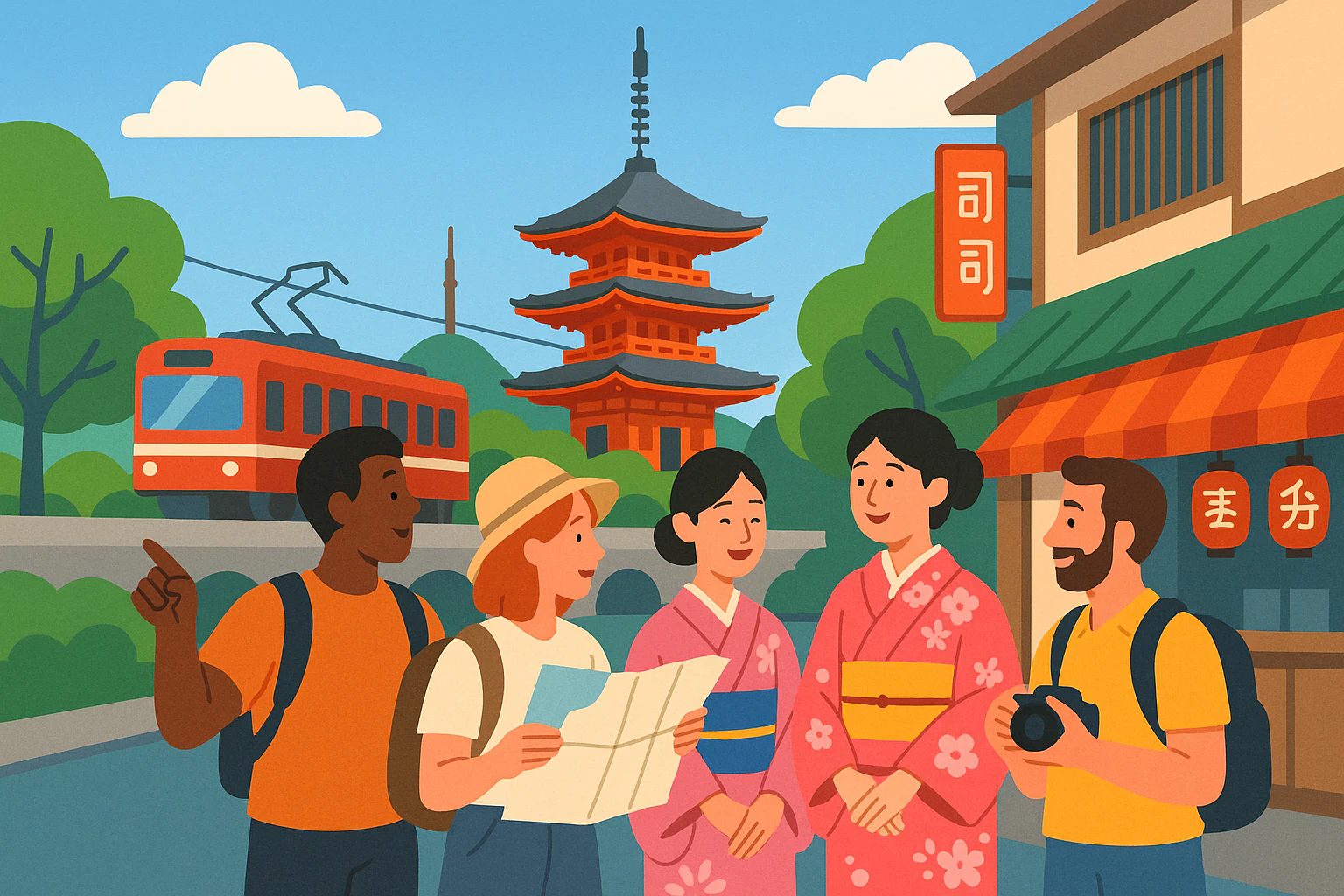
Trying to do Kyoto in 48 hours is hard in any year—but in 2026, the biggest risk isn’t “missing a temple.” It’s losing hours to the most congested city-bus corridors, accidentally breaking local rules in Gion, or arriving at Arashiyama at the exact time every tour bus does.
This Kyoto itinerary 2 days is built to be crowd-smart and train-first. We’ll use buses only when they truly save time (especially Kyoto’s Sightseeing Limited Express Bus), schedule a kimono day in Higashiyama, and still fit Arashiyama and Fushimi Inari with fast rail access.
Kyoto itinerary 2 days in 2026: the real pain points (crowds, buses, local rules) + planning tools
Kyoto’s “classic” sightseeing routes (Kyoto Station → Kiyomizu-dera → Gion, and Kyoto Station → Arashiyama) are exactly where the city gets bottlenecked. Kyoto City Transportation Bureau now runs peak-season measures like extra services, routing tweaks, and even real-time information trials to reduce bus stress in busy seasons.
For example, Kyoto has officially announced seasonal crowd measures that include promoting the Sightseeing Limited Express Bus, trialing real-time bus operation information, and campaigns aimed at reducing large luggage brought onto buses. You can see a detailed example of these measures in Kyoto’s fall crowd-control announcements from the Transportation Bureau (2025), which also show how targeted and time-limited these measures can be.
Kyoto City Transportation Bureau: autumn bus crowd measures (official)
At the same time, local rules in Gion have gotten stricter and more explicit. A common mistake is wandering into photogenic side streets that are actually private—some have multilingual “no entry” signage and even a stated penalty for violations.
Asahi Shimbun report on Gion private street “no entry” signage and stated ¥10,000 fine
2026 reality check (plan around this): Expect bus delays around Higashiyama and Arashiyama in peak seasons, and assume Gion etiquette is enforced by signage (and sometimes police calls when behavior is disruptive). Use trains and walking for “time certainty,” then use buses selectively.
Planning tools you should actually use (and when)
1) Kyoto Smart Navi (official): a no-download digital map that helps you check congestion status, live cameras, traffic restrictions, and even “hands-free” luggage services. Use it each morning and again before moving to your next area.
Kyoto City Official Guide: Maps & Tools (Kyoto Smart Navi)
2) Kyoto City Bus & Subway Information Guide (official): use it to confirm fares, how to board (front vs rear), and the Sightseeing Limited Express Bus details.
- Sightseeing Limited Express Bus EX100/EX101 (official)
- How to ride Kyoto City buses (official)
- Kyoto City bus fares (official)
3) “Comfortable access” route pages (official): these are practical, crowd-aware route suggestions that often recommend train + walk instead of default bus routes.
- Comfortable access to Higashiyama/Kiyomizu-dera (official)
- Comfortable access to Saga/Arashiyama (official)
- Comfortable access to Fushimi Inari (official)
4) Hands-free travel support: Kyoto pushes “hands-free sightseeing” so buses stay usable for everyone. If you’re arriving with a suitcase, check official hands-free guidance and luggage delivery/storage listings.
HANDS FREE KYOTO (Kyoto City Official / Kyoto City Tourism Association)
Day 1 (Higashiyama) Kyoto itinerary 2 days: kimono rental + Kiyomizu-dera, Sannenzaka/Ninenzaka, Gion (do’s & don’ts)
Day 1 is your best day for a kimono rental Kyoto experience because Higashiyama is made for slow walking—stone slopes, traditional streets, and short distances between major sights. The trick is starting early so you enjoy the scenery before the midday crowd wall hits.
Day 1 snapshot: Kimono rental (morning) → Kiyomizu-dera → Sannenzaka/Ninenzaka → (optional temple stop) → Gion afternoon/evening manners-safe stroll.
Morning: get to Higashiyama without burning time on the most jammed bus routes
Default bus routes to Kiyomizu-dera often get congested, especially on weekends and during seasonal peaks. Kyoto’s official guidance recommends combining trains with walking (or using the limited-stop sightseeing express bus on eligible days) rather than relying on the standard city-bus approach.
Kyoto City Official Guide: Comfortable access to Higashiyama/Kiyomizu-dera
- Best (weekends/holidays): use Sightseeing Limited Express Bus EX101 or EX100 from Kyoto Station to Gojo-zaka (closest stop to Kiyomizu-zaka). It’s limited-stop and designed for tourists.
- Best (any day, train-first): JR to Tofukuji then transfer to Keihan and walk from Kiyomizu-Gojo (about 25 minutes). This avoids road traffic variability.
- Best (scenic walk, subway-first): use subway access to Higashiyama Station, then walk via Nene-no-michi and the preserved streets (longer but very “Kyoto”).
Using the Sightseeing Limited Express Bus correctly (so it actually saves time)
Kyoto’s Sightseeing Limited Express Bus (EX100/EX101) is a limited-stop service to major sights like Kiyomizu-dera and Gion. It has a higher single-ride fare than regular city buses, but it’s included in the Subway & Bus 1-Day Pass.
Kyoto City Transportation Bureau: Sightseeing Limited Express Bus (official)
- Fare: ¥500 adult / ¥250 child per ride (cash or IC card accepted).
- Boarding procedure: board from the front, pay when getting on, exit from the rear (this is the opposite of many Kyoto bus routes).
- Important: it’s officially positioned as a weekend/holiday service, so do not build a weekday itinerary that depends on it.
Kyoto City Transportation Bureau: how to ride buses (official)
Kimono rental: what’s usually included + what to reserve
Most kimono rentals are “set pricing” and include the essentials (kimono, obi, sandals, etc.), then charge extra for hair styling, upgrades, and sometimes large-bag storage. In peak seasons, walk-in queues can quietly eat 60–90 minutes—so reserve online if you can.
- Budget range (typical examples): standard plans around ¥4,000–¥5,000 are common, with hair styling often added separately (for example, +¥1,500 at some shops).
- Couple plans: vary widely; check what’s actually included (women’s hair, accessories, upgrades).
- Large luggage: many shops charge extra to store a suitcase (often a few hundred yen).
To keep this guide practical (without pushing a single shop), here are real plan pages showing how pricing is structured in Kyoto right now:
- Example pricing structure (Nagomi-no-Wa)
- Example hair set add-on pricing (Yume Kyoto)
- What’s usually included + common extra fees (large bag storage, hair sets)
Reservation tip: choose a shop close to where you’ll start walking (Kiyomizu-Gojo / Gion-Shijo side), not close to where you’re sleeping. You’ll return it later—minimizing “dead travel” in kimono is the real win.
Late morning: Kiyomizu-dera (arrive before the crowd wave)
Kiyomizu-dera opens early (6:00 a.m.), and its closing time varies by season and special evening viewing periods. In spring/autumn illumination periods, it can stay open later into the evening.
Kiyomizu-dera: location and opening hours (official)
Admission: the temple’s official event pages list standard grounds admission at ¥500 for adults and ¥200 for elementary/junior high students (fees can differ for special sub-areas like garden special viewings).
Kiyomizu-dera official notice showing admission fee (example event period)
- Time needed: 60–90 minutes for the main loop (more if you linger for photos and waterfall lines).
- Accessibility note: Kiyomizu-dera provides wheelchair guidance maps and notes about route accuracy (some mapping apps show routes that don’t reach the grounds).
Midday: Sannenzaka/Ninenzaka (and how to keep it photo-friendly)
These preserved slopes are beautiful in kimono—but they’re also where crowd flow slows down the most. Your main job is simple: don’t stop in the center of the slope for photos, and don’t form “human walls” in narrow stair sections.
Food strategy: if you want a calm lunch, step one street away from the most photographed slope, eat early (11:00–11:30), and then return to walking.
Best temples Kyoto (that fit this Day 1 route without extra transit)
If you want more “best temples Kyoto” moments without wrecking timing, pick at most one extra stop in the same walkable zone. These are easy to layer onto a Higashiyama → Gion route:
- Kennin-ji (near Gion): a strong “temple feel” without long detours.
- Shoren-in / Chion-in area: good for gardens and atmosphere if you’re walking toward the subway later.
- Yasaka Shrine (shrine, not temple): an easy landmark stop that naturally connects Gion and Higashiyama.
Afternoon into evening: Gion do’s & don’ts (avoid the 2026 “rule mistakes”)
Gion is not an open-air theme park. It’s a working district with residents, traditional businesses, and geiko/maiko heading to appointments. Kyoto’s official guidance for Southern Gionmachi explicitly asks visitors not to stop, touch, follow, or take unauthorized photos/videos of geiko/maiko—and notes that a resident report may result in police being called.
Kyoto City Official Guide: Gion manner (Southern Gionmachi)
Big mistake to avoid: entering private alleys “because they look quiet.” A private street in the Gion area (Kosode-Koji) posted multilingual no-entry signage for tourists and guided tours, with a stated ¥10,000 fine for violations.
No entry… this is a private road… A fine of 10,000 yen…
Asahi Shimbun report on the Kosode-Koji signage
- Do stay on public streets (Hanami-koji main street is the classic example), follow “no photography” signs, and keep voices low at night.
- Don’t chase geiko/maiko, block doorways, or step beyond barriers that signal private property.
- Do plan a “safe” photo route: Shirakawa area viewpoints, wide sections of main streets, and shrine gates where stopping doesn’t trap pedestrians.
Day 2 Kyoto itinerary 2 days: Arashiyama early-morning route + Fushimi Inari (fast rail access + timing)
Day 2 is your “two extremes” day: Arashiyama at dawn (to beat the photo crowds), then Fushimi Inari later using fast rail. The whole day works best if you treat midday as a transfer window, not a sightseeing window.
Day 2 snapshot: JR to Arashiyama early → bamboo + Tenryu-ji → lunch → JR to Fushimi Inari → hike to viewpoint → return after sunset if you want quieter torii photos.
Early morning: get to Arashiyama by rail (skip the bus uncertainty)
Kyoto’s official guidance recommends rail for Arashiyama because buses can be crowded and time-consuming. From Kyoto Station, the JR Sagano Line reaches Saga-Arashiyama Station in about 11 minutes by rapid service.
Kyoto City Official Guide: Comfortable access to Saga/Arashiyama
Why “early” matters even more in 2026: Arashiyama is also a traffic-regulation zone in peak foliage periods, and bus routes can detour during crowd-control operations. In 2025, Kyoto City Transportation Bureau published notices about temporary route changes during Arashiyama autumn traffic regulation dates—meaning you should assume “normal bus routing” is not guaranteed in peak weeks.
Kyoto City Transportation Bureau notice: Arashiyama autumn traffic regulation detours (official)
Arashiyama route order (designed for photos and minimal backtracking)
- Bamboo Grove first (arrive before 8:30 if you’re photo-focused).
- Tenryu-ji next when it opens (it’s right next to the grove area, and the garden gives you a calmer, curated view).
- Togetsukyo Bridge area for river views and a break.
- Optional: Iwatayama Monkey Park only if you still have energy (it adds uphill walking).
Tenryu-ji (official hours and fees)
Tenryu-ji is one of the strongest “best temples Kyoto” picks in Arashiyama because it’s central and the garden is a highlight. According to Tenryu-ji’s official site, visiting hours are 8:30 a.m.–5:00 p.m. (last admission 4:50 p.m.). The garden admission is ¥500 (high school age and older), and adding buildings costs an additional ¥300.
Tenryu-ji official: admission and access
Optional: Iwatayama Monkey Park (hours and cost)
If you’re traveling with kids (or you just want a high-viewpoint reward), the monkey park is fun—but it’s a climb. Typical posted hours are 9:00–5:00 (summer) and 9:00–4:00 (winter), with admission listed as ¥550 for adults and ¥250 for children.
Arashiyama Monkey Park (hours/fees example listing)
Fushimi Inari how to get there (fast rail access + the #1 train mistake)
Now the easy part: Fushimi Inari is rail-perfect. The shrine is right next to JR Inari Station on the JR Nara Line, only 2 stations / 5 minutes from Kyoto Station. The Keihan option is also simple: it’s about a 5-minute walk from Keihan Fushimi-Inari Station.
Fushimi Inari Taisha official access (JR/Keihan + contact)
- From Kyoto Station (JR): take the JR Nara Line to Inari Station. Important: some rapid services do not stop at JR Inari Station, so check before boarding.
- From Gion/Shijo area (Keihan): go from Keihan Gion-Shijo to Fushimi Inari Station, then walk about 5 minutes.
Kyoto City Official Guide: comfortable access to Fushimi Inari (notes about rapid trains)
Best timing for Fushimi Inari in a 2-day plan
Fushimi Inari is famous for being flexible: the grounds are commonly listed as open 24 hours, and there’s no general admission fee—so you can visit when crowds are lowest. Official tourism listings also commonly note that while the grounds are always accessible, staffed facilities run on daytime hours.
Discover Kyoto listing: hours (grounds open 24 hours) and free admission
- Most crowd-smart: arrive before 8:00 a.m. or after 4:00 p.m.
- Fast “iconic torii” visit: 45–60 minutes for the lower torii tunnels and a short loop.
- Best viewpoint visit: 1.5–2 hours to reach a mid-hike viewpoint and return (bring water).
Respect tip: Fushimi Inari is a sacred site, not just a photo tunnel. If you want a quick refresher on shrine etiquette (how to approach torii, offerings, omikuji, and goshuin), use our guide: Shrine etiquette in Japan (2026): omikuji, goshuin, and modern payment tips.
Transport & budget checklist (passes, express buses, luggage tips) + ask a local on LO-PAL
This itinerary works with simple pay-as-you-go transit, but passes can still help if you’re doing multiple subway/bus rides in one day. The key is understanding what each pass covers—and what it doesn’t.
Kyoto City bus basics (2026 fares and boarding)
- Flat fare zone (most central sightseeing): ¥230 adult / ¥120 child per ride.
- EX100/EX101 Sightseeing Limited Express Bus: ¥500 adult / ¥250 child per ride.
- Boarding rules: most routes board rear / pay when exiting; EX buses board front / pay when entering.
Kyoto City Transportation Bureau: bus fares (official)
Kyoto City Transportation Bureau: how to ride (official)
Subway & Bus 1-Day Pass (who it’s for, and where to buy)
The Subway & Bus 1-Day Pass costs ¥1,100 (adult) / ¥550 (child) and can be used year-round. It’s valid on the day you activate it, and Kyoto City’s official ticket page lists multiple purchase locations including subway stations and information centers.
Kyoto City Transportation Bureau: Subway & Bus 1-Day Pass (official)
- Best for: a day where you’ll use subway + city bus multiple times and want the flexibility (especially if you’ll use EX100/EX101 on an eligible day).
- Not ideal for: a heavy JR/Keihan day (Arashiyama by JR + Fushimi by JR), since those are not Kyoto City Bus/Subway services.
Luggage tips (Kyoto’s 2026 “don’t bring it on the bus” vibe)
If you arrive in Kyoto and immediately head to sightseeing with a suitcase, you’ll feel the friction fast—especially on buses. Kyoto actively promotes hands-free sightseeing and publishes resources for luggage storage and delivery so visitors don’t clog bus aisles.
HANDS FREE KYOTO: luggage services and “hands-free” concept (official)
- Best move: store luggage at Kyoto Station lockers or send it to your hotel, then start the itinerary with only a day bag.
- If you must carry luggage: prefer trains (more space and predictable boarding) over city buses.
Official help contacts (when you’re stuck in transit)
If something goes wrong (missed stop, disruption, “which bus stand is D1?”), Kyoto City Transportation Bureau publishes official contact points. The Navi Dial line is listed as 0570-666-846 (call charges apply). Kyoto Station-front bus/subway guidance is also listed with a local phone number.
- Kyoto City Transportation Bureau Navi Dial: 0570-666-846
- Kyoto Station-front bus/subway info (listed): (075) 371-4474
Kyoto City Transportation Bureau: inquiry contacts (official)
2-day budget example (per person, conservative)
- Transit: ¥1,000–¥2,500 (depends on whether you buy the Subway & Bus 1-Day Pass and how much JR/Keihan you use)
- Temples/shrines: ¥1,300–¥2,000 (Kiyomizu-dera + Tenryu-ji, plus optional extras)
- Kimono rental day: ¥4,500–¥9,000+ (plan + hair + any upgrades + large-bag storage if needed)
- Food: ¥3,000–¥7,000 (depends on sit-down meals vs street snacks)
Quick Q&A for this Kyoto itinerary 2 days
Q1: Is the Sightseeing Limited Express Bus (EX100/EX101) a daily service?
A: No—plan train-first. It’s positioned as a weekend/holiday sightseeing service, so check the official schedule before relying on it. (Official details)
Q2: Fushimi Inari how to get there from Kyoto Station?
A: Take the JR Nara Line to JR Inari Station (2 stations / 5 minutes) and you’re basically there; Keihan Fushimi-Inari Station is also an option with a short walk. (Official access)
Q3: What time should I do Arashiyama Bamboo Grove?
A: If photos matter, go early (before the tour-bus wave) and then move to Tenryu-ji when it opens. If you’re visiting during autumn traffic regulation periods, trains help avoid bus detours. (Official detour notice example)
Q4: What’s the biggest Gion rule mistake tourists make?
A: Treating residential/private alleys as tourist photo spots. Stick to public streets and follow signage; some private streets have explicit no-entry warnings. (Example report)
Related Articles
- Kyoto 2-day itinerary by public transport (2026): routes and passes
- Suica vs PASMO for tourists (2026): tap-to-pay and transit tips
- Shrine etiquette Japan (2026): omikuji, goshuin, and respectful behavior
Need More Help? Ask on LO-PAL
If you want to know more about this Kyoto itinerary 2 days plan—or you need specific local info like “Which kimono shop is fastest near Kiyomizu-Gojo?”, “Is EX100 running on my date?”, or “Which Gion streets should I avoid today?”—ask a local Japanese person on LO-PAL.
Just post a question or task request in the app, and local Japanese helpers will respond. We support multiple languages (English, Chinese, Vietnamese, Portuguese, Korean, Nepali, Tagalog, Indonesian, Spanish), so you can plan confidently even if you don’t read Japanese.
Written by

Founder, LO-PAL
Former Medical Coordinator for Foreign Patients (Ministry of Health programme) and legal affairs professional. Built LO-PAL from firsthand experience navigating life abroad.
Written with partial AI assistance
Read full bio →