Japan Hoikuen Daily Life: Notebooks, Supplies & the 37.5°C Rule
Daily life after your child enters a Japanese daycare. The acclimation period (慣らし保育), what to bring every day, the contact notebook (連絡帳), illness rules, monthly events, and how to communicate when everything is in Japanese.
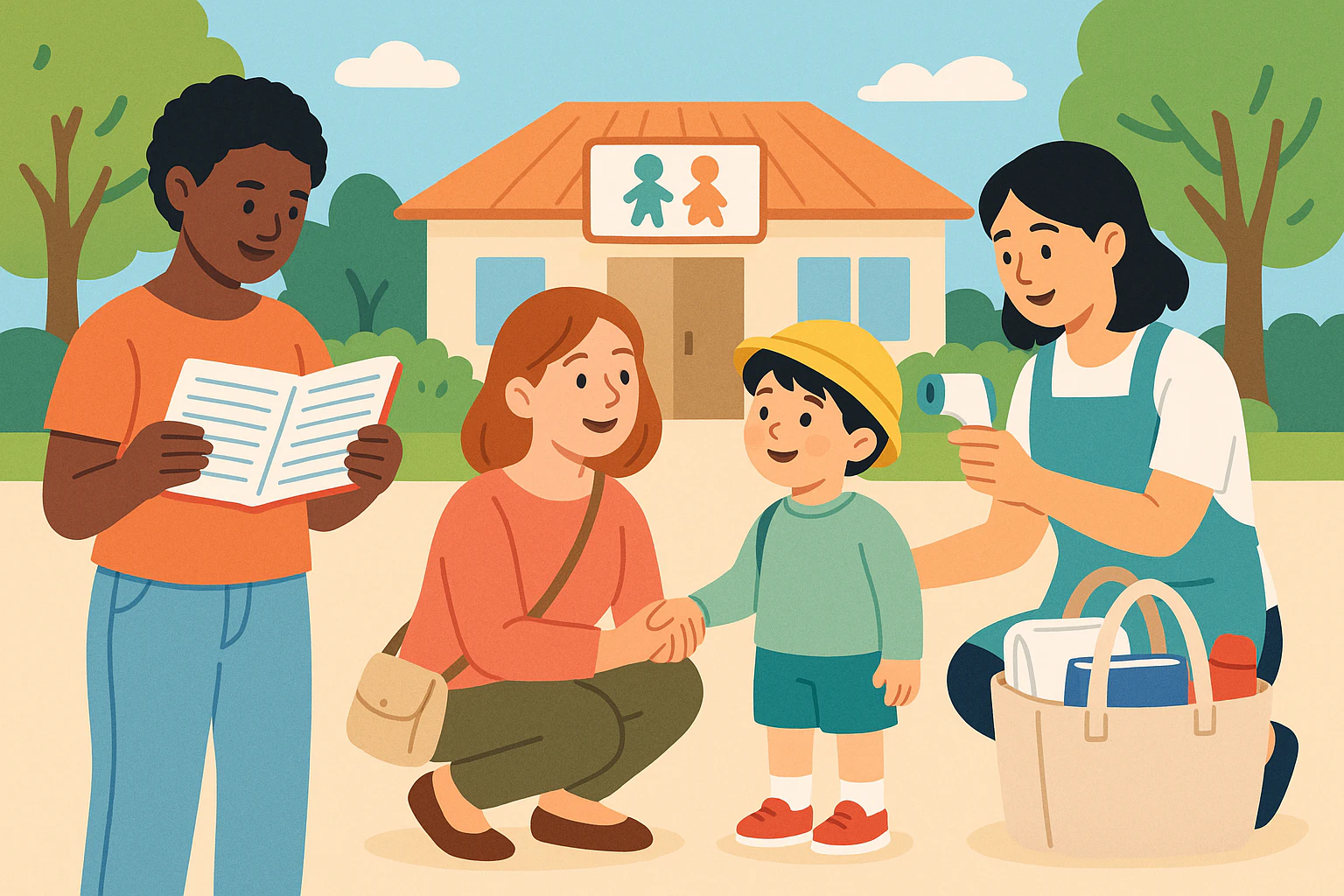
What this covers: Daily life after your child enters a Japanese daycare. The acclimation period, what to bring every day, the contact notebook, illness rules, monthly events, and how to communicate when everything is in Japanese.
Bottom line: Getting in is one milestone. The bigger one is the next 3–5 years of daily Japanese-only paperwork and routines. This guide prepares you.
Information current as of April 2026 based on the Children and Families Agency / MHLW infectious disease guidelines for daycare facilities (revised May 2023) and parent experience accounts from foreign families across Tokyo, Osaka, and regional cities.
Most foreign parents prepare hard for the application and then are blindsided by the daily reality. Japanese daycares ask parents to do a lot every day: temperature checks, contact notebook entries, supply restocking, daily clothing changes, and constant vigilance about illness. None of it is malicious — Japanese parents do it too — but the workload is heavy and almost entirely in Japanese.
The first 1–4 weeks: 慣らし保育 (acclimation period)
Almost every Japanese daycare requires a gradual acclimation period (慣らし保育 / narashi hoiku) before your child attends full days. The purpose is to help young children adjust to being away from parents and to a new environment. You cannot start a new full-time job in the first week of April — both you and your employer need to plan for this.
Typical schedule (for 0–2 year olds)
| Week | Daily duration | What happens |
|---|---|---|
| Week 1 | 1–2 hours | Drop off after breakfast, pick up before lunch. Child plays with teachers. |
| Week 2 | 3–4 hours | Stay through lunch. Child eats one meal at the daycare. |
| Week 3 | 6–7 hours | Stay through nap time. Lunch + afternoon nap. |
| Week 4 | Full day | Drop off morning, pick up evening. Normal schedule. |
Variations:
- Some daycares compress this to 1 week if your child adjusts quickly
- Some daycares extend it to a full month, especially for sensitive children
- Older children (3+) often have shorter acclimation (2–5 days)
- The teachers will tell you each day whether to extend or shorten
What to plan
- Take leave from work for at least the first 1–2 weeks. Many parents use childcare leave or flex time for the acclimation period.
- Have a backup plan for unexpected pickup requests during acclimation (the daycare might call you at any time)
- Budget extra emotional energy — your child will probably cry at drop-off for the first 2–3 weeks. This is normal and expected. Teachers handle it.
The daily supplies list (持ち物)
You'll bring (and refresh) supplies every day or week. The exact list varies by daycare but expect something like this for a 0–2 year old:
Brought every day
| Item | Japanese | Quantity |
|---|---|---|
| Spare clothes | 着替え | 2–3 sets (top + bottom + underwear) |
| Diapers (disposable) | 紙おむつ | 5–8 per day |
| Wet wipes | おしりふき | 1 pack at facility, refilled weekly |
| Plastic bags for soiled clothes | 汚れ物入れ用ビニール袋 | 3–5 |
| Small face towel | フェイスタオル | 1–2 |
| Hand towel | ハンドタオル | 1 |
| Water bottle / cup | 水筒/コップ | 1 |
| Meal apron (food bib) | お食事エプロン | 2–3 (one for each meal) |
| Apron after-meal cloth | 口拭きタオル | 2–3 |
| Contact notebook | 連絡帳 | 1 — filled out each morning |
Brought weekly (Monday) / returned Friday
| Item | Japanese | Notes |
|---|---|---|
| Nap futon set | お昼寝布団セット | Sheet, blanket, pillow. Bring Monday, take home Friday for washing. |
| Pajamas | パジャマ | For nap time (2+ year olds) |
| Sheets cover | シーツ・カバー | Washed at home each weekend |
Brought monthly
- Stockpile of diapers (10–20 sent in at once for the daycare to store)
- Diaper cream, lotion, sunscreen
The name labeling marathon
Every single item must be labeled with your child's name. Including individual diapers. Each clothing item, each cup, each towel, each diaper. Yes, really.
- Order お名前スタンプ (name stamp set) in advance — ¥2,000–¥3,000 on Amazon. The stamp set includes various sizes for diapers, clothes, and small items.
- Order お名前シール (name stickers) for items you can't stamp. ¥500–¥1,500 on Rakuten/Amazon for 200+ stickers in various sizes.
- For foreign names: katakana is fine. The stamps and stickers are made-to-order — provide your child's name in katakana when ordering.
The contact notebook (連絡帳)
The 連絡帳 is the daily communication channel between you and your child's teachers. It travels with your child every day. You write in the morning, the teacher writes in the afternoon, and you read the teacher's notes when you pick up.
What you write each morning
| Field | Japanese | What to fill in |
|---|---|---|
| Date | 日付 | Today's date |
| Temperature | 体温 | Take your child's temperature in the morning. e.g., 36.7°C |
| Mood | 機嫌 | 機嫌が良い (good mood) / 普通 (normal) / 機嫌が悪い (bad mood) |
| Sleep | 睡眠 | Bedtime and wake-up time. e.g., 20:00–6:30 |
| Last meal | 食事 | What and when. e.g., 朝食: パン、バナナ、牛乳 |
| Last bowel movement | 排便 | Today/yesterday. (Yes, really.) |
| Health concerns | 健康状態 | Cough, runny nose, rash, anything unusual |
| Notes for teacher | 連絡事項 | Anything special — late pickup, doctor visit, family event, etc. |
Sample entry (you can copy)
4月15日(火)
体温:36.6度
機嫌:良い
睡眠:20:30〜6:45
朝食:ご飯、納豆、味噌汁、バナナ
排便:あり(今朝)
連絡事項:少し鼻水が出ています。様子を見てください。よろしくお願いします。
April 15 (Tue) / Temp: 36.6°C / Mood: good / Sleep: 20:30–6:45 / Breakfast: rice, natto, miso soup, banana / Bowel: yes (this morning) / Notes: Slight runny nose. Please watch for symptoms. Thank you.
What the teacher writes back
- Activities of the day (what they played, songs, books)
- What and how much your child ate at each meal
- Nap time and duration
- Bowel movements and diaper changes
- Mood throughout the day
- Any health observations
- Special events or notes
Digital alternative: app-based notebooks
Many daycares now use apps like CoDMON (コドモン), kid's diary, or BabyTech to handle the contact notebook digitally. Teachers can upload photos. You can fill in your morning notes from your phone. The interface is still in Japanese, but you can use Google Translate's screen translation to read incoming messages. Some apps have basic English UI.
The 37.5°C rule (and what to do when daycare calls)
Japan's official infectious disease guideline (Children and Families Agency, revised May 2023) sets 38°C as the formal "consider keeping the child home" threshold. But in practice, most daycares use 37.5°C as the call-home threshold. The reasoning: with very young children, even a minor fever is a sign that the child is unwell or contagious, and other children in the daycare are vulnerable.
What happens when you're called
- The daycare calls you (work phone or mobile) saying your child has a fever and asking you to pick up
- You're expected to arrive within ~1 hour
- If you can't, the daycare will call your designated emergency contact (typically the other parent or a relative)
- You bring the child home and (depending on severity) take them to a pediatrician
The 24-hour rule
After a fever, most daycares require the child to be fever-free for 24 hours before returning. So a fever today means at minimum the child stays home tomorrow. For working parents, this means losing a day or two whenever a fever happens — and fevers happen often (4–8 times in the first year of daycare for many children).
Re-entry certificates (登園許可証)
For specific infectious diseases — influenza, hand-foot-and-mouth, COVID-19, RSV, chickenpox, gastroenteritis — the daycare requires a doctor's note (登園許可証 / touen kyokasho) certifying that your child is no longer contagious. The pediatrician issues this at a follow-up visit. Some daycares accept a parent-signed declaration form (登園届) instead for milder illnesses.
How working parents survive
- Sick-child daycare (病児保育) — Some hospitals and daycares offer same-day sick-child care. Apply in advance (can take 1-2 days). Available in most major cities. Around ¥2,000–¥4,000 per day.
- Babysitter services — Kidsline, Poppins, BeMOM. Same-day or next-day. ¥2,000–¥4,000/hour.
- Grandparent backup — If you have family nearby
- Flexible work day — One parent works from home that day
- Job-share with another parent — Trade off care days with another foreign parent in your area
Monthly events at daycare
Japanese daycares have a year-round schedule of events. You'll receive notice about each one (in Japanese, in the contact notebook or app). Here are the most common:
| Event | Japanese | What it is | What you do |
|---|---|---|---|
| Birthday celebration | 誕生会 | Monthly group celebration for kids born that month | Just attend / nothing special |
| Parent visit day | 保育参観 | Once a year — observe a typical day | Visit during your slot, watch quietly |
| Sports day | 運動会 | Once a year — kids do races and dances | Attend, bring a camera, sometimes pack a bento |
| Stage performance | 生活発表会 / お遊戯会 | Once a year — kids perform songs/skits | Attend; sometimes children need a costume from home |
| Field trip | 遠足 | 1–2 times a year — kids visit a park or farm | Pack a small bento, water bottle, hat |
| Individual meeting | 個人面談 | 1 time/year — 15 min with the teacher | Prepare questions about your child's progress |
| Health check | 健康診断 | 2 times/year — pediatrician visits the daycare | Sign the consent form |
| Fire drill | 避難訓練 | Monthly — practice evacuation | Nothing required of parents |
| Graduation | 卒園式 | For 5 year olds going to elementary school | Formal attire, attend the ceremony |
Communication with teachers when you can't speak Japanese
Daycare teachers are generally patient with foreign parents but rarely speak English. Tactics that work:
For routine messages
- Templates in this guide — Copy the contact notebook examples
- Google Translate — Type your message in English, translate to Japanese, write what comes out (use simple grammar)
- DeepL — Often produces more natural Japanese than Google Translate
- Voice notes via app — Some daycare apps allow voice messages, which the teachers can listen to multiple times
For complex topics (illness, special needs, scheduling conflicts)
- Bring a Japanese-speaking friend or partner to in-person meetings
- Use a translation service via phone app (Google Translate conversation mode)
- Book a LO-PAL helper to attend the meeting with you
- Write your concerns in advance, translate them, and hand the printout to the teacher
Useful phrases at drop-off and pickup
| Japanese | Romaji | Meaning |
|---|---|---|
| おはようございます。よろしくお願いします。 | Ohayou gozaimasu. Yoroshiku onegai shimasu. | Good morning. Please take care of [child]. |
| 今日の様子はどうでしたか? | Kyou no yousu wa dou deshita ka? | How was [child] today? |
| ありがとうございました。失礼します。 | Arigatou gozaimashita. Shitsurei shimasu. | Thank you. Goodbye. |
| 少し早めにお迎えに来ます。 | Sukoshi hayame ni omukae ni kimasu. | I'll come pick up a bit early today. |
| 遅くなってすみません。 | Osoku natte sumimasen. | Sorry I'm late. |
Related Articles
- Japan Daycare Guide: Pillar Overview
- Hoikuen Application Step-by-Step
- School Renrakucho Guide (for older children)
Need More Help? Ask on LO-PAL
Need someone to translate this week's contact notebook? Or come with you to a parent-teacher meeting? Or help you understand the orientation handouts? LO-PAL matches you with a local helper who has done it. Post your request and get matched.
Written by

Founder, LO-PAL
Former Medical Coordinator for Foreign Patients (Ministry of Health programme) and legal affairs professional. Built LO-PAL from firsthand experience navigating life abroad.
Written with partial AI assistance
Read full bio →