Japanese Train Etiquette for Foreign Residents: 2026 Unwritten Rules
A 2026 resident-focused guide to Japanese train etiquette: real rules vs manners, city differences, luggage, priority seats, and escalator ordinances.
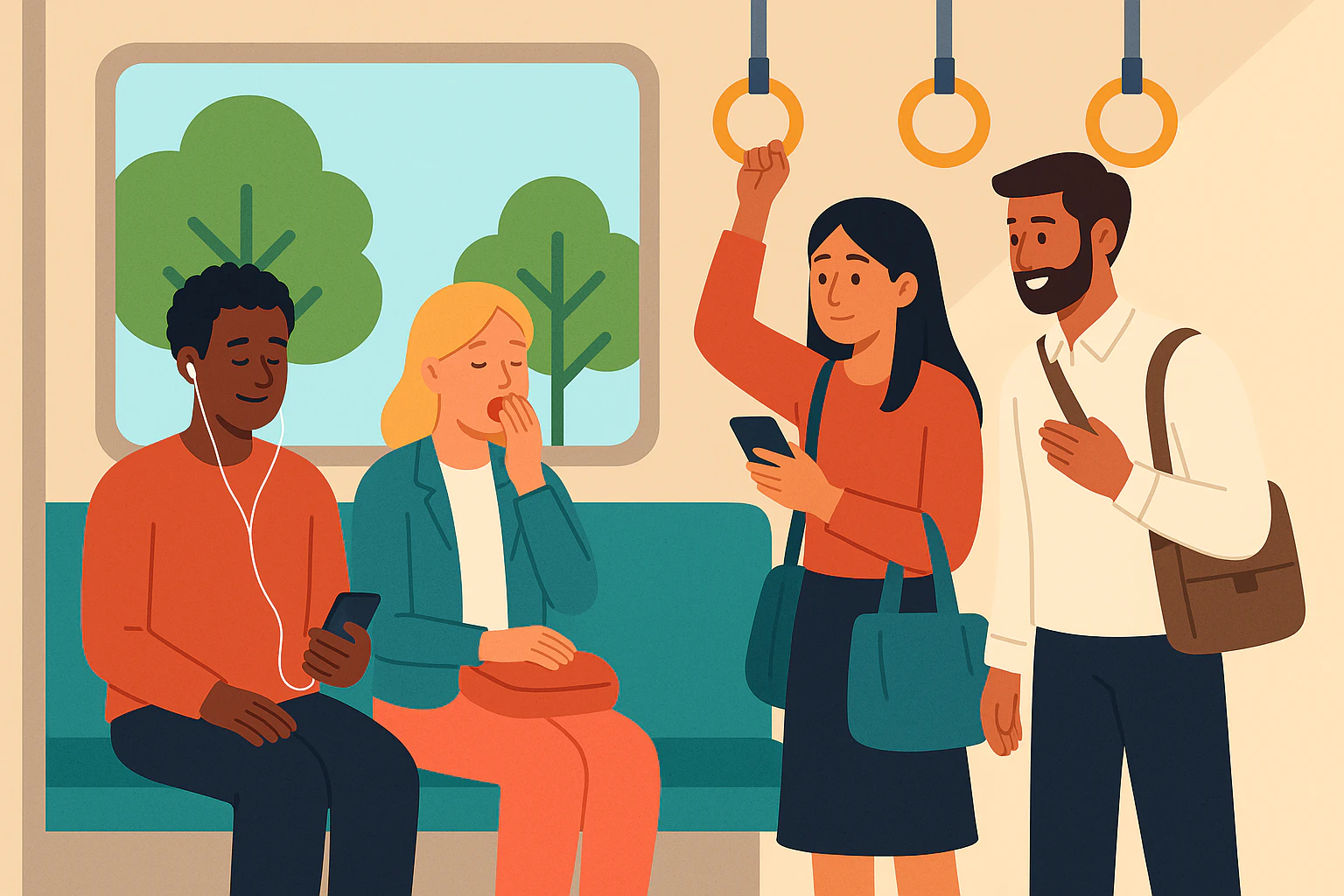
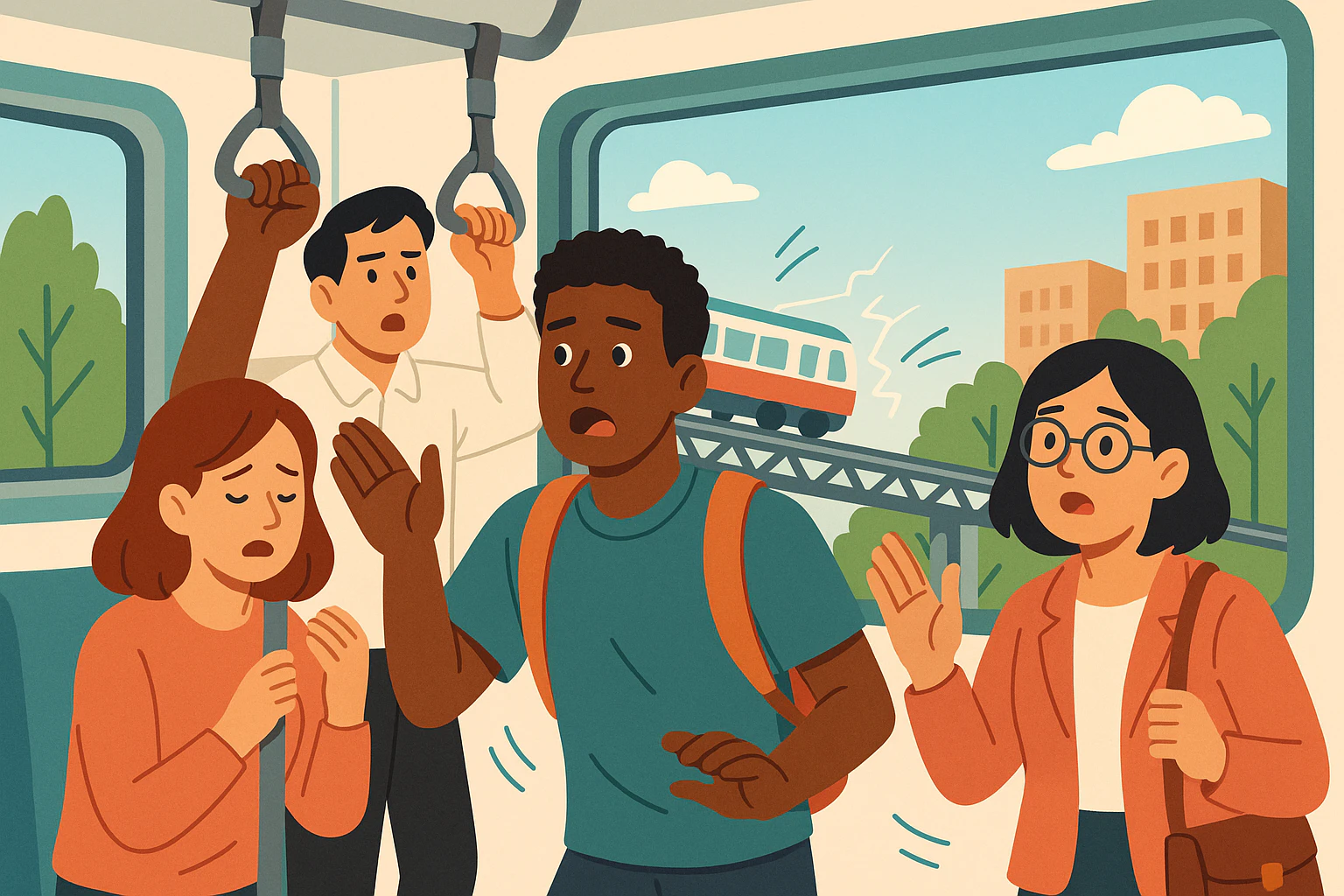
If you live in Japan, you already know the “basics” of Japanese train etiquette: line up, don’t be loud, don’t block the doors. The tricky part in 2026 is what long-term residents still get wrong—because some guidance changed over the last decade, and some “rules” are actually just local habits.
This guide focuses on the confusing, resident-level details: what’s a real rule vs. an operator request vs. pure manners, plus city-by-city differences (Kyoto buses and luggage pressure, and Saitama/Nagoya escalator ordinances). When in doubt, you’ll also get safe phrases to ask politely and move on.
Rule vs. Manners in Japanese Train Etiquette (Why Locals React Differently)
One reason foreigners get mixed feedback is that Japan has three layers of “do this” on public transport. Locals react differently depending on whether you broke a hard rule, ignored an operator request, or just missed an unwritten manner.
| Type | What it feels like | Common examples (2026) | What to do |
|---|---|---|---|
| Law / ordinance | Often posted by a local government; sometimes staff actively remind people | Saitama’s “stand still on escalators” ordinance (in effect since Oct 1, 2021) and Nagoya City’s ordinance (in effect since Oct 1, 2023) | Follow the posted instruction, even if some locals don’t |
| Operator rule / policy | Stations and trains can enforce it (e.g., staff intervention) | Non-smoking policies like Toei’s ban in stations/vehicles (including refraining from e-cigarettes) | Assume it’s enforceable if it’s written on signs/announcements |
| Manners / requests | “Please cooperate” guidance; social pressure is the main enforcement | Priority seat norms, quiet behavior, baggage placement, eating considerations (varies by line/crowding) | Default to “smaller, quieter, less space” and you’ll almost always be fine |
Resident tip: if the only “evidence” is what your coworker said years ago, treat it as manners—not a universal rule. Japan’s operators update campaigns and announcements over time, and they’re not always consistent across regions (phone guidance near priority seats is the best example).
Inside the Train: Japanese Train Etiquette on Quiet Culture, Phone Calls, Food/Drink, Priority Seats
This is the core of Japan subway etiquette and commuter-train life: reduce noise, reduce smell, reduce space. The “newer” confusion is that the exact wording on phone use near priority seats changed, and it still differs by operator and by train vs. bus.
Quiet culture: why phone calls are still the biggest problem
Across operators, the social expectation is that the car is a shared quiet space. Many companies explicitly ask riders to avoid phone calls in the train (set your phone to silent / マナーモード, then message instead), and campaigns repeat this every year.
For example, Toei Transportation’s manner guidance asks riders to set phones to manner mode and refrain from calls, and it’s part of their annual manner-poster/manner-video campaigns (FY Reiwa 7 / 2025).
Priority-seat phone etiquette: what changed (and why you still hear different versions)
Older residents may remember “Always turn off your phone near priority seats.” That message was revised in stages: in Kansai, JR West and other operators changed guidance starting July 1, 2014 to “turn off your phone near priority seats when the train is crowded.” You can see the change described in JR West’s 2014 press release.
In the Kanto/Koshinetsu/Tohoku area, a group of operators (including JR East) announced a similar revision in 2015, changing the message to “turn off your phone when the train is crowded” near priority seats (effective Oct 1, 2015), as summarized in ITmedia’s coverage.
But operators still aren’t perfectly uniform. Toei’s own page says: near priority seats, turn off your phone when crowded—and additionally notes that on Toei buses, near priority seats, riders should turn off their phones (not just when crowded). This is written on the same Toei manners page.
Practical rule-of-thumb (2026): Keep your phone silent everywhere. Don’t take calls inside the car. Near priority seats, follow whatever that operator’s posters/announcements say—because the wording still differs by region and sometimes by train vs. bus.
Food and drink: what’s “allowed” vs. what’s considerate
There isn’t one nationwide “no eating” law for commuter trains, but there is a strong manners expectation to avoid bothering others—especially with strong smells or messy food. JR East’s official manners guidance explicitly asks riders to be considerate about eating onboard, and also warns about baggage during crowding and where to place large items.
See JR East’s guidance on manners, including priority seating and large baggage placement, on their official page: JR East “Manners” (なるほどQ&A Guide excerpt).
Priority seat etiquette Japan: who it’s for, and what residents often miss
Priority seats are not only for visibly elderly or wheelchair users. JR East explicitly includes people with internal disabilities, pregnant riders, and riders with infants, and asks passengers to yield when needed. JR East also explains the Help Mark (a JIS-standard mark) and notes that Help Mark stickers are posted near priority seats on conventional lines.
Details are on the same JR East manners page: priority seats + Help Mark information (JR East).
- If you sit in a priority seat: it’s generally acceptable, but be mentally ready to stand up quickly. Don’t “camp” with headphones on and your eyes glued to the phone.
- If you need a seat (temporary or invisible need): making eye contact and a small gesture often works. If not, use a short phrase (examples below) and point to the priority-seat sign or your Help Mark.
- If someone offers you a seat: a quick thanks is enough. A long refusal/insistence loop can make the situation more awkward than simply accepting.
Smoking (including e-cigarettes): a straightforward “don’t”
This one is not an “unwritten rule.” Many systems clearly prohibit smoking, and some explicitly ask riders to refrain from e-cigarettes as well. Toei’s official guidance states that Toei transportation is non-smoking in vehicles and station areas, and asks riders to refrain from using electronic cigarettes and similar products due to comfort and potential trouble with other passengers: Toei “All-day non-smoking” guidance.
Space Management for Japanese Train Etiquette: Backpacks, Strollers, and Large Luggage (Kyoto Case Study)
In daily life, the biggest “manner escalation” isn’t noise—it’s taking space. This section is where residents get the most direct pressure: backpacks hitting people, strollers blocking flow, and suitcases turning a doorway into a traffic jam.
Backpacks: the small habit that changes everything
Tokyo Metro’s official manners videos explicitly ask riders to place backpacks/large luggage on the overhead rack or hold them properly: Tokyo Metro “Luggage Manner”. Tobu Railway similarly asks riders with big luggage to put it on a rack or hold it in front to avoid blocking aisles or touching others, especially when crowded: Tobu Railway “Manners When Using Trains”.
- Rush hour: move your backpack to your front, hold it low, or use the overhead rack.
- Near doors: if you’re by the door, be ready to step out briefly so others can pass (Tokyo Metro also calls this out in their boarding manners videos).
- Small win: keep straps and dangling keychains under control—those are what snag sleeves and umbrellas.
Strollers: “allowed,” but you’re expected to manage the flow
Strollers are common, but the expectation is to avoid blocking doors and to prioritize safety in crowds. If the car is packed, folding is often the fastest way to reduce stress (for you and others), but not always possible—so positioning matters.
One useful detail for longer trips: JR Central notes that seats with an oversized baggage area can also be used by customers who need extra space for items such as strollers. This is written in JR Central’s official oversized-baggage guidance: JR Central: Seats with an oversized baggage area (and stroller note).
Large luggage on trains: use the right space (and don’t block doors/aisles)
JR East’s manners guidance is very specific: large luggage should not block aisles, decks, or boarding doors, and some Shinkansen/limited express trains have designated luggage spaces you should use. JR East also asks riders to be mindful when placing items at their feet or on racks for safety, especially with sudden stops and train movement: JR East “Large baggage” manners guidance.
Shinkansen “oversized baggage” reservations (still catching residents by surprise in 2026)
If you ride the Tokaido–Sanyo–Kyushu Shinkansen route with big luggage, there’s a real procedure—not just manners. JR Central states that baggage with total dimensions (A+B+C) of more than 160 cm (and up to 250 cm) requires reserving a seat with an oversized baggage area, and if you bring oversized baggage without a reservation you will be charged a 1,000 yen baggage fee (tax included). See: JR Central oversized-baggage reservations.
JR Central also notes a newer operational detail: starting July 1, 2025, the “oversized baggage compartment” offered on some decks is being made available as a baggage storage area usable without reservation on a trial basis (check current conditions before you travel). That notice is also on the same official JR Central page: JR Central oversized-baggage notice (July 1, 2025).
- Measure first: add height + width + depth (A+B+C). If it’s over 160 cm, plan on reserving the correct seat type on the applicable Shinkansen lines.
- Reserve correctly: choose a seat that includes oversized-baggage space (online reservation systems and ticket counters can handle this).
- Boarding behavior: keep luggage out of door zones and don’t block the aisle while you reorganize.
Kyoto case study: why suitcases on buses are “legal” but socially high-pressure
Kyoto is the clearest example of how manners become a daily-life friction point. Kyoto City has received requests to ban suitcases on city buses, and its published response explains why a simple “tourists only” restriction isn’t allowed: as a public route bus, it cannot treat specific passengers unfairly under applicable laws, and any restriction would apply to all riders (including residents, students, and business travelers). Kyoto City also notes that city buses are one-person operation, making baggage-by-baggage enforcement difficult and potentially disruptive to operations. See the city’s Q&A page: Kyoto City: “Ban suitcases on city buses?” (Jan 10, 2025).
Instead, Kyoto City emphasizes “hands-free tourism” (手ぶら観光) and asks riders to avoid bringing large baggage onto buses. The city also states it operates the web information site HANDS FREE KYOTO to find baggage storage, delivery services, and coin locker locations, and mentions efforts like temporary baggage delivery/storage counters at Kyoto Station. See Kyoto City’s newer Q&A page dated Feb 6, 2026: Kyoto City: countermeasures for crowded buses due to large baggage (Feb 6, 2026).
- Use the official map first: the city-backed “HANDS FREE KYOTO” site helps you search storage/delivery options and locker locations: HANDS FREE KYOTO.
- If you’re a resident and want to raise a practical issue: Kyoto City lists responsible departments and phone contacts on its published Q&A pages, including the Kyoto City Transportation Bureau (e.g., Transport Division phone: 075-863-5123) and the Tourism MICE Promotion Office (phone: 075-746-2255). Those numbers are shown on the city page here: Kyoto City “suitcase ban” Q&A contact section.
Stations & Escalators: Japan Escalator Rules (Stand Left or Right) Habits vs. “No-Walking” Ordinances (2026)
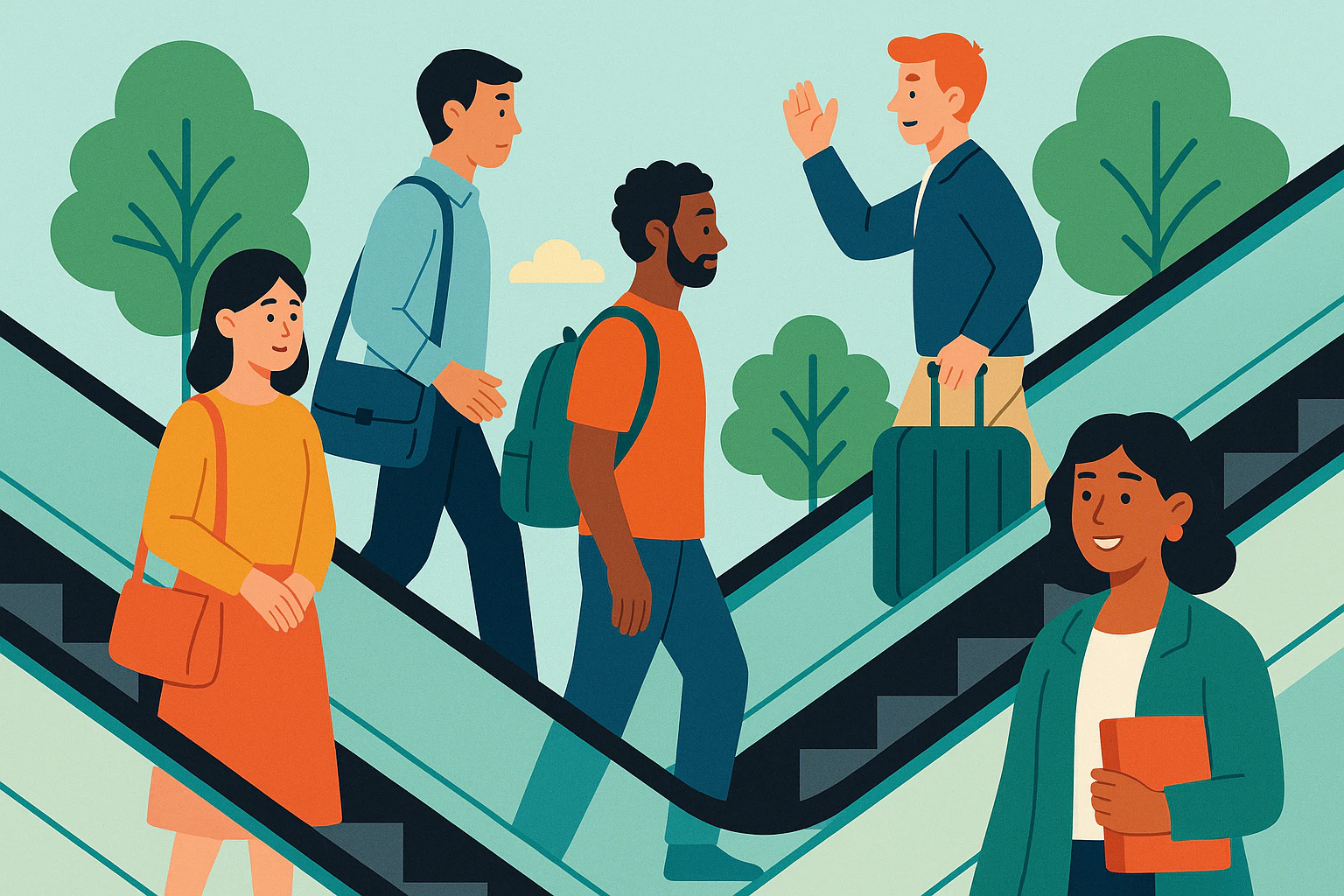
Escalators are where “everyone knows the custom” can collide with actual local ordinances. In many places, people still follow the habit of standing on one side and walking on the other—but that habit is increasingly challenged by safety campaigns and city rules.
Left/right habits: treat them as local custom, not a guarantee
You’ve probably learned the common pattern: in Tokyo and many Kanto areas, people often stand left and walk right; in parts of Kansai (like Osaka), it’s often the reverse. But because it’s custom—not a nationwide rule—you should watch the first few escalators at each station and follow what people are doing unless signs say otherwise.
When you see “Don’t walk” markings or repeated announcements, follow those—even if the crowd is inconsistent. That’s your clearest signal that the station/city is actively pushing “stand still” behavior.
Saitama Prefecture: standing still is an ordinance (and it explicitly has no penalties)
Saitama’s escalator rules are no longer just etiquette. The prefecture states that its ordinance has been in effect since Oct 1, 2021, requires users to use escalators while standing still, and requires managers to publicize the rule; it also explicitly notes there are no penalties. See: Saitama Prefecture: Escalator safety and ordinance summary.
Nagoya City: standing still on either side is an ordinance (and managers must promote it)
Nagoya City’s official page (updated Dec 22, 2025) explains that the city ordinance took effect on Oct 1, 2023. It states that users must stand still regardless of left/right side (Article 8), and that managers must publicize the “stand still” rule (Article 9). See: Nagoya City: Escalator safety ordinance (updated Dec 22, 2025).
Nagoya has also tested strong reminders: for example, The Asahi Shimbun reported that Nagoya City used sensors and AI-based audio warnings at a subway station to discourage walking and encourage two-line standing, and the report notes the ordinance itself does not include penalties.
Escalator survival rule (2026): If you’re in Saitama or Nagoya, default to standing still in two lines. Elsewhere, follow local flow—but never assume “stand left / right” is mandatory if the station is clearly posting “don’t walk” warnings.
Quick, Safe Phrases + What to Do When You’re Unsure
When you’re unsure about a local rule, the fastest way to avoid trouble is to ask in short, simple Japanese and match the station’s signage. Tokyo’s multicultural portal explains “Easy Japanese” (やさしい日本語) as Japanese adjusted to be easier to understand—short sentences, one idea at a time, less complex wording—and emphasizes that there isn’t one “correct” version. See: TIPS: What is “Easy Japanese”?.
Useful phrases (safe even if your Japanese is basic)
- すみません。 (Sumimasen.) — Excuse me / Sorry.
- 通ります。 (Tōrimasu.) — I’m coming through.
- 降ります。 (Orimasu.) — I’m getting off (use this near doors).
- ここ、いいですか? (Koko, ii desu ka?) — Is it okay if I stand/sit here?
- この電車は、飲んでもいいですか? (Kono densha wa, nondemo ii desu ka?) — Is drinking okay on this train?
- 優先席ですか? (Yūsen seki desu ka?) — Is this a priority seat?
- どうぞ。 (Dōzo.) — Please (offering a seat / letting someone pass).
- 座ってください。 (Suwatte kudasai.) — Please sit down.
- 大丈夫ですか? (Daijōbu desu ka?) — Are you okay?
- これはルールですか? マナーですか? (Kore wa rūru desu ka? Manā desu ka?) — Is this a rule, or just manners?
What to do when you’re unsure (fast checklist)
- Look for the most “official” signal: posted notices, floor markings, repeated announcements, station staff directions.
- Default to low-impact behavior: silent phone, no calls, no blocking doors, bag in front or overhead, avoid eating smelly food.
- If you need to ask: ask the nearest staff member (駅員さん / station staff) or a local passenger with a short phrase like “ここ、いいですか?”
- If someone corrects you: a quick “すみません” and immediate adjustment is usually the smoothest resolution.
Japanese Train Etiquette FAQ (2026)
Q: Is “stand on the left / right” an actual rule?
A: Usually it’s local custom, not a nationwide rule. But in places like Saitama and Nagoya, there are ordinances pushing “stand still,” so signage beats habit.
Q: Do I have to turn off my phone near priority seats?
A: It depends on the operator, the region, and whether it’s crowded. Many operators moved to “turn off when crowded,” and some systems (like Toei) note stricter guidance on buses near priority seats.
Q: Can I bring a suitcase on Kyoto City buses?
A: It’s not simply banned for tourists, and the city has explained why a tourist-only restriction is not allowed; instead Kyoto strongly promotes “hands-free tourism” and asks riders to avoid bringing large baggage onboard when possible.
Q: Who counts as “priority seat” eligible?
A: It includes elderly riders, riders with disabilities (including internal/invisible disabilities), pregnant riders, and riders with infants; Help Mark is also a common signal near priority areas.
Related Articles
If you’re building daily-life confidence in Japan, these guides may also help:
- Easy Japanese for city hall paperwork (free guides, 2026)
- Free Japanese classes near you in Japan (city hall guide, 2026)
- Making friends in Japan as a foreigner (city hall & events)
Need More Help? Ask on LO-PAL
Etiquette in Japan is often local: a sign in one city may be a suggestion in another, and the “right” behavior can change depending on time of day and crowding. If you want to confirm what’s normal on your line, in your station, or how to phrase something politely, ask a local Japanese person on LO-PAL.
On LO-PAL, you can post a question (Q&A) or request practical help (like figuring out a station route that avoids stairs, or finding luggage storage). Local Japanese helpers in your area reply, and we support multiple languages (English, Chinese, Vietnamese, Portuguese, Korean, Nepali, Tagalog, Indonesian, Spanish).
Written by

Founder, LO-PAL
Former Medical Coordinator for Foreign Patients (Ministry of Health programme) and legal affairs professional. Built LO-PAL from firsthand experience navigating life abroad.
Written with partial AI assistance
Read full bio →