How to Get Your Traffic Accident Certificate in Japan Fast
Call 110, see a doctor quickly, and get the Traffic Accident Certificate insurers actually need for a Japan accident claim.
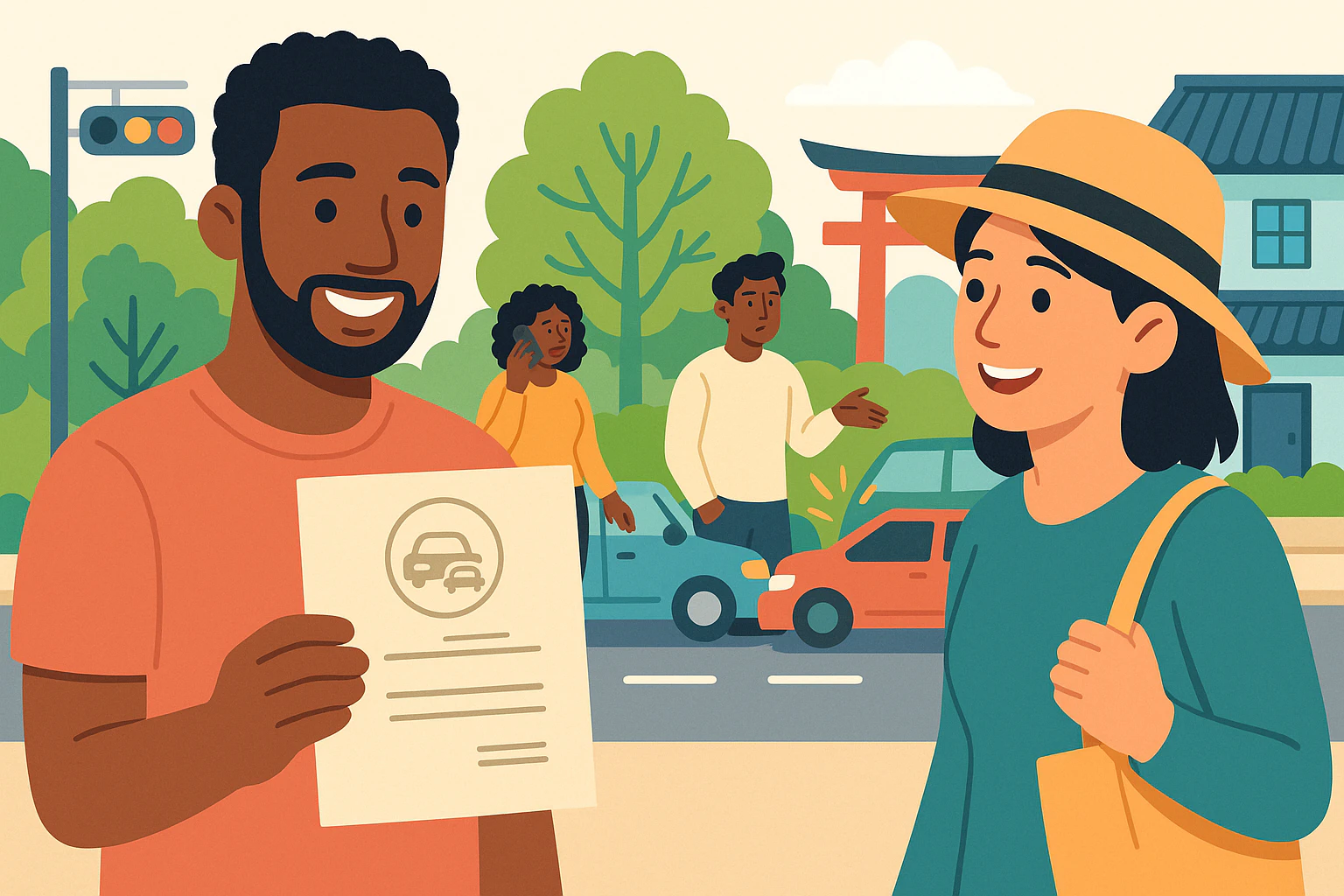
Call 110 from the scene, even for a minor car or bicycle accident. If anyone is hurt, call 119 too, then get checked at a clinic or hospital as soon as possible.
Your key paperwork is the Traffic Accident Certificate (交通事故証明書, often called kotsujiko shomeisho), issued by the Japan Safe Driving Center based on the police report.
Fastest route: report the accident, note which police station handled it, see a doctor before the injury link gets challenged, then apply through the Japan Safe Driving Center online, by post, or at a counter.
Do not settle privately too early and do not let an insurer keep things vague. The certificate, diagnosis, and timeline are what unlock the claim.
Information current as of March 2026 based on guidance from the Ministry of Land, Infrastructure, Transport and Tourism (MLIT), the Japan Safe Driving Center, the Tokyo Metropolitan Police, JAF, and public health insurance guidance.
If you search for traffic accident certificate Japan after a crash, most English advice stops at “call 110.” That is necessary, but it is not the part that actually gets your claim moving. In Japan, the Traffic Accident Certificate is the official proof that you were involved in the accident, and MLIT says clearly that no certificate is issued for accidents that were not reported to police.
This matters even more if pain appears later, the other driver changes their story, or the insurer starts stalling. For any car accident Japan police report details are not just paperwork; they are the basis for the certificate the insurer, your health insurer, and sometimes a dispute center will rely on later. And for a bicycle accident Japan insurance claim, the same rule applies: police report first, certificate next, medical proof right away.
| Item | Amount/count | Source/as-of date |
|---|---|---|
| Traffic Accident Certificate fee | ¥1,000 per copy | JSDC fee revision notice, updated October 1, 2025 |
| Online payment handling fee | ¥143 per copy | JSDC application page, accessed March 2026 |
| Counter issuance speed | Same day if police data has already reached the center | JSDC application page, accessed March 2026 |
| Mail/online delivery time | About 10 days | JSDC application page, accessed March 2026 |
| Application window | 5 years for injury accidents / 3 years for property-damage accidents | MLIT and JSDC, accessed March 2026 |
What to do in the first 30 minutes after a car or bicycle accident
The first half hour decides whether your later claim is clean or messy.
- Get to safety first. Move out of live traffic if you can do so safely. On an expressway, JAF warns that you should move outside the guardrails before asking for roadside help.
- Call 119 if anyone is injured, then call 110. Even if the damage looks minor, report it. In Tokyo, the police say a police interpreter can be put on the 110 line if you do not speak Japanese. Useful phrase: 交通事故です。けががあります。 (Koutsuu jiko desu. Kega ga arimasu.) — This is a traffic accident. There is an injury.
- Record the scene before memories change. MLIT recommends getting witness names and contact details, saving drive recorder footage, and taking photos while your memory is fresh. Also note the other party’s name, address, phone number, license plate, insurer, and policy number if available.
- Write down which police station handled it. You will need the prefecture and handling police information when you apply for the certificate later.
If your Japanese is limited, keep a translation app open while you wait for police or insurer calls. Our guide to translation apps in Japan can help you choose one that works offline too.
Why you should see a doctor fast even if the crash feels minor
This is the part people delay, and it is where many claims start to weaken.
MLIT warns that if you do not seek medical attention promptly after an accident, it may later be argued that there is no causal relationship between the crash and your injury. In plain English: if your neck, back, wrist, knee, or head starts hurting two days later and you waited a week to get checked, the insurer may say the pain is not from the accident.
When I worked as a Medical Coordinator for Foreign Patients at a hospital in Osaka, I saw this pattern again and again. People waited because the crash felt minor, because they did not know which clinic to call, or because the Japanese paperwork scared them more than the pain. The problem was not a lack of healthcare or systems. It was a lack of access.
- If you have pain, numbness, dizziness, headache, or limited movement, get examined as soon as possible.
- Tell the clinic it was a traffic accident. Useful phrase: 交通事故で受診したいです。 (Koutsuu jiko de jushin shitai desu.) — I need to be seen for a traffic accident.
- Ask for a diagnosis certificate if the police or insurer needs one. Keep receipts, prescriptions, and visit dates in one folder.
- If the accident happened while working or commuting, ordinary health insurance may not be the right route. Start with our Rosai guide for work and commuting injuries.
You can usually still use health insurance for treatment after a traffic accident, but if another party caused the injury, you need to notify your insurer or city hall. For employee health insurance, the FR Health Insurance Organization says to submit a Notification of Injury or Sickness due to a Third-party Act as soon as possible, with the accident certificate attached. Local National Health Insurance offices say the same thing; for example, Yokohama’s NHI guide tells residents to contact the insurance section promptly and warns against settling privately before the office is informed.
Useful phrase for city hall or your insurer: 第三者行為による傷病届について相談したいです。 (Daisansha koi ni yoru shoubyou todoke ni tsuite soudan shitai desu.) — I want to ask about the third-party injury notification.
If this already feels like too much to handle in Japanese, that is exactly why I built LO-PAL. You can post your question for free and get answers from local Japanese people, or request hands-on help with forms, calls, and appointments, and you only pay when you accept a helper’s completed work.
How to apply for a traffic accident certificate step by step
Once the police report exists, your next job is turning it into the actual document.
The Traffic Accident Certificate is issued by the Japan Safe Driving Center based on police data. It states the accident date and time, the parties involved, and other identifying details. The JSDC says applicants can be the at-fault party, the victim, a proxy with authorization, or another person with a legitimate interest.
- Confirm the accident was reported to police. No police report means no certificate.
- Choose the fastest application method. For speed, the best option is usually the nearest JSDC office counter, because the current JSDC application page says same-prefecture cases can be issued the same day if the police data has already arrived. Forms are also available at police stations, koban, and non-life insurers.
- If you cannot go in person, apply online or by post. JSDC accepts applications through its online application system and by postal transfer form. Online is convenient, but JSDC says it is limited to the actual accident party, and the certificate can only be sent to the same address that was reported to police.
- Pay the current fee. As of March 2026, the fee is ¥1,000 per copy. If you still see older English material saying ¥800, follow the official fee revision notice and the current application page.
- Watch the time limits. The general issue window is 5 years for injury accidents and 3 years for property-damage accidents.
Useful phrase at a counter: 交通事故証明書を申請したいです。 (Koutsuu jiko shoumeisho o shinsei shitai desu.) — I would like to apply for a Traffic Accident Certificate.
If pain appears after a crash that first seemed minor, do not wait and “see how it goes.” Get examined immediately, keep the diagnosis, and contact the police station that handled the accident. I would not assume the paperwork will sort itself out later, because the whole problem is the timeline: once treatment is delayed, the medical link gets easier for the insurer to challenge.
What to do if the insurance company delays or disputes your claim
This is where many foreign residents feel stuck, especially when every phone call happens in fast Japanese.
Because I also work in legal affairs in Japan, my advice here is simple: treat every call, message, and document like evidence. Keep one timeline with the accident date, first hospital visit, each insurer contact, what was promised, and what is still missing. After phone calls, send a short email or message summarizing what you understood.
- Ask the insurer to confirm in writing what they need. The older but still practical Tokyo Metropolitan Police victim guide lists common claim documents such as the Traffic Accident Certificate, medical certificate, medical bills, accident situation report, and proof of lost work.
- If the story changes, push evidence fast. Send photos, witness contacts, and any dashcam footage request immediately.
- Do not settle privately before checking with your health insurer or city hall. Public insurance guidance warns that private settlement can create reimbursement problems later.
- If the other side is uninsured or it was a hit-and-run, ask about the Government’s Program Guaranteeing Compensation for Automobile Accidents. MLIT explains the program here.
If you need to escalate, MLIT’s consultation page is the best starting map. The main options are:
- Sonpo ADR Center: 0570-022808, or 03-4332-5241 for Tokyo. This is for complaints and disputes with participating non-life insurers.
- Japan Center for the Settlement of Traffic Accident Disputes: for example, Tokyo Main Office 03-3346-1756. They provide legal consultation and settlement help, but the center’s English page says you need to bring an interpreter if you cannot communicate in Japanese.
- Nichibenren Traffic Accident Consultation Center: 0120-078325 for free lawyer consultation listed on MLIT’s page.
- JAF road service: #8139 or 0570-00-8139. JAF offers 24/7 interpreter-assisted road service in 14 languages.
Real experiences from foreign residents: Individual experiences vary, so treat these as examples of the confusion that often starts after the accident scene is over, not as legal authority.
One foreign resident wrote on Reddit after a March 2025 accident: “Insurance called me today asking for money and says he DOES have a drive recorder, so he lied to the police.”
Another described a minor bicycle crash in May 2025 like this: “Then came the shock: I was told I’m responsible for about 1 million yen.”
That is exactly why your paperwork and timeline matter so much. If the other party, the police, and the insurer do not all seem to be working from the same facts, slow everything down, get documents in writing, and escalate before months pass.
Related Articles
- How to Cap a Huge Hospital Bill in Japan Before You Pay
- Hurt at Work in Japan? Claim Rosai Even If Your Boss Says No
- Best Translation Apps for Foreign Residents in Japan
Book a Local Helper to Go with You to the Police or Clinic
If you need someone to accompany you, translate at the counter, or help you get the certificate and hospital paperwork done in the right order, post on LO-PAL for free. A local Japanese helper can go with you, make calls, or help organize the documents, and you only pay when the task is completed.
Written by

Founder, LO-PAL
Former Medical Coordinator for Foreign Patients (Ministry of Health programme) and legal affairs professional. Built LO-PAL from firsthand experience navigating life abroad.
Written with partial AI assistance
Read full bio →